The skills that matter most when AI writes the code are the ones that humans still have to do, and the ones that scale better when the volume of code goes up. Eight skills currently pay more in 2026 than they did three years ago: code review at speed, debugging in production, system design judgment, security thinking, prompt engineering, written communication, evaluation design, and the ability to refactor a tangled AI-built codebase. Everything else has either flatlined or quietly lost value.
This piece lists each skill, explains why it matters more now, and tells you what good looks like in 2026.
Why the Skill Map Changed
The thing AI coding tools have done is collapse the cost of writing code while leaving the cost of being right almost untouched. A developer in 2023 spent maybe 60 percent of their time writing and 40 percent reviewing, debugging, and integrating. A developer in 2026 spends 20 percent writing and 80 percent on the rest. The total amount of code shipped per developer has roughly doubled, but the share of work that is "type out a function" has shrunk to almost nothing.
This shift has changed what companies pay for. The premium has moved from production speed (cheap now) to production correctness (still expensive). Anyone with AI tools can write a thousand lines of TypeScript in a day. The bottleneck is whether those thousand lines do the right thing safely.
A 2025 GitHub study of AI-assisted development found that developers using Copilot wrote 55 percent faster on the input side, but the rate of bugs that reached production stayed flat. The compression happened on writing, not on shipping. This is why the new premium skills are the ones that connect "code exists" to "code is correct in production".
The pattern to copy is the music industry after digital production tools became cheap. Anyone could record a song in their bedroom by 2010, but the people who made money were still the ones who could pick the right song to record, mix it well, and get it heard. The cost of production fell, the cost of judgment did not, and the talent at the top of the field consolidated around taste, not technical ability.
The Eight Skills That Pay More Now
Each of these skills has gotten more valuable, not because AI cannot do them at all, but because AI does them less reliably than the rest of the work. They are the new edges.
Code review at speed. When AI generates ten times more code, someone has to read ten times more code. Engineers who can read a 400-line diff in under five minutes and find the three things that matter are now critical. The skill is part pattern matching, part security instinct, part product judgment.
Debugging in production. AI rarely produces clean failure modes. It produces code that works in the happy path and fails subtly when reality intrudes. Engineers who can read a stack trace, narrow down a hypothesis, and fix a live system without breaking something else are paid premiums of 30 to 80 percent over those who cannot.
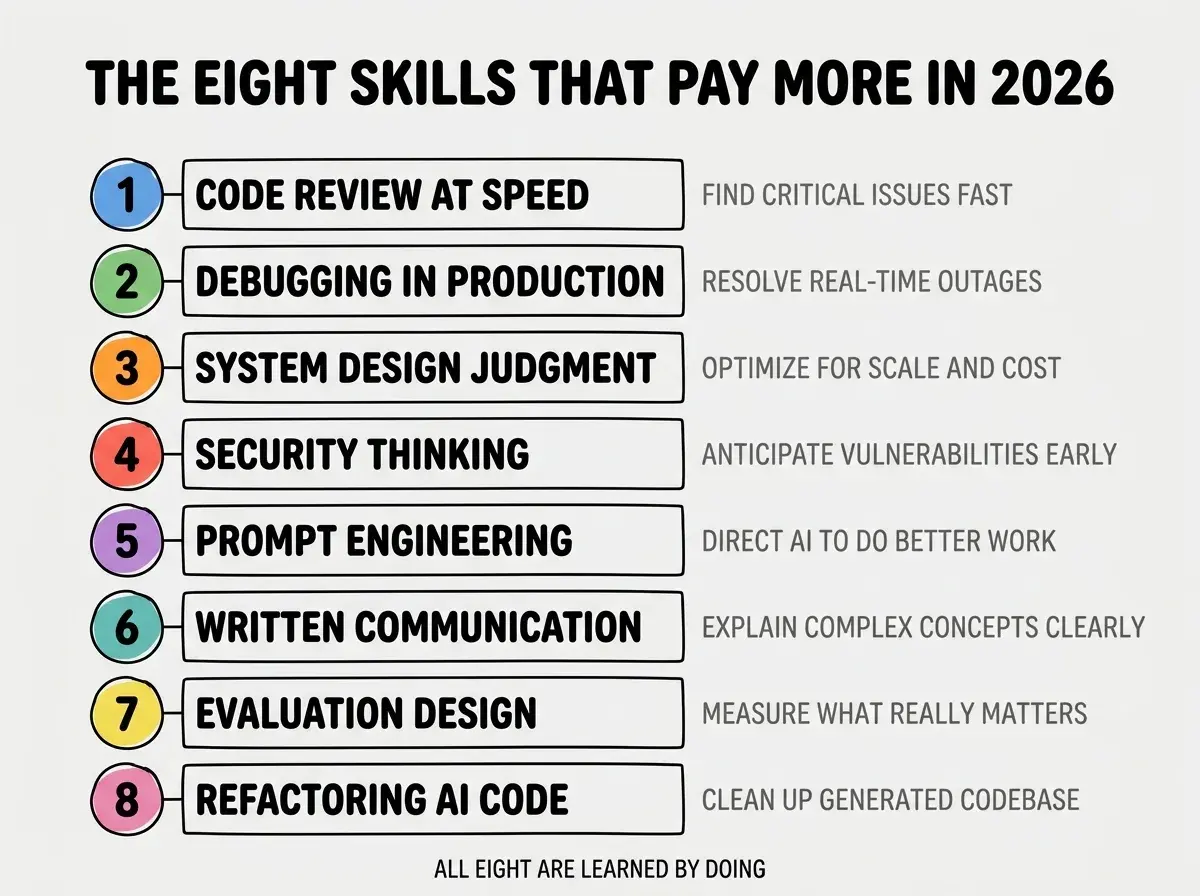
System design judgment. AI is great at building components, weak at choosing how components fit together. Decisions like "monolith or services," "Postgres or DynamoDB," "queue or webhook" are still made by humans, and the people who make them well outearn the people who do not by 50k or more per year.
Security thinking. AI-generated code introduces vulnerabilities by default. Hardcoded secrets, missing rate limits, broken auth checks, SQL injection, all of these show up regularly in AI output. Engineers who notice them in review are now treated as senior even if they are not yet five years into their career.
Skills 5 Through 8
The remaining four are slightly less obvious, but no less valuable. These are the skills that tend to differentiate engineers in their second or third year of working with AI tools.
Prompt engineering. Not the surface version (better prompts produce better code), but the deeper version (designing the prompt as a contract, knowing what to put in context, knowing when to ask for refactors versus rewrites). Senior prompt engineers move 2 to 3x faster than juniors with the same models.
Browse more career and learning guides for the AI era
Read more foundationsWritten communication. Specs, PRDs, design docs, and architecture decision records have always mattered, but they matter more now because they are increasingly executable inputs to AI. A clearly written spec produces 30 to 50 percent fewer iterations than a vague one. Writing well is now a coding skill.
Skills That Quietly Lost Value
This is the harder list to publish, but it is honest. Some skills that used to anchor engineering careers have slipped, sometimes dramatically. Acknowledging this lets you redirect your time.
Memorizing language syntax. Knowing the exact name of every Python standard library function used to matter. It does not now. AI fills that gap instantly.
Speed-typing code. The 80 words per minute developer used to outperform the 40 wpm developer on output volume. AI has flattened this completely.
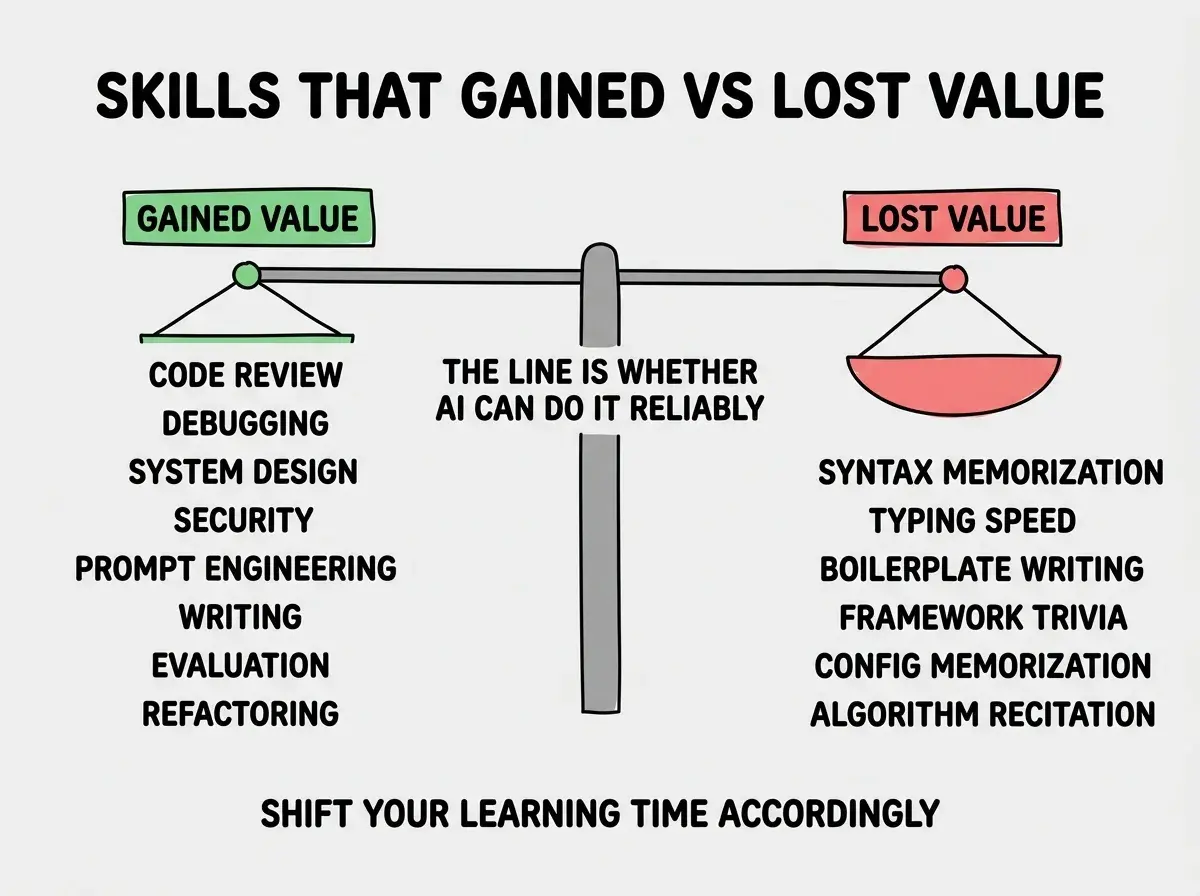
Boilerplate writing. CRUD endpoints, basic forms, standard React components, all of these were the bread and butter of junior work. They are commoditized now, and you cannot build a career on writing them by hand.
Framework trivia. Knowing 87 React hooks by name was a marker of seniority in 2022. In 2026 it just means you spent time memorizing instead of building.
The most expensive skill mistake people make in 2026 is doubling down on the wrong half. Spending 100 hours mastering a new framework's syntax produces almost no career return now. Spending those same 100 hours on review speed, debugging discipline, or system design produces 5 to 10x the salary impact over the next three years. Audit your learning time and shift the ratio.
The honest read on this is that the gap between "AI-fluent engineer" and "AI-resistant engineer" is widening fast, but the gap is not about loving AI. It is about which skills you invest in. Engineers who quietly redirected their study time toward review, debugging, and system design over the last 24 months have outpaced their peers by a wide margin.
What This Means For You
The skill map has shifted, and the payoff for picking the right skills has gotten larger, not smaller. Investing in the eight skills above is a high-leverage move regardless of where you are in your career.
- If you're a founder: Hire for review speed and system design judgment, not for typing speed or framework familiarity. The wrong filter produces bad hires fast.
- If you're changing careers: Lean into communication, debugging, and review. Your prior career almost certainly built these skills more than a CS degree did.
- If you're a student: Spend more time reading code than writing it. The future job is reading 10x and writing 1x, not the other way around.
Read more career and learning guides for the AI era
Browse foundations articles