Vibe coding for developers is not about learning to code with AI. You already know how to code. It is about using your decade-plus of experience to get dramatically more from AI tools than anyone else can, turning your expertise into a multiplier instead of letting it sit idle while you type boilerplate.
The data backs this up in a way that should make every senior engineer pay attention. A Fastly survey of 791 US developers found that seniors ship 2.5 times more AI-generated code than juniors. 32% of senior developers say over half their shipped code is AI-generated, compared to just 13% of juniors. And across the board, senior developers report 81% productivity gains. The experience gap does not shrink with AI tools. It widens.
Why Experience Becomes a Multiplier
You might think that AI coding tools would be the great equalizer, giving junior developers the same output as seniors. But actually, the opposite is happening. Seniors are pulling further ahead, and the reason is structural.
AI generates code that is statistically likely to be correct. It draws on patterns from millions of codebases. For common tasks, the output is often good enough. But "good enough" and "production ready" are separated by exactly the kind of judgment that takes years to develop. Knowing that the AI's suggested database query will work but will also create a full table scan at scale. Recognizing that the authentication flow is functional but missing a critical edge case. Seeing that the error handling is present but insufficient for the failure modes your system actually encounters.
Juniors accept the first response. Seniors evaluate it against years of production incidents, architectural decisions, and debugging sessions. That evaluation is the multiplier. The AI writes the code. Your experience decides whether the code is actually good.
Senior developers ship 2.5x more AI-generated code than juniors because experience lets them evaluate, correct, and direct AI output at a level that less experienced developers simply cannot match. The AI amplifies the gap rather than closing it.
Google engineer Addy Osmani drew a crucial distinction between "vibe coding" and "AI-assisted engineering." Vibe coding means accepting AI output and moving fast. AI-assisted engineering means using AI as a tool while maintaining full responsibility for the output. As a senior developer, you are naturally positioned for AI-assisted engineering, and that is where the real productivity gains live.
The Master Chef With a Kitchen Full of Sous Chefs
Think of yourself as a master chef who just received a kitchen full of sous chefs. You do not suddenly do less work. You orchestrate more, because you know what good food tastes like.
A junior cook who gets sous chefs does not know what to delegate or how to evaluate the results. They might accept an oversalted sauce because they have not developed their palate. They might let the sous chef plate the dish in a way that looks fine but falls apart when a customer picks up a fork. The sous chefs amplify whatever skill level already exists.
You know what good code looks like, smells like, and fails like. When the AI produces a function, you can taste-test it in seconds. You know whether the error handling will hold up in production. You can spot the N+1 query hiding behind a clean abstraction. You can see that the AI chose an approach that works today but creates tech debt for six months from now. This palate is your superpower, and AI tools let you use it at a scale that was previously impossible.
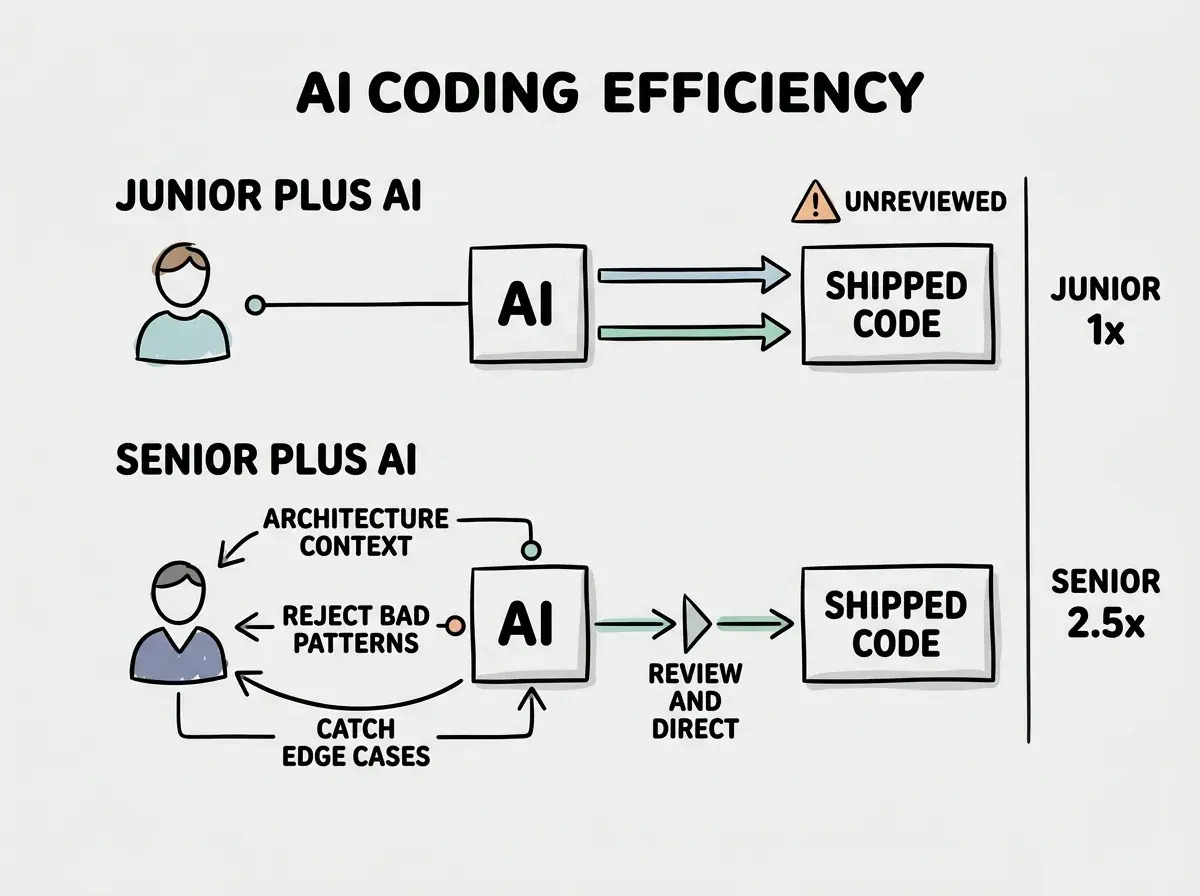
The chef analogy extends further. A great chef does not just evaluate finished dishes. They direct the preparation. They tell the sous chef how to cut the vegetables, what temperature to use, which ingredients to prep first. Similarly, the best senior developer workflows with AI are not "generate code and review it." They are "provide architectural context, constrain the solution space, and then review."
Architecture-First Prompting
This is where senior developer workflows diverge sharply from how everyone else uses AI tools. The advanced approach is architecture-first prompting: giving the AI enough context about your system's architecture before asking it to generate anything.
This confuses everyone at first because it feels like unnecessary work. Why spend five minutes writing context when you could just ask for the code? Because that five minutes of context is the difference between getting code that fits your system and getting code that works in isolation but creates integration problems.
Context management is the highest-leverage skill. Before generating code, provide the AI with your architectural constraints. Your database schema. Your API conventions. Your error handling patterns. Your testing approach. The AI does not know any of this unless you tell it. When you do tell it, the output quality jumps dramatically because the AI is working within your constraints instead of inventing its own.
Defensive commits are non-negotiable. Commit before every AI generation session. If the AI produces something that cascades into broken code across multiple files, you can roll back cleanly. Seniors who skip this step eventually lose an afternoon of work to a single bad AI suggestion that touched twelve files.
Constrain the solution space. Instead of "build a user authentication system," tell the AI "add a login endpoint using our existing JWT middleware, following the pattern in our /api/orders endpoint, with the same error response format." The more you constrain, the better the output. Juniors do not know enough to constrain effectively. You do.
Understand the fundamentals that power every AI coding tool.
Read the guideThe difference between these workflows and basic AI usage is the difference between asking a sous chef to "make something good" and giving them a prep list with exact measurements, timing, and plating instructions. Both use the same kitchen. One produces significantly better results.
Where the 81% Productivity Gain Actually Lives
Senior developers do not get 81% faster by writing code 81% faster. The gain comes from eliminating the tasks that ate your time without requiring your judgment.
Boilerplate generation is the obvious win. The CRUD endpoints, the test scaffolding, the migration files, the configuration boilerplate. You used to spend hours on these tasks, not because they were hard, but because they were tedious. Now the AI handles them in seconds, and you spend your time on the parts that actually require ten years of experience.
Code review acceleration is the less obvious win. When the AI generates a first draft of a feature, your review of that draft is significantly faster than writing it from scratch. You are reading and evaluating instead of creating from nothing. Your brain processes code faster than it produces code, so having the AI produce the first draft and then applying your judgment to it is a genuine cognitive shortcut.
Exploration and prototyping are the third win. When you want to evaluate three different approaches to a problem, the AI can generate all three in minutes. You then apply your experience to evaluate the tradeoffs between them. Previously, you might have only implemented one approach because the time cost of trying all three was too high. Now you can explore broadly and decide based on evidence rather than intuition.
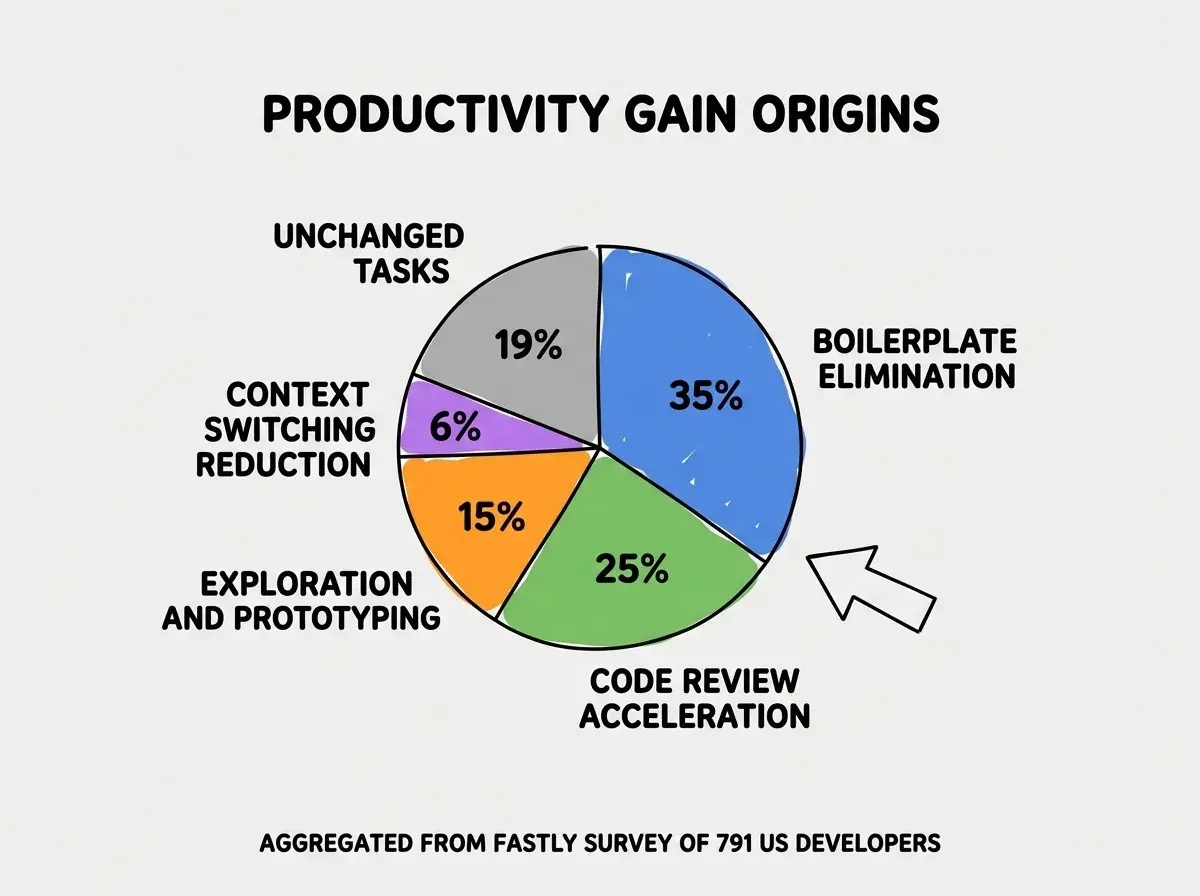
But here is what the productivity stats do not tell you. The 81% gain is an average, and it varies enormously based on how you use the tools. Seniors who just ask for code and accept it get modest gains. Seniors who have developed the context management, defensive commit, and architecture-first prompting workflows described above get gains that are off the chart. The tools reward investment in workflow design.
Treating AI tools as autocomplete instead of as a junior developer on your team. The highest-performing senior developers give their AI tools the same context, constraints, and code review standards they would give a new team member. When you treat the AI as an autocomplete that should just finish your line, you get autocomplete-quality output instead of junior-developer-quality output.
The 92% of US developers who use AI tools daily are not all using them equally well. The gap between basic usage and optimized senior workflows is massive, and it represents a significant competitive advantage for engineers who invest in refining their approach.
Dig deeper
A few hand-picked sources if you want to go further.
What This Means For You
AI coding tools do not replace senior engineering experience. They amplify it. The developers who get the most from these tools are the ones who bring the most context, judgment, and architectural knowledge to the interaction. Your years of experience are not becoming less valuable. They are becoming the multiplier that determines how much value AI tools actually deliver.
- If you are skeptical of AI tools: Your skepticism likely comes from seeing AI produce mediocre code without the context and constraints that make it good. Try one session where you invest five minutes providing architectural context before asking for any code. The difference in output quality will either convert you or confirm that your specific workflow genuinely does not benefit, and both outcomes are valuable to know.
- If you are already using AI daily: Audit your workflow for the architecture-first patterns described above. Most senior developers who have been using AI tools for months still have not formalized their context management approach. Moving from informal to deliberate context management is usually the single biggest quality improvement available.
- If you lead a team: Your team members are using AI tools whether you have a policy or not. 92% of developers use them daily. The question is not whether they use them, but whether they use them well. Creating team-level architectural context documents that everyone feeds to their AI tools can standardize output quality across the entire team.
Advanced techniques for developers who want to get more from every AI interaction.
Go deeper