Vibe coding for agencies is like giving every developer on your team a senior architect who works for free, never sleeps, and has already built a version of whatever the client is asking for. The architect does not replace your team. But they eliminate the hours your team used to spend on scaffolding, boilerplate, and "we've built this exact pattern before" work, freeing them to focus on the parts that actually require human judgment.
If you run a digital agency, you already know the math that kills margins. The client wants a custom dashboard, an e-commerce flow, a marketing site with twelve integrations. You scope it at 200 hours. Your team burns 80 of those hours on setup, configuration, and patterns they have implemented dozens of times before. The remaining 120 hours go to the interesting, valuable, client-specific work. Vibe coding collapses those 80 hours into 15. Your team still does the 120. But now a 200-hour project takes 135 hours, and your margins just got significantly healthier.
The Senior Architect on Every Project
The reason 61% of digital agencies have already adopted AI-assisted development is not ideology. It is economics. Client work runs on timelines and budgets, and agencies that deliver faster win more proposals, maintain better margins, and keep clients happier.
This confuses everyone at first because the narrative around AI coding tools focuses on individual developers building side projects. Agency work is fundamentally different. You are managing multiple clients, multiple codebases, multiple deadlines, and a team with varying skill levels. The question is not "can AI write code?" but "can AI write code that fits into our workflow, meets client requirements, and does not create a maintenance nightmare six months from now?"
The answer, for the majority of agencies, is yes, with caveats.
YC CEO Garry Tan put it bluntly: "Ten engineers using vibe coding are delivering what used to take 50 to 100." That ratio matters enormously in the agency world, where headcount is your biggest expense and project capacity is directly tied to how many hours your team has available.
61% of digital agencies have adopted AI-assisted development, and tech startup founders show 73% adoption. Agencies that have not started integrating these tools are competing against firms that can deliver comparable quality in a fraction of the time, which directly affects win rates on proposals.
The senior architect analogy is important because it sets the right expectations. An architect does not build the house. They accelerate decisions, reduce mistakes, and ensure the team does not waste time solving problems that already have known solutions. AI tools in an agency context work the same way. They accelerate the known parts so your team can spend their expertise on the unknown parts, which is where client value actually lives.
Where the 3x Speed Comes From
You might think the speed gains come from AI writing entire features end to end. But actually, the biggest gains come from three specific bottlenecks that plague every agency.
Project setup and scaffolding. A new client project used to mean a developer spending a day or two setting up the repository, configuring the build system, installing dependencies, creating the component library structure, setting up routing, connecting to APIs, and writing the authentication flow. With vibe coding, a senior developer describes the project architecture in plain language, the AI generates the scaffolding, and the developer reviews and adjusts. A day and a half becomes two hours.
Repetitive UI patterns. Every agency builds the same patterns repeatedly. Data tables with sorting and filtering. Form wizards with validation. Dashboard layouts with charts. Settings pages with toggle groups. These are not creative work. They are implementation of well-known patterns. AI tools generate these with remarkable consistency because they have been trained on millions of examples of exactly these patterns. A developer who used to spend four hours building a data table component now spends 30 minutes reviewing and customizing one.
Client revision cycles. This is the underrated one. When a client says "Can we try it with the sidebar on the right instead of the left?", that used to mean filing a ticket, waiting for a developer to context-switch, implementing the change, deploying to staging, and sending a link. With vibe coding, a developer can make that change in minutes, sometimes while the client is still on the call. Faster revisions mean fewer meetings, shorter feedback loops, and clients who feel heard instead of waiting.
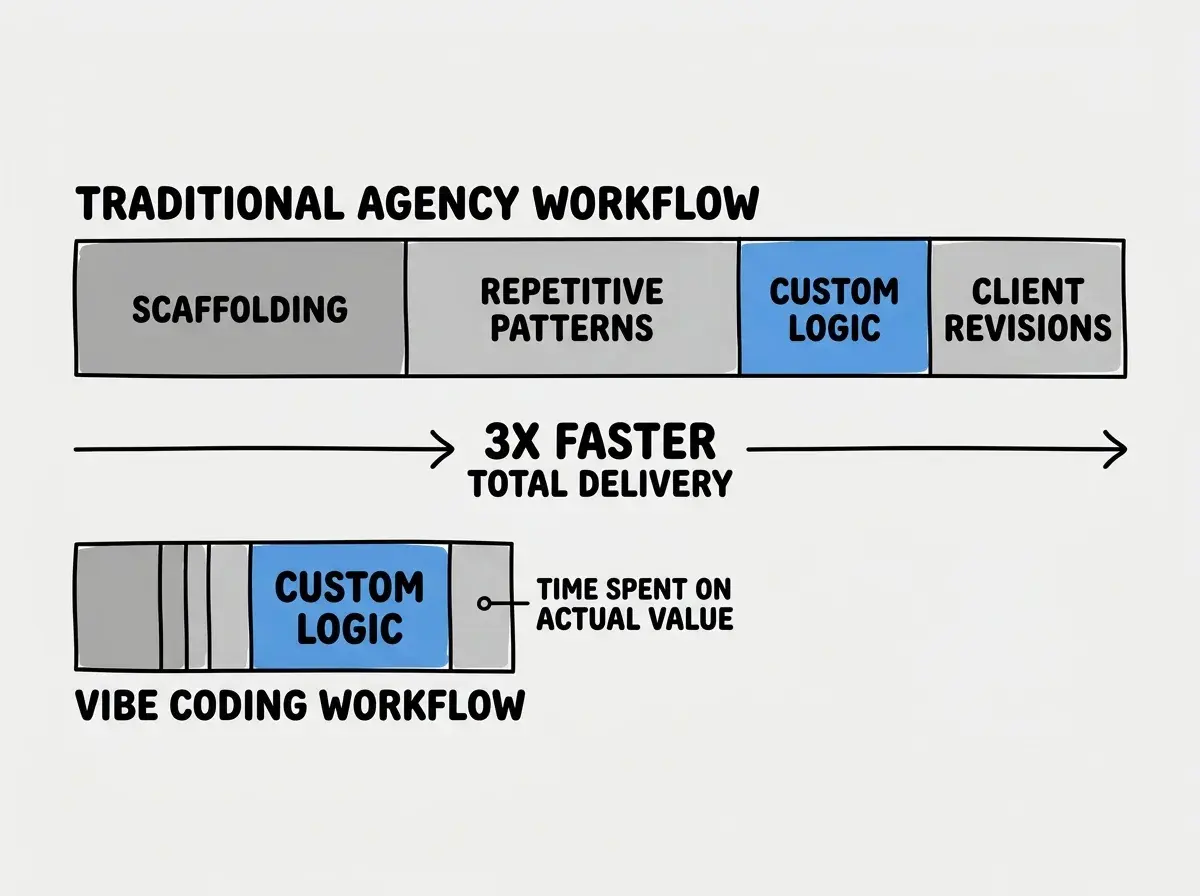
The compound effect is what makes this transformative. When every project starts faster and moves through revisions quicker, your agency's capacity increases without hiring. A team of ten that could handle five concurrent projects can now handle eight or nine.
The Client Conversation
Agencies face a unique challenge that solo developers do not. You need to talk about AI with your clients, and that conversation can go in very different directions.
Some clients love it. Be transparent, show quality, let results speak. Some clients are nervous: "If AI is doing the work, why am I paying agency rates?" The answer is the same answer that has always justified agency rates: you are paying for expertise, judgment, and accountability. The AI is a tool, like Figma for designers or Excel for accountants. Nobody asks their accountant to charge less because they use Excel instead of a ledger.
Some clients are skeptical. They have probably seen AI output from untrained people without review. Your response: show them your QA process, the testing, a before-and-after of raw AI output versus the reviewed production version. Let quality win the argument.
Understand the fundamentals before integrating AI into your agency workflow.
Learn the basicsThe most successful agencies are transparent about AI usage without making it the centerpiece. It is a capability, not a selling point. You do not sell clients on "we use AI." You sell them on "we deliver faster, with higher quality, at competitive rates." How you achieve that is an operational detail, not a marketing message.
The Cleanup Economy and Quality Control
Here is the honest part that most AI evangelists skip. Vibe coding at agencies has created what some are calling "the cleanup economy." Specialists now charge $200 to $400 per hour to refactor AI-generated codebases that were shipped without proper review. Understanding why this happens will help your agency avoid contributing to it.
The agencies creating messes treat AI output as finished work. They generate, do minimal review, ship, and move on. Six months later, the codebase is a tangle of inconsistent patterns and compounding performance problems.
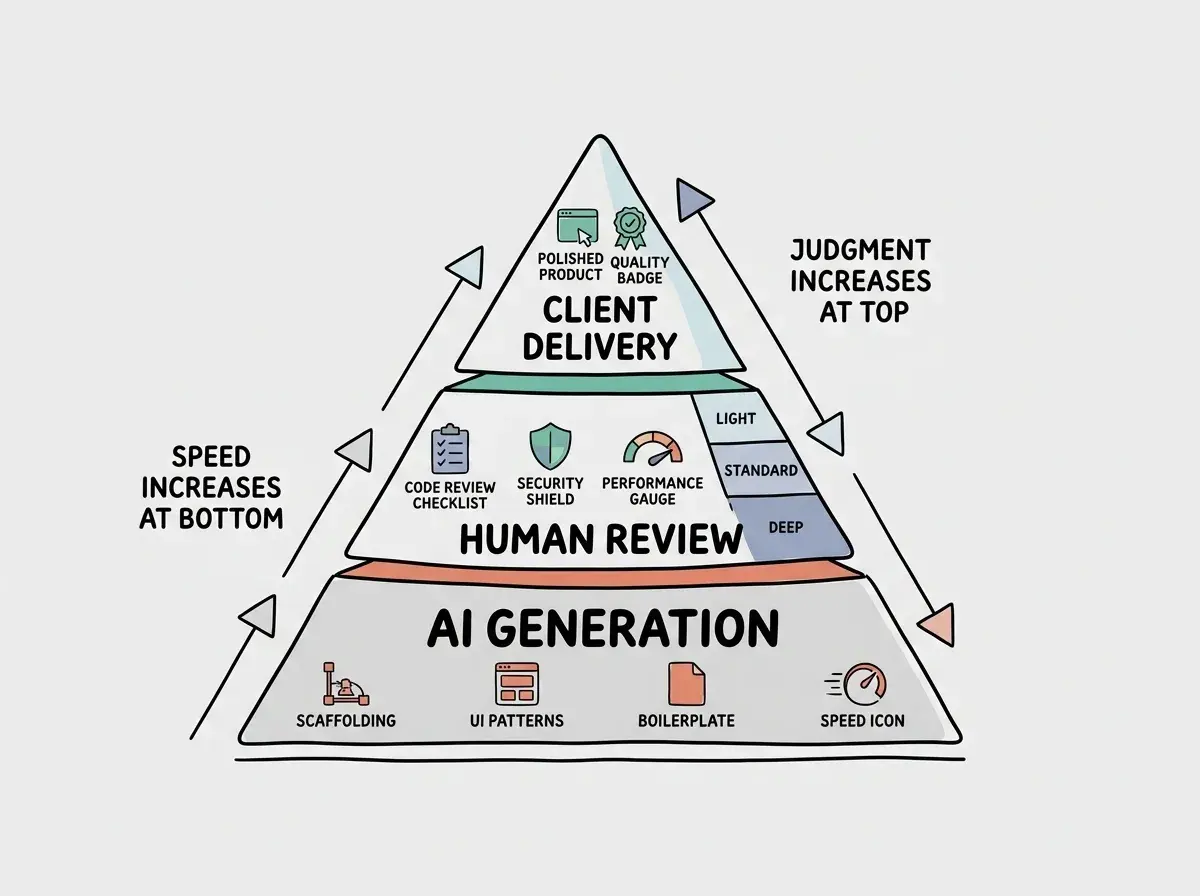
The agencies doing it right treat AI output as a first draft. Every piece of AI-generated code goes through the same review as human-written code. The AI accelerates the writing. The team ensures the quality. The speed of production does not reduce the rigor of review.
Skipping code review on AI-generated output because "the AI wrote it, so it's probably fine." AI tools produce plausible code that often works on the surface but contains subtle issues: inconsistent error handling, missing edge cases, security vulnerabilities, or performance problems that only emerge at scale. Every line of AI-generated code should receive the same review scrutiny as human-written code. The speed gain comes from faster generation, not from skipping quality checks.
The agencies winning the market have both: the speed of AI generation and the quality of experienced human judgment.
Structuring Your Team Around AI
The practical question for agency leaders is how to restructure workflows to capture these gains without creating chaos.
Pair AI-fluent developers with domain experts. Your best vibe coders might not be your most senior developers. They are often mid-level developers who adapted quickly to the new tools. Pair them with senior developers who know the client's domain and can evaluate output quality. The mid-level developer drives the AI. The senior developer steers.
Standardize your prompting patterns. Create a library of proven prompts for your common patterns: authentication flows, data tables, form builders, API integrations. When a new project needs a data table, your developer should adapt a proven template, not start from scratch.
Build review checklists for AI output. Authentication and payment code needs deep review. A styled landing page section needs lighter review. Create tiered checklists that match the risk level of the code being generated.
Bill for value, not hours. If vibe coding cuts your delivery time by 60%, billing hourly means your revenue drops by 60%. The answer is value-based pricing. A custom client portal is worth $50,000 to the client regardless of whether it takes 300 hours or 120. Agencies that make this shift early capture the margin gains instead of passing them to clients as discounts.
Dig deeper
A few hand-picked sources if you want to go further.
What This Means For You
Vibe coding is not a threat to the agency model. It is an amplifier. Agencies exist because clients need expertise, accountability, and execution capacity. AI tools increase your execution capacity without diluting your expertise. The agencies that integrate these tools thoughtfully will outcompete those that do not, because they free their teams to focus on the work that actually justifies agency rates.
- If you are a founder: The agency landscape is splitting into two tiers: those that have integrated AI into their workflow and those that have not. If you hire agencies, ask how they use AI tools and what their review process looks like. The best answer is not "we don't use AI" or "AI does everything." The best answer is "AI accelerates our known patterns, and our senior team reviews everything before it ships." That is the agency you want building your product.
- If you are a career changer: Agencies are actively hiring developers who are fluent with AI tools. If you are transitioning into development, vibe coding skills make you immediately useful in an agency setting because you can contribute to scaffolding, UI patterns, and revision cycles from your first week. Learn the tools, build a portfolio of AI-assisted projects, and position yourself as someone who can hit the ground running.
- If you are a student: Agency work is one of the fastest ways to build a broad skill set because you work on many different projects with different requirements. Learning vibe coding now means you can contribute meaningfully to agency projects much earlier in your career than previous generations could. Your first agency job will involve AI tools as a default. Arriving already fluent in them is a significant competitive advantage.
Master the fundamentals that power faster agency delivery.
Explore more