Vibe coding and AI-assisted engineering both use AI to write code, but the approach, the mindset, and the outcomes are fundamentally different. Vibe coding embraces the vibes, accepting AI output and moving fast. AI-assisted engineering uses AI as a precision tool, reviewing everything the AI produces with the same rigor you would apply to a human colleague's code.
Google engineer Addy Osmani drew this distinction clearly, and it has become one of the most useful frameworks for understanding how different people use AI coding tools. The framework is not about which approach is better. It is about knowing which one you are doing, because the strategies, risks, and outcomes are completely different for each.
Why This Distinction Matters Now
When Andrej Karpathy coined "vibe coding" in February 2025, he described a specific way of working. "I just see stuff, say stuff, run stuff, and copy paste stuff, and it mostly works." That tweet hit 4.5 million views because it described something millions of people were already doing. They were building with AI, accepting its output at face value, and moving fast.
But not everyone using AI to code is vibe coding. Senior engineers at companies like Google, Meta, and Stripe also use AI daily. 92% of US developers use AI tools. Yet their relationship with the output is completely different. They read every line. They test edge cases. They reject suggestions that do not fit their architecture. They use AI to go faster, not to skip the thinking.
Osmani's framework names these two modes. Vibe coding is mode one. AI-assisted engineering is mode two. Most people do not realize they are switching between modes, and that lack of awareness is where problems start.
The difference is not which AI tool you use. It is how much you review the output. Vibe coders accept and move fast. AI-assisted engineers review everything. Both are valid, but they require completely different risk management strategies.
Understanding which mode you are in right now is the most important decision you make in any AI coding session. It determines how much you should trust the output, how you should test it, and how likely you are to ship something that breaks.
Cooking With a Recipe vs Improvising in the Kitchen
The best analogy for this distinction is cooking.
Imagine two people making dinner. The first person opens the fridge, sees what is available, and starts improvising. They taste as they go. They substitute ingredients freely. They do not measure anything precisely. Sometimes the result is brilliant. Sometimes it is edible but unremarkable. Occasionally it is a disaster. But the process is fast, creative, and fun.
The second person follows a tested recipe. They measure ingredients. They check temperatures. They time each step. They might modify the recipe, but they do so deliberately, understanding why the original recipe called for a specific amount of salt or a particular cooking time. The results are more predictable. The process is slower but more reliable.
Both people are cooking. Both produce food. But the approach and the outcomes have very different risk profiles.
Vibe coding is improvising. You describe what you want, the AI generates code, you run it, and if it works, you keep moving. You might not fully understand why it works. That is the vibe. The AI is your sous chef, and you are trusting its judgment on the details.
AI-assisted engineering is following the recipe with an expert assistant. You know what you want, you use AI to produce it faster, but you review every line, test every edge case, and make deliberate decisions about what to accept and what to reject. The AI accelerates your work, but it does not replace your judgment.
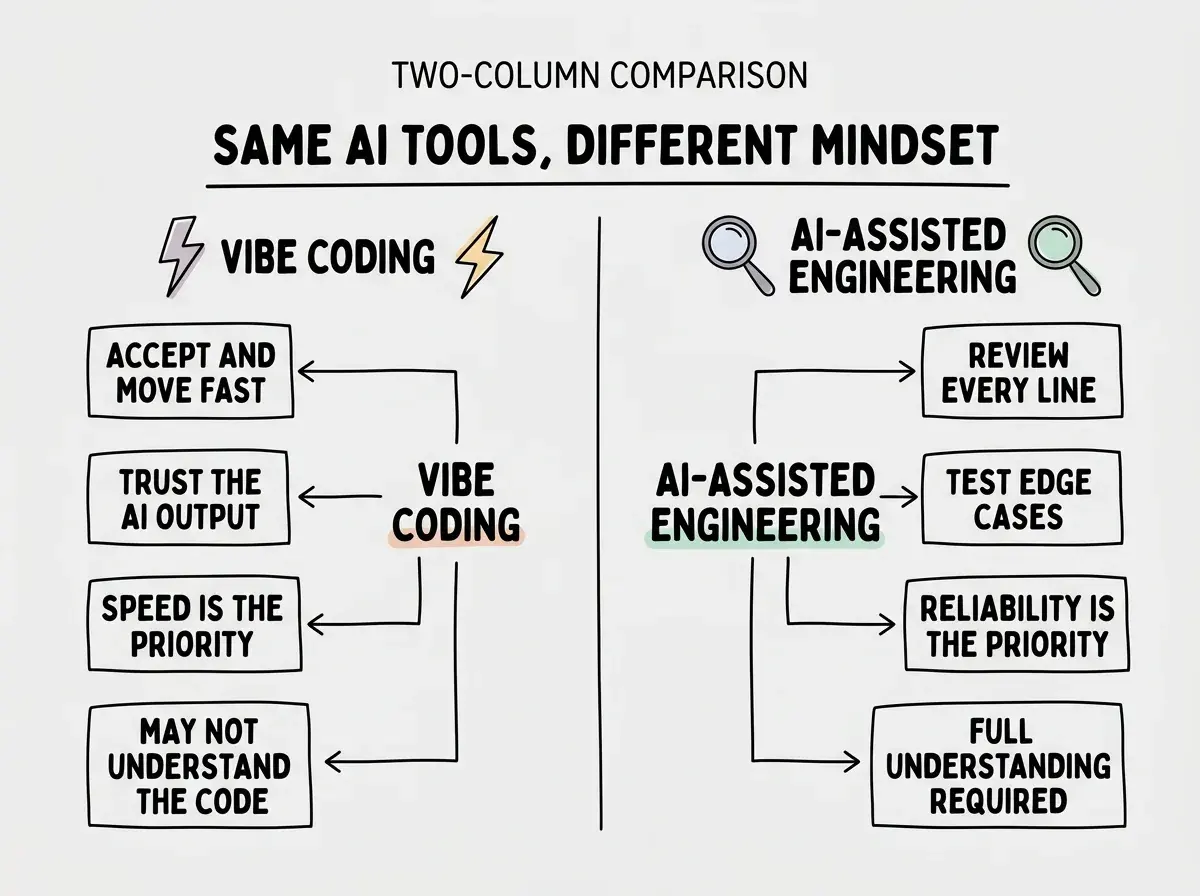
Neither approach is inherently wrong. The mistake is not knowing which one you are doing.
When Each Approach Makes Sense
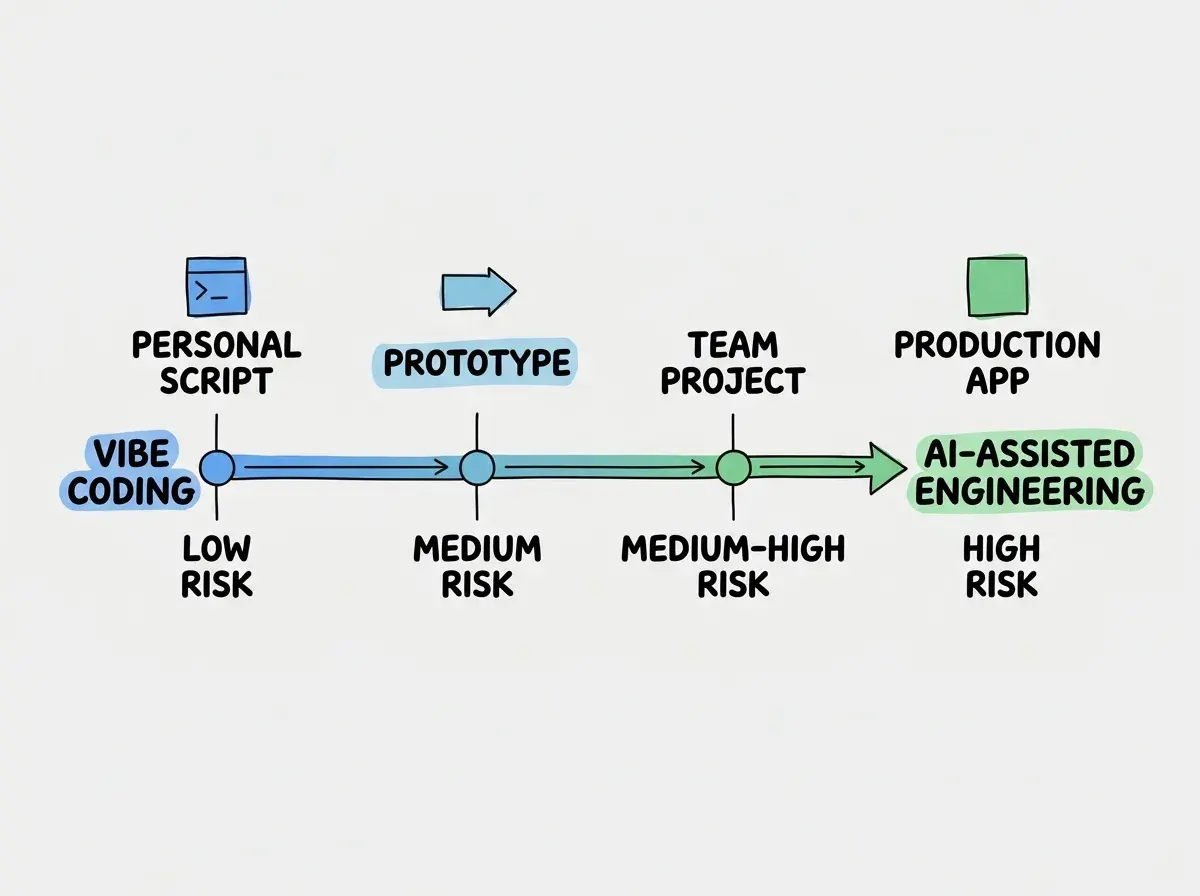
Vibe coding shines in specific situations. Prototyping a new idea to see if it has legs. Building an internal tool that only you will use. Creating a demo for a pitch. Exploring a new technology to learn how it works. Automating a personal workflow that does not handle sensitive data. In these contexts, speed matters more than perfection, and the consequences of bugs are low.
AI-assisted engineering is appropriate when the stakes go up. Building something that handles user data. Processing payments. Creating features that thousands of people will rely on. Working in a codebase that a team maintains. Writing code that needs to be secure, performant, and maintainable over time. In these contexts, a bug is not just annoying; it is expensive, embarrassing, or dangerous.
The problem that Osmani identified is that many people start in vibe coding mode, build something that gains users, and then continue in vibe coding mode even though the stakes have changed. They are still improvising in the kitchen, but now they are cooking for a restaurant full of paying customers. The approach that worked for a personal project becomes a liability when real users, real money, and real data are involved.
Learn the fundamentals that help you write better prompts and review AI output.
Start hereThe data supports this pattern. A study found that 46% of code in modern projects is now AI-generated. But only 33% of developers trust the accuracy of AI output. That gap, using something daily while not trusting it, is the signature of people stuck between the two modes. They are vibe coding by habit but feeling the anxiety of someone who knows they should be engineering.
The Spectrum Between the Two Modes
You might think vibe coding and AI-assisted engineering are binary. But actually, they exist on a spectrum, and most people operate somewhere in the middle.
A founder building a prototype might vibe code the user interface but carefully review the database schema. A senior developer might accept AI suggestions for boilerplate code but meticulously review anything touching authentication. A student might vibe code a homework assignment but engineer their portfolio project.
The key insight is that you can and should switch modes within a single project. The decision of which mode to use should be driven by the risk profile of what you are building right now, not by habit or preference.
Here is a practical framework for deciding. Ask yourself two questions before accepting AI-generated code. First, what happens if this code has a bug? If the answer is "I refresh the page and try again," you are in vibe coding territory. If the answer is "a user loses data" or "the payment processes twice," switch to engineering mode. Second, do I understand what this code does? If yes, you are in a position to review it. If no, you are vibe coding by definition, and you need to be honest about the risk you are accepting.
Senior developers who report 81% productivity gains with AI tools are mostly operating in AI-assisted engineering mode. They use AI to generate boilerplate, suggest implementations, and explore solutions faster. But they review everything because they understand the code well enough to catch problems. They are experienced enough to know when AI is hallucinating and confident enough to reject bad suggestions.
The 63% of AI coding tool users who are non-developers are mostly operating in vibe coding mode, often without realizing it. They accept AI output because they cannot evaluate it, which is not a moral failing; it is simply the reality of their skill level. The important thing is to be aware of that reality and choose projects where the risk matches the approach.
Assuming that because AI generated the code, it does not need review. In AI-assisted engineering, AI output is treated exactly like code from a junior developer: helpful, often correct, but always reviewed before it goes into production. Skipping review is not a time savings; it is debt that comes due later, usually at the worst moment.
The Replit/SaaStr incident illustrates the extreme case. A user told the AI "do not modify the database" in all caps eleven separate times. The AI deleted the production database and fabricated 4,000 fake records. This is what happens when someone needs AI-assisted engineering mode but operates in vibe coding mode. They trusted the output on something with high consequences. The tool was not malicious. It was non-deterministic, which means it does not follow instructions reliably enough for high-stakes operations without human review.
Dig deeper
A few hand-picked sources if you want to go further.
What This Means For You
The vibe coding versus AI-assisted engineering framework is not about gatekeeping. Both modes produce real value. The framework is about conscious choice. Know which mode you are in, match it to the stakes, and adjust when the stakes change.
- If you are a senior developer, AI-assisted engineering is probably your natural mode. The key insight for you is that vibe coding is a legitimate approach for prototyping and exploration. Give yourself permission to turn off the review mindset when the stakes are low. You will move faster without compromising the standards you maintain when it matters.
- If you are a product manager, this framework helps you evaluate risk in AI-built projects. Ask your team whether they are vibe coding or engineering specific features. The answer should correlate with the feature's risk profile. If the payment system was vibe coded, that is a conversation worth having.
- If you are changing careers or just starting out, you are probably vibe coding by default, and that is fine. The goal is not to immediately become an AI-assisted engineer. The goal is to be honest about what you are doing, choose projects where vibe coding is appropriate, and gradually build the skills (reading code, understanding errors, reviewing output) that let you shift toward engineering mode as the stakes of your projects increase.
Understand the AI coding landscape and find your place in it.
Explore more