Vibe coding for product managers means building working prototypes before writing specs, letting your team react to something real instead of debating a document. AI tools now let PMs create functional demos in an afternoon, fundamentally changing how ideas get validated and communicated.
You do not need to become a developer. You do not need to ship production code. You need to build just enough to show what you mean, to replace the abstract with the concrete, and to get honest reactions from stakeholders who have never once read your PRD all the way through. The ACM published "The Vibe Coding Imperative for Product Managers" for exactly this reason. PM legend Jackie Bavaro started an entire series on vibe coding for PMs. This is not a niche trend. It is the profession adapting.
Why PRDs Are Losing to Prototypes
Every product manager has lived this moment. You spend two weeks writing a detailed product requirements document. You schedule a review meeting. Half the attendees skim it five minutes before the call. The other half did not open it. Everyone has a different mental picture of what you described. The meeting ends with more questions than answers, and you schedule a follow-up meeting to clarify what the first meeting failed to resolve.
Now imagine a different version of that meeting. You walk in with a working prototype on your laptop. You click through it. People react instantly: "Oh, I thought you meant something different." "Can we move this button here?" "What if we added a field for X?" The conversation is concrete instead of abstract. Decisions get made in minutes instead of weeks.
This is not hypothetical. PMs at companies of every size are using AI coding tools to build onboarding flows, internal dashboards, and proof-of-concept features. Not to replace engineering, but to make the handoff to engineering dramatically more efficient. When an engineer receives a working prototype instead of a document, the gap between "what PM imagined" and "what engineering builds" shrinks to nearly zero.
A working prototype communicates product intent more clearly in 30 seconds than a 20-page PRD does in 30 minutes. PMs who can build prototypes do not replace engineers; they give engineers a concrete starting point that eliminates weeks of back-and-forth clarification.
The shift is happening because the cost of building prototypes has collapsed. When building a functional demo required weeks of engineering time, asking for a prototype before writing the spec was unreasonable. Now that a PM can build one in an afternoon using AI tools, skipping the prototype feels like the unreasonable choice.
The Scale Model Before the Building
Think of vibe coding for PMs like building a scale model before constructing a building. Architects do not describe buildings with 50 pages of text. They build a model that everyone can walk around, point at, and react to. The model is not the building. Nobody confuses it with the building. But it communicates the vision in a way that words on paper never can.
Your prototype is that scale model. It does not need to handle a thousand concurrent users. It does not need to survive a security audit. It does not need beautiful error handling. It needs to show what the thing does, how it feels, and why it matters. That is a fundamentally different bar than production code, and it is a bar that AI tools clear easily.
This distinction matters because it sets the right expectations. You are not trying to build something that ships to customers. You are trying to build something that communicates to your team. The scale model does not need working plumbing. It needs the right number of floors, the right proportions, and enough detail that people can react to the actual design instead of their imagination.
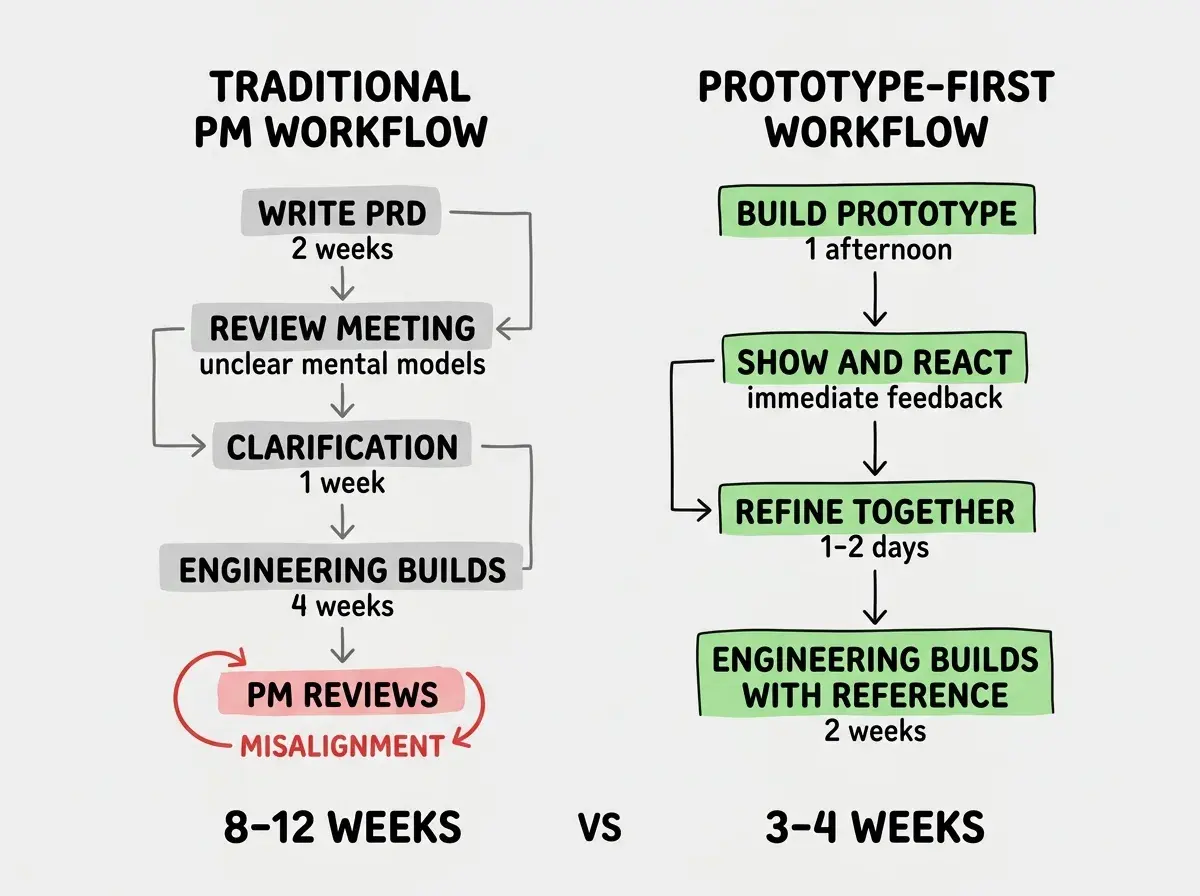
When you walk into a meeting with a working prototype, something interesting happens to the power dynamics. People stop debating abstractions and start giving specific, actionable feedback. "Move this to the top" is more useful than "I think the information hierarchy needs work." The prototype forces specificity, and specificity is what moves products forward.
Building Your First Prototype
This confuses everyone at first because PMs expect they need technical setup. You do not. The modern AI coding tools are designed for people who have never written code. Here is the practical workflow.
Start with the user story, not the feature list. Open an AI tool like Cursor, Replit, or Lovable and describe the user's journey. "A new employee opens this page on their first day. They need to set up their profile, choose their department, and get directed to the right onboarding checklist." That is enough to start. The AI will build a working version of that flow.
Iterate by showing, not by describing. When the first version appears, you will see things you want to change. Tell the AI directly: "Make the department dropdown show only active departments" or "Add a progress bar at the top so users know how many steps are left." Each iteration takes minutes. Within an hour, you will have something that looks and behaves like a real product.
Know your use cases. The PM sweet spot for vibe coding includes onboarding flows, internal tools, dashboards, admin panels, and proof-of-concept features. These are all things where the primary audience is internal (your team, your stakeholders, your beta users) and where the goal is communication and validation, not production deployment.
Build your foundation with the concepts that power every vibe coding session.
Start hereThe key insight is that you do not need to be good at this to get value from it. Your first prototype will be rough. The layout might be off. The colors might not match your brand. None of that matters. What matters is that people can click through it and react to the actual product idea instead of their interpretation of your words.
The Meeting Where Everything Changes
You might think the prototype is the deliverable. But actually, the real value is what happens in the room when people see it.
There is a specific moment in every prototype review meeting that transforms how a product team works. It is the moment when a stakeholder says, "Oh, wait, I thought we meant something completely different." That moment, which used to happen six weeks into engineering, now happens on the first afternoon. The cost of discovering misalignment drops from weeks of wasted engineering time to minutes of a PM's afternoon.
Internal tools are where many PMs start because the stakes are low and the impact is immediate. That customer success dashboard your team has been requesting for three quarters? Build a prototype in an afternoon. Show it to the team. Collect their reactions. Now you have a spec that is grounded in real feedback on a real interface, not guesses about what people might want.
Jackie Bavaro, whose "Cracking the PM Interview" defined a generation of product managers, started her vibe coding series because she recognized this shift as fundamental. The PM role is moving from "person who writes documents about products" to "person who shows what products should be." That is a significant evolution, and PMs who lean into it will have a meaningful advantage over those who do not.
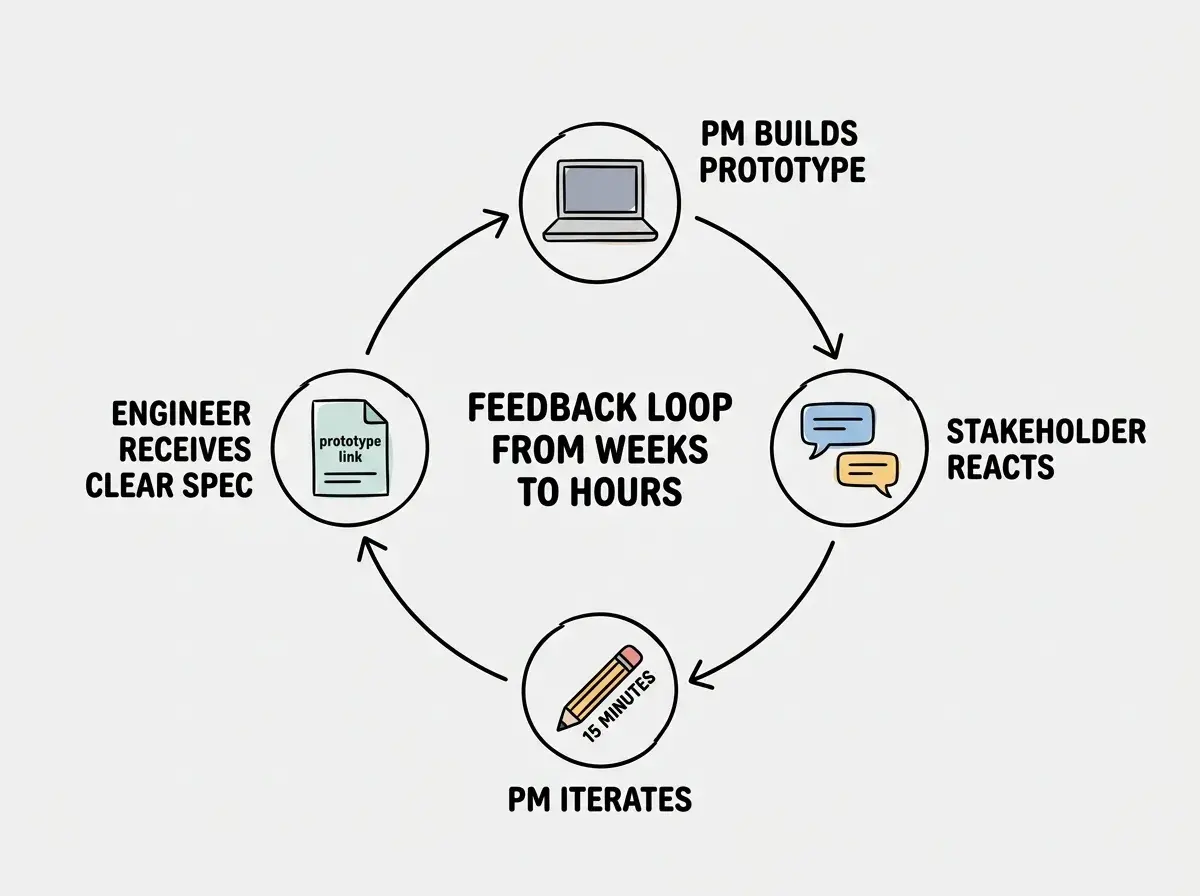
The prototype also changes your relationship with engineering. When you hand an engineer a working prototype instead of a document, you are speaking their language. They can inspect how the prototype works, see the interactions you intended, and ask questions about specific behaviors instead of trying to decode your written descriptions. Engineers consistently report that working from a prototype reduces misunderstanding and shortens build time.
Trying to build production-quality code instead of a communication tool. Your prototype does not need authentication, error handling, or scalable architecture. It needs to show what the product does. PMs who try to build "real" software get stuck in technical complexity that has nothing to do with their actual goal: validating and communicating a product idea.
Remember the scale model. Nobody expects the model to have working elevators. They expect it to show them the building. Hold yourself to the same standard, and you will move faster and communicate more effectively than any PRD ever could.
Dig deeper
A few hand-picked sources if you want to go further.
What This Means For You
Vibe coding does not replace the strategic thinking that makes a great PM. It gives that thinking a faster, more concrete outlet. The PMs who adopt this approach are not becoming developers. They are becoming PMs who can show instead of tell, validate before they specify, and eliminate the ambiguity that slows every product team down.
- If you are writing PRDs: You do not have to stop writing documentation entirely. But try building a prototype before your next spec. Show it to three stakeholders and see how the conversation changes. Most PMs who try this once never go back to spec-first workflows for new features.
- If you manage engineers: Prototyping does not mean you are doing engineering's job. It means you are giving engineering a clearer starting point. Frame it as reducing ambiguity, not as encroaching on their territory. The best engineering leads actively welcome PM prototypes because they eliminate weeks of clarification cycles.
- If you are transitioning to PM: Vibe coding is a genuine competitive advantage in PM interviews and on the job. Being the PM who can build a quick prototype to demonstrate an idea sets you apart from PMs who can only describe ideas in documents. Start practicing now, even with simple personal projects, and add prototype-first workflows to your PM toolkit.
Everything you need to go from idea to working demo in one afternoon.
Get started