To build vibe-coded education products that meet FERPA requirements in 2026, recognize that FERPA covers personally identifiable information from student records at federally funded educational institutions, design data flows so student data stays under the school's control via signed Data Sharing Agreements, implement the four protective patterns (encryption at rest, role-based access, audit logging, data deletion), and document your compliance posture for school district procurement. Most EdTech serving K-12 schools must address FERPA; not doing so blocks both deals and legal compliance.
This piece walks through the four data categories that trigger FERPA, the Data Sharing Agreement basics, the protective patterns that work, and the four mistakes that block EdTech from school district procurement.
Why FERPA Matters for Modern EdTech
FERPA (Family Educational Rights and Privacy Act) covers any educational institution receiving federal funding, which includes virtually all US public schools and most private schools. EdTech products that handle student data from these institutions inherit FERPA obligations through Data Sharing Agreements signed at procurement.
The 2026 stakes are higher than ever: school districts have become significantly more sophisticated about FERPA compliance after a wave of student data breaches in 2022-2024. Procurement teams now include detailed FERPA compliance review; products that cannot demonstrate compliance get rejected before evaluation.
A 2025 EdTech Survey of 600 K-12 procurement officers found that 84 percent of districts now require formal FERPA documentation as part of vendor evaluation, up from 31 percent in 2020. Of products evaluated, 47 percent were rejected for FERPA-related reasons (missing documentation, weak data protection, unclear data flows). FERPA compliance is no longer optional for K-12 EdTech; it is the threshold requirement that decides which products even reach evaluation.
The pattern to copy is the way HIPAA shaped healthcare technology. The compliance framework was initially seen as bureaucratic overhead; over time, it became the foundation of trust that enabled the digital transformation of healthcare. FERPA is at a similar inflection point in education: the framework that initially feels like a barrier becomes the foundation that enables EdTech to scale.
The Four Data Categories That Trigger FERPA
Not all student data is FERPA-protected. Knowing which categories trigger compliance focuses your engineering effort.
Category 1, personally identifiable information (PII). Names, addresses, dates of birth, social security numbers, photos that identify students. The core FERPA-protected data.
Category 2, academic records. Grades, transcripts, attendance, disciplinary records, test scores. Always FERPA-protected when associated with identified students.
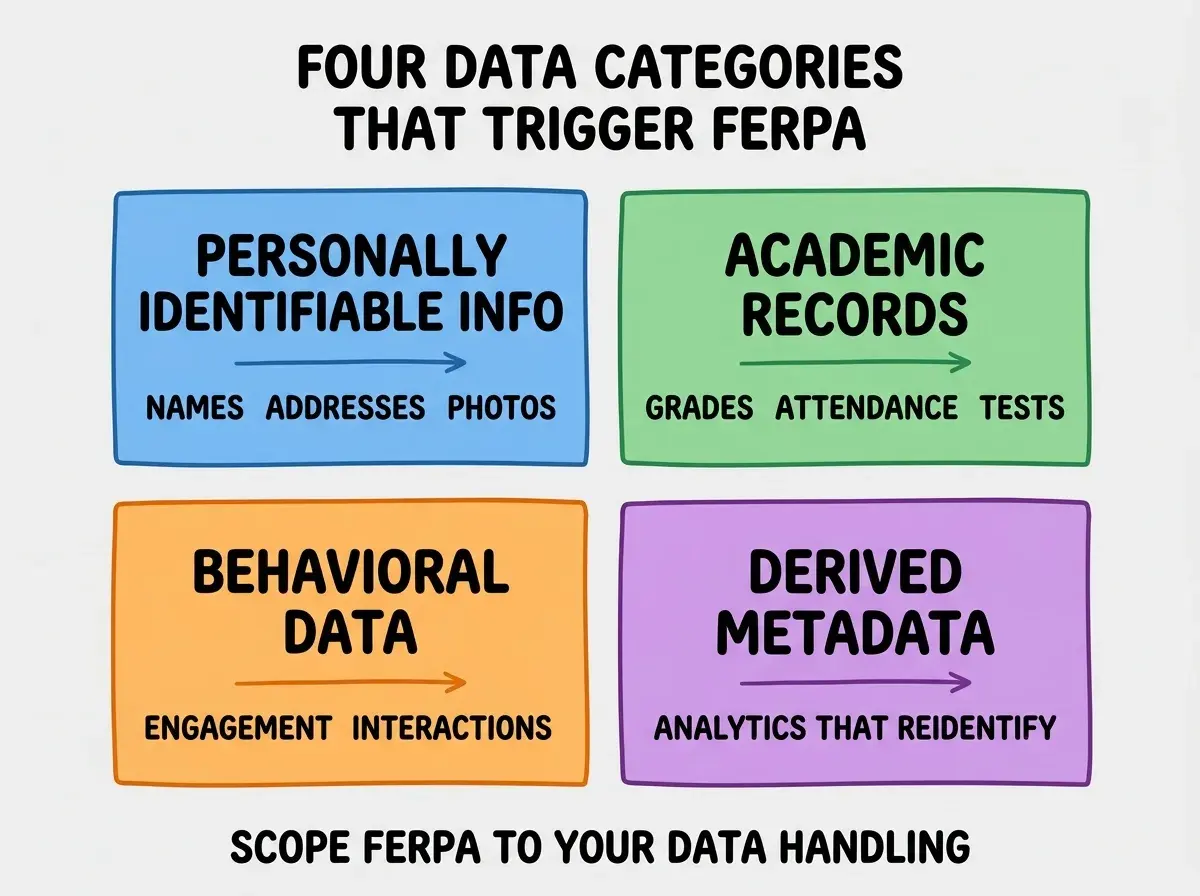
Category 3, behavioral data. Engagement metrics, interaction patterns, learning behavior. FERPA-protected when linked to identified students.
Category 4, derived metadata. Analytics that could re-identify students even when nominally anonymized. The trickiest category; small classroom analytics often re-identify by elimination.
The Data Sharing Agreement Basics
Every K-12 EdTech product needs Data Sharing Agreements with school districts. Three components matter most.
Component 1, data uses specification. Exactly what student data you collect, why, and what you do with it. Schools want this in plain language, not lawyer-speak.
Browse more education tech guides
Read more pulse articlesComponent 2, data retention and deletion. How long you keep data, when you delete it, what happens to data on contract termination. Schools want explicit retention schedules.
Component 3, security commitments. What protections you provide (encryption, access controls, breach notification). Schools increasingly require specific certifications (SOC 2, ISO 27001) at this point.
The DSA is the contractual foundation of school relationships. Get it right and procurement becomes routine; get it wrong and every deal becomes a months-long legal negotiation.
The Four Protective Patterns
Four technical patterns implement most of what FERPA-aware EdTech needs.
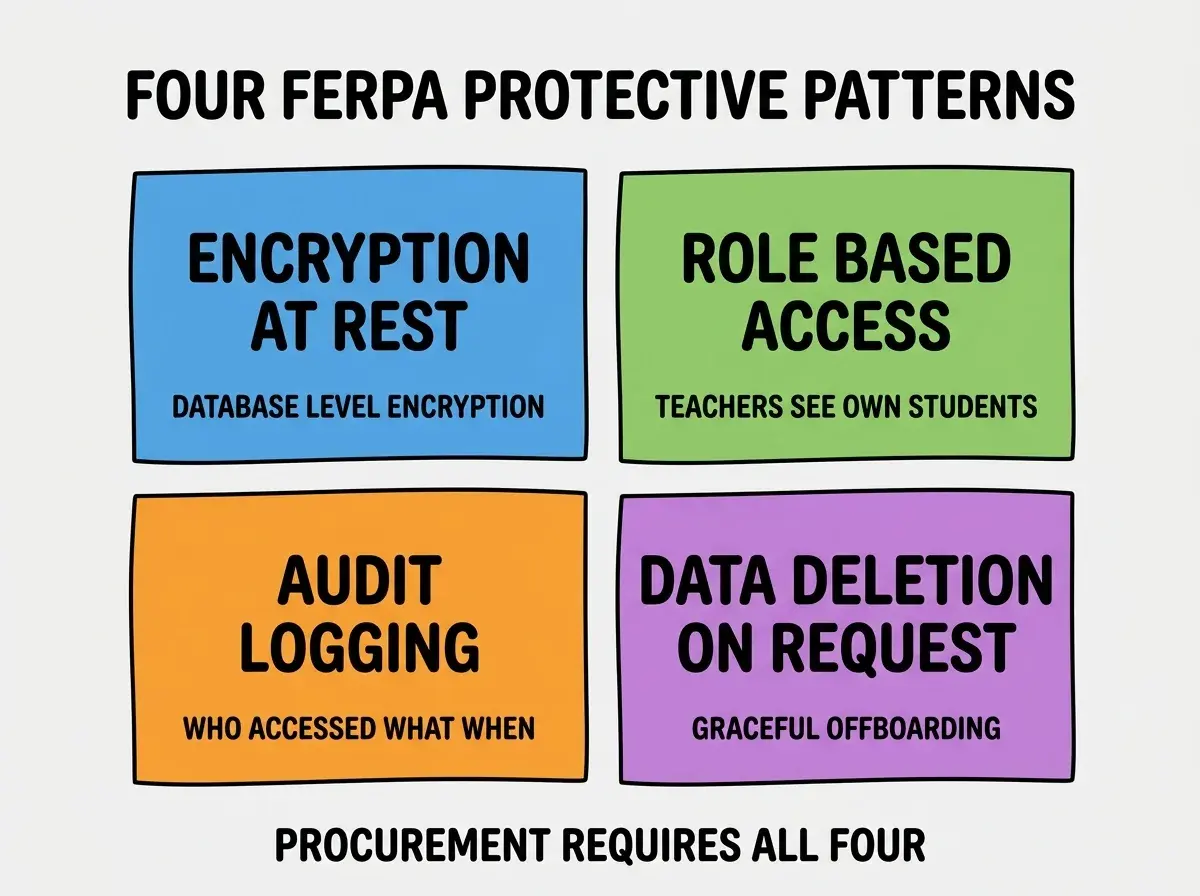
Pattern 1, encryption at rest. Database-level encryption for all student data. Most cloud databases provide this; just confirm it is enabled.
Pattern 2, role-based access. Teachers see only their own students; admins see only their school. Cross-school access requires explicit permission. Standard RBAC patterns apply.
Pattern 3, audit logging. Log every access to student data with timestamp, user, and action. Retention for at least 1 year. Required for breach investigation and compliance audits.
Pattern 4, data deletion on request. Clean offboarding when contracts end. Provide deletion confirmation to the school. Document the deletion process.
The Mistakes That Block School Procurement
Four mistakes consistently block EdTech from school district procurement.
Mistake 1, treating FERPA as optional. Some EdTech founders view FERPA as a "nice to have" until they get a bigger contract. School districts treat it as table stakes. Skipping it blocks every deal.
Mistake 2, vague data flow documentation. Schools want clear diagrams showing what data goes where. Hand-wavy answers raise red flags and prolong evaluation.
Mistake 3, third-party integrations without DSAs. If you use third-party services that touch student data (analytics, error tracking, AI providers), each needs to be in your DSA. Schools dig into this.
Mistake 4, inadequate breach notification commitments. Schools require notification within 24-72 hours of any breach. Vague commitments do not pass procurement.
The combination of these four mistakes blocks most non-compliant EdTech from K-12 procurement. Avoiding them requires upfront investment but enables a market that is otherwise inaccessible.
The most damaging FERPA mistake is using AI services that train on student data. Many AI providers default to using submitted data for training; this is a FERPA violation when the data is student data covered by a school's DSA. The fix is to use AI services that explicitly do not train on submitted data (Anthropic and OpenAI both offer this for enterprise customers) and document this in your DSA. Some EdTech founders do not realize their AI integration is creating compliance gaps until a school district discovers it during audit. Build with no-training-by-default AI services from the start; retrofitting later is expensive.
The other mistake is over-engineering the FERPA architecture before having any school customers. The compliance framework matters when you have students; it is theoretical until then. Build with FERPA-aware patterns from day one (the cost is small) but do not block product development on perfect compliance until you have actual deals to protect.
State-Level Variations on FERPA
While FERPA is a federal law, several states have layered additional protections that EdTech vendors must navigate. Three states with the most stringent additional rules are worth knowing.
State 1, California. SOPIPA (Student Online Personal Information Protection Act) adds prohibitions on targeted advertising and selling student data. AB 1584 adds specific contract requirements. EdTech serving California schools must address both federal FERPA and state SOPIPA.
State 2, New York. Education Law 2-d adds specific data security requirements and parent disclosure rights. Vendors must publish parent-friendly privacy descriptions.
State 3, Illinois. SOPPA (Student Online Personal Protection Act) requires public posting of vendor contracts and sets specific encryption requirements.
The combination of federal FERPA and state-specific layers means EdTech with national ambitions must address overlapping compliance regimes. Most vendors address California's stringent requirements as a baseline; products that comply with California's rules generally comply with weaker state requirements.
How AI Features Complicate FERPA Compliance
AI features in EdTech (personalized learning, automated grading, AI tutoring) create specific FERPA considerations that need explicit handling.
Consideration 1, AI service provider DSAs. If you use external AI services, those providers become subprocessors under FERPA. They need to be in your DSA with explicit data handling commitments.
Consideration 2, training data isolation. AI services that train on submitted data violate FERPA when student data is submitted. Use only no-training enterprise AI tiers for student data.
Consideration 3, AI outputs as student records. AI-generated assessments or feedback become part of the student record under FERPA. Storage, access, and deletion requirements apply.
Building AI features into K-12 EdTech requires deliberate FERPA architecture from day one. Retrofitting AI compliance is expensive; building it in is cheap.
What This Means For You
FERPA literacy is increasingly essential for any EdTech product targeting K-12 schools in 2026. The compliance gap between "we comply" and "we know FERPA" determines which products win school deals.
- If you're a founder building EdTech: FERPA is your threshold requirement, not an afterthought. Build with it in mind from product design forward.
- If you're changing careers into EdTech: FERPA literacy demonstrates regulatory awareness that EdTech employers value. Read the FERPA basics even before your first interview.
- If you're a student: If you build EdTech for a school project, learn the FERPA basics. The discipline transfers to other regulated industries.
Browse more education tech guides
Read more pulse articles