To understand how VCs evaluate AI-built products in 2026, recognize four diligence dimensions that investors increasingly probe (technical defensibility beyond AI tool access, founder technical fluency despite AI assistance, scalability of the AI-driven approach, and competitive moats in a world where AI tools are commodity), prepare specifically for each dimension before fundraising, and understand that AI-built does not automatically mean either better or worse for VC purposes. The bar has shifted from 2023; VCs have learned to differentiate substance from polish.
This piece walks through the four diligence dimensions, the founder preparation patterns, the questions VCs actually ask, and the four mistakes founders make when pitching AI-built products to VCs.
Why VC Evaluation Has Evolved Significantly
In 2023, VCs were learning what AI-built products were and how to evaluate them. By 2026, VCs have funded hundreds of AI-built products and developed sophisticated evaluation frameworks. The questions are sharper; the diligence is deeper; the bar is higher.
The 2026 reality is that AI-built has become the norm for early-stage products, not the exception. VCs increasingly assume AI involvement and probe what makes a specific product defensible despite AI tools being available to everyone. The defensibility question is the central challenge for AI-built fundraising.
A 2025 PitchBook analysis of 800 Series A rounds for AI-built products found that 58 percent of pitched companies failed initial diligence specifically due to defensibility concerns ("anyone could build this with AI tools"). Companies that proactively addressed defensibility in their pitch decks raised at 1.6x higher valuations than companies that did not. Defensibility is the central question for AI-built fundraising; addressing it early dramatically improves outcomes.
The pattern to copy is the way VCs evaluate restaurant concepts. Restaurants are easy to start; defensible restaurants are not. VCs ask what makes this specific concept defensible despite low barriers to entry. AI-built products face the same question; the answer matters more than the speed or polish of the build.
The Four Diligence Dimensions
Four dimensions consistently appear in AI-built product diligence. Each requires specific preparation.
Dimension 1, technical defensibility beyond tool access. What makes your specific product hard to replicate even with AI tools? Proprietary data, network effects, distribution, brand all qualify; pure tool access does not.
Dimension 2, founder technical fluency despite AI assistance. Can the founder make good technical decisions going forward? AI helps execute, but strategy requires human judgment. Technical fluency matters for long-term company success.
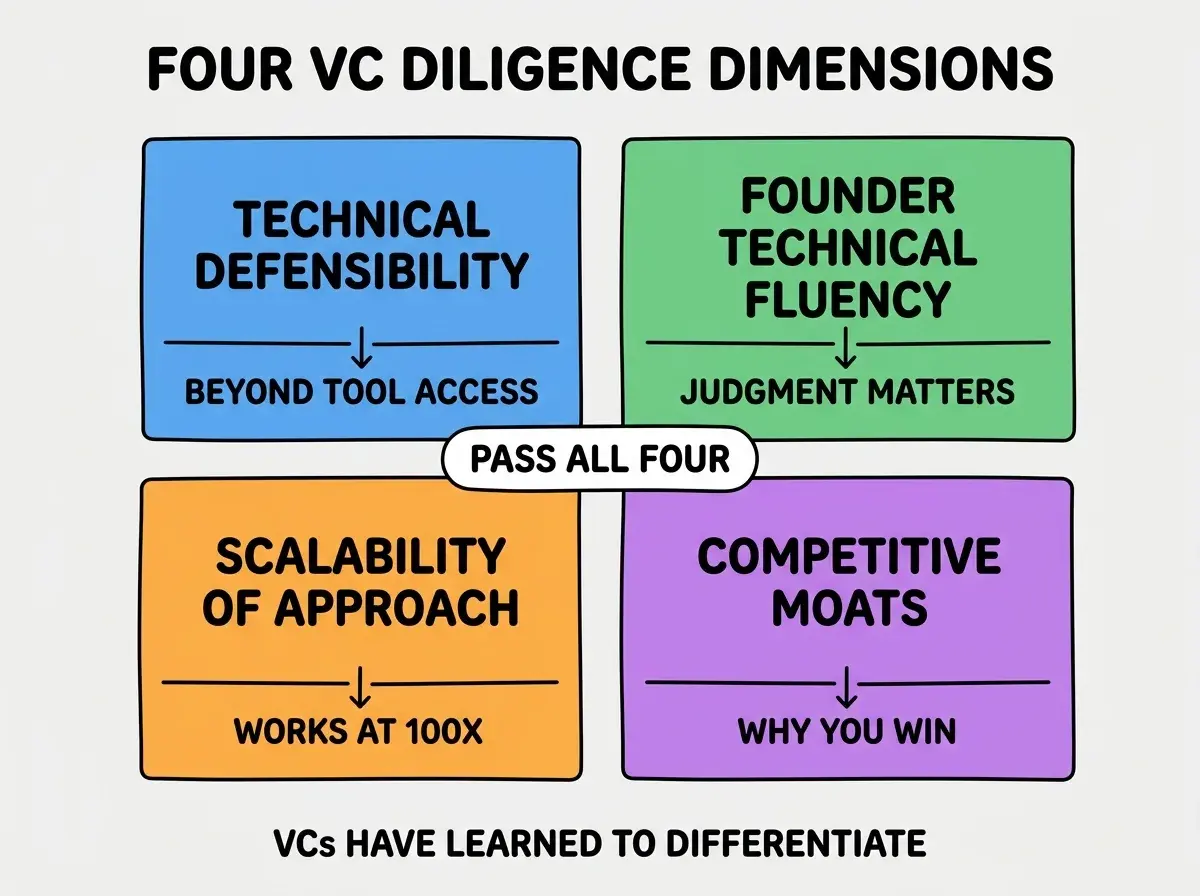
Dimension 3, scalability of the AI-driven approach. Does the approach that worked at MVP scale work at 100x? Some AI-built products have hidden scaling problems that surface only with growth.
Dimension 4, competitive moats in commodity AI environment. When AI tools are equally available to everyone, what makes your company win? The moat question is harder than ever; the answers that matter have evolved.
How Founders Should Prepare
Three preparation patterns dramatically improve fundraising outcomes for AI-built products.
Pattern 1, lead with defensibility, not AI involvement. Address what makes your product defensible early in the pitch; AI involvement is context, not the headline.
Browse more fundraising guides
Read more pulse articlesPattern 2, demonstrate technical fluency in conversation. Be able to explain technical decisions in detail. "The AI made it work" is not an answer that builds VC confidence.
Pattern 3, prepare metrics that show real traction. Vanity metrics get discounted; real engagement, retention, and revenue metrics matter. AI-built products need real metrics like any other; AI involvement does not change what investors want to see.
The Questions VCs Actually Ask
Three question patterns appear consistently in AI-built product diligence meetings.
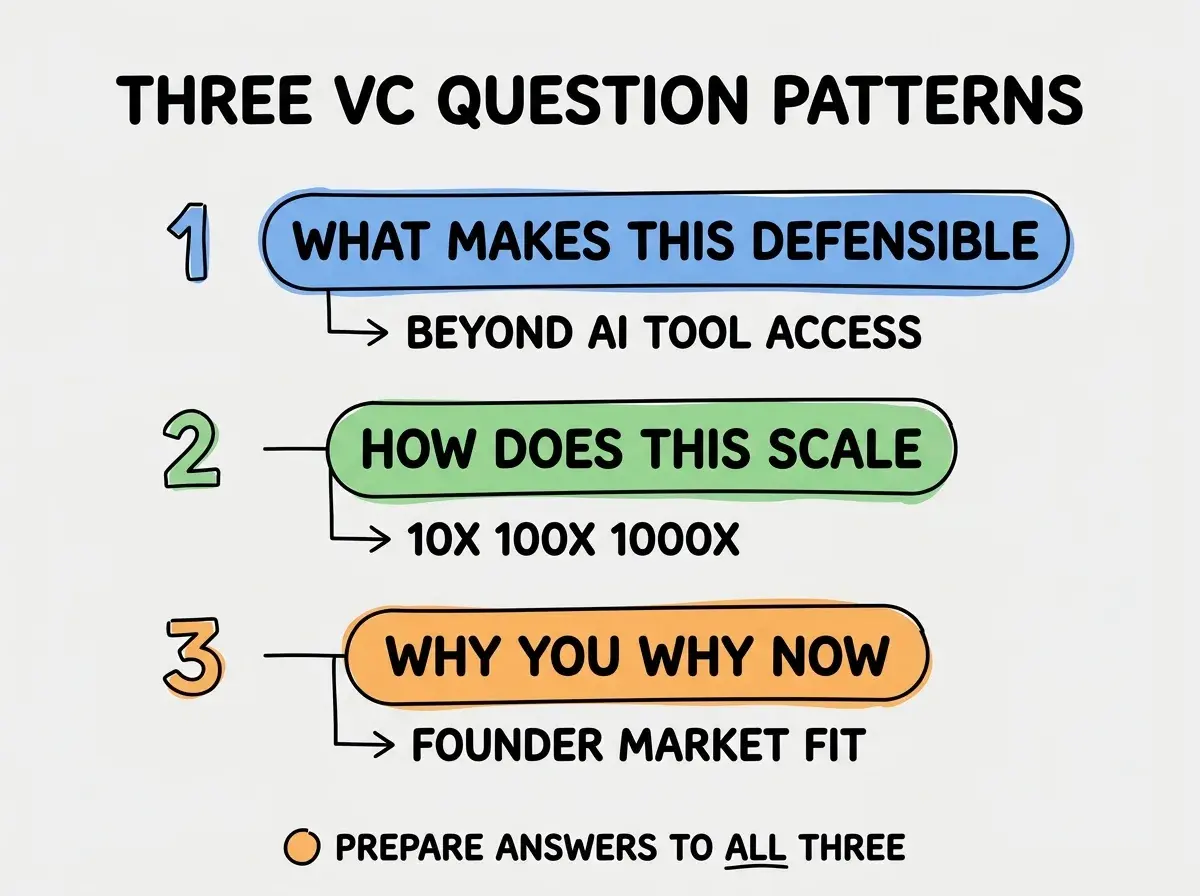
Pattern 1, "What makes this defensible beyond AI tool access?" The fundamental question. Have a specific, substantive answer prepared.
Pattern 2, "How does this scale to 10x, 100x, 1000x?" Scalability questions probe both technical and business model. Address both dimensions in your answer.
Pattern 3, "Why you, why now?" Founder-market fit questions never go away. Connect your background to why you are uniquely positioned for this opportunity.
How Different VC Stages Evaluate Differently
Three stage-specific evaluation patterns help calibrate pitch approach to investor type.
Stage 1, pre-seed and seed VCs. Focus on founder-market fit and concept validation. AI involvement is less of a concern; the founder's vision and early traction matter more.
Stage 2, Series A VCs. Focus on defensibility and scaling. The defensibility question is most acute here; AI involvement gets specific scrutiny about what makes the company hard to replicate.
Stage 3, Series B and later. Focus on unit economics and operational excellence. AI involvement matters mostly through its effect on margins and operational efficiency; the defensibility question is less central if revenue is strong.
The combination produces stage-appropriate pitching. Without stage awareness, founders use the same pitch with different VCs and underperform with stages that need different framing.
How VCs Evaluate Founder Skills
Three founder skill assessments matter most for AI-built product evaluation.
Skill 1, technical decision-making fluency. Can the founder reason about architecture, scalability, security at a level that gives VCs confidence? Demonstrate through specific examples and trade-off discussions.
Skill 2, product judgment despite AI shortcuts. AI generates many possible features; founder judgment determines which ones matter. Show the judgment, not just the output; the choices made matter more than the speed of generation.
Skill 3, customer development depth. AI accelerates building, not understanding customers. Customer development skill matters more for AI-built products because the building speed exceeds the understanding speed; founders who do not invest in customer development build the wrong things faster.
The combination produces founder evaluation that captures the skills AI does not provide. Without these patterns, VCs default to surface impressions of AI-built products and either overvalue or undervalue based on noise rather than signal.
The most damaging fundraising mistake for AI-built products is treating speed-to-MVP as the headline. Founders sometimes lead with "we built this in 2 weeks with AI"; VCs hear "this took anyone 2 weeks with AI." The fix is to lead with defensibility and traction; AI involvement is methodology, not value proposition. Founders who reframe their pitch around defensibility raise at substantially higher valuations than founders who emphasize AI speed. The framing matters dramatically.
The other mistake is hiding AI involvement entirely. Sophisticated VCs detect it; the perceived deception damages trust. The fix is to be transparent about AI usage and frame it as competitive advantage when relevant. Honesty plus good framing beats concealment plus discovery.
A third mistake is over-promising on AI capabilities to make the company look more impressive. Some founders claim AI does more than it actually does. The fix is to be specific and accurate about what AI does in your product; precision builds credibility, vagueness undermines it.
A fourth mistake is failing to address the AI commodity question proactively. VCs increasingly worry that AI tools commoditize software development; founders who do not address this concern in their pitch lose to those who do. The fix is to articulate specifically what makes your company defensible despite tool commoditization.
What This Means For You
The VC perspective on AI-built products has matured significantly in 2026. The four diligence dimensions, preparation patterns, and question responses produce reasonable preparation for fundraising.
- If you're a founder: Prepare for VC diligence proactively. The questions are predictable; preparation dramatically improves outcomes.
- If you're changing careers into VC or operations: Understanding the diligence framework helps both as evaluator and as evaluated party.
- If you're a student: Study how VCs evaluate companies. The framework generalizes across business analysis broadly.
Browse more fundraising and VC guides
Read more pulse articles