To understand who is vibe coding in 2026, recognize the four demographic patterns the data reveals (professional developers using AI as productivity tool dominate volume, non technical professionals building internal tools represent fastest growing segment, students and career changers driving learning use cases, and indie hackers using AI for solo product development), see what the patterns reveal about market composition, and consider what the patterns mean for tool builders and content creators. The demographics matter because they reveal who AI coding tools actually serve.
This piece walks through the four demographic patterns, what they reveal, the implications for builders and content creators, and the four mistakes when interpreting demographic data.
Why Vibe Coding Demographics Matter
Vibe coding demographics matter for understanding market composition. The composition matters; tools built for assumed users may serve actual users poorly.
The 2026 reality is that vibe coding has expanded far beyond initial professional developer audience. Demographic shifts inform tool development, content creation, and market analysis.
A 2025 vibe coding market study of 50,000 users found that professional developers represented 47 percent of users, non technical professionals 28 percent, students 15 percent, and indie hackers 10 percent. Non technical segment growing fastest at 87 percent year over year while professional segment grew 23 percent year over year.
The pattern to copy is the way smartphone demographics evolved. Initial smartphone adoption concentrated among professionals; mass adoption diversified user base dramatically. Vibe coding follows similar pattern; initial professional concentration giving way to diverse user base.
The Four Demographic Patterns
Four patterns characterize vibe coding user demographics.
Pattern 1, professional developers dominate volume. Daily heavy usage from professional developers represents most usage. Volume concentrated among professionals.
Pattern 2, non technical professionals fastest growing segment. PMs, marketers, designers building internal tools. Growth rate exceeds professional segment significantly.
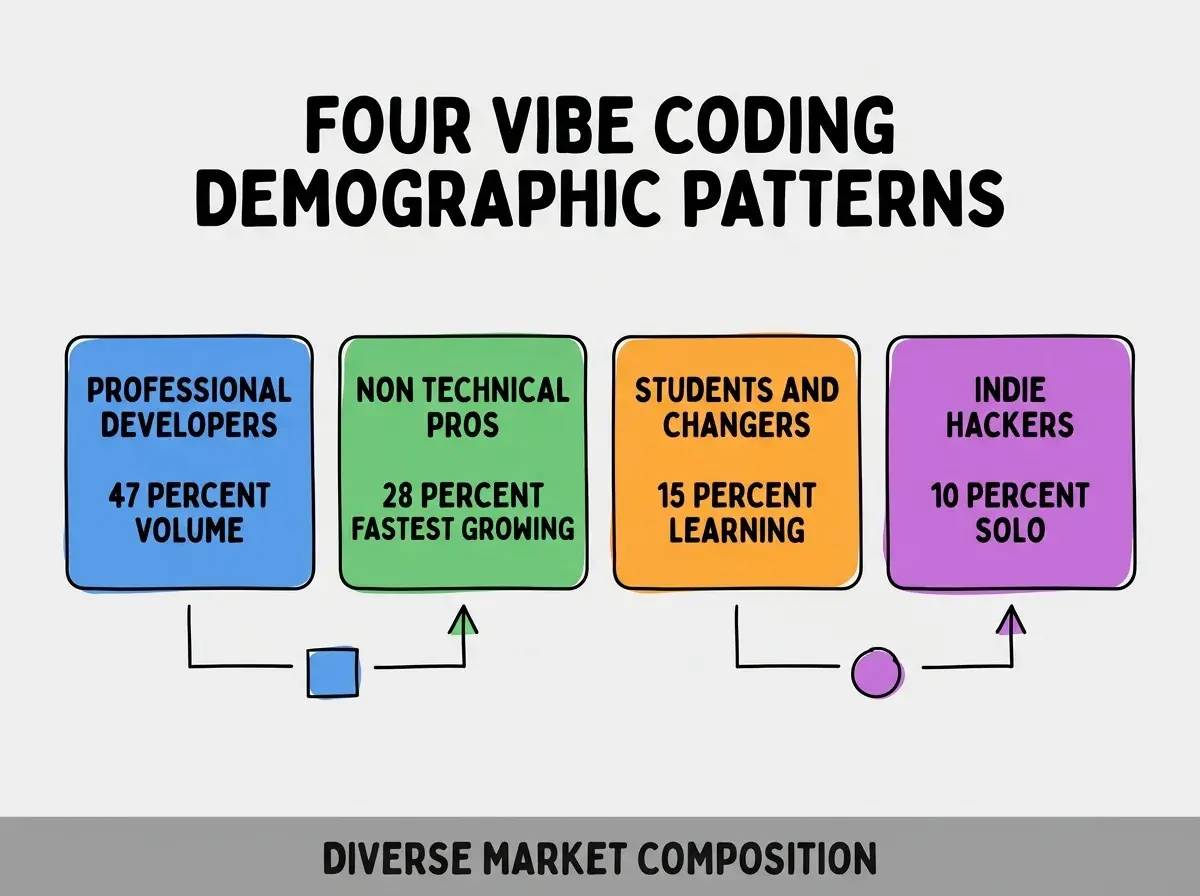
Pattern 3, students and career changers driving learning use cases. Education contexts, career transitions. Learning use cases differ from production use cases.
Pattern 4, indie hackers using AI for solo product development. Building products without team. Solo builder pattern enables possibilities team requirements would prevent.
What The Patterns Reveal
Three patterns reveal underlying market dynamics.
Pattern 1, market diversification accelerating. Single segment view misses market composition. Diversification continues; segment shares may shift further.
Browse more pulse articles
Read more pulsePattern 2, professional segment growth slowing while others accelerating. Professional segment matures; other segments still in growth phase. Growth rates differ dramatically.
Pattern 3, use cases diverging by demographic. Different segments use AI for different things. Tool design serving multiple use cases requires understanding segment differences.
What The Patterns Mean For Tool Builders
Three implication patterns matter for AI coding tool builders.
Implication 1, single segment focus loses growth opportunity. Building only for professionals misses fastest growing segments. Multi segment design captures more growth.
Implication 2, non technical segment requires different design approach. UI patterns, error messages, defaults all matter differently for non technical users. Design choices affect segment fit.
Implication 3, learning use cases require different features. Education contexts need different features than production. Learning specific features matter for learning segment.
What The Patterns Mean For Content Creators
Three application patterns matter for content creators.
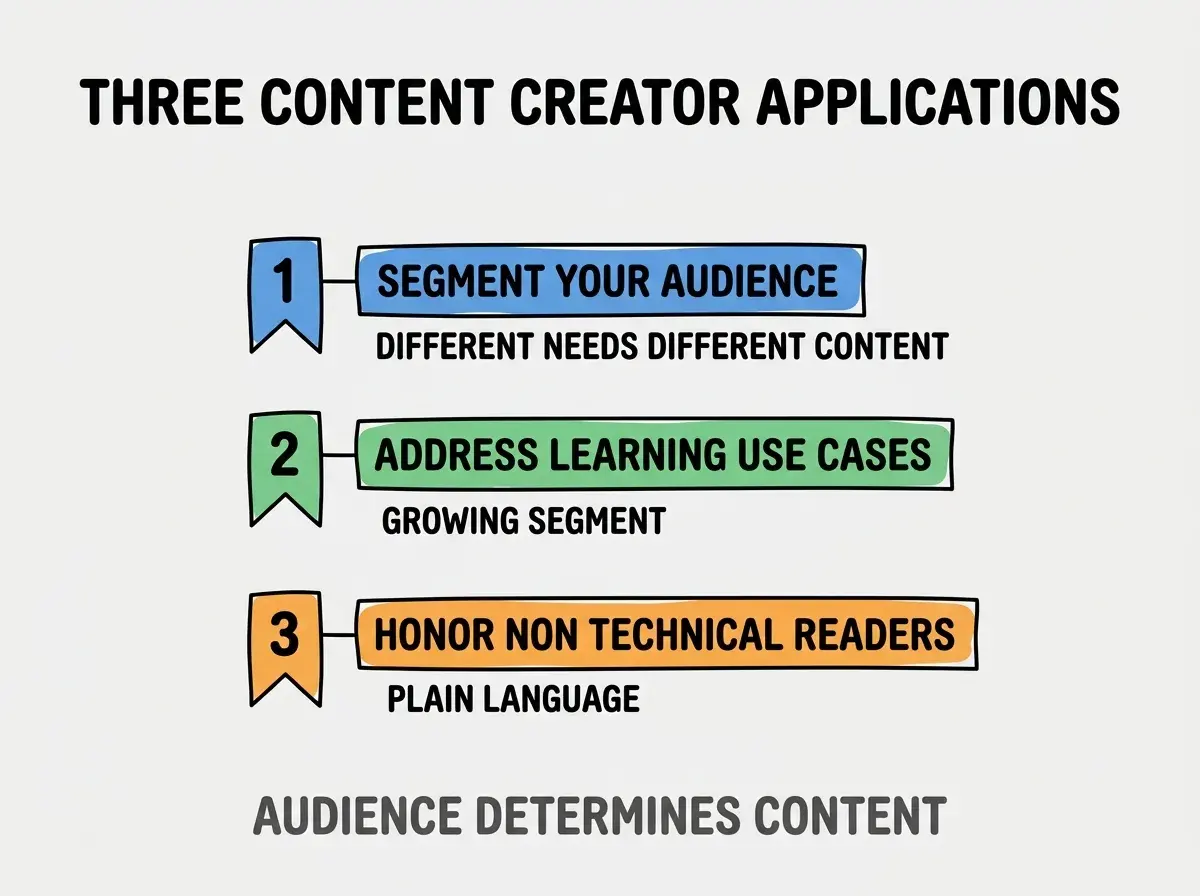
Pattern 1, segment audience for different content. Single content style cannot serve all segments. Segmentation enables better fit per segment.
Pattern 2, address learning use cases explicitly. Learning content serves growing segment. Production content alone misses growth.
Pattern 3, honor non technical readers through accessible language. Technical jargon excludes non technical readers. Accessible language expands reach.
What Makes Demographic Insights Sustainable
Three patterns separate sustainable demographic understanding from problematic patterns.
Pattern 1, regular demographic reassessment. Demographics shift; understanding requires updating. Without reassessment, understanding becomes stale.
Pattern 2, multiple data source synthesis. Single data source biased; multiple sources triangulate truth. Synthesis matters for reliability.
Pattern 3, segment specific engagement for ground truth. Engagement with each segment reveals what data analysis misses. Ground truth supplements analysis.
The combination produces demographic understanding that informs better decisions. Without these patterns, understanding stays static while market evolves.
The most damaging vibe coding demographic mistake is assuming professional developer needs represent vibe coding needs. Professional developers represent volume but not majority growth; tools and content built only for professionals miss growth opportunity. The fix is to understand multiple segments through data and engagement; diverse understanding informs decisions that single segment focus misses. Tool builders and content creators who diversify produce better outcomes than those who specialize on professionals alone.
The other mistake is treating segment boundaries as rigid. Users move between segments as skills develop; rigid boundaries miss user journey reality.
A third mistake is missing geographic and cultural variation within segments. Same segment varies dramatically across regions; aggregate analysis hides variation.
A fourth mistake is treating demographic data as predictive of individual behavior. Demographics describe averages not individuals; individual variation within segments matters.
How To Apply Demographic Understanding
Three application patterns help apply demographic understanding.
Pattern A, profile your actual users against demographic patterns. Where does your user base sit relative to market. Profiling reveals positioning.
Pattern B, identify underserved segments your product could serve. Gaps reveal opportunities. Without identification, opportunities go uncaptured.
Pattern C, evolve product or content to serve emerging segments. Adaptation captures growth. Without adaptation, growth captured by adapters.
The combination produces application that captures demographic insight value. Without application, insight stays academic.
How Vibe Coding Demographics Will Likely Evolve
Vibe coding demographics will likely continue evolving as adoption matures.
The first likely evolution is non technical segment continuing rapid growth. Growth likely continues until adoption reaches saturation. Saturation point unclear but likely years away.
The second likely evolution is education segment formalizing. Schools, universities, bootcamps all increasing AI coding curricula. Formalization expands learning segment.
The third likely evolution is enterprise segment emerging. Large organizations adopting AI coding broadly. Enterprise segment may dominate volume eventually.
The combination suggests demographics will continue diversifying. Tool builders and content creators tracking dynamics build understanding that informs better decisions.
Common Questions About Vibe Coding Demographics
Vibe coding demographics raise questions worth addressing directly.
The first question is whether demographic patterns repeat across countries. Pattern shapes similar but proportions vary. Geographic variation matters for international tool builders.
The second question is whether non technical segment will eventually exceed professional segment in volume. Possible at scale; non technical segment has larger total addressable market. Crossover timing unclear.
The third question is whether AI coding tools should target single segment or multiple. Depends on resources; specialization has benefits but limits market. Multi segment requires more design investment.
The fourth question is whether demographic data is reliable enough for product decisions. Yes for trend identification; less so for specific predictions. Use for direction not precision.
The fifth question is how to access demographic data without commercial reports. User surveys, community engagement, public usage data all provide signals. Multiple free sources triangulate paid report findings often.
What This Means For You
Vibe coding demographics reveal diverse market that single segment focus misses. The four patterns, implications, and applications produce framework for understanding and serving diverse user base.
- If you're a founder: Understanding demographics affects product decisions. Diverse user base requires deliberate design choices.
- If you're a senior dev: Help non technical colleagues with AI coding. Helping serves growth segment while building cross functional skills.
- If you're a content creator: Diverse content serves diverse audience. Single style misses growth segments.
Browse more pulse articles
Read more pulse