To understand the 4.7 billion dollar vibe coding market in 2026 and where the money is going, recognize the four spending categories the market divides into (AI coding tool subscriptions consume the largest share at roughly 38 percent, AI assisted infrastructure and hosting consumes the second largest share at 27 percent, AI training and education consumes 19 percent, and AI consulting and implementation services consume the remaining 16 percent), see what the spending patterns reveal about market maturity and growth, and consider what the patterns mean for builders contemplating where to position. The market data shows a maturing ecosystem with substantial investment beyond just tool subscriptions.
This piece analyzes the four spending categories, what the patterns reveal, the growth projections, and the four mistakes builders make when interpreting market data.
Why the Vibe Coding Market Size Matters
The vibe coding market size matters for builders thinking about where opportunity exists. Market size signals demand; demand signals where building investment can generate returns. The 4.7 billion total reveals substantial spending across multiple categories beyond just AI coding tool subscriptions.
The 2026 reality is that vibe coding has moved from experimental to substantial market segment. Enterprise budgets, individual subscriptions, and infrastructure spending all contribute to the total; the diversity of spending sources makes the market resilient to changes in any single segment.
A 2025 Gartner market analysis estimated the vibe coding market at 4.7 billion dollars in 2025 with projected 67 percent growth in 2026. The growth rate has accelerated from 2024 estimates; vibe coding has crossed the threshold from emerging to substantial market segment with ongoing rapid expansion.
The pattern to copy is the way cloud computing market size grew through the 2010s. Cloud started as small market estimated in single digit billions; it grew to hundreds of billions over the decade. Vibe coding shows similar early stage growth patterns; 4.7 billion today may grow to 50+ billion within 5 years if growth rates sustain.
The Four Spending Categories
Four spending categories divide the 4.7 billion market.
Category 1, AI coding tool subscriptions consume 38 percent. GitHub Copilot, Cursor, Claude Code, ChatGPT subscriptions. Individual and team subscriptions both contribute. Tool subscriptions remain the largest single category.
Category 2, AI assisted infrastructure and hosting consumes 27 percent. Cloud hosting for AI built apps, vector databases, model serving infrastructure. The infrastructure spending often exceeds tool spending for production deployments.
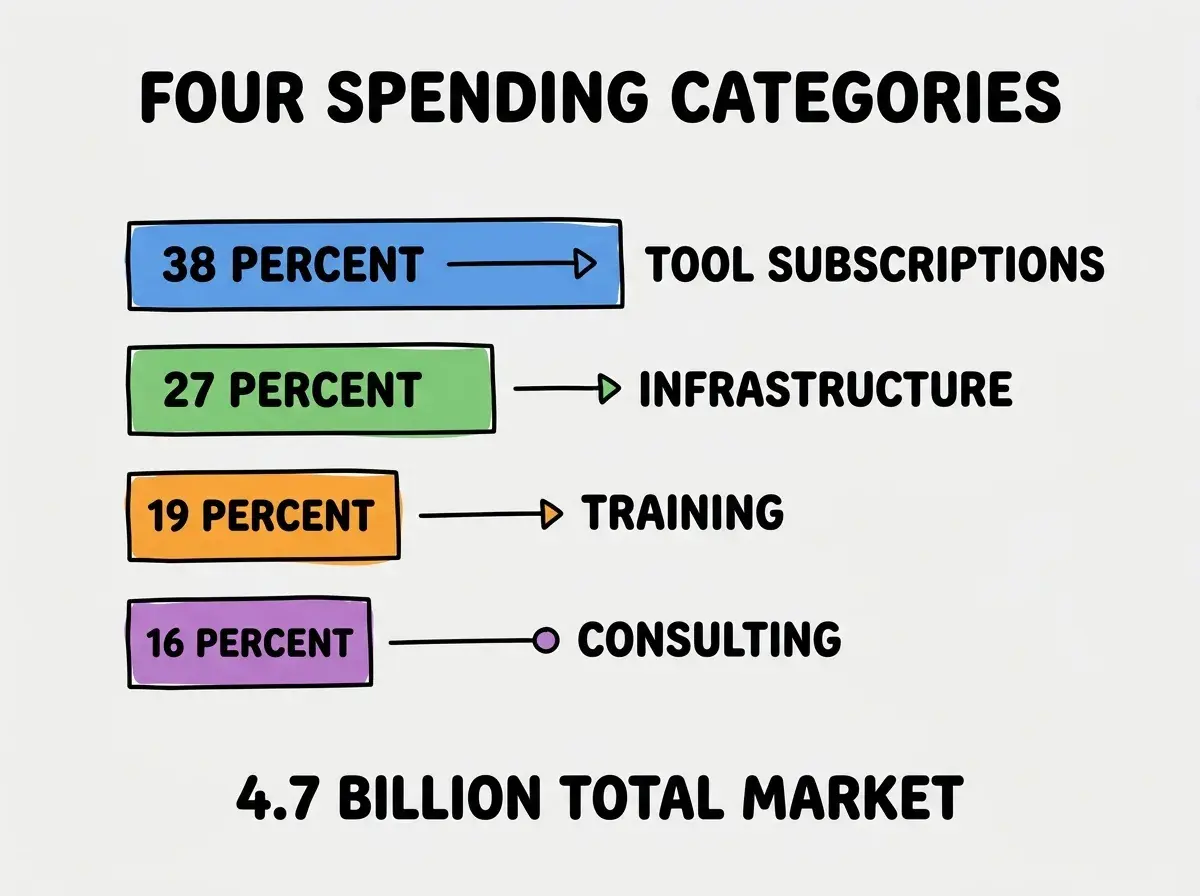
Category 3, AI training and education consumes 19 percent. Online courses, certification programs, internal training programs. Training spending grew faster than other categories in 2025; organizations invest in workforce capability.
Category 4, AI consulting and implementation services consume 16 percent. Consulting firms helping enterprises adopt AI coding. Implementation services for specific AI integrations. Service spending often translates AI tool capability into specific business outcomes.
What the Spending Patterns Reveal
Three patterns from the spending data reveal market maturity and direction.
Pattern 1, infrastructure spending matters more than just tool spending. The 27 percent infrastructure share reveals that production AI deployments require substantial spending beyond just tools. Builders who only consider tool spending miss the larger opportunity.
Browse more market analysis
Read more pulse articlesPattern 2, training spending growth signals enterprise commitment. Enterprises invest in training when they commit to capability; training spending growth signals sustained AI coding adoption rather than experimental usage.
Pattern 3, consulting spending reveals implementation gaps. Substantial consulting spending shows that enterprises need help bridging tool capability and business outcomes. Implementation gaps create opportunity for products that close them automatically.
The Growth Projections
Three growth projection insights matter for thinking about the next few years.
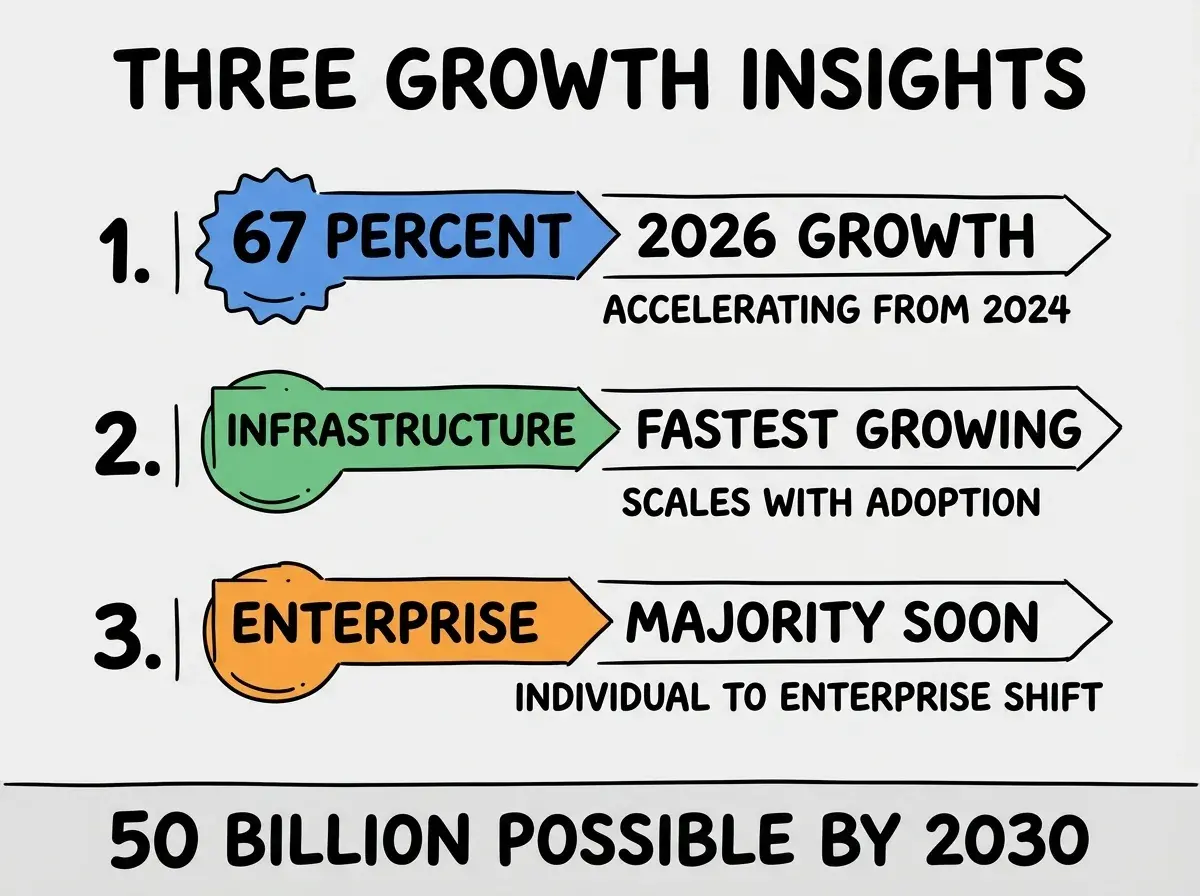
Insight 1, 67 percent growth projected for 2026. Growth rate accelerating from 2024 estimates. The acceleration reveals momentum rather than maturation; vibe coding remains in growth phase rather than approaching market saturation.
Insight 2, infrastructure category fastest growing. Production AI deployments scale with adoption; infrastructure spending grows faster than tool spending as adoption matures. The shift signals movement from experimentation to production.
Insight 3, enterprise share growing toward majority. Individual subscriptions dominated 2024; enterprise spending dominates 2025. The shift toward enterprise signals broader organizational adoption rather than just individual developer adoption.
What This Means For Builder Positioning
Three positioning patterns help builders think about where to position in the market.
Pattern A, infrastructure adjacent products show strong demand. Building infrastructure that AI built apps need produces sustained demand. The 27 percent infrastructure share reveals this opportunity.
Pattern B, training and education products show enterprise demand. Building training tools and curriculum produces enterprise sales. The 19 percent training share reveals this opportunity.
Pattern C, consulting tools that automate implementation gaps produce demand. Building tools that automate what consultants do reveals product opportunity. The 16 percent consulting share suggests automation potential.
The combination shows that the vibe coding market extends substantially beyond just AI coding tool subscriptions. Builders who recognize the broader market scope find more positioning opportunities.
The most damaging market interpretation mistake is assuming AI coding tool vendors capture all the market value. The 38 percent tool subscription share reveals that 62 percent of market spending happens outside tool subscriptions. Builders who only think about competing with AI coding tool vendors miss the larger 62 percent of market opportunity in infrastructure, training, and implementation services.
The other mistake is assuming current growth rates continue indefinitely. Market growth eventually maturates; 67 percent annual growth rates rarely sustain past 5 years. Builders should plan for eventual maturation rather than assuming permanent rapid growth.
A third mistake is treating the market as monolithic rather than segmented. Different segments grow at different rates and have different dynamics. The fix is to analyze specific segments rather than overall market; segment specific dynamics matter more than overall trends.
A fourth mistake is missing the international dimension. Most market analyses focus on North American spending; international spending may grow faster than North American spending. Builders thinking globally find opportunities others miss.
What the Market Data Reveals About Customer Segments
Three customer segment insights matter for builders thinking about positioning. First, individual developer subscriptions remain the entry point for many vibe coding adopters; the entry market continues growing despite enterprise share growth. Second, mid sized companies (50-500 employees) drive the fastest growth in spending; this segment finds AI tooling immediately valuable but lacks the procurement complexity of larger enterprises. Third, regulated industries (healthcare, finance, government) represent emerging segments with specialized needs that horizontal tools struggle to serve well; vertical opportunities exist in these segments.
What This Means For You
The 4.7 billion vibe coding market with 67 percent projected growth represents substantial and growing opportunity in 2026. The four spending categories, growth projections, and positioning patterns produce framework for thinking about where to build.
- If you're a founder: Market data reveals where customers spend money; spending data validates demand. Position your product against specific spending categories rather than general market.
- If you're a senior dev contemplating founding: Market growth creates timing opportunity that may not last forever. Building during growth phases differs from building during maturation phases.
- If you're a senior dev at an existing company: Market data informs career positioning. Skills aligned with growing categories produce career growth that skills in flat categories cannot match.
Browse more market analysis
Read more pulse articles