To implement usage-based pricing in your SaaS in 2026, pick a single clear usage metric (API calls, processing minutes, GB of storage), instrument the metric reliably with idempotent tracking, use Stripe's metered billing or a dedicated tool like Orb or Lago for invoice generation, surface usage prominently in your app so customers can see what they will be billed, and handle the edge cases (overages, plan downgrades, refunds) explicitly. The implementation takes 2 to 3 weeks for a basic version and produces billing that scales with customer value.
This piece walks through the four metering patterns, the implementation that ships, the edge cases that catch teams off guard, and the four mistakes that turn usage-based pricing into customer support nightmares.
Why Usage-Based Pricing Wins for Many SaaS
Flat-rate SaaS pricing is simple but frequently misaligned with customer value. A startup using your tool lightly pays the same as an enterprise hammering it. The startup feels overcharged; the enterprise feels they got a steal. Usage-based pricing aligns price with value, which often produces better unit economics for both sides.
The 2026 advantage is that usage-based pricing has matured significantly. The tooling is better (Stripe, Orb, Lago, Metronome all handle the complexity), the customer expectation is established (most modern dev tools price this way), and the metering patterns are well-understood. The barriers that made usage-based pricing hard five years ago have largely fallen.
A 2025 OpenView Partners survey of 600 SaaS companies found that companies with usage-based pricing had 38 percent higher net revenue retention than companies with pure flat-rate pricing. The mechanism was simple: as customers used the product more, they paid more, which compounded with growth in customer success. Flat-rate pricing caps your revenue per customer; usage-based pricing scales with customer value capture.
The pattern to copy is the way utility companies price electricity. You pay for what you use; light users pay less, heavy users pay more. The price is fair to both sides because it scales with value delivered. SaaS that aligns pricing with usage produces the same alignment.
The Four Metering Patterns
Different products meter different things. Four patterns cover almost all usage-based SaaS.
Pattern 1, transactional. Per-action pricing (per API call, per email sent, per file processed). Easiest to meter; most aligned with operational cost.
Pattern 2, time-based. Per minute of compute, per hour of usage, per day of uptime. Right for tools where time is the resource.
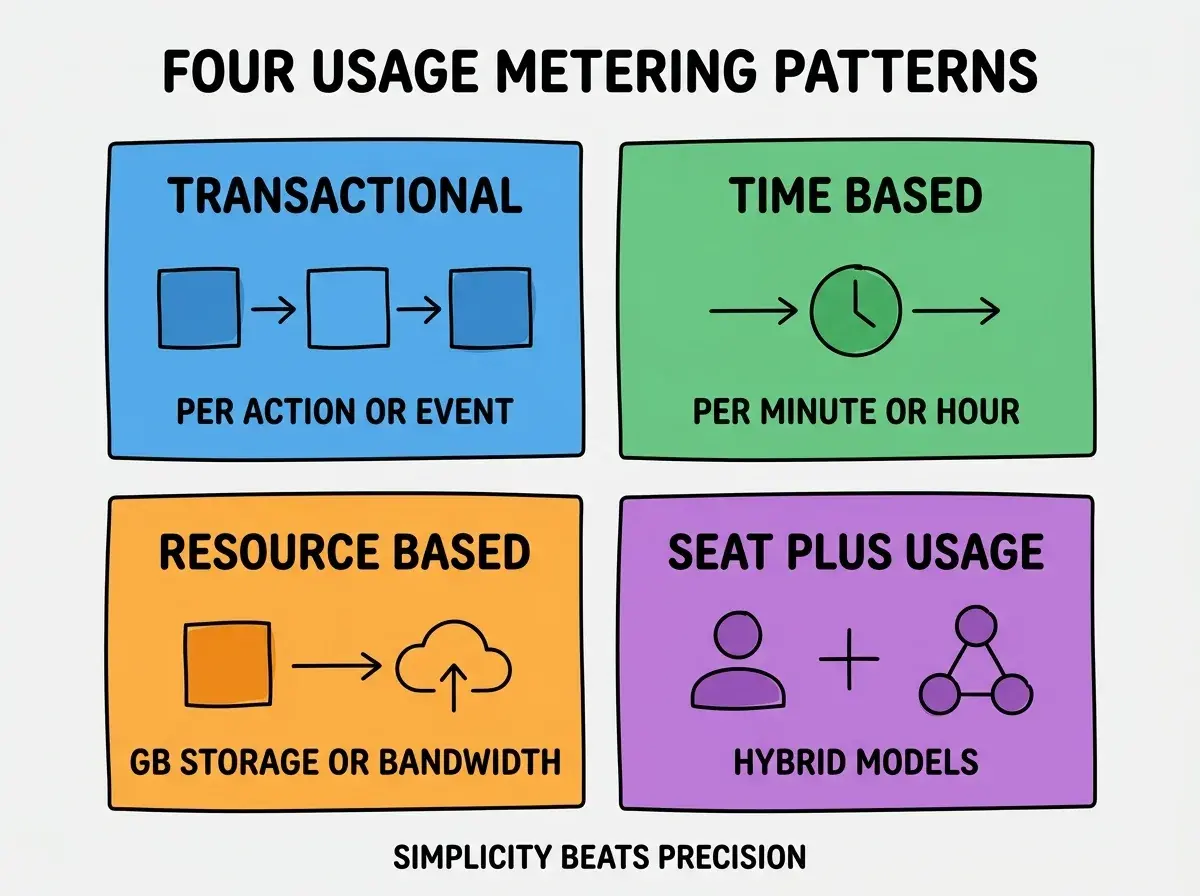
Pattern 3, resource-based. Per GB of storage, per GB of bandwidth, per record stored. Right for tools where infrastructure cost scales with data.
Pattern 4, seat plus usage. Hybrid: per-user fee plus per-action fee. Common in collaborative tools. More complex but matches some businesses well.
The Implementation That Ships in 2-3 Weeks
A basic usage-based billing system fits in 2-3 weeks of focused work. Three pieces handle most of it.
Piece 1, the meter. Instrumentation in your app that records each usage event. Must be idempotent (no double-counting on retries) and durable (no lost events on crashes).
Browse more monetization guides
Read more grow articlesPiece 2, the aggregator. Process that sums usage events into billable quantities per customer per period. Run hourly or daily; store snapshots for auditability.
Piece 3, the biller. Integration with Stripe metered billing (or Orb, Lago) that pushes the aggregated usage and generates invoices. Handle refunds and adjustments via the same path.
The complexity is in the meter and aggregator; the biller is mostly configuration. Most teams underestimate the meter complexity (event ordering, late events, retries) and overestimate the biller complexity (which is straightforward with modern tools).
The Edge Cases That Catch Teams Off Guard
Three edge cases consistently surprise teams implementing usage billing for the first time.
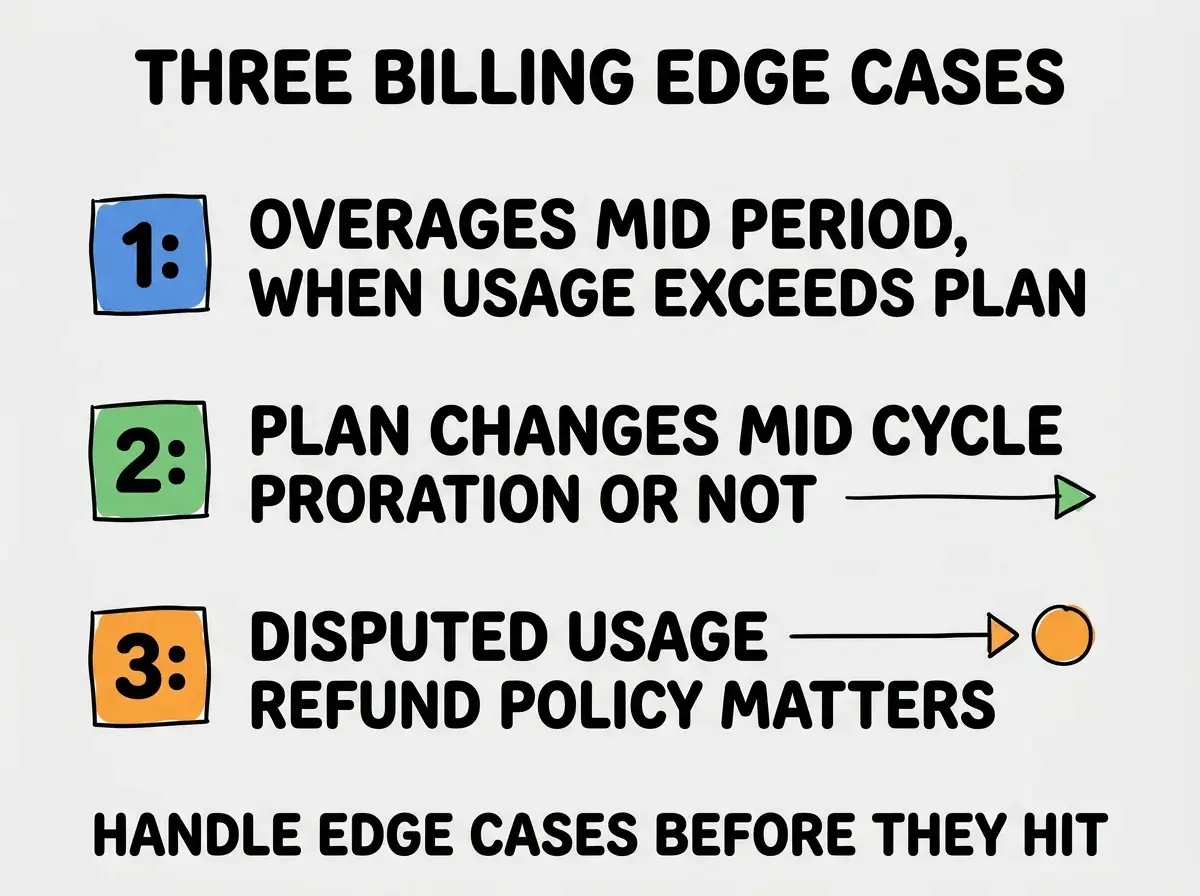
Edge case 1, overages mid-period. Customer hits their plan limit halfway through the month. Do you cut them off? Charge overage fees? Auto-upgrade the plan? Pick a policy and document it.
Edge case 2, plan changes mid-cycle. Customer downgrades from $200 plan to $50 plan with 10 days left in the month. Do you prorate the difference? Apply credit? Charge nothing extra? Decide upfront.
Edge case 3, disputed usage. Customer claims they did not make those API calls. Do you refund? Investigate? Trust the meter? Have a clear policy and audit trail.
How to Surface Usage in the App
Customers should never be surprised by their bill. Three patterns make usage transparent.
Pattern 1, real-time usage dashboard. Customers see current period usage and projected month-end total. Updated continuously. Removes "what will my bill be" anxiety.
Pattern 2, threshold notifications. Email or in-app alert when usage hits 50%, 80%, 100% of plan limit. Lets customers self-manage before overages hit.
Pattern 3, invoice preview. Before each billing cycle, show the customer what they will be charged. Catches surprises before they become disputes.
The combination of these three patterns dramatically reduces billing-related support tickets. Customers who can see their usage manage it; customers who cannot see it open tickets when bills surprise them.
The most damaging usage-based pricing mistake is metering on something that does not align with customer value. Some SaaS companies meter on "API calls" but the customer perceives value in "successful results." When a customer's API call fails and gets billed, they feel cheated. The fix is to meter on the unit of value the customer actually cares about. If they care about successful results, only bill for successful results. If they care about features unlocked, price by feature tier instead. Misaligned metering produces customer churn that no amount of clever billing can recover.
The other mistake is over-engineering the metering precision. Some teams build to-the-millisecond metering with byte-level resource tracking. Customers do not care about that precision; they care about predictability. Round usage to clean numbers (100s of API calls, GBs not bytes), and surface those clean numbers in your dashboard. Precision serves engineering; clarity serves customers.
Migrating From Flat Rate to Usage Based
Migrating existing customers from flat-rate to usage-based pricing requires careful handling. Three patterns reduce churn during migration.
Pattern A, grandfather existing plans. Existing customers keep their flat-rate pricing forever, regardless of how their usage grows. New customers get usage-based pricing. Slowest transition but lowest churn risk because nothing changes for the customers who built trust on the original pricing.
Pattern B, calculator and choice. Show existing customers what they would pay under the new model based on their actual usage. Let them choose to switch or stay. Most customers who would save money will switch voluntarily.
Pattern C, scheduled mandatory migration. Announce a future date when all customers move to usage-based pricing. Give 90 days notice minimum. Honest but high-churn-risk approach.
The right approach depends on your customer base and pricing economics. Most healthy migrations use option A or B; option C should be reserved for cases where the flat-rate pricing is genuinely unsustainable for the business. The discipline of careful migration preserves the customer relationships that took years to build, and customers who see the migration handled thoughtfully often become more loyal afterward rather than less. The investment in handling migration well pays back through the trust it builds with the customers who stay.
What This Means For You
Usage-based pricing is one of the highest-leverage business model decisions for SaaS in 2026. Done well, it aligns price with value and produces better unit economics than flat-rate pricing.
- If you're a founder: Consider usage-based pricing for new SaaS launches. The alignment with customer value compounds across the customer lifetime.
- If you're changing careers into SaaS: Understanding usage-based pricing is increasingly expected for product and engineering roles. The patterns transfer between companies.
- If you're a student: Read the pricing pages of modern dev tools (Vercel, Cloudflare, Anthropic) to see usage-based pricing in production. The patterns repeat across the industry.
Browse more monetization guides
Read more grow articles