The choice between free trial and freemium for a SaaS product in 2026 depends on four product traits: how quickly users see value (faster favors trial), how much usage drives the value (more usage favors freemium), how viral the product is (viral favors freemium), and how sales-led the go-to-market is (sales-led favors trial). Free trial works best for products with quick time-to-value and clear demonstrable use cases (analytics tools, project management, design software). Freemium works best for products with network effects, usage-based value, or strong upgrade paths (file storage, communication tools, developer tools). Picking the wrong model can crush conversion by 4 to 8x even with otherwise identical product quality.
This piece walks through the four product traits, the conversion benchmarks for each model, the cost of switching mid-stream, and the four mistakes that consistently lead founders to pick the wrong model.
Why This Decision Is Often Made Wrong
Founders frequently pick free trial vs freemium based on what their favorite SaaS company does rather than on what their specific product needs. The result is products that have the wrong model for their characteristics, which produces dramatically worse conversion than the same product with the right model.
The decision is also often made too late. By the time a SaaS has launched and discovered the model is wrong, switching costs are substantial: marketing materials need updating, customer expectations have been set, signed contracts may include the original model. Picking the right model upfront saves substantial work later.
A 2025 ProfitWell analysis of 2,000 SaaS products compared conversion rates across pricing models. Products with the right model for their characteristics converted at 4 to 12 percent of free users to paid. Products with the wrong model converted at 0.5 to 2 percent. Same products, dramatically different outcomes based on the pricing model fit. Picking well at launch prevents months of wasted growth efforts.
The pattern to copy is the way restaurants choose between table service and quick-serve formats. Both models work for the right products; both fail for the wrong ones. A fine-dining restaurant trying quick-serve format alienates customers who came for the experience. A fast-casual restaurant trying full table service has unsustainable economics. SaaS pricing models follow the same logic.
The Four Product Traits That Decide
Each trait has a clear right answer that points to one model. Most products fit one model strongly when you honestly evaluate all four traits.
Trait 1, time to value. How quickly can a new user get meaningful value from your product? If they can see value in 5 minutes (analytics dashboard, design tool), free trial works because the trial period is enough to demonstrate value. If they need weeks to see value (data warehouse, ML platform), freemium is better because the value compounds over time.
Trait 2, usage-driven value. Does the product become more valuable as users use it more (a knowledge base, a CRM with their data, a file storage with their files)? If yes, freemium creates lock-in that drives upgrades. If no (a one-time-use calculator, a comparison tool), free trial is fine.
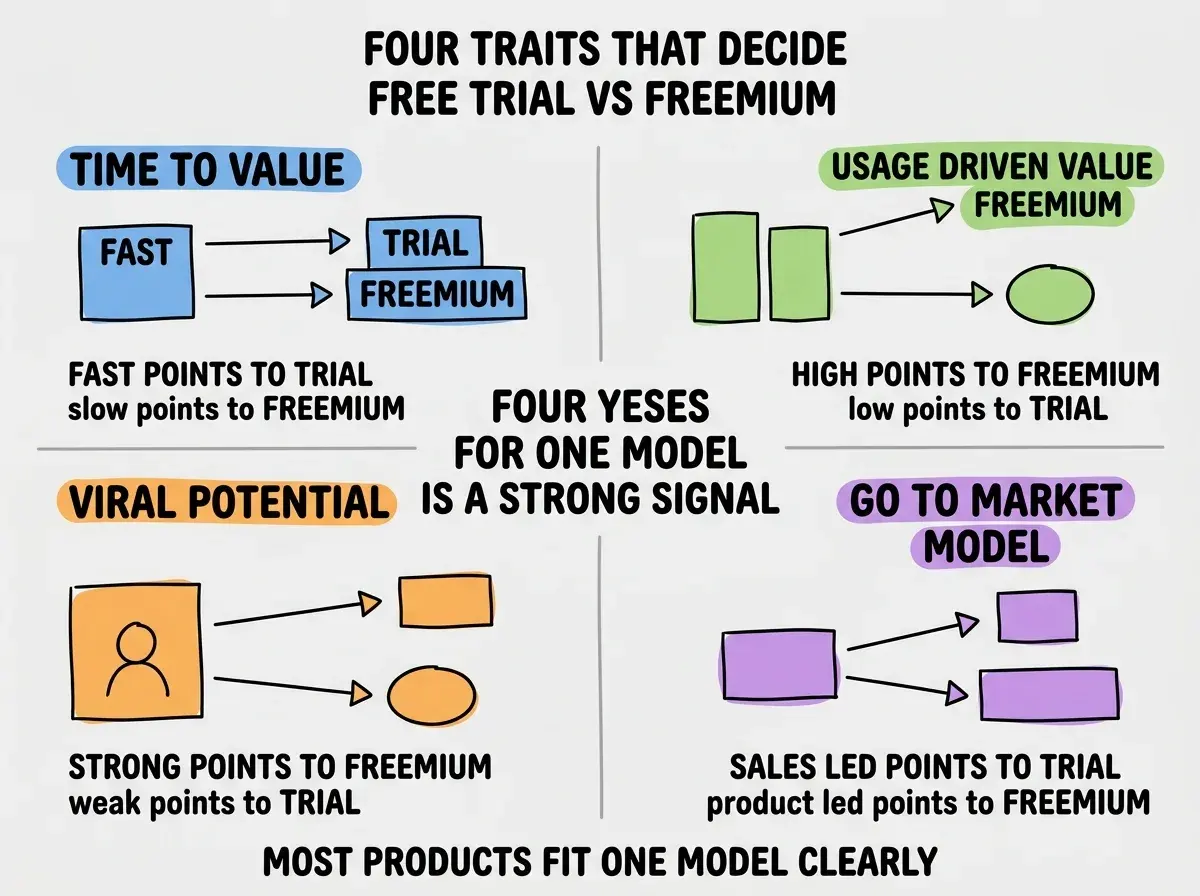
Trait 3, viral potential. Does using the product naturally spread to other users (collaboration tools, communication, marketplaces)? Strong viral effect favors freemium because each free user brings more users who eventually upgrade. Weak viral effect favors trial because there is no growth payoff to free users.
Trait 4, go-to-market model. Are you selling to enterprise via sales (sales-led growth) or to individuals via product (product-led growth)? Sales-led typically uses free trial because it qualifies prospects and creates urgency. Product-led typically uses freemium because the user adopts the product before any human interaction.
The Conversion Benchmarks for Each Model
Knowing what good looks like helps you tell whether your model is working. The benchmarks vary by model but are stable enough to plan around.
Free trial benchmarks. Average trial-to-paid conversion is 15 to 25 percent for B2B SaaS, 5 to 12 percent for consumer SaaS. Top quartile is 30 percent and 18 percent respectively. Bottom quartile is below 8 percent and 3 percent.
Browse more growth and pricing guides
Read more grow articlesFreemium benchmarks. Average free-to-paid conversion is 2 to 5 percent for B2B SaaS, 1 to 3 percent for consumer SaaS. Top quartile is 8 percent and 5 percent. Sounds lower but the volume of free users is much higher, so total paid users can be larger.
Hybrid benchmarks. Some products use both (limited freemium with optional free trial of paid features). Conversion rates fall between the two pure models.
The Cost of Switching Mid Stream
Switching pricing models after launch is expensive but sometimes necessary. Three categories of cost are common.
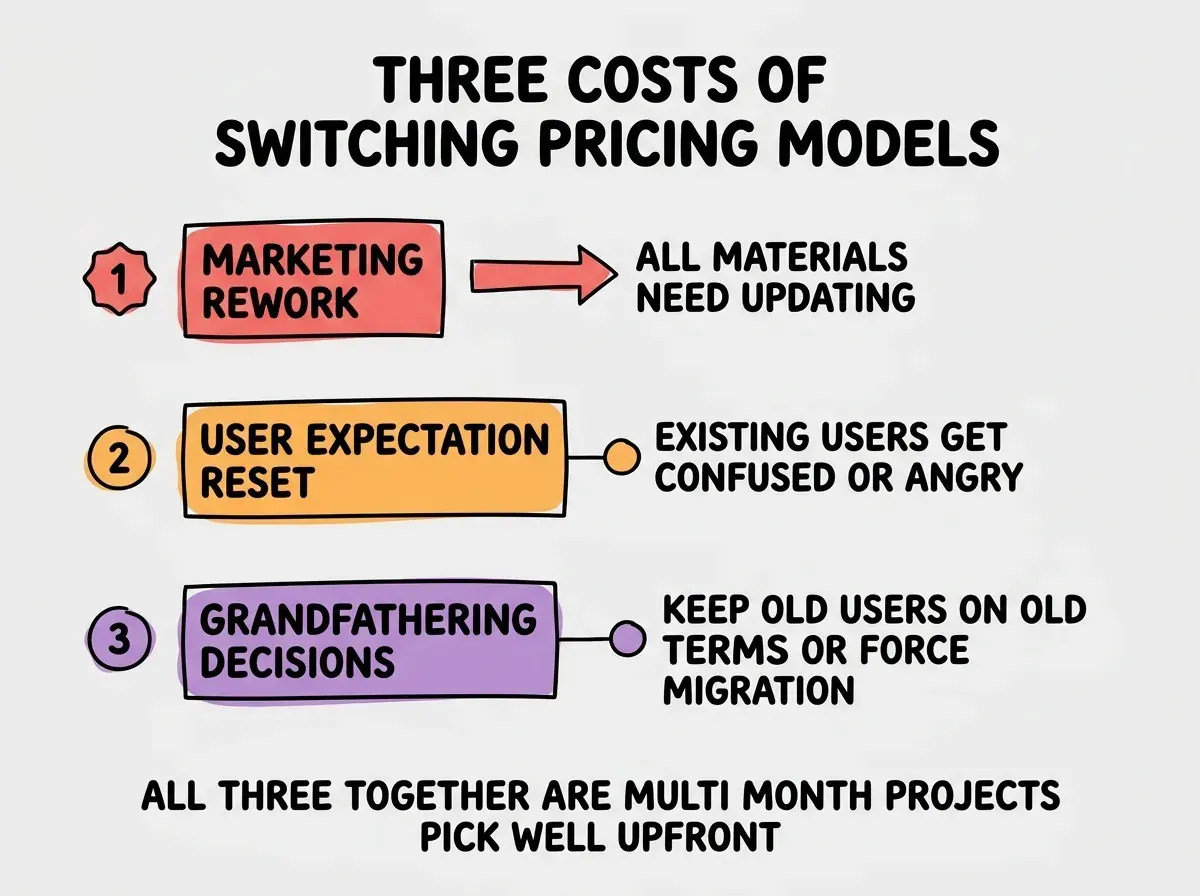
Marketing rework. All landing pages, ads, emails, demo flows need updating. Several weeks of work even for small teams.
User expectation reset. Existing users had specific expectations about what they were paying for and what was free. Changes generate support load and some churn.
Grandfathering decisions. Do you keep existing users on the old terms forever, migrate them all to the new terms, or offer a transition period? Each path has costs and tradeoffs.
The most damaging pricing model mistake is copying the model used by the SaaS company you most admire without understanding why they chose it. Slack uses freemium because of its strong network effects. Notion uses freemium because of its viral collaboration. HubSpot uses free trial for its enterprise tier and freemium for its starter tier; each fits the specific product traits. Copying one of these without analyzing your own product traits leads to the wrong model. Pick based on your product, not based on aspiration.
The other mistake is changing the model based on early conversion data alone. Conversion takes 6 to 12 months to stabilize for most SaaS, and changing the model based on the first 3 months of data often means changing back later when the original model would have worked. Give the model time to prove or disprove itself before switching.
A useful diagnostic before launch is to talk to 10 potential customers and ask how they would expect to try a product like yours. The answer is often unanimous (either "I want to try it free" or "I want a trial period"), and the answer points clearly to one model. Founders who do this exercise are much more likely to pick the right model upfront.
A second diagnostic is to look at the closest 3 competitors and which models they use. If two of three use the same model, that is strong signal that the model fits the category. If they all differ, the choice is more open and depends more on your specific positioning.
A useful pattern for products on the boundary is to launch with the simpler model (usually free trial) for 3 to 6 months, then add freemium as a second option once you have enough data to know what differentiates the users who would pay vs the ones who would not. This sequence preserves optionality without committing to the harder model upfront.
What This Means For You
The free trial vs freemium decision is one of the highest-leverage product decisions for any SaaS. Picking right at launch is dramatically cheaper than fixing it later.
- If you're a founder: Evaluate all four product traits honestly before deciding. Resist the urge to copy a famous SaaS without doing the analysis for your specific product.
- If you're changing careers: Understanding pricing model trade-offs is a great PM skill. Practice on real SaaS products by analyzing why each one chose their model.
- If you're a student: Study the pricing pages of 10 SaaS products you use and identify which trait drove their model choice. The exercise builds intuition you will use repeatedly.
Browse more growth and pricing guides
Read more grow articles