The agency boom in 2026 is real, but it is concentrated in a specific segment: small AI-native agencies (3 to 15 people) growing 80 to 150 percent year over year, while traditional mid-sized digital agencies are flat or declining. The driver is that small agencies can adopt AI workflows fast (often within a quarter), while larger agencies face cultural and process inertia that takes years to overcome. The result is the most rapid market reshaping in the digital agency industry since the dot-com era, with new entrants taking share from established players and clients increasingly choosing the AI-native option.
This piece walks through the data behind the boom, the patterns that distinguish growing agencies from shrinking ones, what clients should look for when hiring an agency in 2026, and the predictions for which segment of the market consolidates by 2027.
What the Numbers Show
Traditional measures of the digital agency market would suggest steady growth around 8 to 12 percent annually. The 2026 reality is much more bimodal. Small AI-native agencies are growing 80 to 150 percent year over year. Traditional agencies of 50+ people are flat or shrinking 5 to 10 percent. The aggregate growth number masks an industry being reshaped underneath.
The reason for the bimodality is structural. AI tools change the underlying production economics of agency work, and the agencies that adopted them quickly captured the gain. Agencies that did not have either lost talent to the AI-native ones or have seen margins compress as clients reset their expectations.
A 2025 Digital Agency Network annual report tracked 2,000 agencies and found that the top decile (almost entirely AI-native agencies of 3 to 15 people) grew an average of 124 percent year over year. The bottom decile (mostly mid-sized traditional agencies) shrank 8 percent. The middle 80 percent grew at the historical industry rate. The variation by agency type is the largest in the 25 years of the report's history.
The pattern to copy is the way the music industry restructured around independent producers in the 2010s. Major labels did not adapt fast enough to digital production tools and lost ground to small studios that did. The labels that survived bought the small studios; the ones that did not adapt or acquire shrank. The agency industry is going through the same compression, just on a faster timeline.
What Distinguishes Winning Agencies
Looking at the agencies in the top decile, four patterns appear consistently. They are not glamorous; they are mostly about discipline and process.
Pattern 1, AI workflow design. Top agencies have explicit per-client AI workflows, context documents, and review processes. They treat the workflow as a competitive advantage and invest in it accordingly.
Pattern 2, value-based pricing. Almost all top agencies have moved off hourly billing to value, outcome, or productized pricing. Agencies still on hourly billing are disproportionately in the bottom half of the distribution.
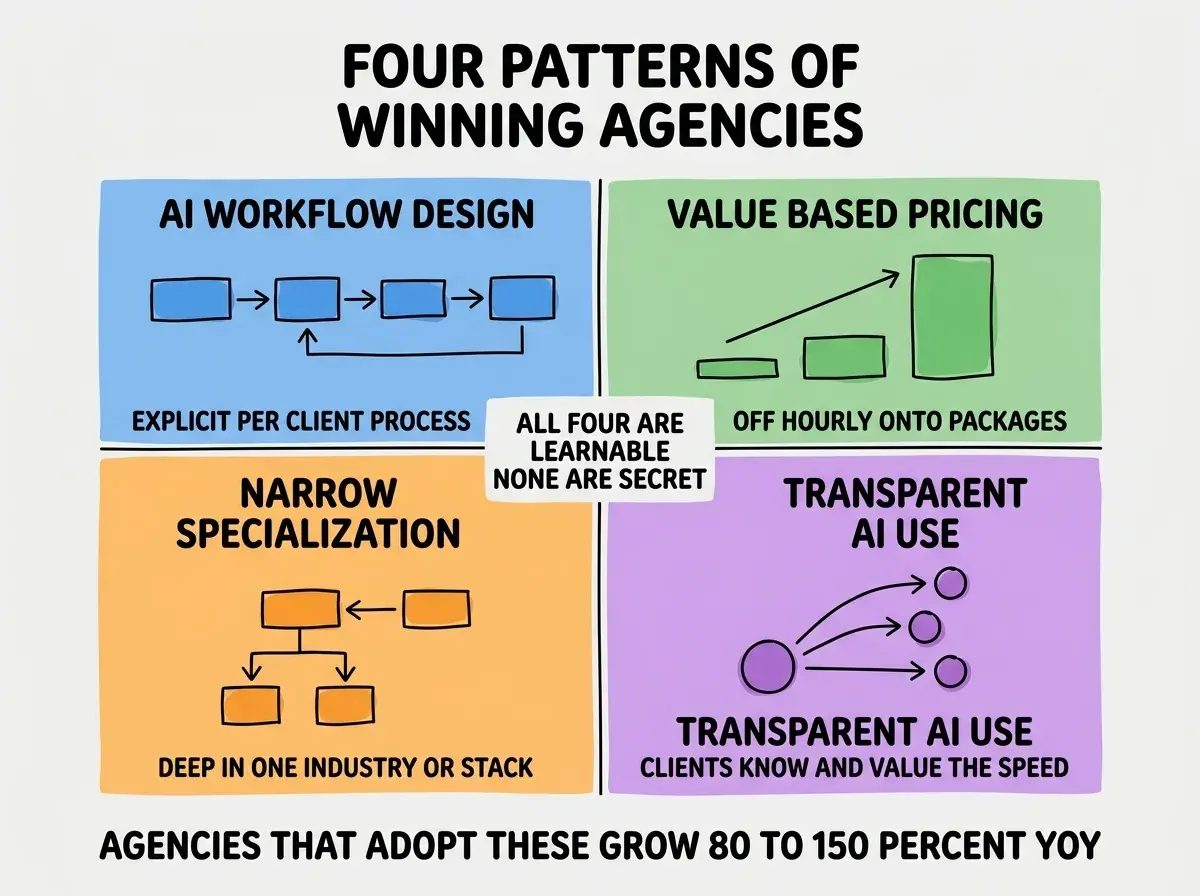
Pattern 3, narrow specialization. Top agencies are deep in one industry (fintech, e-commerce, healthcare) or one stack (Next.js + Supabase, React Native + Firebase). The depth lets them ship faster and price higher.
Pattern 4, transparent AI use. Top agencies tell clients explicitly that they use AI tools and frame it as a speed and quality advantage. Hiding AI use creates fragile relationships; embracing it builds trust.
What This Means for Clients Hiring Agencies
The market shift creates real opportunity for clients who know what to look for. Three signals separate strong agencies from weak ones in 2026.
Signal 1, ask about workflow. A strong agency can describe their per-client workflow, AI context management, and review process in detail. A weak agency talks about "using AI" without specifics.
Browse more analysis on the agency market
Browse pulse articlesSignal 2, ask about pricing model. Hourly pricing in 2026 is a yellow flag. Value-based, productized, or outcome-based pricing is a sign the agency has adapted to AI economics and will not waste your budget on slow billable hours.
Signal 3, ask for a recent case study. Strong agencies can show you a project shipped in the last 6 months that demonstrates their AI workflow producing real client outcomes. Weak agencies show you old case studies from before the AI era.
What 2027 Likely Looks Like
Extrapolating from the current data, three predictions seem likely for the agency market in 2027.
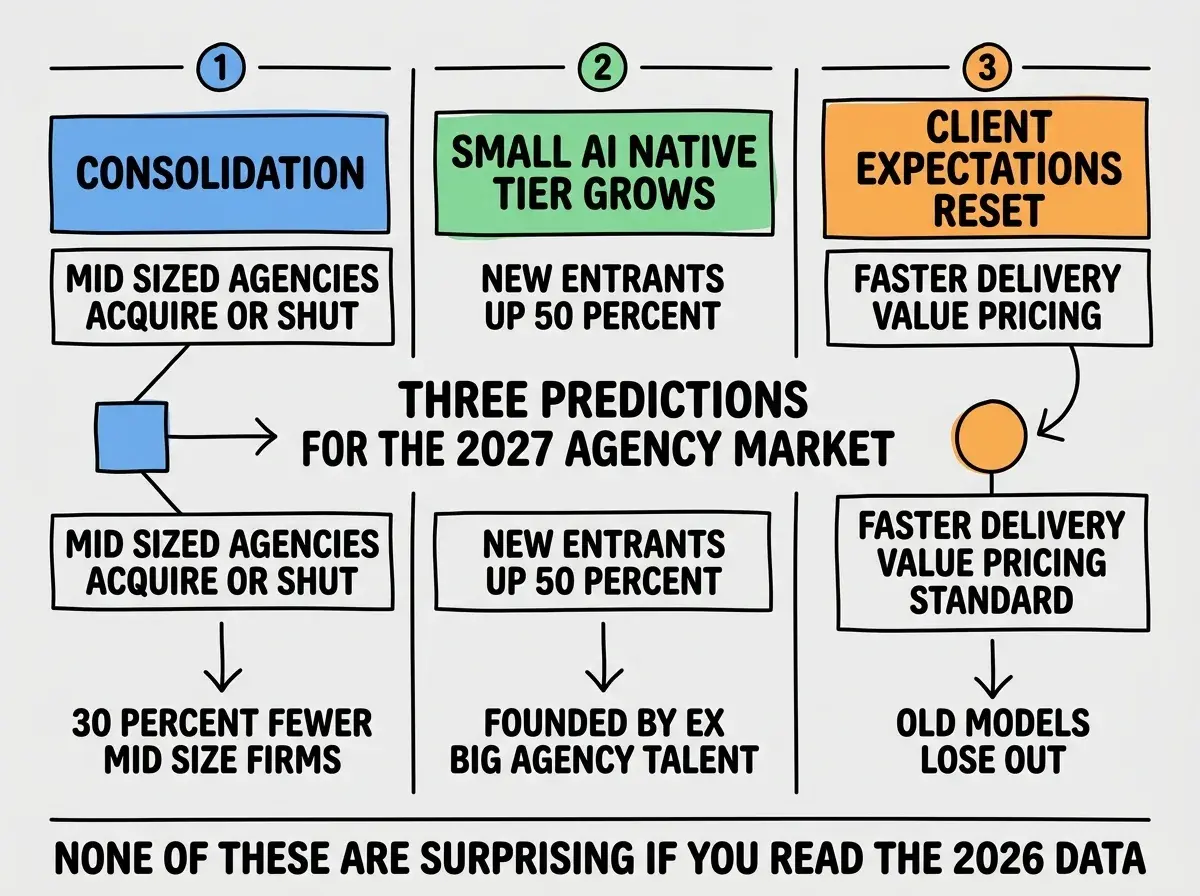
Consolidation among mid-sized agencies. The 50 to 200 person agencies that did not adopt AI fast will either be acquired by larger firms or shut down. Roughly 30 percent fewer mid-sized firms exist by end of 2027.
Small AI-native tier grows. New small agencies (often founded by ex-big-agency talent who left to use AI freely) increase in number by 50 percent. The tier becomes the default for clients who want speed.
Client expectations reset. "Faster delivery, value pricing" becomes the standard expectation for any agency engagement. Hourly billing and slow timelines become deal-breakers for most clients.
The biggest mistake clients make in 2026 when hiring an agency is to default to the largest agency they can find. Larger does not mean better in this market; it often means slower and more expensive for the same outcome. The right approach is to evaluate agencies on workflow, pricing model, and recent case studies regardless of headcount. A 5-person AI-native agency frequently outperforms a 100-person traditional agency on the same project, often at lower cost.
The other mistake agencies make is trying to compete on size. Small agencies that try to grow to mid-sized status to "look bigger" often lose what made them work. Stay small and specialized, or commit to a different growth path; trying to be both rarely works.
A useful exercise for agency leaders is to read the case studies of the top decile agencies and identify which patterns are transferable to your own. Most of the patterns are not unique to a single industry or location; they are process choices that any agency can adopt with deliberate work. The fact that the patterns are public and obvious is itself the opportunity, since most agencies do not act on them despite reading the same articles.
A final point worth noting is that the agency boom is not a one-time event. The pattern of fast-adopting small firms taking share from slow-adopting large ones repeats with each new technology wave. Whatever comes after AI coding tools (agentic engineering, multi-modal coding, something not yet visible) will produce the same dynamic, and agencies that build a culture of fast adoption will be positioned to capture the next wave too.
For clients evaluating agencies, the implication is that adoption velocity is itself a quality signal. An agency that has demonstrably moved fast on AI tools is more likely to move fast on whatever comes next, which protects the value of a multi-year relationship. An agency that is still adapting to AI in 2026 is unlikely to be a leader in whatever the 2028 conversation will be about, and choosing them locks in a slower-moving partner for the duration of the engagement.
What This Means For You
The agency boom is reshaping the digital services market in 2026, and the changes are likely to accelerate through 2027. Knowing the patterns helps both agencies and clients make better decisions.
- If you're a founder: Choose AI-native agencies for speed-to-market projects. The throughput gain is real and matters more than agency size.
- If you're changing careers: Joining or starting a small AI-native agency is one of the highest-upside career moves in 2026. The market is growing and the talent supply is limited.
- If you're a student: Study the workflow design of agencies you admire. The patterns transfer to almost any team you might join.
Browse more analysis on industry trends
Browse pulse articles