92% of US developers now use AI coding tools daily. That number is remarkable. What is even more remarkable is what comes after the builds. 41% of AI-generated code gets reverted within two weeks. That is nearly half of everything AI produces, undone, rolled back, discarded.
Those two numbers sitting next to each other tell you something important. We are all shipping faster than ever, and a lot of what we ship is not working. Testing AI generated code is the bridge between "I built something" and "I built something that works." If you have been skipping this part, you are not alone. But you are leaving yourself exposed in ways that will catch up with you.
This article is your starting point. No advanced frameworks required. No computer science degree needed. Just the mindset shift and practical first steps that separate apps people trust from apps people abandon.
Why AI Makes Testing Both Easier and More Urgent
AI tools can generate tests with 85-95% code coverage automatically. That sounds like testing is solved. It is not, but it is a genuinely useful starting point. Ask your AI tool to write tests for a feature and it will produce a solid set of checks for the obvious scenarios. The form submits correctly. The button shows the right state. The calculation returns the right number.
The problem is the 5-15% that AI consistently misses. That slice is not random. AI tests the happy path, the scenario where everything works as expected. What happens when a user submits an empty form? What happens when the network drops mid-checkout? What happens when someone pastes a 10,000-character string into a field designed for a name?
Those scenarios are edge cases. They are also where apps break in ways that users notice, write reviews about, and tell their friends about. The AI is fast, thorough, and cheap on fundamentals. The edge cases require your judgment.
But there is a second reason testing AI generated code is more urgent than testing hand-written code. When you write code yourself, you understand it. You made every decision. When AI writes code, you are trusting a system that confidently produces plausible-looking solutions, some of which are subtly wrong in ways that do not surface until the wrong moment.
You would not publish a document you had not read. You should not ship code you have not tested.
The Whack-a-Mole Bug Loop Is a Testing Failure
The number one debugging frustration for vibe coders has a name. The whack-a-mole bug loop is what happens when you fix one bug and two more appear. You fix those, three more pop up. The session that was supposed to take twenty minutes turns into three hours of increasingly desperate prompting.
This loop is not a debugging problem. It is a testing problem. Specifically, it is the result of shipping changes without verifying that previous things still work.
Here is what the loop looks like from a testing lens. You add a feature. You do not test it. A bug appears somewhere else. You fix the bug without testing. That fix breaks something you cannot see because you have no test for it. You fix that break. It breaks something else. Each round of fixing adds uncertainty because you have no baseline to compare against.
Automated tests create that baseline. When you run tests after every change, you know immediately if something you were not touching has started failing. You catch the cascade at step one instead of step five. The mole gets whacked before it can multiply.
The fix count also matters as a signal. If you have asked AI to fix the same part of your code more than three times in a single conversation, you are in the loop. Stop, commit what you have, and start a fresh conversation with a precise description of the actual problem. Tests give you the evidence you need to write that precise description.
Three Levels of Testing and Where to Start
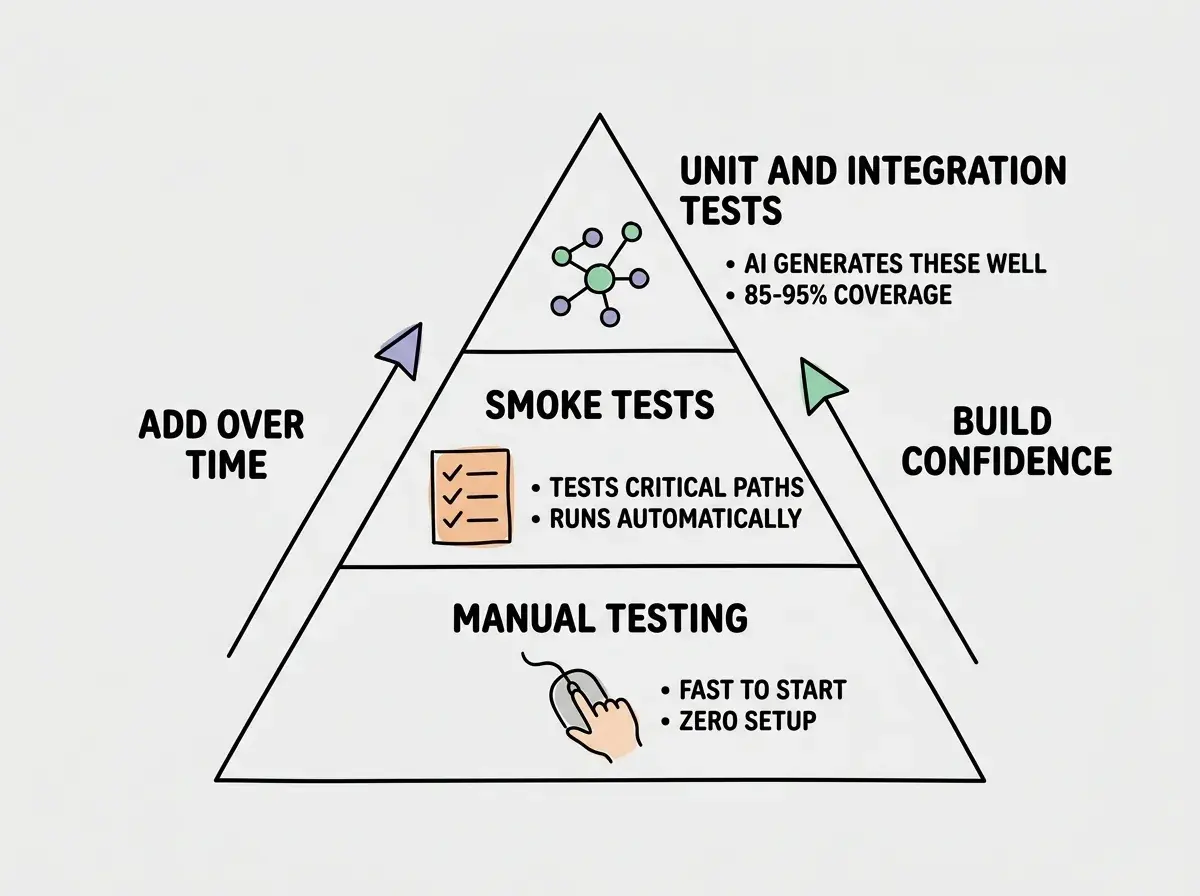
Testing has three levels. Most vibe coders do not need all three immediately. But knowing what the levels are helps you decide what to add first.
Manual testing is the testing you are already doing, probably without calling it that. You open your app, click around, see if things work. This is valid and important, but it does not scale. You cannot manually test every user journey every time you make a change. Manual testing is your first layer, not your only layer.
Smoke tests are the simplest form of automated testing. A smoke test checks that the most critical paths in your app still work after a change. Does the homepage load? Does the login flow complete? Does a purchase go through? These tests take minutes to write and run in seconds. They will not catch everything, but they will catch the breaks that would embarrass you in front of real users.
Unit and integration tests go deeper. Unit tests check individual functions in isolation. Integration tests verify that multiple pieces work together correctly. These are the tests AI tools generate well, and they are where the 85-95% coverage numbers come from. When your app is past the prototype stage and you are relying on it, this level of testing is worth the investment.
Start with smoke tests. Get your critical paths covered. Then let AI generate unit tests for your core logic. Manual testing remains valuable for visual and interaction bugs that automated tools miss.
What Testing Actually Looks Like Day to Day
You do not need to become a QA engineer. You need a lightweight practice that catches problems before users do.
After building a feature, do three things. First, click through the feature yourself, including the failure paths. Try to break it. Submit the form empty. Enter invalid data. Refresh the page in the middle of an action. Second, ask your AI tool to write tests covering both the happy path and edge cases. The specific prompt matters: "write tests for this component including tests for empty inputs, invalid data, network failures, and error states." The phrase "edge cases" is doing real work in that prompt. Third, run the tests before merging or deploying. Most projects use npm test or a similar command. If tests pass, ship with confidence. If they fail, you have caught a problem for free.
This three-step process adds maybe ten to fifteen minutes per feature. It saves hours per week.
One more habit is worth building in from the start. Run your existing tests after every change, not just the tests for the new feature. This is called regression testing. It catches the breaks where your new code unexpectedly affects older code. The whack-a-mole loop becomes much less likely when regressions surface immediately instead of days later.
AI tools generate tests covering 85-95% of standard scenarios automatically. That is a genuine productivity unlock. But the 5-15% they consistently miss is where the most damaging bugs live, edge cases, unusual inputs, race conditions, and error states. Your job is not to write every test yourself. It is to ask for edge case coverage explicitly and to think about the scenarios the AI would not think of.
A Reality Check on the 41% Reversion Rate
41% of AI-generated code gets reverted within two weeks. That is not a statistic about AI being bad. It is a statistic about the gap between "it looks like it works" and "it actually works under real conditions."
Some of that 41% is just exploration, code you tried and then took a different direction. But a meaningful chunk is code that shipped, broke something, and had to be rolled back. Testing cannot prevent every reversion. It can prevent the embarrassing ones, the regressions that hurt real users, the payment flows that silently fail, the auth bugs that lock people out of their accounts.
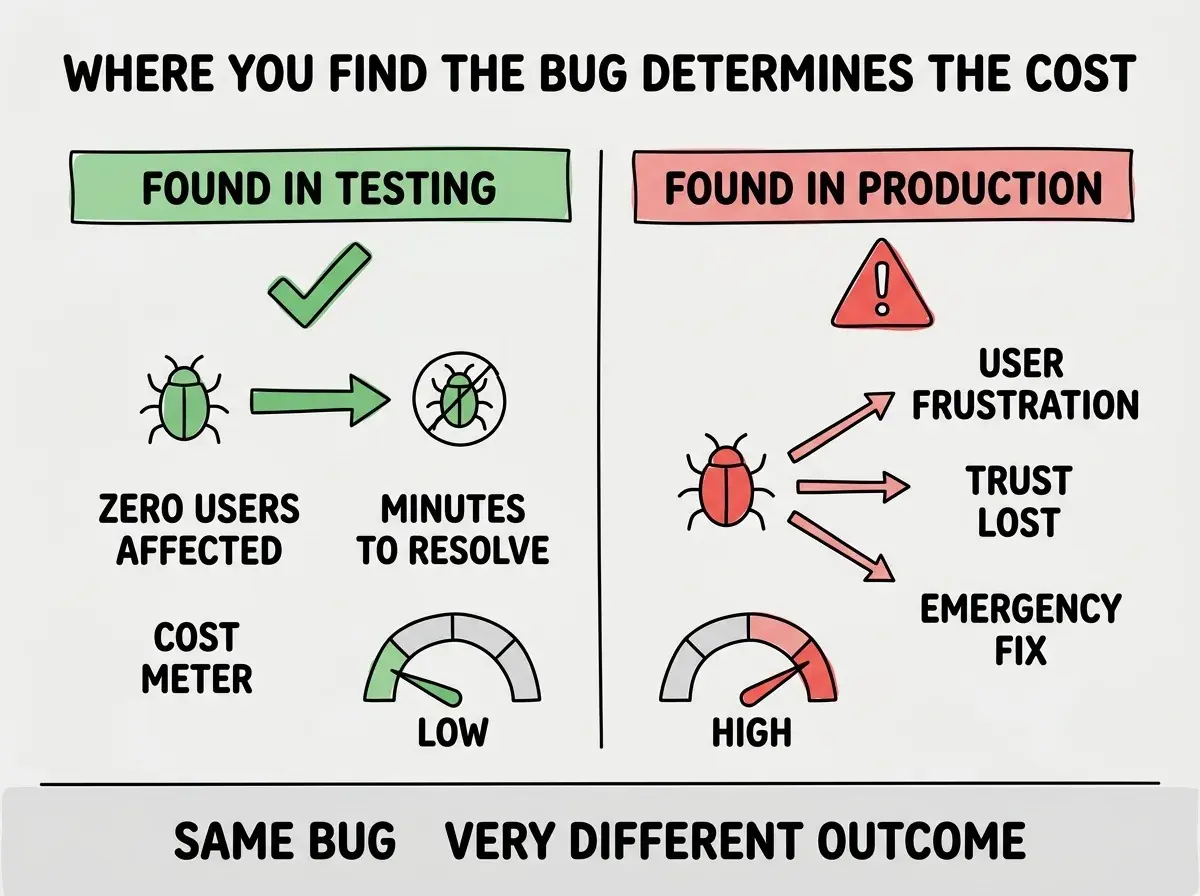
The cost difference between catching a bug in testing and catching it in production is enormous. In testing, you fix it quietly and ship a corrected version. In production, real users experience the failure, lose trust, and sometimes leave. Testing is not about perfection. It is about moving the discovery of problems from a place where it costs you users to a place where it costs you nothing but a few minutes.
Where to Go From Here
Testing is not a single skill you learn once. It is a practice that grows alongside your app. Start small. Manual testing plus smoke tests plus AI-generated unit tests gets most vibe coders 80% of the way there without a major investment.
The goal is not perfect coverage. The goal is a habit of verification before you ship, so that what you put in front of users is something you have actually proven works.
Treating testing as a separate phase that happens after you finish building. By the time most vibe coders think to add tests, the codebase is already complex enough that retrofitting them is painful. The better approach is to ask AI to write tests for each feature as you build it, not in a final cleanup sprint at the end. Ten minutes per feature now beats several hours of coverage work later.
You can start today. Build something, ask AI to write tests for the core logic and edge cases, run them, and see what comes back. That single loop, build, test, review, ship, is how testing becomes part of how you work rather than something you mean to add later.
This is the first article in the testing section. The rest covers manual testing, smoke tests, and reading test output when things fail.
Explore the blogTesting AI generated code is not about proving you are a real developer. It is about proving your app works. Those are different things, and the second one is the only one that matters to your users.
Dig deeper
A few hand-picked sources if you want to go further.
Build the foundational habits that make vibe-coded apps worth trusting.
Read the fundamentals