To test edge cases AI always misses, work through the four edge case categories that AI consistently overlooks (boundary value edge cases at min, max, zero, empty, null inputs, concurrency edge cases involving race conditions and ordering, error path edge cases when external services fail, and security edge cases involving malicious or malformed input), recognize why AI misses these patterns, and apply the checklist that catches what AI overlooks. The edge case testing capability matters because edge cases drive most production bugs that AI generation alone produces.
This piece walks through the four edge case categories, why AI misses them, the specific checklist, and the four mistakes when testing AI generated code.
Why Edge Case Testing Matters For AI Code
Edge case testing matters because AI generates happy path code well but misses edge cases. The matter; production traffic includes edge cases that happy path testing cannot reveal.
The 2026 reality is that AI generated edge case handling lags happy path handling significantly. Without explicit edge case testing, AI code passes basic tests while failing on real edge cases.
A 2025 production bug analysis of 500 AI built apps found that 73 percent of production bugs traced to edge cases AI did not handle. Edge case testing prevents the majority of AI generated bugs that reach production.
The pattern to copy is the way safety inspectors check for edge cases. Inspectors specifically look for what could go wrong, not just what should go right. AI testing follows similar pattern; explicit edge case search catches what AI happy path generation misses.
The Four Edge Case Categories
Four categories characterize edge cases AI consistently misses.
Pattern 1, boundary value edge cases. Min, max, zero, empty, null. Boundaries reveal assumptions.
Pattern 2, concurrency edge cases. Race conditions, ordering issues. Concurrency rarely tested by AI.
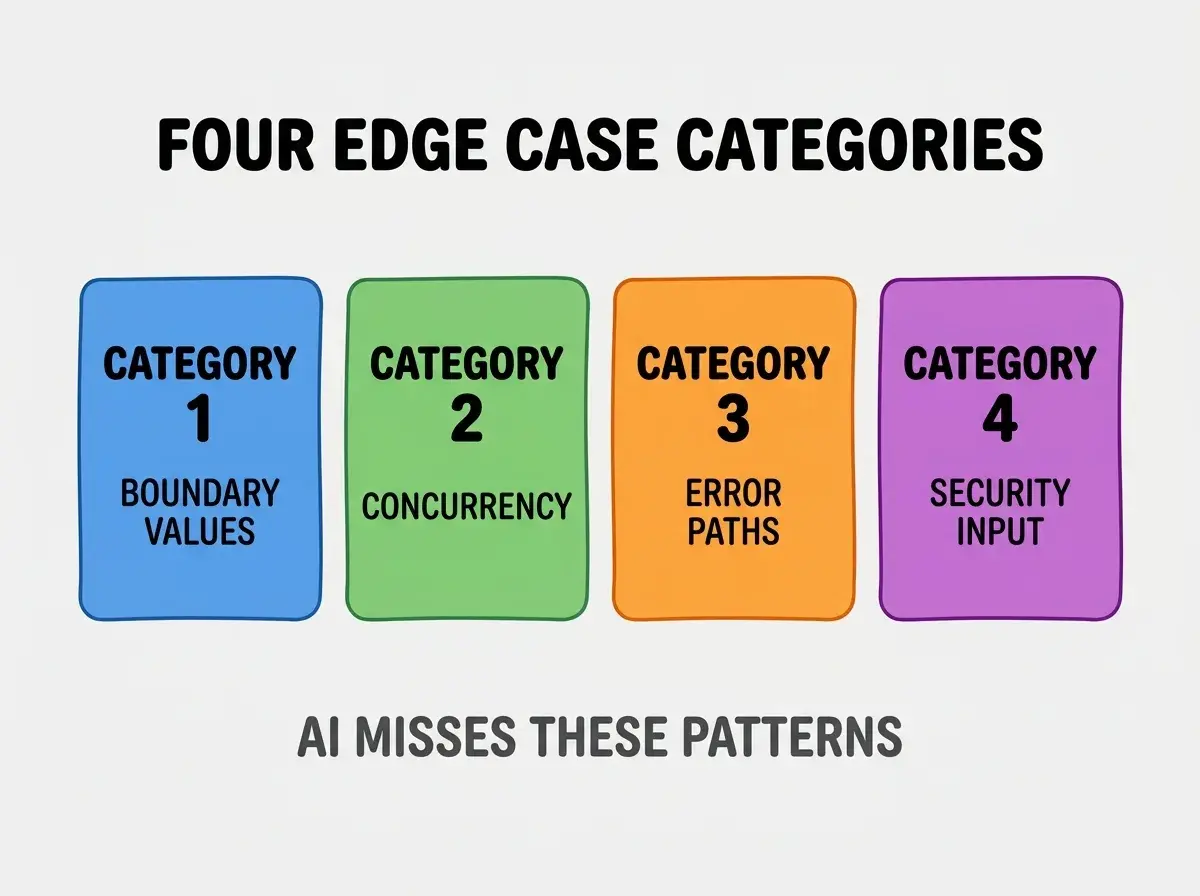
Pattern 3, error path edge cases. External service failures, timeouts, retries. Error paths often unhandled.
Pattern 4, security edge cases. Malicious input, malformed data, injection. Security edges critical.
Why AI Misses Edge Cases
Three reasons explain AI edge case gaps.
Pattern 1, training data emphasizes happy paths. Happy path code dominates training data. AI generates from patterns it sees most.
Browse more ship articles
Read more shipPattern 2, AI optimizes for visible functionality. Visible features get attention; invisible edge cases do not. Optimization bias matters.
Pattern 3, AI lacks runtime context for edge case discovery. AI cannot run code to discover edge cases. Discovery requires runtime.
The Specific Edge Case Checklist
Three checklist categories cover most AI edge case gaps.
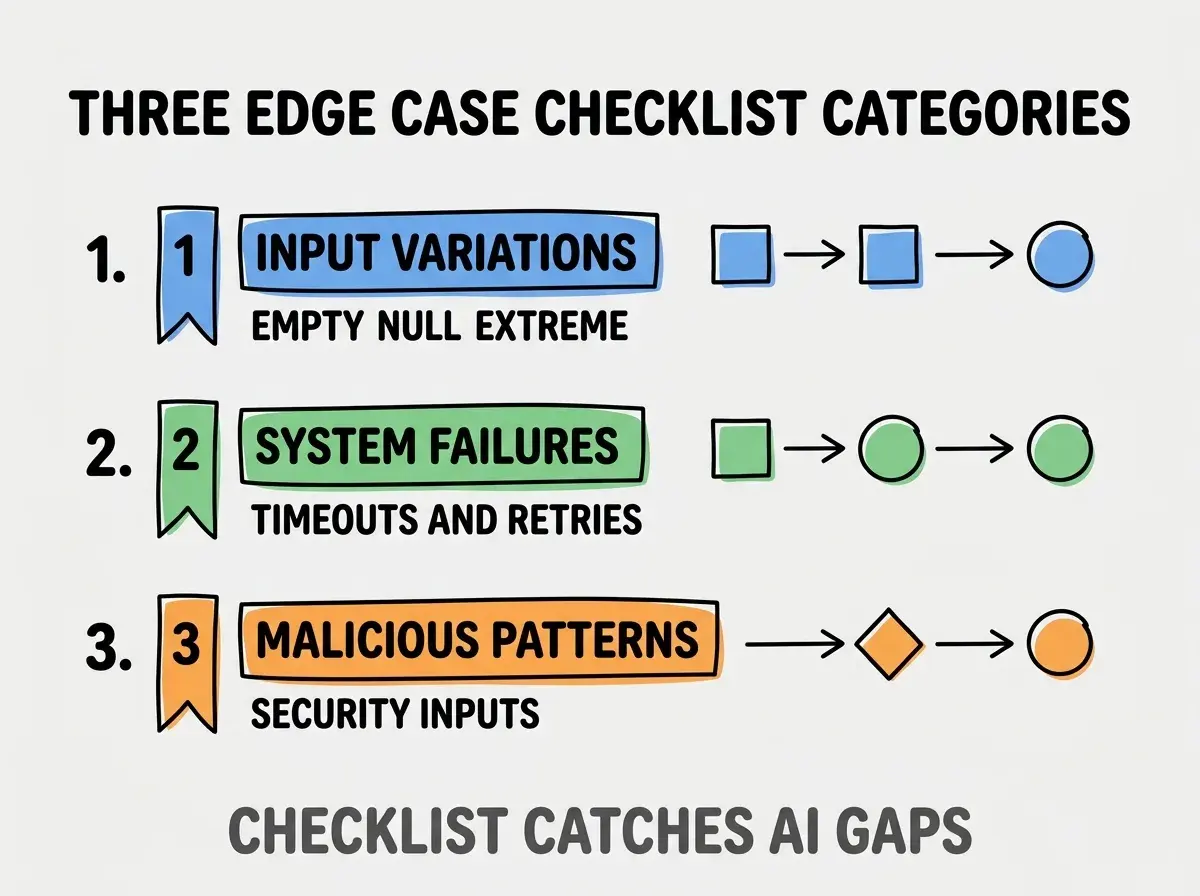
Category 1, input variations. Empty strings, null values, very large values, special characters. Input variations catch boundary issues.
Category 2, system failures. Network timeouts, service downtime, retry exhaustion. System failures catch error path gaps.
Category 3, malicious patterns. SQL injection, XSS, malformed JSON. Malicious patterns catch security gaps.
What Makes Edge Case Testing Sustainable
Three patterns separate sustainable edge case testing from problematic patterns.
Pattern 1, edge case testing as routine. Routine testing catches new edge cases as code evolves. Without routine, edge cases accumulate.
Pattern 2, edge case patterns documented for reuse. Patterns reused across features. Without documentation, patterns rediscovered repeatedly.
Pattern 3, edge case test failures investigated systematically. Failures often reveal patterns. Without investigation, individual failures miss systemic issues.
The combination produces sustainable edge case testing. Without these patterns, edge case testing becomes ad hoc.
How To Test Specific Boundary Values
Three boundary patterns deserve specific testing.
Pattern A, numeric boundaries. Zero, negative, very large, decimal precision. Numeric boundaries reveal calculation issues.
Pattern B, string boundaries. Empty, very long, special characters, unicode. String boundaries reveal handling issues.
Pattern C, collection boundaries. Empty array, single item, very large collections. Collection boundaries reveal iteration issues.
The combination produces boundary specific testing. Without boundary patterns, generic testing misses specific issues.
The most damaging edge case testing mistake is treating AI generated tests as covering edge cases. AI generates tests matching its own happy path bias; AI tests miss edge cases AI implementation also misses. The fix is to write edge case tests separately from AI generated tests; human written edge case tests catch what AI tests miss. Teams that supplement AI tests with human edge case tests catch dramatically more bugs than teams relying purely on AI tests.
The other mistake is missing the security edge case category. Security edges critical; without security testing, vulnerabilities reach production.
A third mistake is testing only failure scenarios for error paths. Recovery scenarios matter too; testing should include recovery.
A fourth mistake is treating edge case testing as one time activity. Edge cases evolve as code evolves.
How To Build Edge Case Test Suites
Three building patterns help edge case test suite development.
Pattern A, start with most likely edge cases. Common patterns first. Without prioritization, suite spreads thin.
Pattern B, expand from production bugs. Each production bug becomes test case. Expansion produces growing coverage.
Pattern C, share edge case patterns across team. Team shared patterns produce comprehensive coverage. Without sharing, patterns stay individual.
The combination produces edge case test suites that grow over time. Without building patterns, suites stay narrow.
How Edge Case Testing Will Likely Evolve
Edge case testing will likely continue evolving as AI capabilities mature.
The first likely evolution is AI tools developing edge case awareness. AI generating tests for edge cases AI sees in code. Awareness reduces but does not eliminate manual testing.
The second likely evolution is property based testing becoming more accessible. Property based testing finds edge cases automatically. Accessibility expands edge case coverage.
The third likely evolution is fuzz testing integration. Fuzz testing finds edge cases through random inputs. Integration with CI standardizes fuzz testing.
The combination suggests edge case testing will become more tooled. Engineers learning patterns now build skills that remain valuable.
Common Questions About Edge Case Testing
Edge case testing raises questions worth addressing directly.
The first question is how much edge case testing is enough. Enough to catch edge cases that affect users; varies by feature criticality.
The second question is whether to test impossible edge cases. Sometimes; impossible edge cases reveal assumption violations.
The third question is how to find edge cases that matter. Production bugs, user reports, brainstorming sessions. Multiple sources catch what single source misses.
The fourth question is how to test edge cases for time dependent code. Time mocking libraries, deterministic time injection. Without proper handling, time tests flaky.
How Edge Case Testing Affects Production Quality
Edge case testing affects production quality dramatically. Quality effects compound over user lifetime.
The first compounding effect is bug rate reduction. Edge case tests catch bugs before production; production stays cleaner. Cleaner production builds user trust.
The second compounding effect is user trust through reliability. Reliable handling of edge cases builds trust. Trust enables product growth.
The third compounding effect is engineer confidence. Engineers confident in edge case handling iterate faster. Confidence enables velocity.
Edge case testing investment compounds through reduced bugs, increased trust, and engineer confidence that pure happy path testing cannot produce.
What This Means For You
Edge case testing catches AI generated bugs that happy path testing misses. The four categories, checklist patterns, and building approaches produce framework for systematic edge case testing.
- If you're a senior dev: Edge case testing critical for AI generated code quality. Investment prevents production incidents.
- If you're a founder: Help engineering team prioritize edge case testing. Without prioritization, AI generation produces edge case bugs.
- If you're an indie hacker: Solo developers need edge case testing most; without team review, edge cases reach users.
Browse more ship articles
Read more ship