To decide how much testing is enough for your AI built project, apply the four testing investment criteria (risk of bugs reaching users, cost of bugs that reach users, complexity of features being tested, and team capacity for testing maintenance), see how the criteria combine into practical framework, and apply the framework that produces appropriate testing investment. The how much question matters because both under testing and over testing waste resources; appropriate testing produces better outcomes than either extreme.
This piece walks through the four investment criteria, the practical framework, the specific testing patterns by feature type, and the four mistakes when deciding testing investment.
Why Testing Investment Decisions Matter
Testing investment decisions matter because testing consumes substantial development capacity. The matter; appropriate investment produces sustainable quality while inappropriate investment either wastes resources or produces quality crises.
The 2026 reality is that AI tools can generate tests faster than humans can write them, but generated tests vary in quality. Without explicit framework for how much testing matters, AI generated test volume often exceeds value while leaving important coverage gaps.
A 2025 software quality study of 400 production teams found that teams with explicit testing investment frameworks achieved equivalent quality with 38 percent less testing effort compared to teams without frameworks. The difference reflects how much waste comes from undirected testing investment.
The pattern to copy is the way insurance underwriters set premiums. Premiums match risk; same coverage costs different amounts based on risk profile. Testing follows similar pattern; different features deserve different testing investment based on risk profile rather than uniform investment.
The Four Investment Criteria
Four criteria characterize testing investment decisions.
Criterion 1, risk of bugs reaching users. Frequency of similar bugs in past, complexity of code, change rate. Risk drives investment level.
Criterion 2, cost of bugs that reach users. Customer impact, business impact, recovery cost. Cost determines investment ceiling.
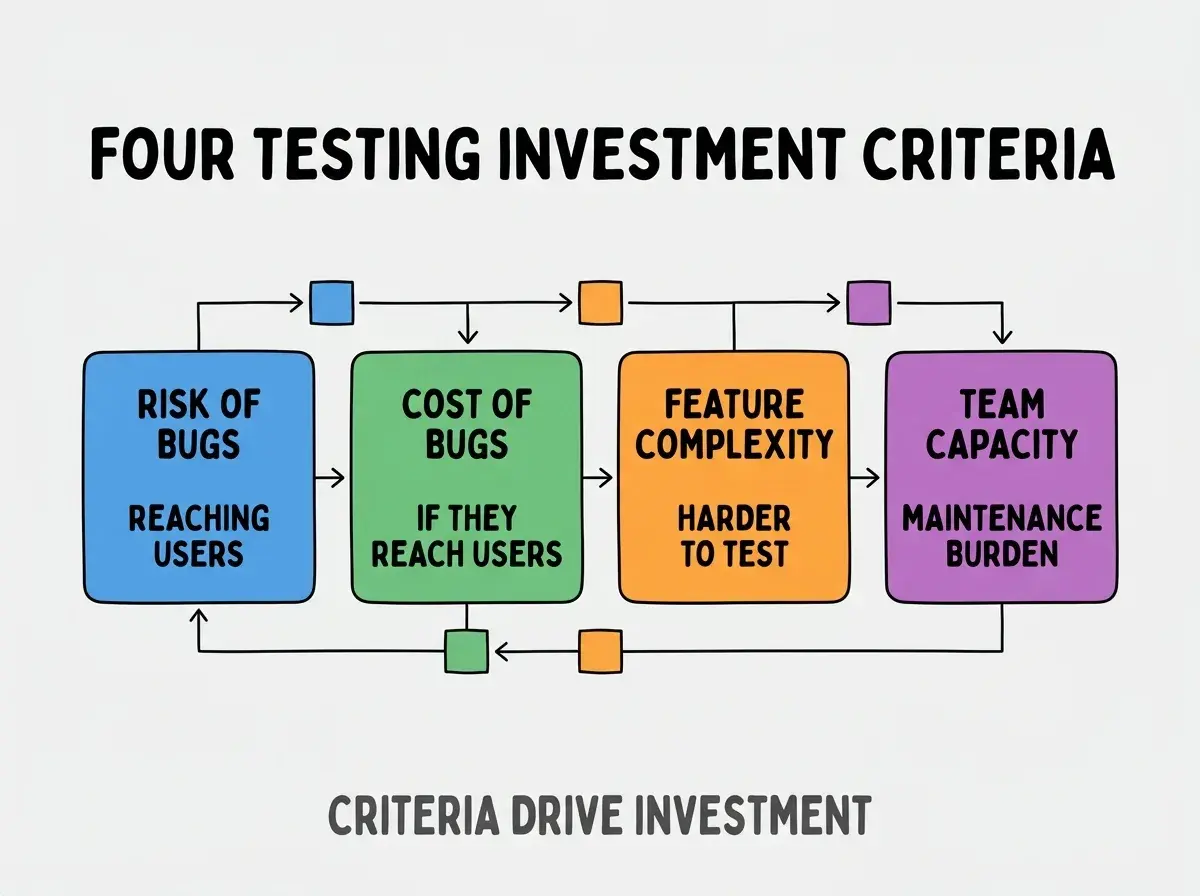
Criterion 3, complexity of features being tested. Simple features need simple tests; complex features need complex tests. Complexity drives test design.
Criterion 4, team capacity for testing maintenance. Tests require maintenance; capacity limits sustainable test count. Capacity caps investment.
How The Framework Combines Criteria
Three patterns combine criteria into practical framework.
Pattern 1, high risk plus high cost equals high investment. Critical features deserve substantial testing. Investment matches consequence of failure.
Browse more ship articles
Read more shipPattern 2, low risk plus low cost equals low investment. Cosmetic features deserve minimal testing. Investment matches actual stakes.
Pattern 3, complexity adjusts within risk plus cost matrix. Complex features within high risk plus cost get more sophisticated tests. Complexity refines investment type.
What Specific Testing Patterns By Feature Type
Three feature categories deserve specific testing patterns.
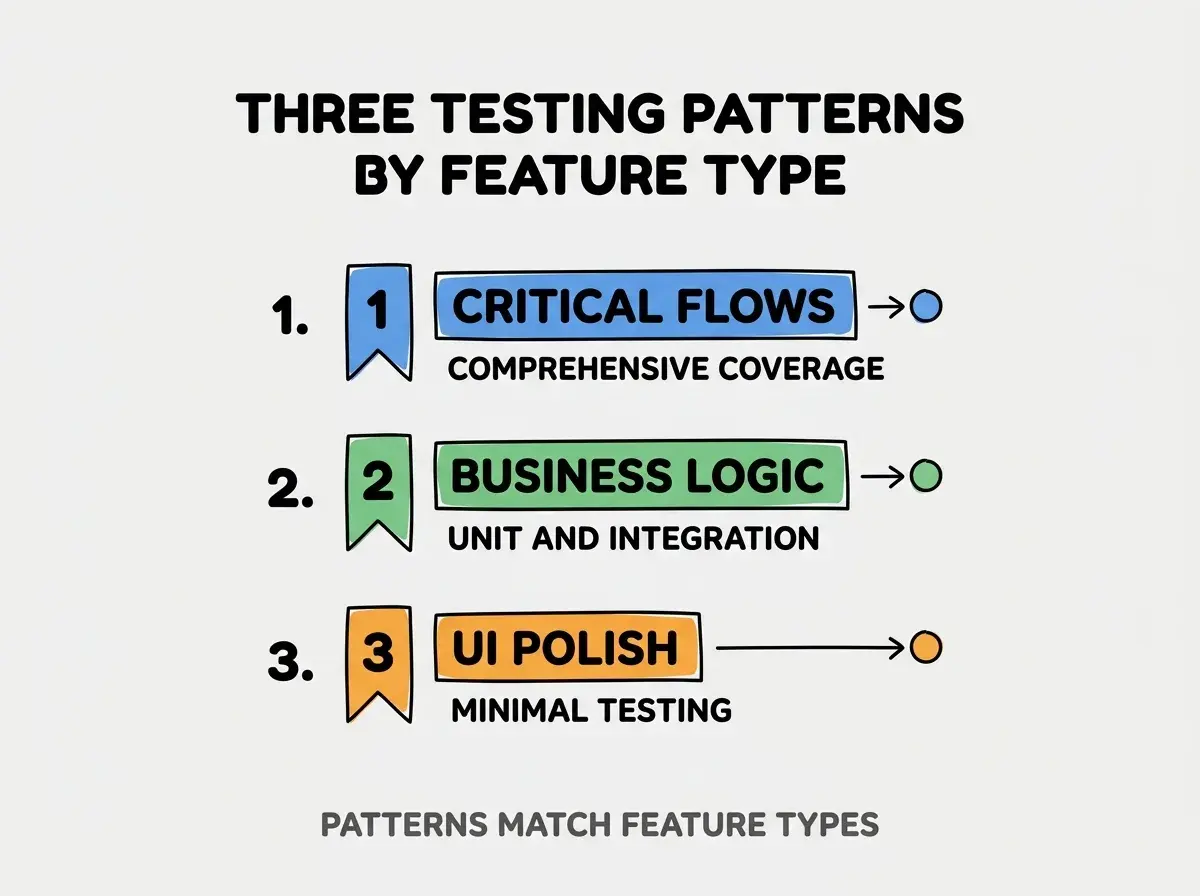
Pattern 1, critical user flows with comprehensive testing. Login, payment, core actions. End to end tests, edge cases, error handling all matter.
Pattern 2, business logic with unit plus integration testing. Calculations, validations, transformations. Unit tests for logic, integration tests for data flow.
Pattern 3, UI polish with minimal automated testing. Animations, layouts, visual elements. Manual testing often sufficient; automated tests often expensive without commensurate value.
What Makes Testing Decisions Sustainable
Three patterns separate sustainable testing decisions from problematic patterns.
Pattern 1, regular review of testing investment alignment. Quarterly review of test value relative to maintenance cost. Without review, tests accumulate beyond value.
Pattern 2, removing tests that produce more cost than value. Stale tests, low value tests, redundant tests deserve removal. Without removal, test suite degrades over time.
Pattern 3, AI assisted test maintenance reducing burden. AI helps update tests when features change. Without AI assistance, maintenance burden caps investment.
The combination produces testing investment that scales sustainably. Without these patterns, testing either becomes inadequate or unsustainable.
How To Calibrate Testing Investment Initially
Three calibration patterns help teams calibrate testing investment.
Pattern A, start with critical flows comprehensive testing. Critical flows get most investment first. Other testing builds on critical flow foundation.
Pattern B, add business logic testing as features stabilize. Stable features benefit most from unit tests. Unstable features waste tests through churn.
Pattern C, defer UI testing until UI stabilizes. UI changes frequently early; defer automated testing until UI stabilizes. Stability matters for test sustainability.
The combination produces calibration matched to project lifecycle. Without lifecycle awareness, testing investment often misaligns with project state.
The most damaging testing investment mistake is applying uniform testing standards across all features. Uniform standards either over invest in low risk features or under invest in high risk features. The fix is to apply differentiated standards based on risk and cost; high stakes features deserve more testing while low stakes features need less. Teams that differentiate produce better outcomes than teams that apply uniform standards regardless of feature characteristics.
The other mistake is treating coverage percentage as testing goal. Coverage percentage measures test quantity not quality. The fix is to focus on critical path coverage rather than aggregate percentage.
A third mistake is generating tests with AI without quality review. AI generated tests vary in quality; without review, low quality tests accumulate.
A fourth mistake is missing test maintenance time in capacity planning. Tests require maintenance; without planning, maintenance burden eventually overwhelms team.
How To Decide Specific Test Types
Three test types deserve specific decision frameworks.
Type A, end to end tests for critical user flows. Worth investment when flows justify; expensive when applied broadly. Reserve for highest value flows.
Type B, unit tests for business logic. Cheap to write, fast to run, valuable for stable logic. Default to unit tests for logic.
Type C, integration tests for system boundaries. Worth investment when boundaries matter; expensive when applied to everything. Apply to important boundaries.
The combination produces test type decisions matched to test characteristics. Without type specific frameworks, generic testing produces suboptimal outcomes.
How Testing Investment Will Likely Evolve
Testing investment patterns will likely evolve as AI capabilities mature.
The first likely evolution is AI generated test quality improving. Better tests generated automatically. Improvement reduces manual test writing burden.
The second likely evolution is AI assisted test maintenance becoming standard. AI updates tests when features change. Standardization reduces maintenance burden.
The third likely evolution is testing intent specification replacing test writing. Specifying what to test rather than writing tests. Specification reduces effort while increasing coverage.
The combination suggests testing investment will become more accessible. Engineers learning frameworks now build skills that remain valuable as AI evolves.
Common Questions About Testing Investment
Testing investment raises questions worth addressing directly.
The first question is whether AI generated tests count toward coverage goals. Yes if quality reviewed; no if quality unverified. Coverage means little without quality.
The second question is whether to test private implementation details. Generally no; test public behavior not implementation. Implementation tests break with refactoring while behavior tests survive.
The third question is whether to test simple getters and setters. Generally no; cost exceeds value. Reserve testing for behavior that matters.
What This Means For You
Testing investment decisions affect both quality and capacity. The four criteria, framework patterns, and feature specific approaches produce framework for appropriate testing investment.
- If you're a senior dev: Apply differentiated testing standards based on feature risk and cost. Differentiated investment produces better outcomes than uniform investment.
- If you're a founder: Help engineering team prioritize testing for high stakes features. Without prioritization, testing spreads thin across all features.
- If you're an indie hacker: Solo builders need testing efficiency dramatically. Apply framework to focus testing investment on highest value features.
Browse more ship articles
Read more ship