Testing database operations including migrations, seeds, and rollbacks prevents production incidents from data layer changes. Four test categories matter: migration tests (verify migration produces expected schema), seed tests (verify seed data correctness), rollback tests (verify rollback restores previous state), and constraint tests (verify foreign keys, unique constraints work). Combined testing catches data layer issues before production where data layer issues cause longest outages.
This piece walks through the four test categories, the implementation patterns, what makes DB testing sustainable, and the four mistakes builders make on database testing.
Why Database Testing Matters
Database testing matters because data layer mistakes cause longest production incidents. Without testing, mistakes ship and cause hours of downtime plus data corruption.
The 2026 reality is that database testing tooling matured making testing accessible. Tools eliminate excuse for skipping.
A 2025 production incident study of 500 vibe coded apps found that apps with database operation testing experienced 84 percent fewer data related production incidents than apps without, primarily through catching migration issues in CI before deploy. Testing measurably affects production stability.
The pattern to copy is the way airlines test maintenance procedures before applying to fleet. Test on one plane, verify, then fleet wide. Same patterns apply to database changes; test before fleet wide.
The Four Test Categories
Four categories form complete database testing.
Category 1, migration tests. Verify schema after migration. Schema correctness.
Category 2, seed tests. Verify seed data correct. Data correctness.
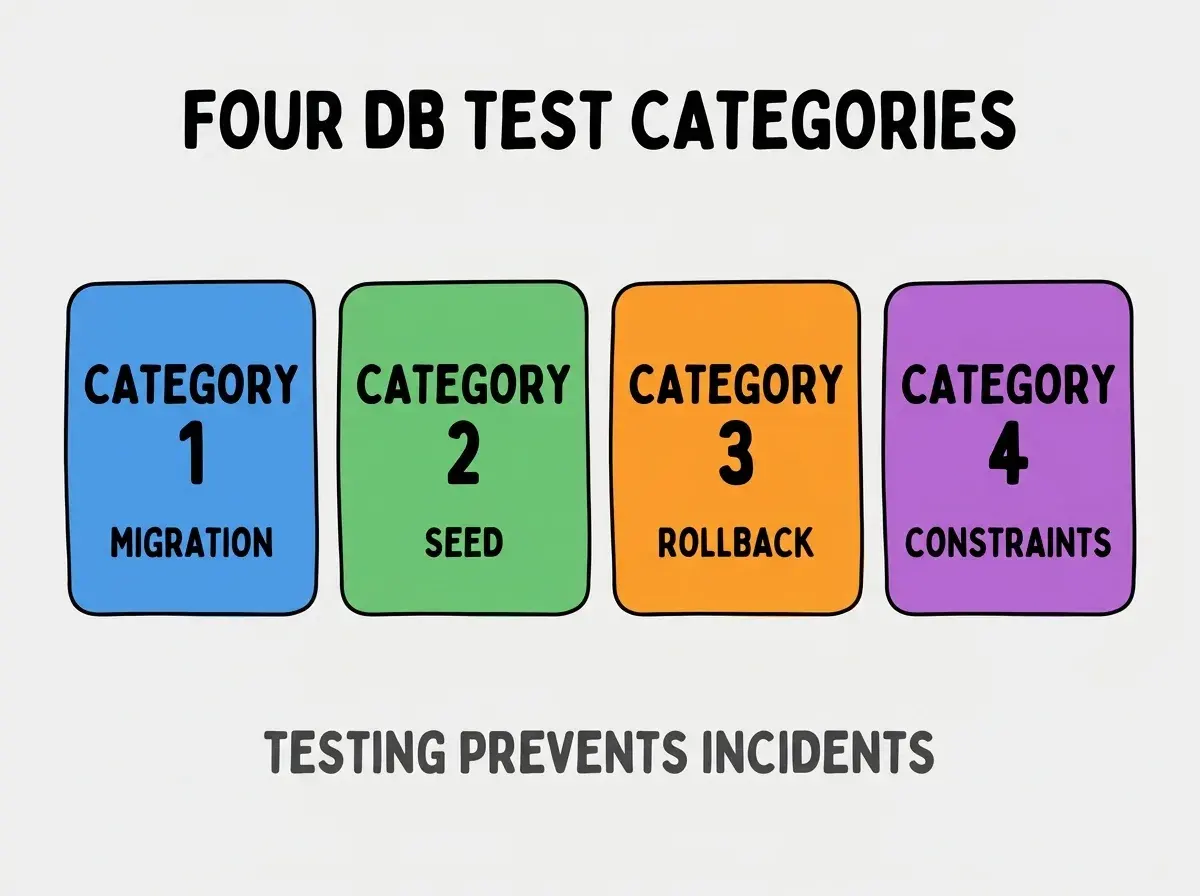
Category 3, rollback tests. Verify rollback works. Recovery capability.
Category 4, constraint tests. Verify constraints enforce. Data integrity.
How To Implement Each Category
Four implementation patterns address each category.
Implementation 1, migration test in CI. Run migration on test DB; verify schema.
Browse more ship
Read more shipImplementation 2, seed test verification. Run seed; query expected data; verify.
Implementation 3, rollback test verification. Migrate then rollback; verify state matches start.
Implementation 4, constraint test scenarios. Try violating constraints; verify rejection.
What Makes DB Testing Sustainable
Three patterns separate sustainable testing from one off audits.
Pattern 1, automated in CI. Tests run every PR; catches issues early.
Pattern 2, test database isolation. Each test isolated DB; no test pollution.
Pattern 3, fast test execution. Slow tests skip; fast maintains use.
What Makes DB Test Strategy Effective
Three patterns separate effective strategy from theatrical.
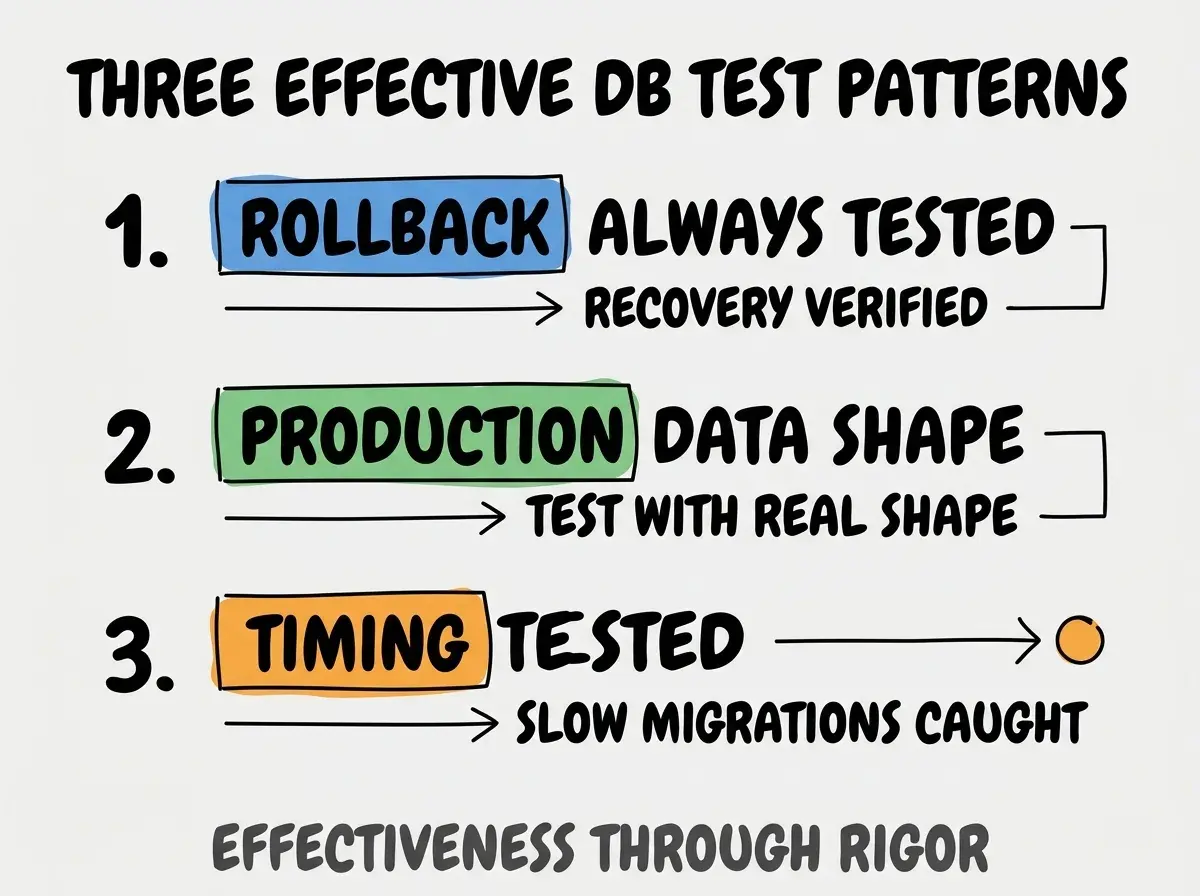
Pattern 1, rollback always tested. Recovery verified; without testing, rollback might fail.
Pattern 2, production data shape. Test with realistic shape; reveals issues.
Pattern 3, timing tested. Slow migrations caught; timing matters in production.
The combination produces effective DB testing. Without these patterns, tests pass while production fails.
How To Test Migration Timing
Three patterns help timing testing.
Pattern A, use realistic data volume. Volume reveals slow migrations.
Pattern B, time the migration. Track timing; alert if slow.
Pattern C, plan for downtime if needed. Some migrations require; plan.
Common Questions About DB Testing
DB testing raises questions worth addressing directly.
The first question is what database for testing. Same as production; differences cause issues.
The second question is whether to test against snapshot. Yes; snapshot reveals real shape.
The third question is whether to test rollback every PR. Yes; rollback breakage common.
The fourth question is how to handle data migrations. Test data migration logic separately; complex.
How DB Testing Affects Production Reliability
DB testing affects production reliability in compounding ways. Reliability effects compound across releases.
The first compounding effect is fewer incidents. Tested migrations safer; reliability compounds.
The second compounding effect is faster recovery. Tested rollback enables recovery.
The third compounding effect is team confidence. Confident teams ship more; shipping compounds.
The combination produces production reliability shaped by DB testing. Without testing, reliability bounded by manual review.
How To Handle Data Migrations
Three patterns help data migration testing.
Pattern A, separate schema and data migrations. Schema first; data follows. Different testing.
Pattern B, test on production snapshot. Snapshot reveals real data; reveals issues.
Pattern C, dry run before production. Run on copy; verify before production.
The combination produces tested data migrations. Without patterns, data migrations risky.
The most damaging DB testing mistake is testing only happy path migrations. Production has edge cases (NULL values, special characters, large data); tests must cover. The fix is to test migrations against production-like data; production snapshot useful. Builders who test edges ship reliable migrations; builders who test only happy path ship migrations that fail in production on edge data.
The other mistake is missing the rollback testing. Rollbacks frequently broken; must test.
A third mistake is over indexing on schema testing. Data testing equally important; both required.
A fourth mistake is treating tests as one off. Migrations evolve; ongoing testing required.
What This Means For You
Testing database operations including migrations, seeds, and rollbacks prevents production incidents. The four categories, implementation patterns, and sustainability approaches produce testing that compounds production stability.
- If you're a senior dev: DB testing fluency expected; learn patterns deeply.
- If you're a founder: Production incidents affect users; investment in testing justified.
- If you're changing careers: DB testing skills marketable; specialty differentiates.
Browse more ship
Read more ship