Teaching AI coding responsibly requires four pedagogical principles that prevent AI from short circuiting learning while preparing students for AI assisted careers. The principles are explicit AI use policies per assignment, fundamental skills built before AI tools, judgment evaluation as primary assessment, and AI collaboration as core skill. Educators applying these principles produce students who use AI well; educators avoiding them produce students who depend on AI without understanding it.
This piece walks through the four pedagogical principles, why each matters, how to implement them, and the four mistakes educators make when teaching AI coding.
Why Responsible AI Teaching Matters
Responsible AI teaching matters because students who learn AI coding poorly become workers who use AI poorly. Educators shape practice; practice shapes industry.
The 2026 reality is that AI coding instruction varies enormously across institutions. Variance produces graduates with different capabilities; some prepared, some unprepared.
A 2025 educator survey of 200 CS instructors found that instructors using deliberate AI coding pedagogy produced students who scored 47 percent higher on AI judgment assessments than instructors using ad hoc approaches. Pedagogy matters dramatically for student outcomes.
The pattern to copy is the way medical schools teach evidence based medicine. Students learn to use diagnostic tools while building underlying medical knowledge; tools amplify knowledge rather than replace it. AI coding education works the same way; tools amplify fundamentals when fundamentals exist.
The Four Pedagogical Principles
Four principles guide responsible AI coding teaching.
Principle 1, explicit AI use policies per assignment. Each assignment specifies whether AI use allowed, encouraged, or prohibited. Clarity prevents confusion.
Principle 2, fundamental skills built before AI tools. Foundational skills (data structures, algorithms, debugging) taught before AI tools amplify them.
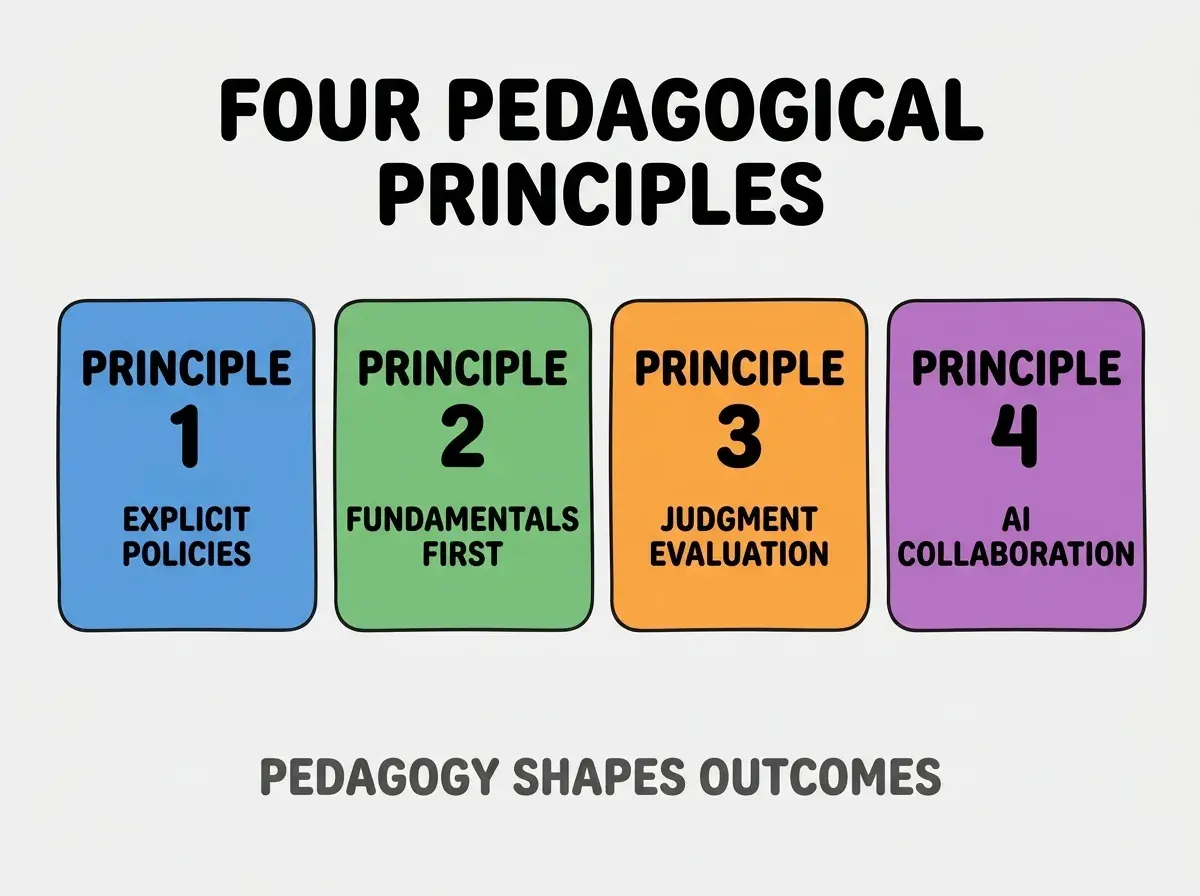
Principle 3, judgment evaluation as primary assessment. Assessment evaluates judgment about AI output, not just final code.
Principle 4, AI collaboration as core skill. Effective AI collaboration is teachable skill; teaching it explicitly builds capability.
Why Each Principle Matters
Four reasons explain principle importance.
Reason 1, policies prevent confusion and unfair advantage. Without policies, students guess; guessing produces inconsistency and ethics issues.
Browse more foundations
Read more foundationsReason 2, fundamentals enable AI productivity. Students without fundamentals hit ceiling using AI; ceiling limits career.
Reason 3, judgment matters more than code in industry. AI generates code; humans judge. Industry rewards judgment.
Reason 4, AI collaboration is professional skill. Workplaces expect AI use; teaching collaboration prepares students.
How To Implement Each Principle
Four implementation patterns make principles practical.
Implementation 1, AI policy per syllabus and per assignment. Top of syllabus and top of assignment both specify policy. Clarity through repetition.
Implementation 2, fundamentals taught AI free initially. First weeks of course AI free; AI introduced after fundamentals established.
Implementation 3, assessment includes process and judgment. Code submission plus reasoning explanation; both evaluated.
Implementation 4, AI collaboration taught explicitly. Lessons on prompting, evaluating output, iterating. Skill teaching explicit.
What Makes AI Pedagogy Sustainable
Three patterns separate sustainable AI pedagogy from one off experiments.

Pattern 1, update with tool evolution. AI tools evolve rapidly; pedagogy must evolve too.
Pattern 2, share practices with peer educators. Peer sharing accelerates pedagogy maturity beyond individual experimentation.
Pattern 3, involve students in policy development. Student input produces policies that work; buy in matters.
The combination produces sustainable AI pedagogy. Without these patterns, pedagogy drifts.
How To Handle AI Use In Assessments
Three patterns handle AI in assessment contexts.
Pattern A, in class assessments AI free. Verify foundational skills without AI assistance. Assessments demonstrate mastery.
Pattern B, take home assessments AI permitted with attribution. Students attribute AI contribution; attribution enables judgment evaluation.
Pattern C, oral defenses for major projects. Students explain decisions; explanation reveals understanding regardless of AI use.
Common Questions About AI Teaching
Teaching AI coding raises questions worth addressing directly.
The first question is whether to ban AI in introductory courses. Mostly no; explicit AI integration prepares students. Brief AI free units for fundamentals work.
The second question is how to detect AI generated student work. Detection unreliable; better to design assessments that work with AI use.
The third question is whether AI changes what should be taught. Yes; emphasis shifts from syntax memorization to systems thinking and judgment.
The fourth question is whether AI tools should be required. Cost considerations matter; free tier tools enable required use without burdening students.
How AI Pedagogy Affects Student Outcomes
AI pedagogy affects student outcomes in compounding ways. Outcome effects compound across student career.
The first compounding effect is graduate employment. Students with AI judgment outperform students without; employment differs.
The second compounding effect is workplace productivity. Workplace AI use comes naturally to prepared students; preparation compounds.
The third compounding effect is career trajectory. Initial productivity affects raises and promotions; trajectory compounds across years.
The combination produces student outcomes shaped by pedagogy. Without thoughtful pedagogy, outcomes vary by accident.
How To Adopt AI Pedagogy Progressively
Three adoption patterns help educators shift to AI pedagogy.
Pattern A, start with one course as pilot. Pilot reveals issues; revealed issues inform broader rollout.
Pattern B, partner with other educators. Peer collaboration accelerates learning; isolation slows adaptation.
Pattern C, gather student feedback regularly. Students reveal what works; feedback informs iteration.
The combination produces sustainable adoption. Without progression, attempts at wholesale change fail.
The most damaging AI teaching mistake is treating AI use as cheating regardless of context. Industry expects AI use; treating as cheating prepares students for jobs that do not exist. The fix is to differentiate AI use by context; some contexts require AI free work, others require AI use, others permit choice. Educators who differentiate prepare students well; educators who blanket ban produce graduates mismatched to industry.
The other mistake is treating AI use as easy without teaching. AI collaboration is skill; skill requires teaching like any other.
A third mistake is missing the judgment evaluation. Assessment of code without judgment evaluation misses what matters most for industry.
A fourth mistake is treating AI tools as static. AI evolves; pedagogy must evolve with tools.
What This Means For You
Teaching AI coding responsibly produces students prepared for AI era careers. The four principles, implementation patterns, and adoption approaches produce pedagogy that compounds student outcomes.
- If you're a student: Engage with AI integration in your education; engagement produces career advantage.
Browse more foundations
Read more foundations