To handle bias in AI-generated code in 2026, recognize four bias categories that consistently appear (training data bias that overrepresents certain languages and patterns, demographic bias in name handling and assumptions, accessibility bias that defaults to non-accessible patterns, and security bias that produces vulnerabilities at higher rates in some contexts than others), audit your AI-generated code for these patterns proactively, and adopt mitigation patterns that catch issues before they reach users. Bias in AI code is real but manageable with awareness; ignoring it produces software that fails specific user groups.
This piece walks through the four bias categories, the detection patterns that surface bias before shipping, the mitigation approaches that work, and the four mistakes developers make when reasoning about AI bias.
Why AI Code Bias Is Often Underestimated
AI coding tools learned from large code corpora that contain biases reflecting the developers who wrote the training code. Most training code came from specific demographics, used specific languages, assumed specific contexts. The AI inherits these patterns and reproduces them in output, often invisibly.
The 2026 reality is that AI bias produces software that fails specific user groups in ways the developers do not notice because the bias matches the developers' own assumptions. The phenomenon is similar to how design teams that lack diversity often produce products that fail users different from themselves.
A 2025 IEEE software fairness study of 1,200 AI-generated codebases found that 43 percent contained at least one bias pattern that affected specific user groups (name handling that broke for non-Western names, accessibility patterns that excluded screen reader users, language assumptions that failed non-English users). Most bias was unintentional and undetected by the deploying teams. AI bias is real and pervasive; the question is not whether to mitigate but how systematically.
The pattern to copy is the way medical research moved from male-only trials to inclusive trials. Medical research that excluded women produced treatments that worked worse for women; the field eventually recognized this and required inclusive testing. AI-generated code faces similar dynamics; the bias in training produces outputs that work worse for underrepresented groups, and intentional inclusion testing is the answer.
The Four Bias Categories That Matter
Four bias categories appear consistently in AI-generated code. Knowing them enables targeted mitigation.
Category 1, training data bias. AI models trained primarily on JavaScript, Python, and Java produce better output in those languages than in less-represented languages. The output quality varies; less-popular languages get worse code.
Category 2, demographic bias in name handling. Name validation that requires "First Last" formats fails for users whose names do not fit. Date format assumptions, address validation, character set handling all show similar patterns.
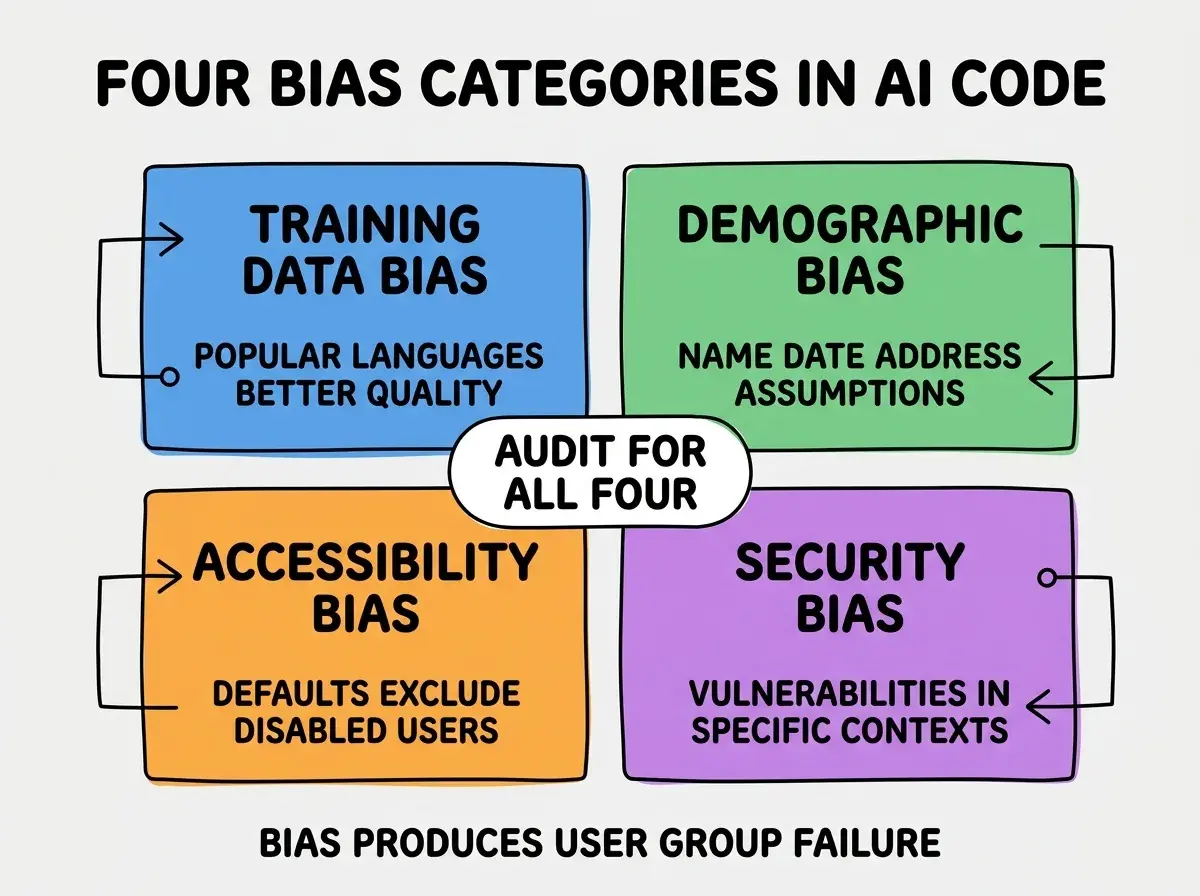
Category 3, accessibility bias. AI defaults often skip ARIA attributes, ignore keyboard navigation, miss color contrast requirements. Accessible patterns require explicit prompting; defaults produce inaccessible code.
Category 4, security bias. AI generates more secure code in contexts where the training data was security-conscious; less secure code in contexts where training data was casual. The variance produces unpredictable security quality.
How to Detect Bias in Your AI-Generated Code
Three detection patterns surface bias before shipping rather than after user complaints.
Pattern 1, test with diverse data deliberately. Names from multiple cultures, addresses from multiple countries, edge cases that reflect real user diversity. The diversity reveals bias the developer would not notice with their own data.
Browse more code quality guides
Read more foundations articlesPattern 2, run accessibility audits automatically. Tools like axe-core, Lighthouse, WAVE catch many accessibility issues automatically. Integrate them into CI; fail builds on regressions.
Pattern 3, manual review with bias checklist. A 10-item checklist (name handling, date formats, accessibility, language assumptions, etc.) applied to AI-generated UI and validation code catches most issues.
Mitigation Patterns That Work
Three mitigation patterns reduce bias in AI-generated code without requiring complete rewrite.
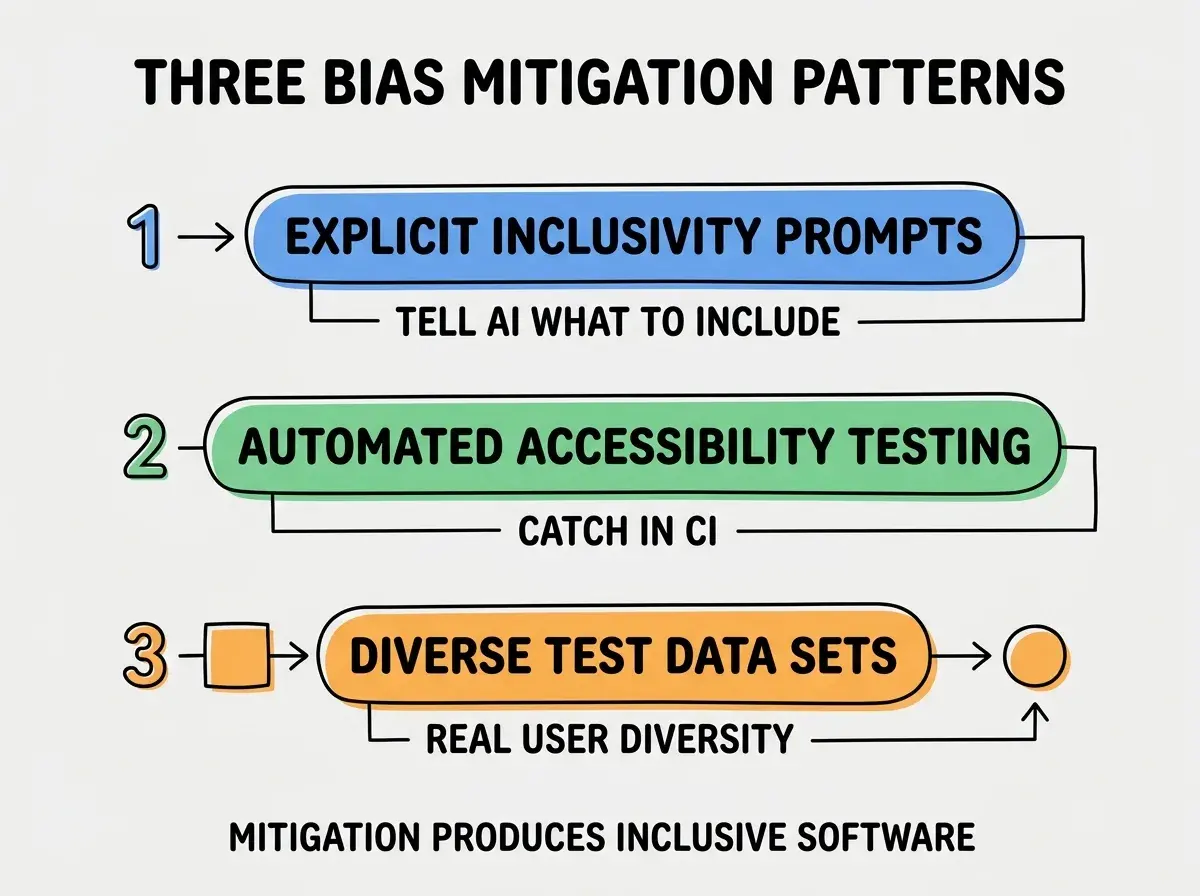
Pattern 1, explicit inclusivity prompts. When asking AI to generate user-facing code, explicitly request inclusive patterns: "handle international names," "include ARIA labels," "support screen readers." Explicit requests usually produce better output.
Pattern 2, automated accessibility testing in CI. Run accessibility tests on every build; fail builds that regress. Continuous testing prevents accessibility bias from accumulating over time.
Pattern 3, diverse test data sets. Maintain test data that reflects real user diversity; run tests against this data before shipping. The diversity catches bias the developer does not see in homogeneous test data.
How to Build Bias Awareness Into Your Team
Three team practices build bias awareness as ongoing capability rather than one-time check.
Practice 1, diverse review panels for user-facing code. Include reviewers from different backgrounds when reviewing user-facing AI-generated code. Diverse perspectives catch bias single perspectives miss.
Practice 2, regular bias-focused code review sessions. Quarterly sessions where the team specifically reviews AI-generated code for bias patterns. The repetition builds collective expertise.
Practice 3, document bias patterns you find for future reference. When you find bias, document it; the patterns inform future code review and prompting practices. Collective learning compounds.
The combination produces teams that catch bias systematically rather than incidentally. Without team practices, bias awareness depends on individual developer awareness, which varies widely and produces inconsistent outcomes.
How to Address Bias You Discover After Shipping
Three response patterns help when bias is discovered in shipped code.
Pattern A, prioritize by impact. Bias affecting many users gets immediate attention; bias affecting few users gets scheduled fixes. Prioritization matches resource investment to user impact.
Pattern B, communicate transparently. When you fix bias issues, tell users. The transparency builds trust; secrecy when bias is discovered damages it more than the original bias.
Pattern C, audit related code paths. Bias in one area often signals bias in others (the same training patterns produced both). Audit related areas when you find bias; the systematic review catches related issues.
The combination produces responsive bias handling. Without these patterns, bias issues accumulate and damage user trust over years.
The most damaging bias mistake is treating AI bias as someone else's problem to solve. Founders sometimes assume AI vendors will improve models to remove bias and they can wait. The fix is to take responsibility for bias in your own shipped code, regardless of who generated it. Vendors do improve over time but slowly; users encountering bias in your product hold you accountable, not the AI vendor. Founders who own bias responsibility produce more inclusive software than founders who wait for upstream fixes.
The other mistake is over-correcting in ways that introduce new problems. Some founders react to AI bias by adding excessive validation that breaks normal cases. The fix is to test mitigations against both the original bias case and normal cases; good mitigations preserve normal functionality while extending support to previously failing cases. Balance matters; over-correction is not better than under-correction.
A third mistake is conflating bias with offensive content. AI generates more offensive content than expected at times, but bias is broader; non-offensive code that simply fails for certain user groups is also bias. The fix is to focus on user-group impact rather than only on inflammatory content; quiet bias often does more cumulative harm than loud bias.
What This Means For You
AI code bias is real consideration in 2026 that requires active mitigation rather than passive hope. The four categories, detection patterns, and mitigation approaches produce inclusive software for committed teams.
- If you're a founder: Audit your AI-generated code for bias before reaching scale. Early audits prevent issues that compound as user base grows.
- If you're changing careers into development: Bias awareness is increasingly expected for senior roles. Study patterns even if your current work does not require them yet.
- If you're a student: Practice writing inclusive code from the start. The discipline transfers across every job and every project you ever touch.
Browse more code quality and ethics guides
Read more foundations articles