With 92% of developers now using AI coding assistants daily, the question is no longer whether to adopt one. The question is where your code goes after you type it. Every keystroke in GitHub Copilot routes through Microsoft's cloud. Every prompt in Cursor passes through external servers. For most developers, that tradeoff is fine. For teams under strict compliance requirements, regulated industries, or organizations that treat source code as their most sensitive IP, it is a dealbreaker.
Tabnine AI coding takes a fundamentally different approach. Think of it this way. Most AI coding tools work like a cloud safe: you hand your valuables to someone else, trust their security, and access them remotely. Tabnine is like keeping your valuables in your own vault at home. You trade some convenience for complete control over who sees what and when.
That vault analogy runs through everything Tabnine does, and it is the lens we will use to evaluate whether the tradeoffs are worth it for your team.
What Tabnine Actually Does
Tabnine is an AI code completion and chat assistant that integrates with most major IDEs, including VS Code, JetBrains, Visual Studio, and Eclipse. At the surface level, it looks similar to Copilot or Codeium. You type code, it suggests completions. You ask questions in a chat panel, it answers with code-aware responses.
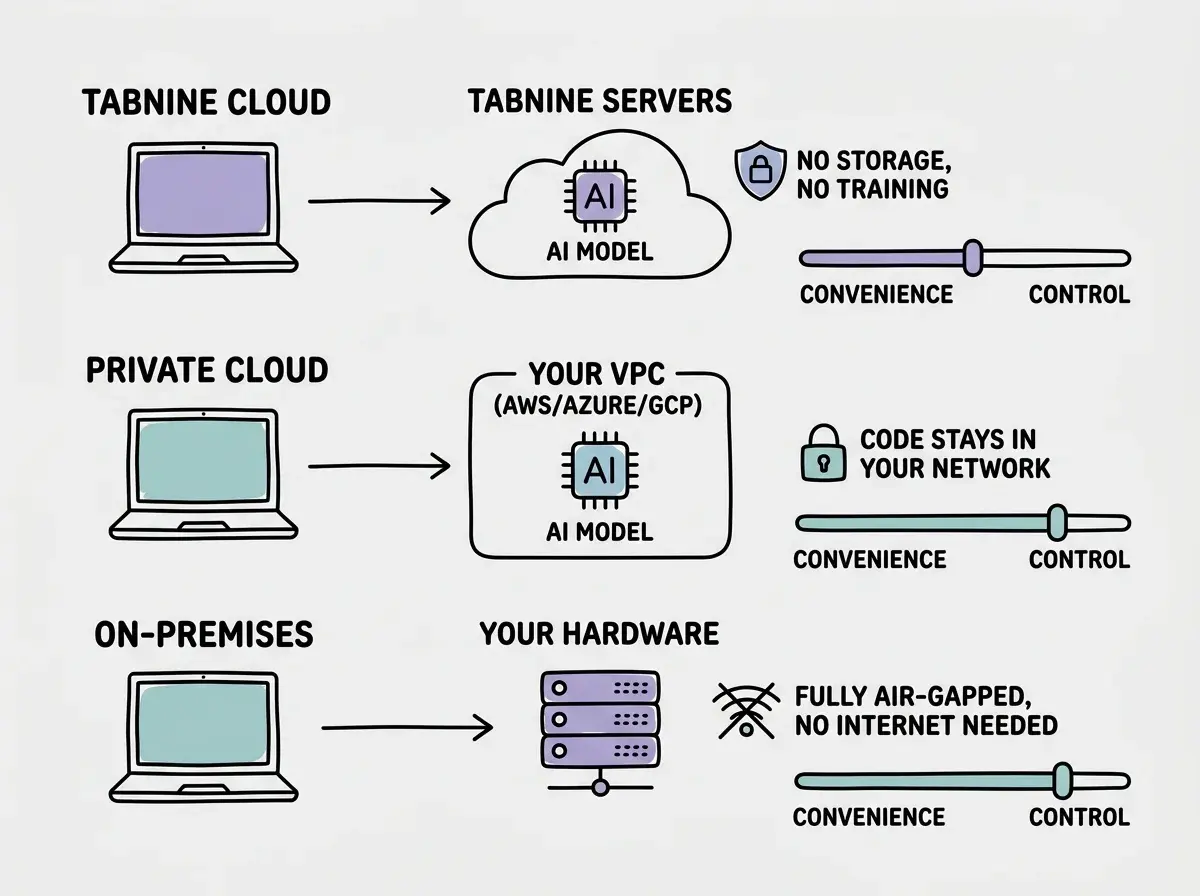
The difference is architectural. Tabnine offers three deployment models that give you increasing levels of control over your data.
Tabnine Cloud runs on Tabnine's own infrastructure with strict data isolation. Your code is processed for completions but never stored, never used for training, and never shared across tenants. This is the simplest setup and the closest experience to other cloud-based tools.
Tabnine Private Cloud deploys the AI models in your own cloud account (AWS, Azure, or GCP). Tabnine manages the software; you manage the infrastructure. Your code never leaves your VPC. This is the vault sitting in a private wing of a secure building that you control access to.
Tabnine On-Premises runs entirely on your own hardware. No internet connection required. No data leaves your network, period. This is the vault bolted to the floor in your own basement. Nobody gets in without your physical permission.
The Privacy Guarantees in Practice
Privacy promises are easy to make and hard to verify. Here is what Tabnine commits to contractually, not just in marketing copy.
Zero data retention. Code snippets sent for completion are processed in memory and discarded immediately. There is no logging of your source code on Tabnine's servers. This applies to all deployment tiers, not just on-premises.
Zero model training on customer code. Tabnine's models are trained exclusively on permissively licensed open-source code with full license attribution. Your proprietary code never influences the model, which means your patterns, naming conventions, and business logic cannot leak to other customers through model behavior.
SOC 2 Type II compliance. Tabnine holds SOC 2 certification, which means an independent auditor has verified their security controls over an extended period. For enterprise procurement teams, this is table stakes but still worth noting since not every AI coding tool has it.
GDPR and CCPA compliance. For teams under European or California data privacy regulations, Tabnine provides the contractual and technical frameworks to stay compliant. The on-premises option makes compliance straightforward because no data ever crosses a network boundary.
For regulated industries like finance, healthcare, and defense, these are not nice-to-haves. They are requirements that eliminate most competitors before a single line of code gets written.
The privacy advantage of Tabnine AI coding is not just a policy difference. It is an architectural one. While Copilot and Cursor can promise not to train on your code, the data still traverses their infrastructure. With Tabnine's on-premises deployment, your code physically cannot leave your network. For compliance teams, the distinction between "we promise not to look" and "it is technically impossible to look" is everything.
How Tabnine Compares to Copilot and Cursor for Privacy
Let us put the three tools side by side through a privacy lens.
| Tabnine | GitHub Copilot | Cursor | |
|---|---|---|---|
| Self-hosted option | Yes (on-prem + private cloud) | No (Copilot Business has telemetry controls) | No |
| Air-gapped deployment | Yes | No | No |
| Code used for training | Never (any tier) | Not on Business/Enterprise plans | Not on Pro plans |
| Data residency control | Full (you choose the region) | Microsoft's regions | Cursor's infrastructure |
| SOC 2 certified | Yes | Yes (via GitHub) | Not publicly listed |
| On-prem model hosting | Yes | No | No |
GitHub Copilot Business does offer meaningful privacy improvements over the individual plan. Microsoft promises no code retention and no training on your data. But "promises" and "architecturally impossible" sit at different points on the trust spectrum. Copilot Business is the cloud safe with strong locks. Tabnine on-prem is the vault in your basement.
Cursor currently has no enterprise self-hosted option. Its privacy policy for Pro users states that code is not used for training, but all processing happens on Cursor's servers. For teams that need to demonstrate to auditors that code never leaves the corporate network, Cursor cannot satisfy that requirement today.
AI Quality and the Honest Tradeoffs
Here is where the vault analogy reveals its tension. The most secure vault in the world is useless if you cannot get to your valuables when you need them.
Tabnine's AI models are good. They are not best-in-class. In head-to-head completion quality tests, Copilot (powered by OpenAI's models) and Cursor (which routes through Claude and GPT-4) consistently produce more accurate, more contextually aware suggestions. This is not a controversial opinion; it is a reflection of the model size and training data advantages that cloud-scale infrastructure provides.
Tabnine compensates in several ways. It offers personalized models that learn your team's codebase patterns and naming conventions, improving relevance over time. Completion latency is excellent, particularly on-premises where there is no network round-trip. Tabnine also supports connecting to external LLMs (Claude, GPT-4) through your own API keys, letting you blend the privacy of local processing with the power of frontier models when appropriate.
The practical impact depends on your workflow. For routine completions (boilerplate, imports, repetitive patterns, test scaffolding), Tabnine performs nearly identically to Copilot. For complex multi-file reasoning and large refactors, the gap widens. Teams that rely heavily on AI chat for design decisions will feel the difference. Teams that primarily use completions will barely notice.
Evaluating Tabnine purely on raw suggestion quality without factoring in the personalization period. Out of the box, Tabnine feels noticeably weaker than Copilot. After two to three weeks of learning your codebase, the gap narrows significantly for project-specific completions. Teams that trial Tabnine for three days and dismiss it are testing the tool before it has had time to open the vault and learn what is inside.
Enterprise Deployment and Team Management
For engineering managers evaluating Tabnine AI coding across a large team, the administrative features matter as much as the AI quality.
Centralized team management. Tabnine's admin dashboard controls developer access, enforces organization-wide policies for code sharing, and monitors usage. You can mandate that all team members use the private deployment and block fallback to public models.
Custom model training on your repos. Tabnine Enterprise fine-tunes models on your organization's codebases, aligning suggestions with internal libraries, API patterns, and architectural conventions.
IDE-agnostic support. Unlike Cursor (its own IDE) or Copilot (best in VS Code), Tabnine supports virtually every major IDE. Teams with mixed editor preferences do not need to standardize.
Privacy is one factor. Understand the full landscape before committing.
See the full comparisonPricing Breakdown
Tabnine's pricing reflects the infrastructure flexibility it offers.
| Plan | Price | What You Get |
|---|---|---|
| Dev | Free | Basic code completions, limited chat |
| Pro | $12/user/mo | Full completions, AI chat, personalization |
| Enterprise | Custom pricing | On-prem/private cloud, custom models, SSO, audit logs, dedicated support |
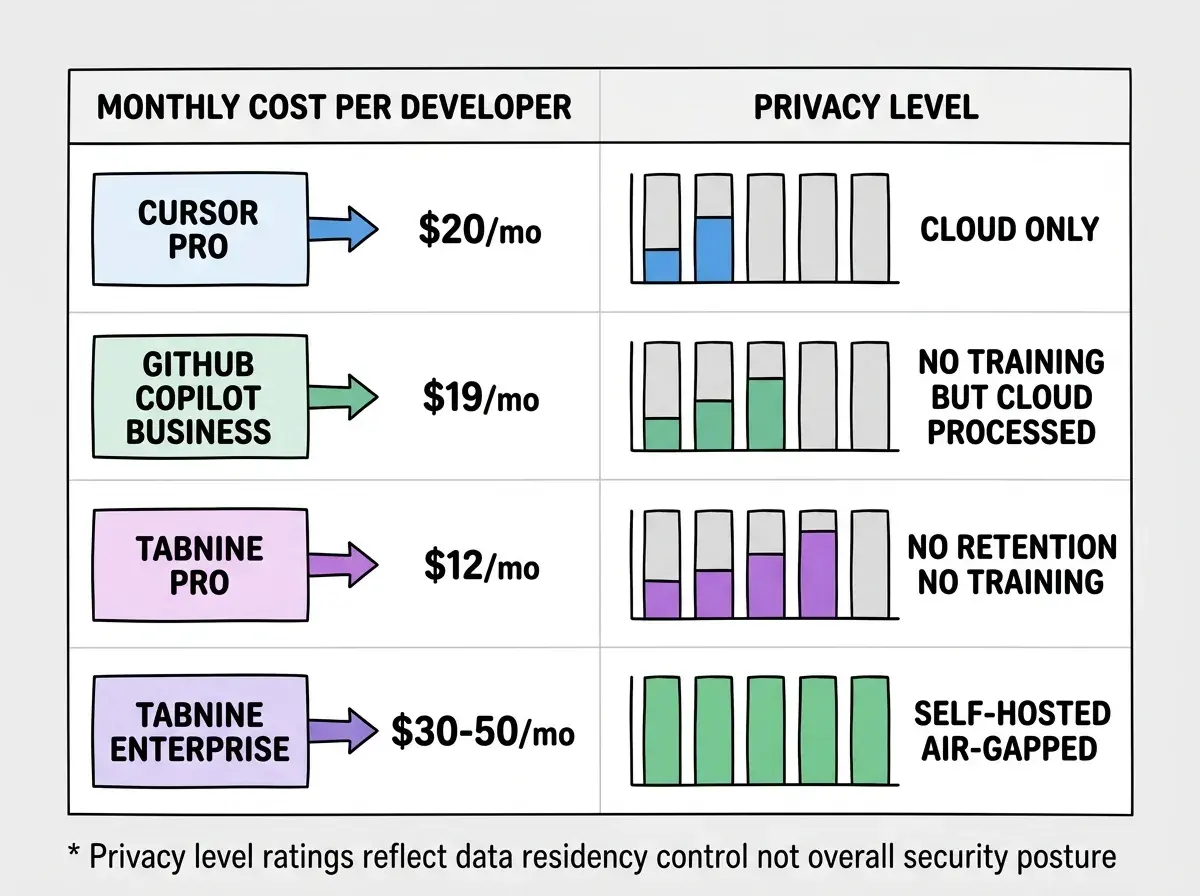
The free tier is functional for individual developers who want basic completions with privacy guarantees. Pro at $12/user/month is cheaper than Copilot Business ($19/user/month) while offering stronger privacy defaults.
Enterprise pricing varies by deployment model, seat count, and custom model requirements. Organizations typically report $30-50 per user per month for fully self-hosted deployments, including infrastructure overhead.
Who Should Choose Tabnine
Tabnine is not the right tool for every developer. It is the right tool for a specific and growing set of teams.
Choose Tabnine if you work in a regulated industry where auditors need proof that code never leaves your network. If your security team has vetoed Copilot over data residency concerns. If you value privacy guarantees backed by architecture, not just policy.
Look elsewhere if you are a solo developer optimizing purely for suggestion quality, or your codebase is open-source and privacy is not a constraint.
The vault at home will never be as flashy as the cloud safe with a marble lobby. But when the compliance audit lands and the CISO asks where your source code goes, the team with the vault at home is the one that sleeps soundly.
Understand how different AI assistants handle your code before choosing one.
Explore AI tool guidesFinal Thoughts
Tabnine is not trying to win the benchmark war against Copilot or the UX battle against Cursor. It is solving a different problem entirely, giving organizations complete control over where their code lives while still providing meaningful AI-assisted development.
The AI quality gap is real but narrowing. The privacy gap between Tabnine's on-premises deployment and everything else is not narrowing at all. As organizations face increasing regulatory scrutiny around AI and data handling, that gap becomes more valuable over time.
For privacy-sensitive teams, Tabnine AI coding is not a compromise. It is the only option that lets you keep the vault at home.