To apply systems thinking to vibe-coded apps in 2026, recognize that AI-generated code excels at local fixes but often misses the system-level interactions (data flow across components, state shared between features, performance characteristics of the whole, security boundaries that span layers), develop the habit of asking "what else does this affect" before accepting AI changes, sketch the system before generating code, and treat the whole app as the unit of design rather than individual features. Vibe coders who develop systems thinking ship more reliable products than those who only think feature-by-feature.
This piece walks through the four system interactions that matter most, the analogy that carries, the practical habits, and the four mistakes that come from treating a vibe-coded app as a collection of features rather than as a system.
Why Systems Thinking Matters More With AI
AI assistance dramatically speeds up local code generation: write a function, refactor a component, fix a bug. The speed of local changes makes it easy to lose track of how the whole system fits together. A change that fixes one feature can subtly break another. Without systems thinking, these breakages compound silently until something goes seriously wrong.
The 2026 reality is that AI rarely thinks systemically without prompting. Asked to fix a bug, AI focuses on the bug and may miss the upstream cause or downstream effects. The human's job becomes increasingly the "whole system" thinking that AI handles poorly.
A 2025 GitHub research study tracking 50,000 AI-generated commits found that 41 percent of AI-suggested code changes that fixed the immediate issue introduced subtle problems elsewhere in the codebase, often surfacing weeks later. The "fix what you see" pattern that AI defaults to produces local wins and global losses. Systems thinking is not a luxury skill in vibe coding; it is the discipline that prevents accumulated debt from killing projects.
The pattern to copy is the way urban planners think about cities. A traffic engineer fixing one intersection's congestion can make traffic worse three intersections downstream. The fix has to consider the whole network, not just the local symptom. Vibe-coded apps are the same: features interact in ways that local fixes do not anticipate.
The Four System Interactions That Matter Most
Four categories of interactions consistently bite vibe coders who think feature-by-feature.
Interaction 1, data flow across components. Where does data come from, how does it transform, where does it end up. Changes to one transformation often break consumers downstream.
Interaction 2, state shared between features. User authentication, feature flags, theme settings. Shared state is the second-most-common source of subtle bugs after data flow.
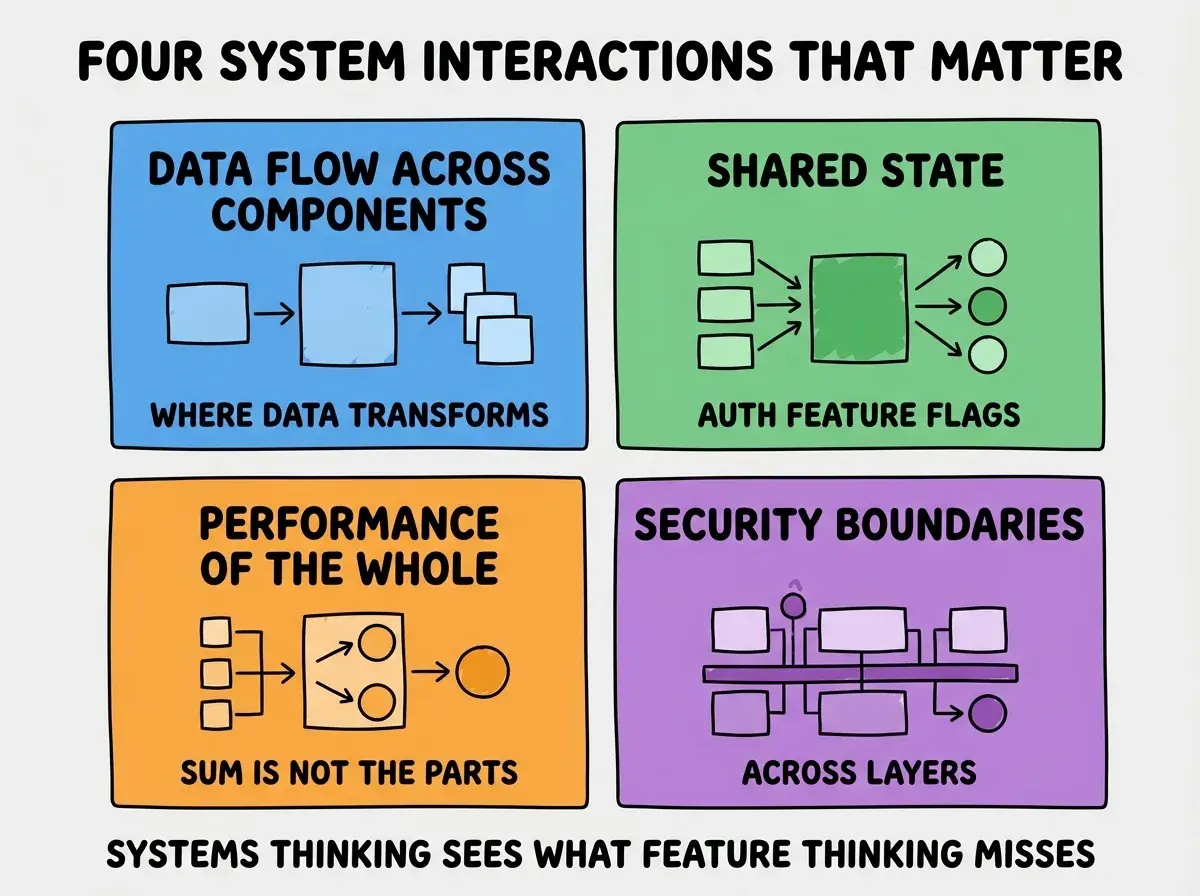
Interaction 3, performance of the whole. A page that loads fast in isolation can become slow when combined with other components on the same page. Performance does not compose linearly.
Interaction 4, security boundaries. Authentication, authorization, input validation. Security gaps often appear at the seams between features, not within any single feature.
How to Develop Systems Thinking
Three practical habits build systems thinking over time. None require formal training.
Habit 1, ask "what else does this affect" before accepting AI changes. Look at the change and trace the implications. Five minutes of thinking prevents hours of debugging.
Browse more mental models guides
Read more foundations articlesHabit 2, sketch the system before generating code. Before prompting AI for a feature, spend 10 minutes drawing the data flow, state interactions, and integration points. The sketch is the systems-thinking artifact.
Habit 3, do periodic system reviews. Once a month, step back and review the whole architecture. Identify the seams where bugs hide. Address them proactively.
The Decisions That Reveal Systems Thinking
Beyond habits, three categories of decisions reveal whether someone is thinking systemically or feature-by-feature.
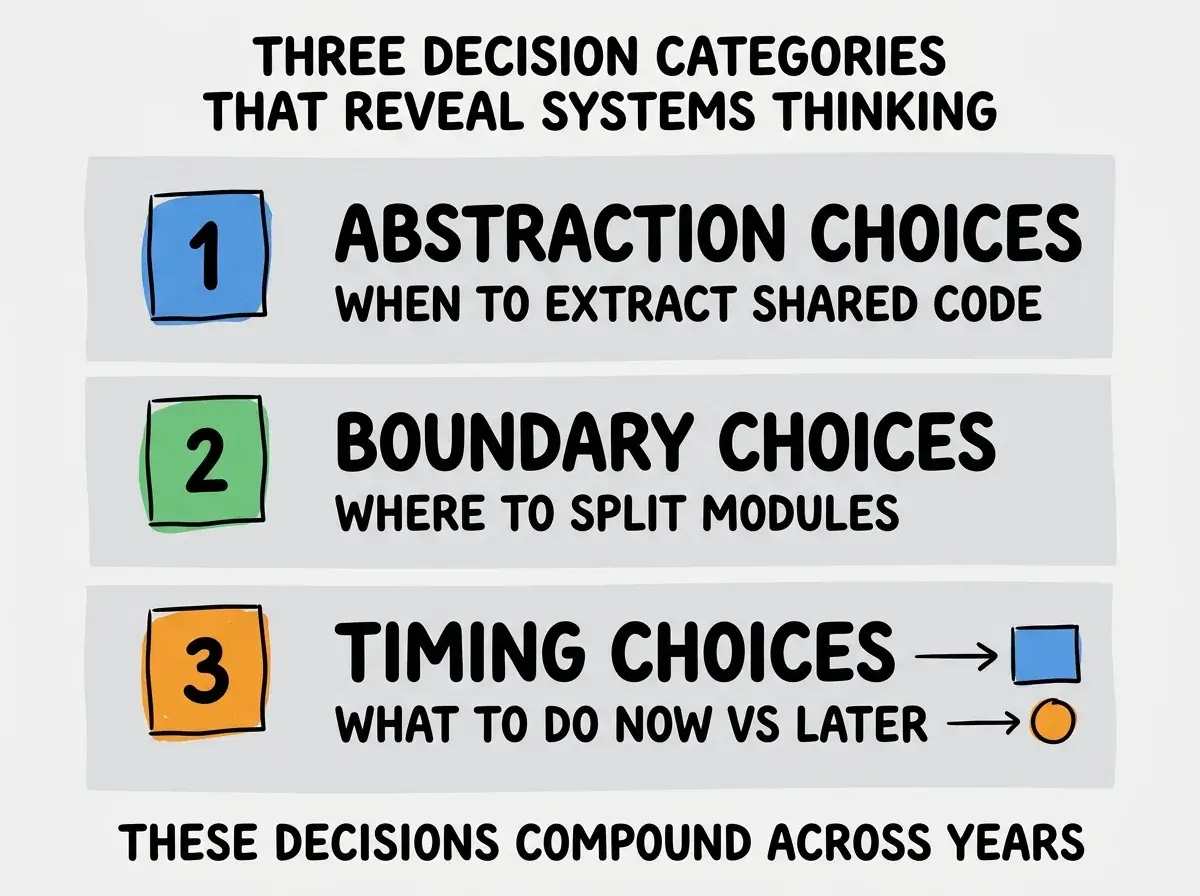
Decision 1, abstraction choices. When to extract shared code into utilities, when to leave it duplicated. Premature abstraction creates worse coupling than thoughtful duplication.
Decision 2, boundary choices. Where to split modules, where to keep things together. Boundaries determine what can change independently and what cascades.
Decision 3, timing choices. What problems to solve now vs defer. Defer wisely; not every problem needs solving today.
What AI Cannot See
Three categories of system-level concerns AI consistently misses. Knowing what AI misses lets you compensate.
Miss 1, organizational context. Why this code was written this way (history, constraints, team preferences). AI generates code that ignores prior decisions; humans need to maintain consistency.
Miss 2, business priorities. What matters most to the business right now. AI optimizes for the prompt; humans align with strategy.
Miss 3, long-term implications. How decisions today will play out over months or years. AI optimizes for immediate output; humans think about debt and evolution.
The combination means AI is a powerful local optimizer but needs human direction for system-level decisions. Vibe coders who provide that direction get exponentially better outcomes than those who treat AI as the architect.
The most damaging mistake vibe coders make is accepting AI changes one at a time without considering the cumulative effect on the system. Each change looks reasonable; the system after 50 changes looks like a tangled mess. The fix is to do periodic "step back" reviews where you ask "is this still the system I want." If not, refactor proactively rather than letting drift accumulate. The discipline of stepping back costs an hour per month and saves weeks of eventual cleanup work. Systems thinking is the practice of making time for the stepping back.
The other mistake is assuming systems thinking only matters for large apps. Even small apps benefit from systems thinking; they just have fewer interactions to track. The habits that serve you on a 5-feature app become essential on a 50-feature app. Build the habits early; they compound across project size.
Tools That Support Systems Thinking
Beyond habits, three tools support systems thinking in vibe-coded projects.
Tool 1, dependency graphs. Tools like Madge or built-in IDE features show how modules depend on each other. Surface unexpected dependencies that signal coupling problems.
Tool 2, architecture diagrams. Excalidraw or Mermaid diagrams kept in the repo. Updated as the system evolves. The diagram itself is not the artifact; the act of maintaining it forces system-level thinking.
Tool 3, system health dashboards. Operational dashboards showing how the whole system behaves under load. Latency, error rates, queue depths across components. Catches system-level problems that local metrics miss.
The combination of tools and habits produces systems thinking as a sustained practice rather than as occasional good intentions. Tools without habits get ignored; habits without tools get expensive in time.
How Systems Thinking Develops Over Years
Systems thinking is not a binary skill; it develops gradually with experience. Three stages mark the typical progression.
Stage 1, learning to ask the question. Early in your career you remember to ask "what else does this affect" sometimes. The discipline is conscious; you have to remind yourself.
Stage 2, automatic pattern recognition. Mid-career you spot patterns automatically. Certain code structures trigger your attention because you have seen them cause problems before.
Stage 3, designing for systems impact. Senior engineers design code with systems impact in mind from the start. The thinking happens before code is written, not after.
Each stage takes years of deliberate practice. Most engineers never reach stage 3 because they never deliberately practice; the practice is what produces the progression.
What This Means For You
Systems thinking is one of the highest-leverage mental models for vibe coders in 2026. The skill differentiates engineers who ship reliable products from engineers who ship features that interact unpredictably.
- If you're a founder: Hire engineers who demonstrate systems thinking. Ask them to walk you through how a feature affects the whole app; the answer reveals the skill.
- If you're changing careers into engineering: Develop systems thinking deliberately. Read "Designing Data-Intensive Applications" and similar books. The investment pays back across every project.
- If you're a student: Practice systems thinking on small projects. Even a personal blog has system interactions worth understanding before they bite you.
Browse more mental models guides
Read more foundations articles