Database, API, and frontend are the three pieces of every web app, and understanding them before AI assembles them lets you guide AI better and debug when things break. The frontend is what users see and interact with. The API is the messenger that carries data between frontend and database. The database stores the information your app remembers. AI handles each piece well; understanding the pieces lets you ask AI for what you actually want.
This piece walks through the three pieces, how they connect, what AI builds for each, and the four mistakes beginners make when treating apps as one indivisible thing.
Why Understanding The Three Pieces Matters
Understanding the three pieces matters because most app problems trace to one specific piece. Bug in the frontend looks different from bug in the API or database. Knowing pieces helps describe problems to AI for faster fixing.
The 2026 reality is that AI assembles working apps without requiring you to know the pieces; debugging when things break does require knowing them. The asymmetry matters; the building works without knowledge but the maintenance does not.
A 2025 beginner vibe coder survey of 600 first time builders found that beginners who understood the three pieces resolved bugs 4.1x faster than beginners who treated the app as one thing. Pieces awareness measurably affects debugging speed.
The pattern to copy is the way drivers understand cars at functional level without mechanical depth. Drivers know engine, brakes, steering exist; understanding lets them describe problems to mechanics. Vibe coders need the same level of app understanding.
The Three Pieces Explained
Three pieces form every web app.
Piece 1, frontend (what users see). The screens, buttons, forms, images, text users interact with. Lives in the browser; runs on user's device.
Piece 2, API (the messenger). Code that runs when frontend asks for data or sends data. Lives on server; runs only when called.
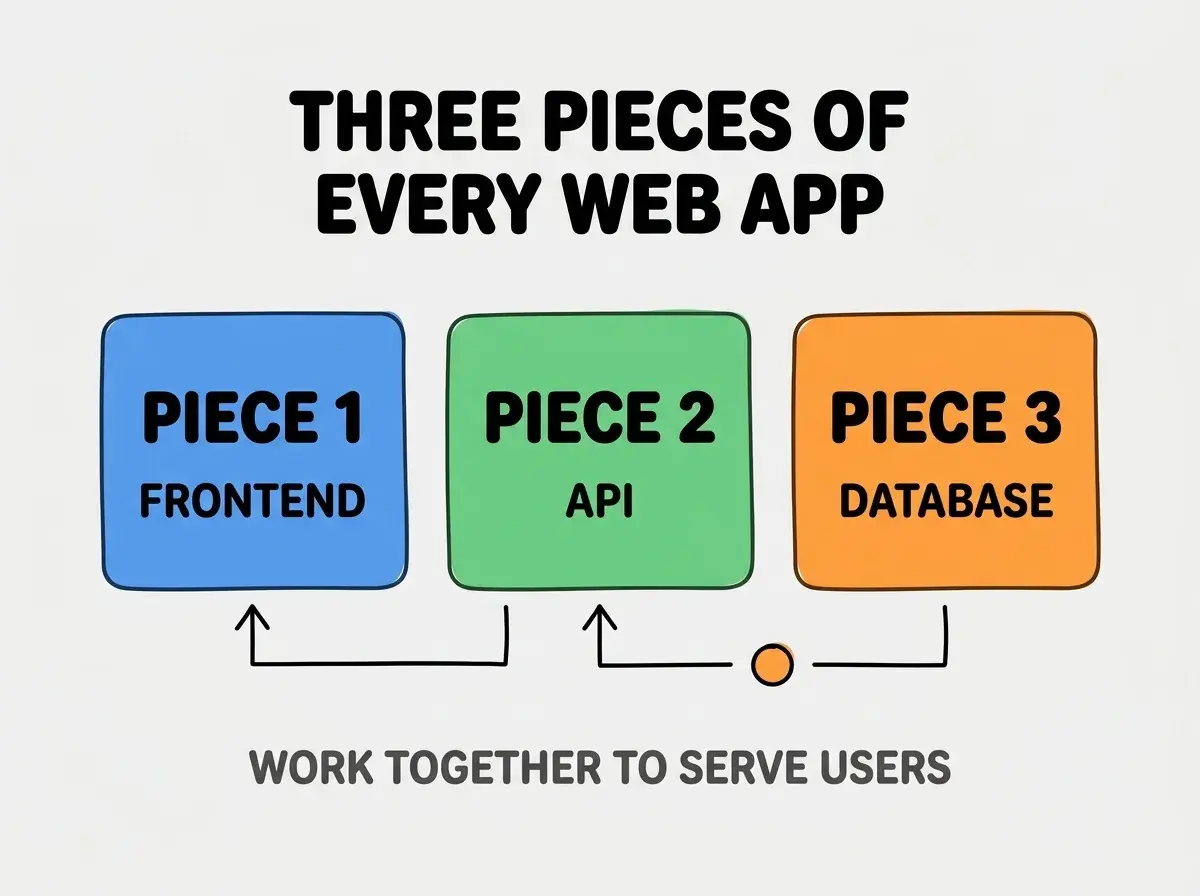
Piece 3, database (the memory). Storage for everything app needs to remember. Lives on server; persists across sessions and users.
How The Three Pieces Connect
Three connection patterns describe how pieces work together.
Connection 1, user clicks something in frontend. Frontend captures click; sends request to API.
Browse more foundations
Read more foundationsConnection 2, API processes request and asks database. API code runs; queries database for needed data; receives data back.
Connection 3, API sends data back to frontend. API formats data; sends to frontend; frontend displays to user.
The cycle repeats for every interaction; understanding the cycle helps describe what is broken when something fails.
What AI Builds For Each Piece
Three pattern groups describe AI generation per piece.
Piece 1, AI builds frontend with React or similar. AI generates components, styling, interactivity. Most visible piece for new builders.
Piece 2, AI builds API with Next.js routes or similar. AI generates code that runs on server when called. Less visible but essential.
Piece 3, AI sets up database with Postgres or similar. AI creates tables, relationships, queries. Foundation everything else uses.
What Makes Three Pieces Mental Model Sustainable
Three patterns help maintain three pieces awareness.
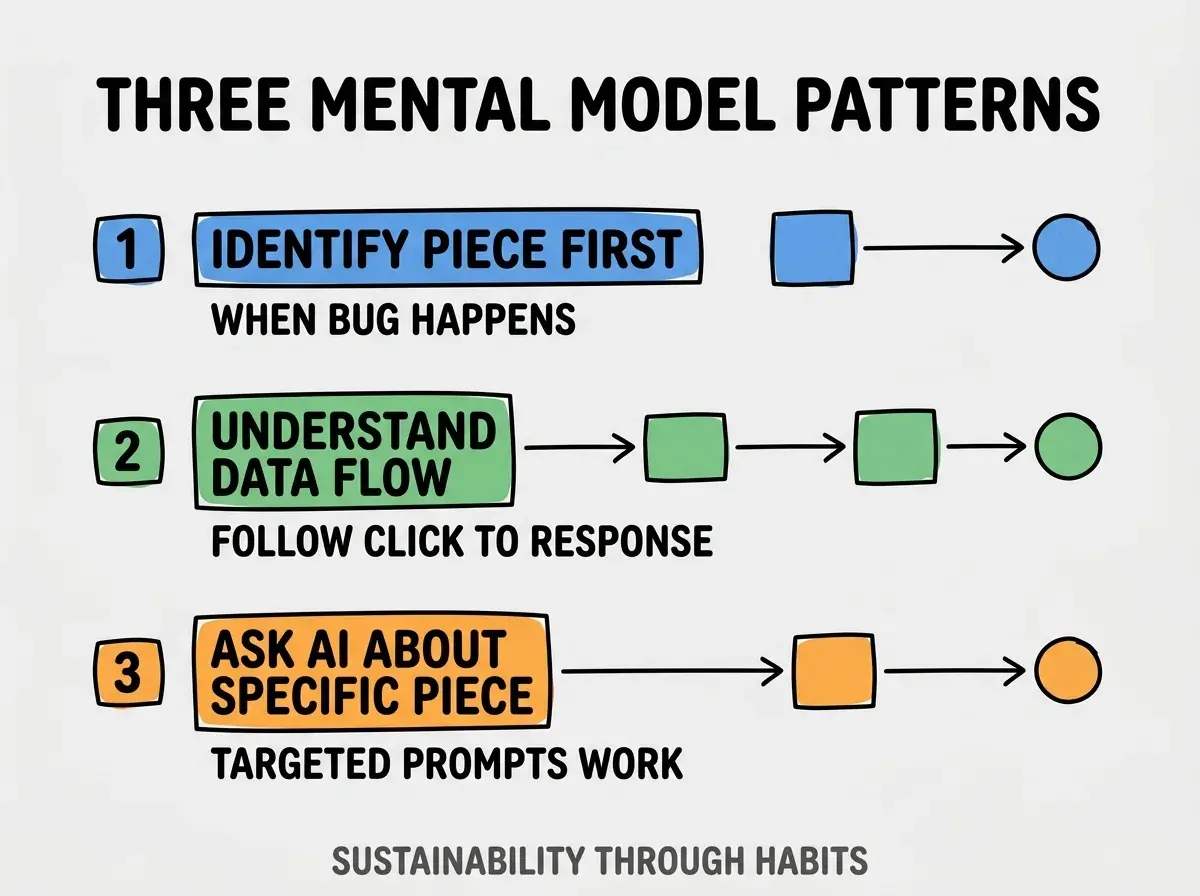
Pattern 1, identify piece first when bug happens. Before debugging, identify which piece. Identification narrows search.
Pattern 2, understand data flow from click to response. Tracing data flow reveals where problems occur.
Pattern 3, ask AI about specific piece. "The frontend is broken" beats "the app is broken". Specificity helps AI help you.
The combination produces sustainable three pieces awareness. Without these patterns, awareness fades.
How To Identify Which Piece Has The Problem
Three diagnostic patterns identify problem location.
Pattern A, visual issues are usually frontend. Wrong colors, broken layout, missing buttons all frontend problems.
Pattern B, missing or wrong data is usually API or database. Empty lists, wrong information, save failures all API or database problems.
Pattern C, "page not found" is usually frontend or API routing. Navigation issues split between frontend routing and API routes.
The combination produces problem identification. Without identification, debugging searches everywhere.
Common Questions About App Pieces
App pieces raise questions worth addressing directly.
The first question is whether all apps have all three pieces. Modern web apps yes; some simple apps may share pieces (frontend talking directly to database service).
The second question is whether to learn the pieces in order. Start with frontend (most visible); add API and database as projects need them.
The third question is whether AI tools handle all three pieces equally well. Frontend best; API and database increasing rapidly. Differences narrowing.
The fourth question is whether to understand pieces deeply or just functionally. Functionally is enough for vibe coding; depth helps for advanced work.
How Pieces Awareness Affects Building
Pieces awareness affects building in compounding ways. Awareness effects compound across projects.
The first compounding effect is faster debugging. Pieces awareness narrows debug search; faster fixes compound.
The second compounding effect is better AI prompting. Specific prompts work better than vague prompts; specificity requires pieces awareness.
The third compounding effect is project ambition. Pieces awareness enables more complex projects; ambition compounds skill.
The combination produces builders that grow over time. Without pieces awareness, growth limits.
How To Build Pieces Awareness Through Practice
Three patterns help build pieces awareness.
Pattern A, label each piece in your project. When AI generates code, identify which piece. Labeling builds recognition.
Pattern B, trace data flow for each feature. Where does data start, where does it travel, where does it end. Tracing builds understanding.
Pattern C, debug deliberately by piece. When bug happens, identify piece first; debug within piece. Practice builds pattern.
The combination produces pieces awareness that compounds. Without practice, awareness stays theoretical.
The most damaging beginner mistake is treating the app as one undifferentiated thing. "It's broken" wastes AI time and your time; "the API is returning wrong data" enables targeted help. The fix is to identify which piece before describing the problem; pieces vocabulary speeds resolution. Beginners who use pieces vocabulary debug faster; beginners who use generic vocabulary stay stuck longer.
The other mistake is over learning before building. Pieces awareness develops through building, not study; build first, learn through doing.
A third mistake is missing the API piece. New builders see frontend and database but miss API; API is the messenger that connects them.
A fourth mistake is treating database as scary. Database is just storage; modern tools (Supabase, Firebase) make database accessible.
What This Means For You
Database, API, and frontend are the three pieces of every web app. Understanding the pieces, connections, and identification patterns produce vibe coders who debug faster and prompt better.
- If you're a founder: Add pieces vocabulary to your bug reports; vocabulary speeds engineering response.
- If you're a career changer: Pieces are professional vocabulary; learning transfers to all software work.
- If you're a marketer: Pieces awareness enables better collaboration with engineers; collaboration improves campaign quality.
Browse more foundations
Read more foundations