To understand architecture decisions as a non architect, recognize the four decision categories that matter most for long term project success (data model decisions that constrain everything built on top, integration decisions that determine extensibility, scaling decisions that determine growth viability, and tooling decisions that determine team capability), see why these decisions matter more than other architectural choices, and apply the patterns that help non architects participate in architectural decisions productively. The architectural understanding matters because AI built projects increasingly involve non architects making decisions that constrain technical futures.
This piece walks through the four decision categories, why these decisions matter most, the participation patterns, and the four mistakes when non architects engage with architecture.
Why Architecture Matters For Non Architects
Architecture matters for non architects because AI built projects increasingly involve non architect decision making. The involvement matters; product managers, founders, and other non architects increasingly own decisions that constrain technical futures.
The 2026 reality is that AI tools enable non architects to build initial architecture without architectural training. Without architectural understanding, initial decisions often constrain future development in ways that proper architectural participation would prevent.
A 2025 product team study of 300 AI built projects found that projects with structured non architect architectural participation showed 56 percent fewer architectural rewrites and 43 percent better long term feature velocity compared to projects without participation. The participation produces better outcomes than either pure architect ownership or pure non architect decision making.
The pattern to copy is the way home buyers participate in architectural decisions with architects. Home buyers do not become architects; they participate in decisions about what matters to them while architects translate decisions into technical specifications. Software architecture follows similar pattern; non architects participate in decisions while architects translate.
The Four Decision Categories
Four categories characterize architectural decisions that matter most.
Category 1, data model decisions constraining everything built on top. What entities exist, what relationships connect them, what fields each entity has. Data model determines feature possibilities.
Category 2, integration decisions determining extensibility. What external services connect, what APIs are exposed, what protocols used. Integration determines future flexibility.
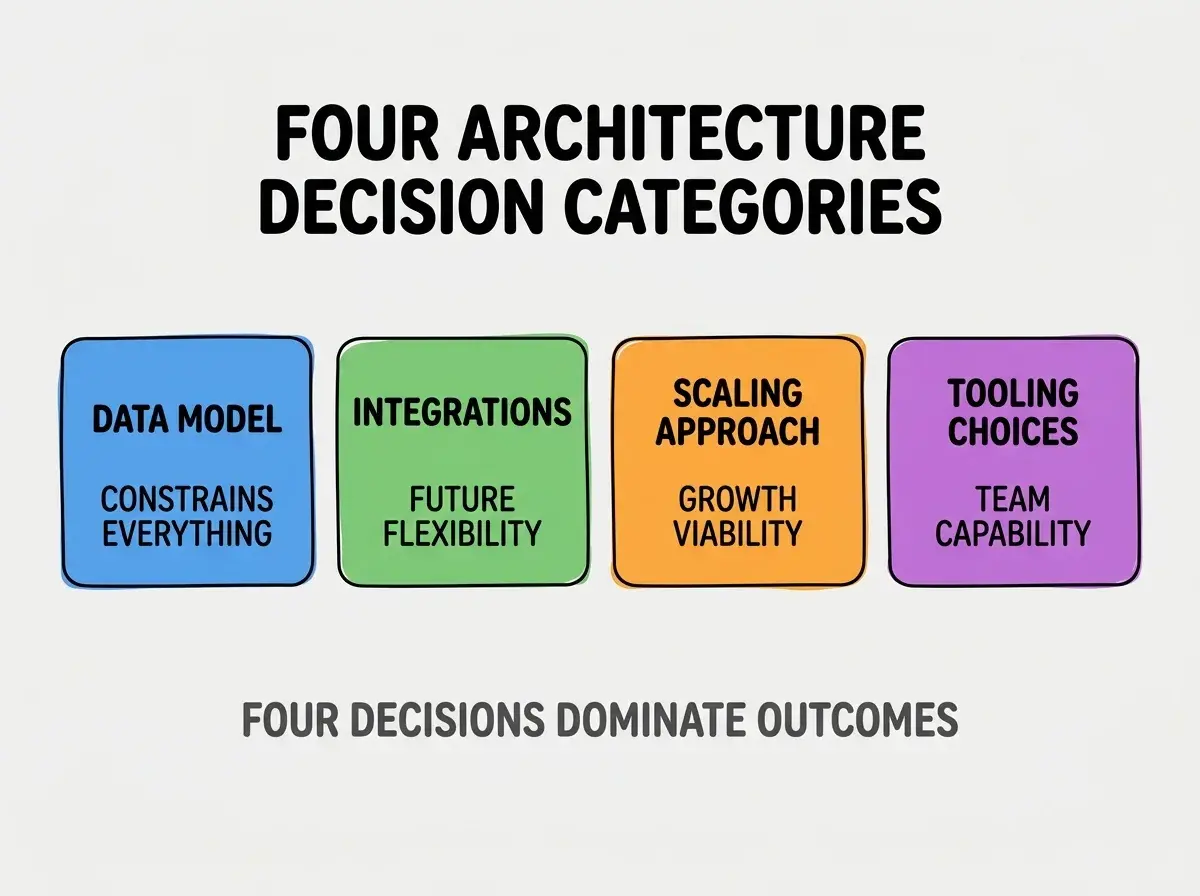
Category 3, scaling decisions determining growth viability. What scale architecture supports, what scale requires rebuild. Scaling decisions determine growth ceiling.
Category 4, tooling decisions determining team capability. What languages, frameworks, services chosen. Tooling determines who can contribute and how.
Why These Four Matter Most
Three reasons explain why these specific decisions dominate.
Reason 1, decisions constrain everything built afterward. Data model changes require touching everything that uses data. Constraint reveals decision importance.
Browse more foundations
Read more foundationsReason 2, decisions hard to change after initial implementation. Changing data model after launch costs dramatically more than choosing right initially. Reversibility difficulty matters.
Reason 3, decisions affect business possibilities not just technical implementation. What features become possible depends on architectural decisions. Business impact matters for non architect participation.
How Non Architects Should Participate
Three participation patterns produce productive non architect involvement.
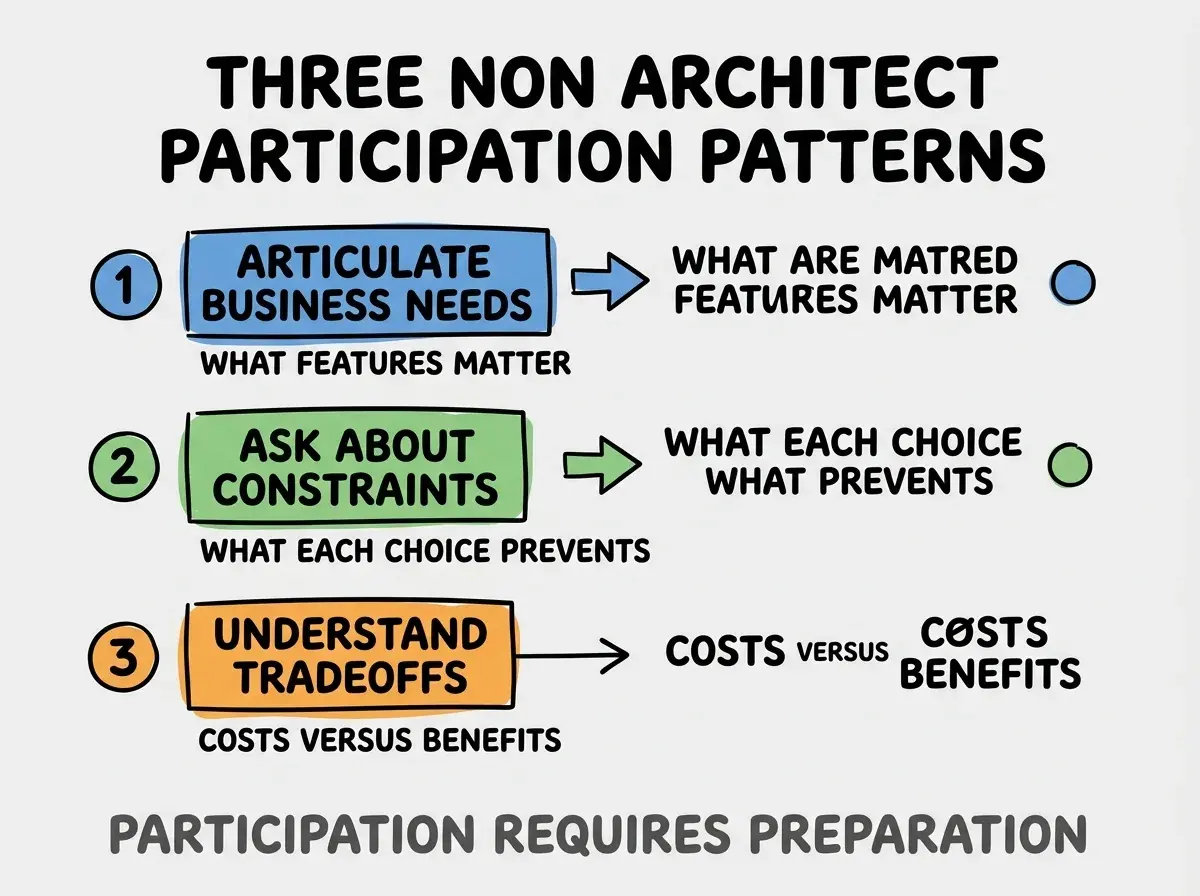
Pattern 1, articulate business needs that architecture must support. What features matter, what scale expected, what constraints exist. Business articulation drives architecture.
Pattern 2, ask about constraints each choice creates. What does this choice prevent in future. Constraint understanding reveals decision implications.
Pattern 3, understand tradeoffs between alternatives. What gains and costs each option produces. Tradeoff understanding enables informed participation.
What Makes Non Architect Participation Sustainable
Three patterns separate sustainable participation from problematic patterns.
Pattern 1, architects translate technical implications into business terms. Translation enables non architect understanding. Without translation, decisions happen in opaque technical language.
Pattern 2, decisions documented with business context. Documentation captures why decisions made, not just what. Without context, future decisions repeat mistakes.
Pattern 3, regular architecture conversations not just at decision points. Ongoing conversations build mutual understanding. Without ongoing conversations, decision conversations require excessive context building.
The combination produces participation that improves architectural decisions. Without these patterns, non architect participation often makes decisions worse rather than better.
How To Have Productive Architecture Conversations
Three conversation patterns help non architects engage productively.
Pattern A, ask architects to explain decisions in business terms. Translation reveals decision implications. Without translation, business stakeholders cannot evaluate.
Pattern B, share business context that informs decisions. Future plans, expected scale, constraint priorities. Context informs better decisions.
Pattern C, push back when decisions seem to constrain business possibilities. Pushback enables architect reconsideration. Without pushback, decisions may overconstrain unnecessarily.
The combination produces conversations that improve architectural decisions. Without conversation patterns, decisions happen with insufficient business input.
The most damaging non architect architectural mistake is deferring all architectural decisions entirely to architects without participation. Pure architect decisions miss business context that affects what architecture should support; pure non architect decisions miss technical implications that affect what architecture can support. The fix is collaborative decision making where architects translate technical implications and non architects share business context. Collaborative decisions outperform either pure approach consistently.
The other mistake is overriding architects on technical considerations. Architects know technical implications; overriding without understanding produces problems. The fix is to push back on business implications while accepting technical guidance.
A third mistake is treating architecture as one time decision. Architecture evolves; ongoing participation matters more than single decision points.
A fourth mistake is engaging with architecture only after problems emerge. Reactive participation cannot prevent problems; proactive participation can.
How To Recognize Architecture Decision Points
Three patterns help non architects recognize when architecture decisions are happening.
Pattern 1, decisions involving data models or schemas. Adding entities, changing relationships, restructuring. Data decisions deserve participation.
Pattern 2, decisions involving external service integration. Choosing payment processors, AI providers, infrastructure services. Integration decisions affect future flexibility.
Pattern 3, decisions involving scaling or capacity planning. Database choices, infrastructure choices, hosting choices. Scaling decisions affect growth viability.
The combination produces recognition that enables timely participation. Without recognition, participation happens too late to influence outcomes.
How Architecture Participation Will Likely Evolve
Architecture participation patterns will likely evolve as AI built projects become more common.
The first likely evolution is non architect participation tools improving. Visualization tools, decision frameworks, business friendly architecture documentation. Tools enable better participation.
The second likely evolution is hybrid roles emerging. Roles combining business and architectural responsibility. Hybrids reduce participation friction.
The third likely evolution is AI assisting architectural decisions. AI explaining tradeoffs in business terms, suggesting alternatives, evaluating implications. AI assistance reduces dependence on architect translation.
The combination suggests non architect participation will become more accessible. Non architects learning participation now build skills that remain valuable as tools improve.
Common Questions About Architecture Participation
Architecture participation raises questions worth addressing directly.
The first question is how non architects should prepare for architectural conversations. Read about decisions architects make, ask architects to explain decisions, build mental models of system structure. Preparation enables productive participation.
The second question is when to push back on architect recommendations. When recommendations seem to overconstrain business possibilities, push back; when recommendations address pure technical concerns, accept. Boundary matters for collaboration.
What This Means For You
Architecture participation as non architect determines long term project success. The four decision categories, participation patterns, and conversation approaches produce framework for productive non architect involvement.
- If you're a founder: Architectural decisions made early constrain company technical futures. Participate productively rather than deferring entirely; participation produces better outcomes than pure deferral.
- If you're a product manager: Product roadmap depends on architecture supporting it. Participate in architectural decisions to ensure product possibilities.
- If you're a marketer: Marketing capabilities depend on platform architecture. Even marketing roles benefit from architectural understanding.
Browse more foundations
Read more foundations