Sprint planning for solo AI-assisted builders in 2026 should be a 30-minute weekly ritual that answers four questions (what shipped last week, what is the priority for this week, what could block it, what am I deliberately not doing), produce a written plan you reference daily, and end with the most important item at the top of your task list. The whole ritual takes less time than most enterprise sprint plannings spend on calendar logistics, and the discipline produces dramatically more focused execution than the default of jumping between tasks based on what feels interesting.
This piece walks through the four-question loop, the right cadence for solo builders, the rhythm that prevents drift, and the four mistakes that turn sprint planning into time wasted.
Why Solo Builders Need Sprint Planning Too
Solo builders often skip sprint planning because the standard enterprise version (90-minute meeting, story points, velocity tracking) is overkill. The reaction is correct, but the conclusion is wrong: solo builders need planning, just a different format.
Without planning, solo builders default to working on whatever feels interesting in the moment. This produces real progress on novelty and zero progress on the unglamorous work that determines whether the product actually ships. Lightweight sprint planning forces the prioritization that prevents the bias toward novelty.
A 2025 IndieHackers survey of 1,000 solo builders found that those who did weekly planning shipped major features 3.2x faster than those without planning. The total hours worked were similar; the difference was in what got worked on. Planning prevents the bias toward novelty that derails most solo builders, and the time investment is small (30 minutes per week) compared to the velocity gain.
The pattern to copy is the way long-distance runners pace themselves. Without a plan, they sprint at the start, burn out, and finish slowly. With a plan, they pace evenly and finish faster overall. Sprint planning is pacing for solo builders.
The Four-Question Planning Loop
Each question takes 5 to 10 minutes to answer honestly. The whole loop is a 30-minute weekly investment.
Question 1, what shipped last week. Look at git log, the deployed app, the closed tickets. Concrete record of what actually got done. Often surprises both directions: more or less than expected.
Question 2, what is the priority this week. One thing that matters most. Not three things, not five. One. Other things can happen but the one priority is what gets defended.
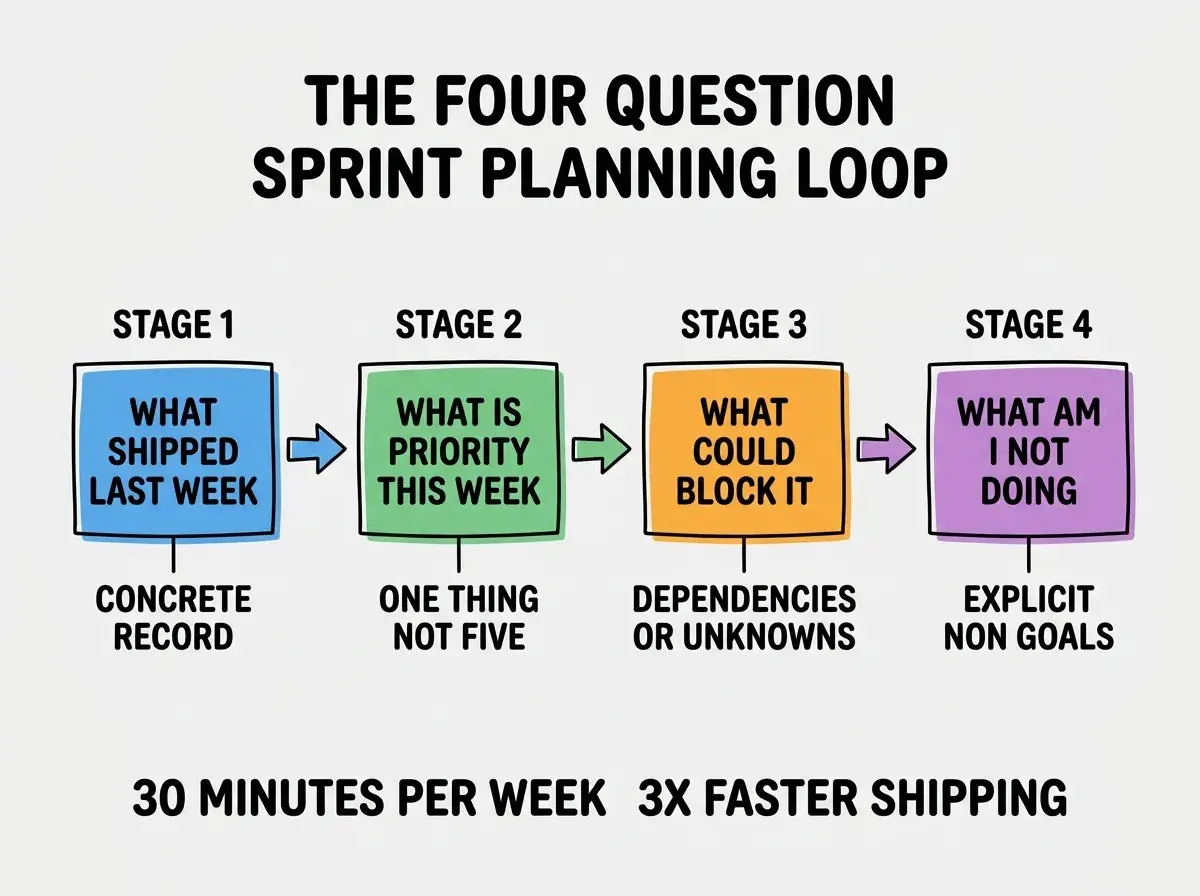
Question 3, what could block this week's priority. External dependencies, unknown technical risks, decisions waiting on someone else. Surfacing these upfront lets you address them early.
Question 4, what am I deliberately not doing. Explicit non-goals. The features that would be nice but are not the priority. Naming them prevents scope creep.
The Right Cadence for Solo Builders
Weekly is the cadence that works for most solo builders. Faster cadences create overhead without benefit; slower cadences let drift compound.
Why weekly works. Long enough to ship meaningful work. Short enough that priorities can shift based on what you learned. Aligns with most external rhythms (customer interactions, sales cycles, content calendars).
Browse more workflow and productivity guides
Read more tools articlesWhy daily is too much. Solo builders cannot completely change direction every day; the planning becomes overhead. Use a daily check-in instead (5 minutes, what is the next concrete task) for daily focus.
Why monthly is too little. A month of drift is hard to recover from. Weekly planning catches drift early.
The Rhythm That Prevents Drift
Three patterns keep weekly sprint planning effective rather than ritualistic.
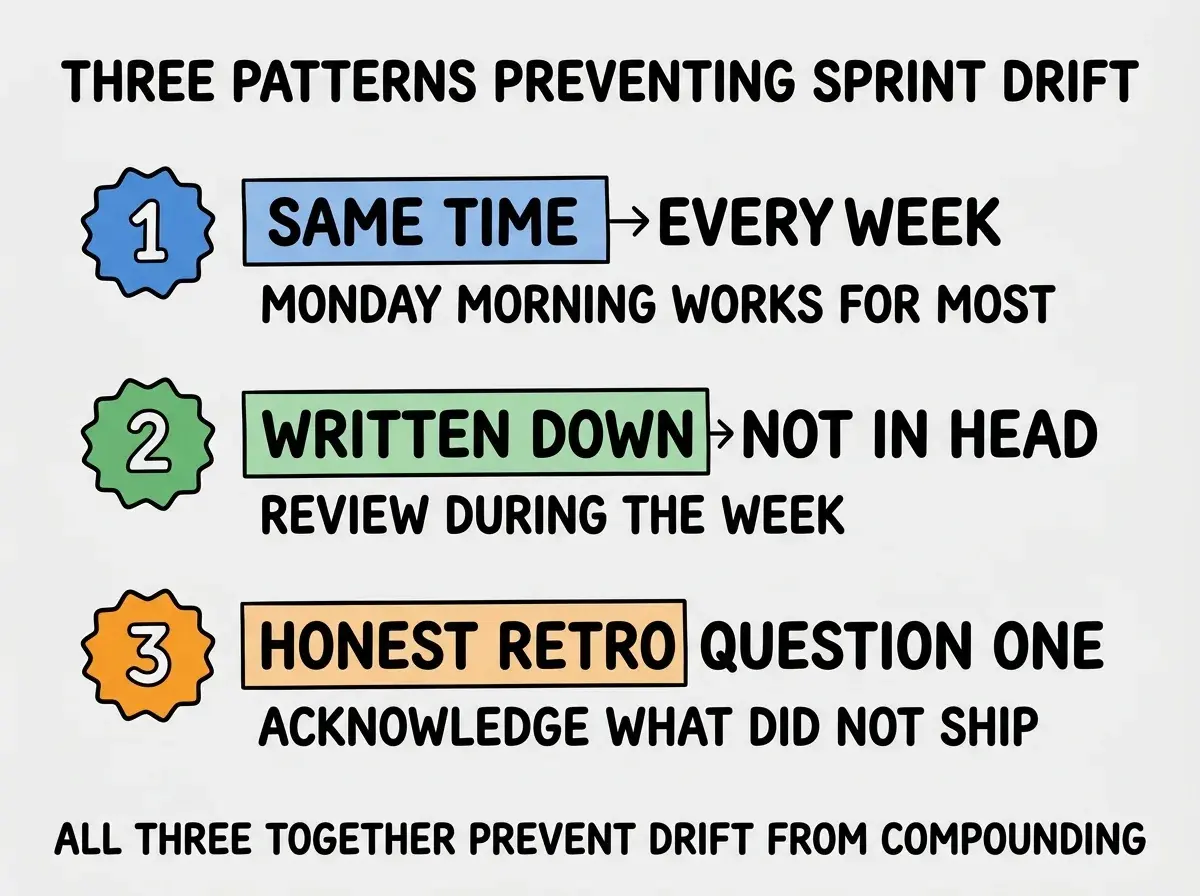
Pattern 1, same time every week. Monday morning works for most. The consistency makes planning automatic rather than requiring willpower.
Pattern 2, written down not in head. A plan in your head drifts; a plan on a doc you reference daily holds. Use a simple markdown file or Linear/Notion doc.
Pattern 3, honest retro on question one. When something did not ship, name it honestly. The acknowledgment prevents the same delay next week.
The "same time every week" pattern is the most underrated of the three because it removes the decision of when to plan from your weekly cognitive load. Solo builders who plan "whenever they remember" plan less consistently and skip the practice during exactly the weeks they need it most. Monday morning works because most external rhythms reset on Monday and the planning happens before the week's demands accumulate. Friday afternoon works for builders who prefer to start Monday already aligned. Pick a slot, defend it, and let the consistency do the work.
The "written down not in head" pattern matters because written plans force specificity that mental plans avoid. When you write down "ship the export feature this week," you are making a public commitment to yourself that becomes harder to silently abandon. When the priority lives only in your head, the abandonment is invisible and you discover it on Friday. The format does not matter much (markdown, Notion, Linear, paper) as long as the plan is somewhere you reference daily.
Tools That Support the Practice
The tooling for solo builder sprint planning is intentionally lightweight. A few tools work well together.
Tool 1, a markdown file in the project repo. Plans-this-week.md committed to git gives you version history and ensures the plan lives next to the work. The simplest option and often the best.
Tool 2, Linear or similar tracker. If you already use a tracker for tasks, the weekly priority can be a labeled item in the tracker. The plan and the work are integrated.
Tool 3, a paper notebook. For builders who think better with pen and paper, a physical notebook works fine. The downside is the plan is not searchable later; the upside is the writing forces deeper thinking.
Tool 4, a recurring calendar event. A 30-minute weekly slot on your calendar with the four questions in the description makes the planning automatic. Pair with one of the storage tools above.
The right combination is usually a recurring calendar event plus a markdown file in the repo. Calendar event ensures you do the planning; markdown file holds the plan. Together they are the lightest possible setup that produces consistent execution.
The most damaging sprint planning mistake is being too ambitious in the weekly priority. Solo builders consistently overestimate what they can ship in a week, set 5 priorities, complete 1, and finish the week feeling like they failed. The fix is to set ONE priority that you are 80 percent confident you can ship. If you finish early, do something else. If you barely make it, the priority was the right size. Calibrating ambition to reality is one of the most underrated solo builder skills.
The other mistake is skipping the planning when you feel busy. Busy weeks are exactly when planning matters most because drift is most likely. The 30 minutes feels expensive in a busy week and is the most leveraged 30 minutes you spend, because it prevents the unfocused execution that wastes the rest of the week.
What This Means For You
Sprint planning is one of the highest-leverage habits a solo builder can adopt in 2026. The time investment is small, the velocity gain is substantial, and the practice compounds across every project.
- If you're a founder: Adopt weekly sprint planning even if you are solo. The 30 minutes pays back many times over in shipping velocity.
- If you're changing careers: Sprint planning discipline is a transferable skill that applies to almost every job. Practice it on your own projects.
- If you're a student: Try the four-question loop on your study schedule for one semester. The clarity transfers to professional work.
Browse more workflow and productivity guides
Read more tools articles