Speed vs quality is the vibe coding tradeoff nobody talks about because vendors emphasize speed and critics emphasize quality. The reality is that both matter, but the right balance depends on context. Four scenarios favor speed (validation, demos, internal tools, time bound experiments), and four scenarios favor quality (production user data, financial transactions, long lived systems, regulated industries). Knowing which scenario you are in determines correct vibe coding strategy.
This piece walks through the eight scenarios, what favors speed in each, what favors quality in others, and the four mistakes builders make when applying the wrong scenario template.
Why Speed Vs Quality Tradeoff Matters
The speed vs quality tradeoff matters because applying the wrong template wastes effort. Quality investment in throwaway prototypes wastes time; speed prioritization in production systems wastes user trust.
The 2026 reality is that the loudest discourse treats one side as universally correct. Speed advocates ignore production realities; quality advocates ignore validation needs. Both extremes mislead.
A 2025 vibe coder survey of 800 builders found that 67 percent reported applying inappropriate quality standards to projects, either over engineering throwaways or under engineering production systems. Mismatch between scenario and approach is widespread; correction produces better outcomes than choosing one extreme.
The pattern to copy is the way photographers use different equipment for different shoots. Wedding photography needs different setup than product photography; both serve clients well. Vibe coding needs different approach for different scenarios; both serve builders well.
The Four Scenarios Where Speed Wins
Four scenarios make speed the right priority.
Scenario 1, idea validation. Test if anyone wants the thing. Speed reveals signal; polish wastes time before knowing if signal exists.
Scenario 2, demos and pitches. Show concept to investors or stakeholders. Working demo communicates better than polished documentation.
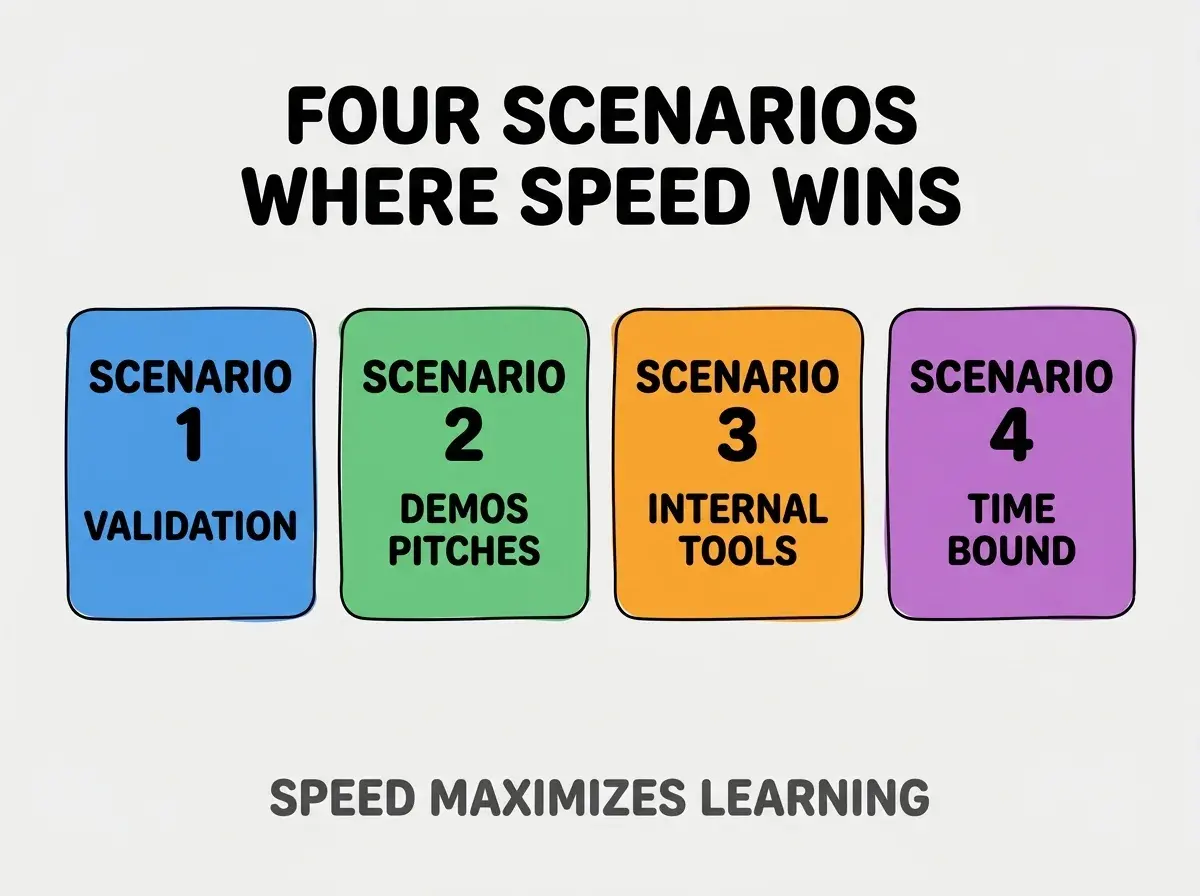
Scenario 3, internal tools for known users. Team uses tool, knows quirks, accepts limitations. Speed beats polish for internal scope.
Scenario 4, time bound experiments. Hackathons, weekend projects, time limited explorations. Speed maximizes what you ship in fixed window.
The Four Scenarios Where Quality Wins
Four scenarios make quality the right priority.
Scenario 5, production user data. Real users entering data they need preserved. Quality protects data they trust you with.
Browse more foundations
Read more foundationsScenario 6, financial transactions. Money handling. Quality prevents financial loss or compliance issues.
Scenario 7, long lived systems. Apps expected to run for years. Quality reduces maintenance burden over long horizon.
Scenario 8, regulated industries. Healthcare, finance, government. Quality prevents regulatory penalties.
How To Know Which Scenario You Are In
Three diagnostic patterns identify scenario.
Diagnostic 1, who uses the output. Real customers entering data favor quality; you alone testing favors speed.
Diagnostic 2, what happens if it breaks. User trust loss favors quality; learning that idea fails favors speed.
Diagnostic 3, expected lifespan. Years favor quality; days favor speed.
The combination produces scenario clarity. Without diagnostics, default templates apply incorrectly.
What Makes Tradeoff Awareness Sustainable
Three patterns separate sustainable tradeoff awareness from rigid quality or rigid speed positions.
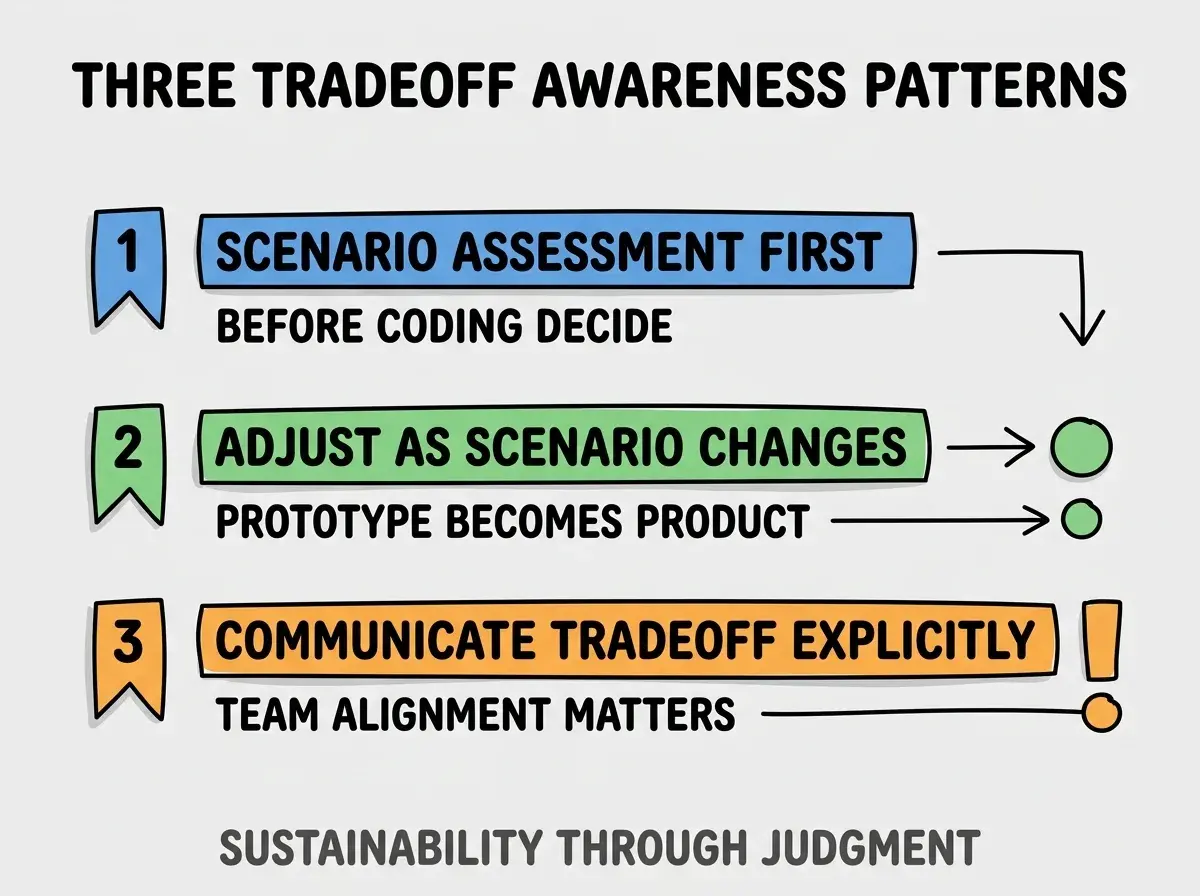
Pattern 1, scenario assessment before coding. Decide priority deliberately; not by default habit.
Pattern 2, adjust as scenario changes. Prototype that becomes product needs quality upgrade; recognize the transition.
Pattern 3, communicate tradeoff explicitly to team. Aligned teams make consistent decisions; unaligned teams thrash.
The combination produces sustainable tradeoff awareness. Without these patterns, individual decisions vary inconsistently.
How To Convert Speed Output To Quality Output
Three conversion patterns help when speed prototypes need quality upgrade.
Pattern A, identify quality gaps systematically. Audit error handling, edge cases, security, accessibility. Quality gaps become work list.
Pattern B, refactor in priority order. Fix highest impact gaps first; not random fixes. Impact prioritization.
Pattern C, add tests during refactor. Tests prevent regression while refactoring; without tests, refactor introduces new bugs.
Common Questions About Speed Vs Quality
The speed vs quality tradeoff raises questions worth addressing directly.
The first question is whether AI tools have eliminated the tradeoff. No; AI shifts the tradeoff but does not eliminate it. Quality work still takes more time than speed work.
The second question is whether to default to one or the other. Default to scenario assessment; scenarios determine priority. Default to either extreme produces wrong outcomes for many cases.
The third question is whether agencies should use speed or quality. Depends on client need; client briefing should specify. Defaults vary by agency positioning.
The fourth question is whether to ship speed first then upgrade. Sometimes; depends on whether speed output reveals validation. Validated ideas justify quality investment; unvalidated do not.
How Tradeoff Awareness Affects Career
Speed vs quality awareness affects career in compounding ways. Career effects compound across decades.
The first compounding effect is decision quality. Better tradeoff decisions produce better project outcomes; outcomes compound reputation.
The second compounding effect is team dynamics. Tradeoff communication aligns teams; alignment compounds team velocity.
The third compounding effect is hiring trajectories. Builders known for appropriate tradeoff judgment get senior roles; reputation compounds opportunity.
The combination produces career trajectories shaped by tradeoff judgment. Without awareness, careers face mismatch consequences without strategy to improve.
How To Recognize Scenario Transitions
Three transition patterns mark scenario changes.
Pattern A, internal tool gains external users. Former internal scope expands; quality requirements increase.
Pattern B, demo becomes product foundation. Demo code becomes basis for production; quality upgrade required before user exposure.
Pattern C, validated idea moves to production. Speed prototype validated; production scenario applies; quality investment justified.
The combination produces transition awareness. Without recognition, scenario changes happen without strategy adjustment.
The most damaging speed vs quality mistake is treating speed and quality as opposing values. They are tradeoffs in finite time, not opposing values. The fix is to view both as legitimate priorities for different scenarios; pick scenario appropriate priority each time. Builders who treat both as legitimate produce appropriate outputs; builders who treat one as superior produce wrong outputs for half their scenarios.
The other mistake is applying speed templates to quality scenarios. Speed code in production produces user trust loss that vibe coding rarely recovers from.
A third mistake is applying quality templates to speed scenarios. Over engineered validation prototypes prevent learning that quick prototypes enable.
A fourth mistake is missing the scenario reassessment opportunity. Scenarios change; periodic reassessment catches changes before quality mismatch produces incidents.
What This Means For You
Speed vs quality vibe coding tradeoff requires scenario specific judgment rather than universal preference. The eight scenarios, diagnostics, and transition patterns produce framework for context appropriate decisions.
- If you're a founder: Apply scenario thinking before each project; defaults waste time on wrong projects.
- If you're an indie hacker: Speed for validation; quality for paying customers; transition deliberately.
- If you're a senior dev: Lead scenario discussions in your team; alignment compounds team output.
Browse more foundations
Read more foundations