Your first enterprise prospect is going to ask for it. Maybe not in the first meeting, maybe not even in the second, but somewhere between the verbal "yes" and the signed contract, someone from their security team will send you a questionnaire with five words: "Do you have SOC 2?"
If your product was built with AI coding tools, and statistically it probably was (92% of developers now use AI daily, 87% of Fortune 500 companies have adopted vibe coding tools), this question carries extra weight. SOC 2 compliance for AI-built products is not just about checking boxes. It is about proving that your development process, including the parts where an AI wrote the code, meets the same trust standards as any other software.
Think of SOC 2 like a building inspection certificate. You can tell tenants your building is safe all day long. You can point to the walls, the fire exits, the sprinkler system. But until an independent inspector walks through, documents what they find, and issues a certificate, it is just your word. SOC 2 is that inspection certificate for your software systems.
What SOC 2 Actually Is
SOC 2 stands for System and Organization Controls 2, developed by the American Institute of Certified Public Accountants (AICPA). It is not a certification you pass or fail. It is an audit report produced by an independent CPA firm that evaluates how your organization handles customer data across five categories called Trust Service Criteria.
The audit examines your controls and tests whether they actually work. A SOC 2 Type I report evaluates the design of your controls at a specific point in time. A SOC 2 Type II report evaluates both the design and operating effectiveness of those controls over a period, usually 6 to 12 months. Enterprise buyers almost always want Type II.
Returning to the building inspection analogy: Type I is the inspector confirming the sprinkler system is installed correctly on the day they visit. Type II is the inspector reviewing maintenance logs, fire drill records, and incident reports over the past year to confirm the system has been working reliably the entire time.
The Five Trust Service Criteria
Every SOC 2 audit evaluates at least one of five categories. Security is always required. The other four are optional, chosen based on what matters for your product and customers.
Security is the baseline. It covers access controls, network monitoring, incident response, and change management. For AI-built products, this means demonstrating that your development pipeline, including AI-generated code, has controls around who can deploy what, and how changes are reviewed before reaching production.
Availability addresses whether your system is up and running as promised. If your SLA says 99.9% uptime, the auditor will check whether you deliver that and whether you have monitoring to maintain it.
Processing Integrity ensures your system processes data accurately and completely. If your AI-built product handles financial transactions or healthcare records, the auditor wants proof that data goes in, gets processed correctly, and comes out intact.
Confidentiality covers how you protect information designated as confidential, including access restrictions, data classification, and disposal procedures.
Privacy addresses how you collect, use, retain, and dispose of personal information. If your product handles PII, this criterion aligns closely with GDPR and CCPA requirements.
SOC 2 is not a pass/fail certification. It is an independent audit report that evaluates whether your controls actually work over time. Enterprise buyers care about Type II reports because they prove sustained operational discipline, not just a good setup on audit day. For AI-built products, every one of the five trust criteria has AI-specific implications that traditional compliance playbooks do not cover.
AI-Specific Challenges That Auditors Will Ask About
Here is where SOC 2 for AI-built products diverges from the traditional playbook. Auditors will probe areas that AI-assisted development makes genuinely harder to control.
Code provenance is the first challenge. When a developer writes code, the audit trail is straightforward: commit history shows who wrote what and when. When an AI coding tool generates code, provenance gets murky. Who is responsible for a function that Claude or Copilot generated? The developer who accepted the suggestion? The AI vendor? The answer, legally and for audit purposes, is you. Your organization owns every line of code in production, regardless of whether a human or an AI wrote it.
This means you need a documented process for reviewing AI-generated code before it enters your codebase. The auditor will want evidence that generated code goes through the same review process as human-written code. If your developers are accepting AI suggestions without review (a pattern sometimes called the "compulsive accept trap"), that is a control gap.
Dependency tracking is the second challenge. AI coding tools often introduce dependencies that developers did not explicitly choose. The tool adds a library, the developer accepts without evaluating the dependency's maintenance status, license compatibility, or known vulnerabilities. Your Software Bill of Materials (SBOM) needs to account for AI-introduced dependencies, and your vulnerability scanning needs to catch them.
Logging and auditability is the third challenge. SOC 2 requires demonstrating who did what and when. With AI tools in the pipeline, "who" includes the AI. You need logs capturing when AI-generated code was introduced, who reviewed it, and what testing it passed before deployment. If you cannot reconstruct the decision chain from "AI suggested this code" to "this code is in production," you have an audit gap.
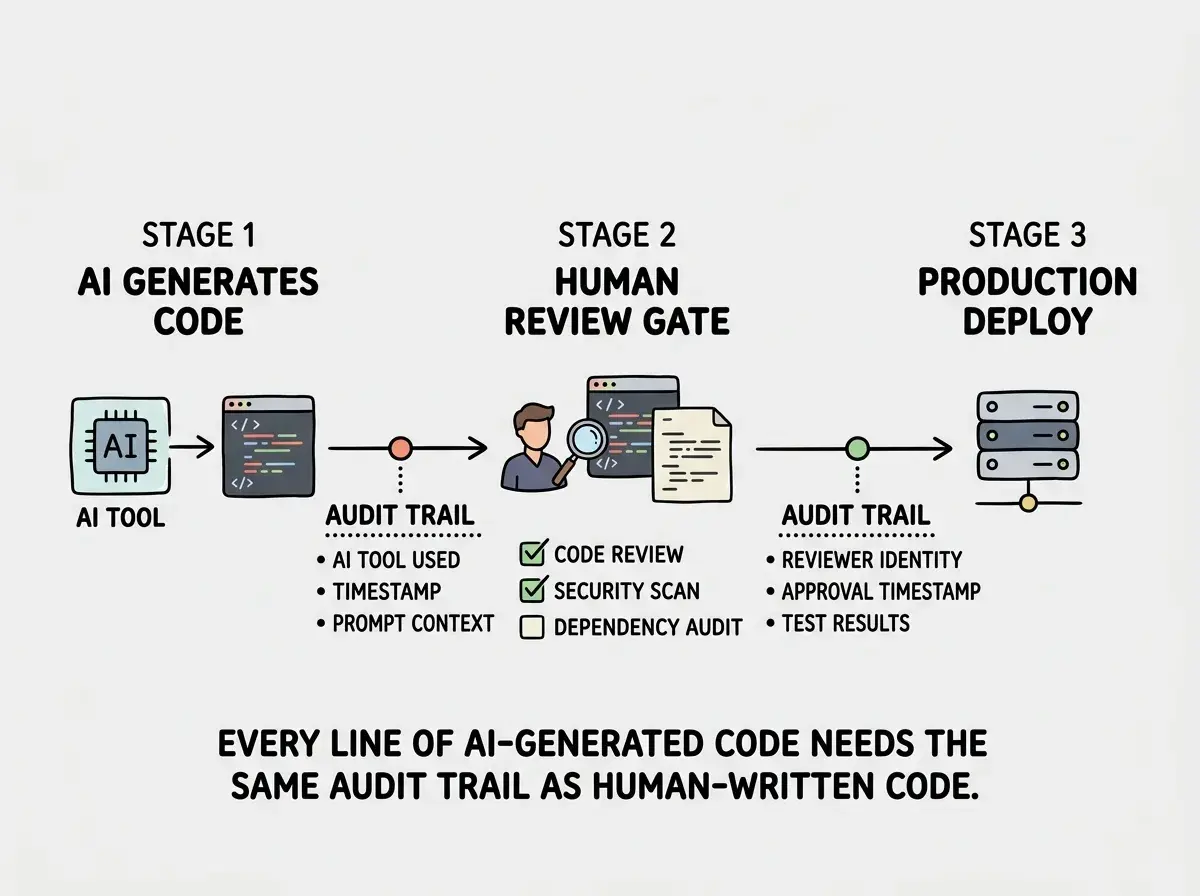
Think of it like building inspection records. The inspector does not just want to see that the electrical work was done correctly. They want to see who the licensed electrician was, when the work was completed, and which inspection it passed. "An AI did the wiring" is not an acceptable entry in the logbook.
Practical Steps for Startups
You do not need to boil the ocean. SOC 2 readiness is a progression, and the earlier you start building the habits, the less painful the actual audit becomes.
Start with Security as your only Trust Service Criterion. You can add Availability, Processing Integrity, Confidentiality, and Privacy later. Most early-stage enterprise deals only require Security.
Implement mandatory code review for all AI-generated code. No code reaches production without at least one human reviewing it. Set up branch protection rules. Require pull request approvals. Make the review gate non-negotiable.
Run automated security scanning in CI/CD. Tools like Snyk, Semgrep, or GitHub's built-in security scanning should run on every pull request, catching the common vulnerability patterns AI tools introduce (SQL injection, hardcoded secrets, missing auth checks).
Maintain a current SBOM. Track every dependency, including ones introduced by AI tools. Run npm audit or equivalent regularly. Know what is in your dependency tree.
Document your AI usage policy. Write down which AI tools your team uses, the review process for AI-generated code, and who is responsible for code quality. The auditor will ask, and "we do not have a formal policy" is a finding.
Set up centralized logging from day one. Capture deployment events, access changes, and security incidents. The audit will ask for evidence going back months. If you start logging when you start the audit, you will not have the history you need.
Security and compliance start with understanding what your code actually does.
Read the security guideWhen You Actually Need SOC 2
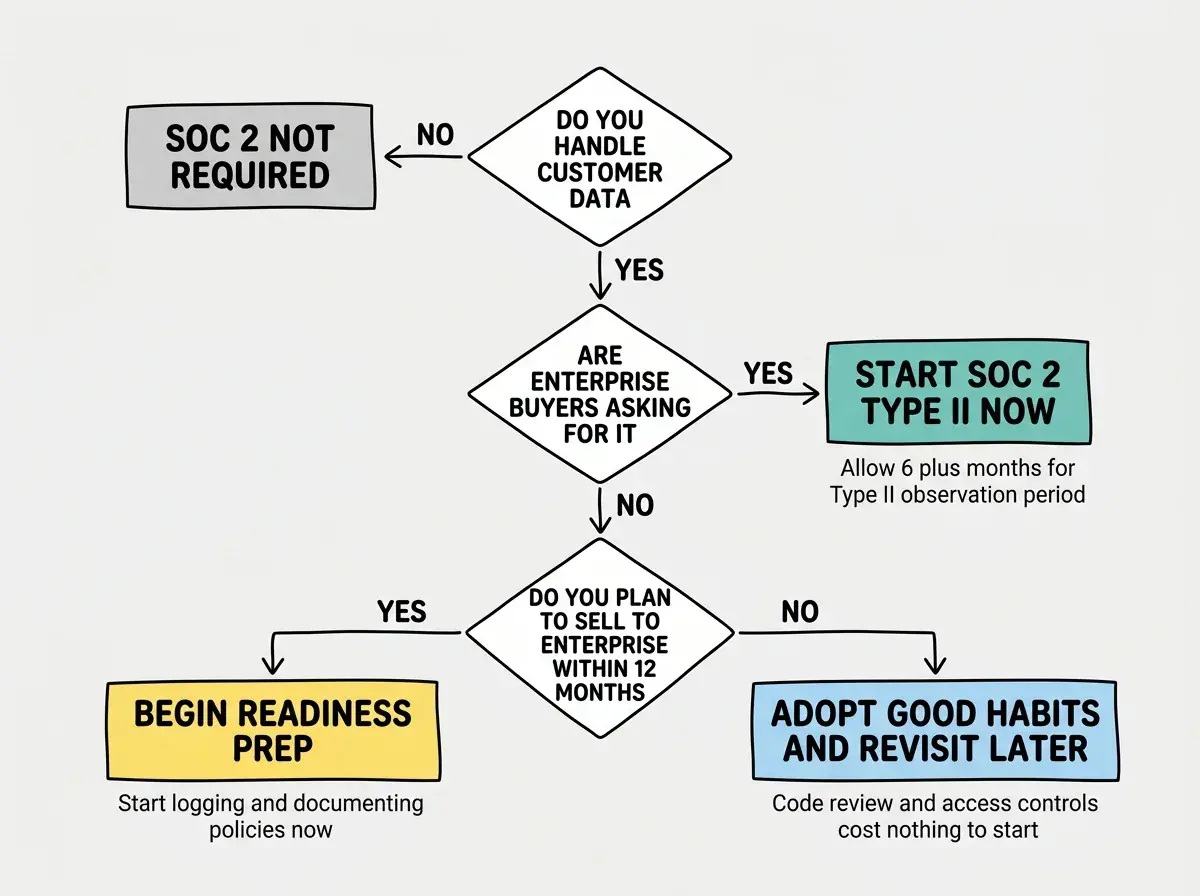
Not every product needs SOC 2, and not every product needs it right now. Here is how to think about timing.
You need it soon if you are selling to enterprise companies with 500+ employees, handling sensitive customer data (financial, healthcare, PII), or prospects are including SOC 2 in their vendor requirements. Start the readiness process at least 6 months before you expect to need the report, since Type II requires a minimum observation period.
You can wait if you are selling to small businesses, pre-product-market-fit, or no prospects have asked about it. But even then, adopt the habits (code review, logging, access controls) because retrofitting them later is significantly harder than building them in from the start.
You do not need it if you are building internal tools without customer data, in a space where SOC 2 is not the relevant standard (healthcare has HIPAA, payments has PCI DSS), or your product does not store external data.
The cost ranges from a few thousand dollars for readiness tooling (Vanta, Drata, Secureframe) to $20,000+ for the audit itself.
Many AI-built startups assume SOC 2 is a documentation exercise and try to rush through it by writing policies after the fact. Auditors test operating effectiveness, not just written policies. If your branch protection rules were enabled last month but your product has been in production for a year, the auditor will note that gap. Controls need to be functioning for the entire observation period. Start the habits early, even if the formal audit is months away.
The Building Inspection You Will Be Glad You Got
SOC 2 can feel like overhead, especially when you are moving fast and AI tools let you ship even faster. But go back to the building inspection analogy one more time. The inspection does not slow down construction. It happens after you have built the building. What it does is give your tenants (your enterprise customers) confidence that the building will not collapse on them.
For AI-built products, SOC 2 forces you to answer questions you should be answering anyway. Who reviews AI-generated code? How do you track dependencies the AI introduced? Can you reconstruct the decision chain for any piece of code in production?
These are not bureaucratic questions. They are engineering discipline questions. The companies that answer them early are the ones that close the deal while their competitors scramble to get audit-ready.
The 92% of developers using AI daily are building faster than ever. SOC 2 is how you prove that faster does not mean riskier.
Dig deeper
A few hand-picked sources if you want to go further.
From security fundamentals to compliance readiness, build the habits that enterprise customers expect.
Explore the guides