A portfolio with AI-assisted projects is the modern equivalent of a resume for technical roles, the artifact that proves you can ship things. The hiring landscape has shifted dramatically, and a thoughtfully assembled portfolio of AI-built work now beats traditional credentials for many entry-level and mid-level positions. The catch is that not every AI-built project counts. Hiring managers have learned to spot the difference between a portfolio of "I prompted ChatGPT" projects and a portfolio that actually demonstrates skill.
This guide walks through the four project types that consistently impress, the case study format that wins interviews, the portfolio structure that converts, and the specific mistakes that disqualify candidates immediately.
Why Portfolios Matter More Than Ever
The traditional credential pipeline (CS degree, internship, full-time offer) still works, but the alternative pipeline (portfolio of shipped projects, plus interview) has grown faster in the last two years than it has in the previous decade. Hiring managers are actively looking for candidates who can show evidence of shipping, not just degrees. The reason is simple, AI tools have made the gap between "talks about coding" and "ships software" enormous, and the portfolio is the cheapest way to prove you are on the right side.
The shift is most pronounced for career changers. A self-taught developer with three real projects shipped to production is now more hireable than the same person with three online certifications and no shipped work. The portfolio is the credential.
A 2025 hiring survey of 400 engineering managers across small and mid-sized companies found that 78% reviewed candidate portfolios before resumes, and that the median time spent per portfolio was 4.7 minutes. The first 30 seconds disproportionately influenced the rest of the review, which is why the project at the top matters more than the rest combined.
The pattern to copy is the architect's portfolio book. An architect's portfolio shows projects, photos, sketches, and the thinking behind each design. It does not list "skills" or "tools used." It shows work. Your software portfolio should follow the same structure, projects first, technical detail second, decorative skills lists last.
The Four Project Types That Win
After watching hiring managers review hundreds of portfolios, four project types consistently land interviews. The pattern is not about technical complexity, it is about what each project signals.
Type 1, the production app with real users. Any project that has actual users, even ten, is worth more than ten side projects nobody uses. The signal is that you can ship and maintain. Even a tiny tool with 50 monthly active users carries more weight than a beautiful portfolio site with no real usage.
Type 2, the technical deep dive. A project where you tackled a specific hard problem (a custom search engine, a real-time collaboration feature, a non-trivial data pipeline) and wrote up how you solved it. The signal is that you can think, not just generate. The write-up matters as much as the code.
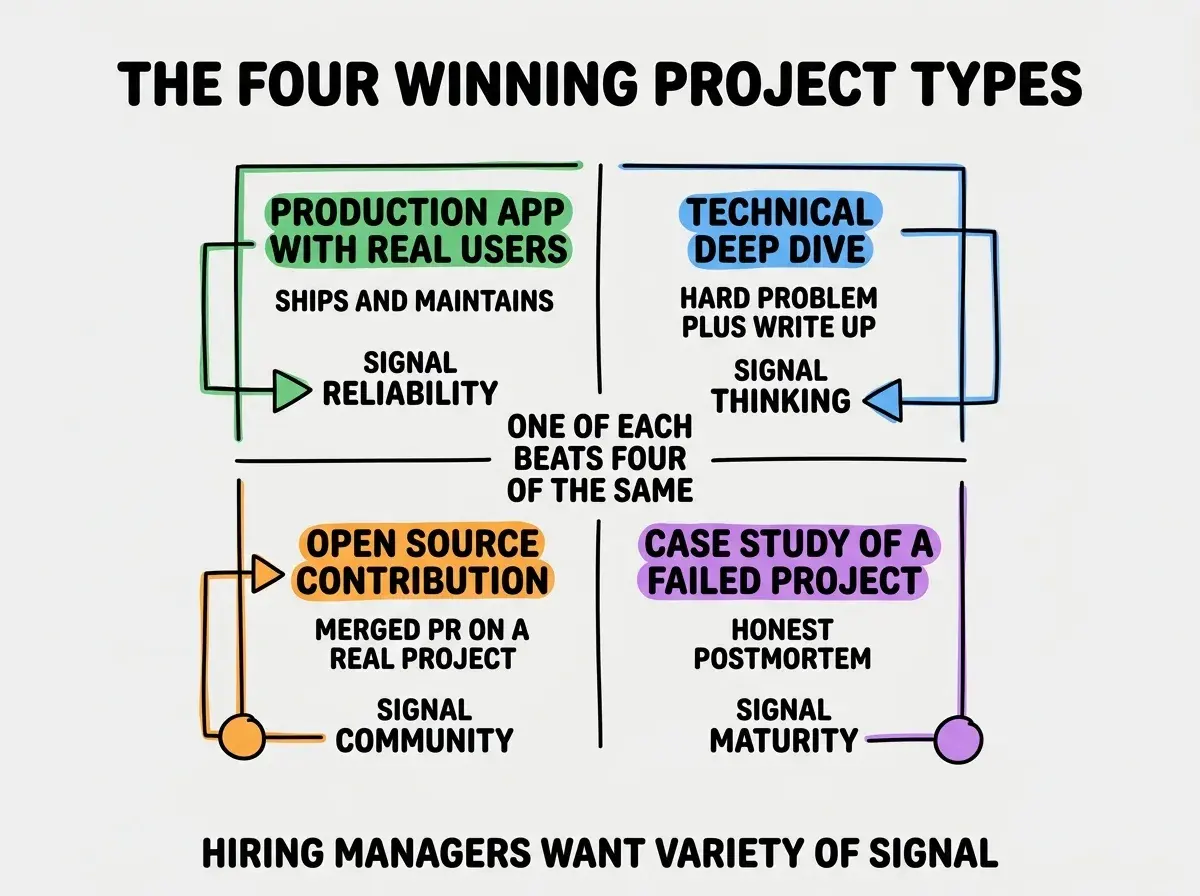
Type 3, the open source contribution. A merged pull request to an established open source project signals that you can read other people's code, follow conventions, and collaborate. The bar is low, even a documentation fix or a small bug fix counts. The signal is community.
Type 4, the case study of a failed project. This is the most underrated project type. A project that did not become a business, with an honest postmortem of what went wrong and what you learned, signals maturity. Most candidates hide failure. The ones who write about it well stand out enormously.
The Case Study Format That Wins
Each project in your portfolio needs a case study, a one-page write-up that explains what you built, why, what you learned, and what you would do differently. The format matters because reviewers read fast and look for specific signals.
The structure I recommend is, problem (1 paragraph), approach (1 paragraph), build details (2-3 paragraphs with screenshots or code snippets), challenges (1 paragraph with at least one specific challenge), what I learned (1 paragraph). Total length, 400 to 600 words. Long enough to convey substance, short enough to read in 90 seconds.
Read more career guides for vibe coders
Browse foundations articlesThe single most important section is "what I learned." Reviewers use it to gauge your reflective capacity, which is the strongest predictor of how fast you grow on the job. Write specific lessons ("I underestimated the cost of dependency drift, next time I would invest in CI from week one"), not generic platitudes ("I learned the importance of testing").
What to Include and What to Hide
Some choices about what to include or hide consistently separate strong portfolios from weak ones.
Include the AI tool stack you used. Hiding that you used AI is a red flag in 2026, every hiring manager assumes you did. Stating it openly and showing how you used it signals self-awareness. "Built with Claude Code, deployed via Vercel" is a strong line, "100% hand-coded" is a suspicious line.
Include live links and source code. Every project should have a live URL where it can actually be used and a public repo. Without both, the project is unverifiable and reviewers discount it heavily. Hosting costs are low, and the reviewer's trust is worth more than the few dollars saved.
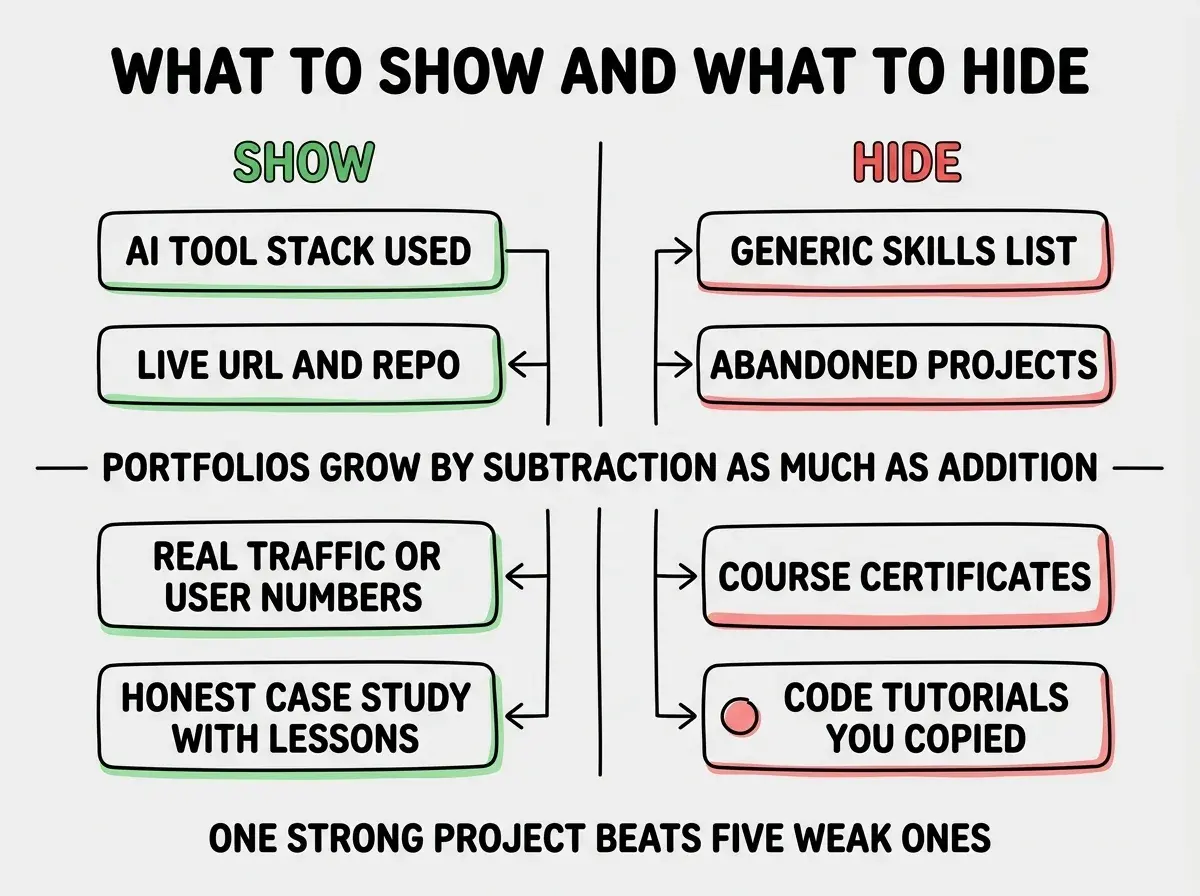
Hide the abandoned half-finished projects. Every portfolio has them, and they signal "starts things, does not finish things." Remove anything that is not at least at v1 or has been deliberately ended.
Hide the course certificates and "100 days of code" listings. They are time-based, not output-based. The portfolio is for showing what you built, not what you watched.
The most damaging portfolio mistake is the resume-style "skills list" with logos for every framework you have ever touched. It signals breadth without depth and tells the reviewer nothing useful. Drop the skills list, let the projects speak. The hiring manager will infer your skills from what you built, not from what you listed.
The corollary is that the portfolio should evolve. Every six months, look at what is on it and ask "would I hire someone based on this." Cut what does not pass the test, even if it took weeks to build. Portfolios grow by subtraction as much as addition.
The other piece worth practicing is the 30-second pitch. When someone clicks your portfolio link, they form an opinion in roughly 30 seconds. The hero project at the top, the case study summary, and the visible evidence of recent activity all influence that first opinion. Practice writing the opening 50 words of each case study like you are writing a movie trailer, because in some ways you are. The sentence that hooks attention is the one that gets the reader to scroll, and scrolling is what turns a portfolio click into an interview request.
What This Means For You
A portfolio in the AI era is the proof that you can do the work. Building one takes effort, but the leverage is enormous compared to traditional credentialing. Six focused months can produce a portfolio that lands meaningful job offers.
- If you're a founder: When hiring, prioritize candidates with portfolios over candidates with credentials. The shipping discipline shown in a portfolio predicts on-the-job performance better than any other signal.
- If you're changing careers: Spend the first three months of your transition shipping one strong project, not on courses. The project does more career work than any certificate.
- If you're a student: Start the portfolio in your first year. By graduation, you will have four years of compound work that competes with senior candidates.
Browse more career and learning guides
Read more foundations