Career paths in the age of vibe coding look different from the linear "junior to senior to staff engineer" ladder that dominated the last two decades. AI coding tools have collapsed parts of that ladder, accelerated others, and created entirely new tracks that did not exist three years ago. The result is four distinct career paths, each with different skills, different pay scales, and different growth trajectories. Knowing which path fits your situation is the most important career decision software people are making in 2026.
This piece explains the four paths, the skills each one requires, what they pay, and the choice points where one path becomes more or less viable than another.
Why the Career Ladder Changed
The traditional engineering ladder was structured around a specific assumption, that experience scales linearly with productivity. A senior engineer was 3 to 5 times more productive than a junior, and the company was willing to pay for that gap. AI coding tools have not eliminated the gap, but they have changed its shape. A junior with strong AI tooling is now 1.5 to 2x more productive than a junior without it. A senior with strong AI tooling is 2 to 3x more productive than a senior without it. The compression is real, and the compensation pyramid has started to shift.
The other shift is that some kinds of work that used to require seniors no longer do, while other kinds that used to be assumed are now scarce. Boilerplate code generation, basic CRUD apps, simple integrations, all of these are now solved problems that anyone with AI tools can do. Architectural judgment, debugging in production, security review, and the ability to refactor a tangled AI-built codebase are now the high-value skills.
A 2025 Stack Overflow developer survey found that 92% of US developers use AI tools daily, but only 33% trust them for work shipped to production without review. The gap between use and trust is where the new career paths emerged, the senior judgment of what to ship is now the bottleneck, not the speed of writing code.
The pattern to copy is the architecture profession after the introduction of CAD software. CAD did not eliminate architects, but it changed which skills mattered. Drawing skill became less important, design judgment and client management became more important, and a new tier of "CAD specialist" emerged. Software is going through the same transition, just compressed.
The Four Paths
After watching the last two years of hiring trends, four distinct career paths have crystallized. Each has different requirements, different ceilings, and different next-step options.
Path 1, the AI-assisted engineer. This is the closest equivalent to the traditional engineer, but with AI as a primary tool. The skills are the same as before plus prompt engineering, AI judgment, and the ability to review AI-generated code at speed. Median compensation in 2026 is 130k to 220k for mid-level, 220k to 380k for senior, with the top of the market reaching 500k+ at frontier labs.
Path 2, the product engineer. This path leans into AI for the routine work and emphasizes business judgment, product thinking, and customer-facing skills. Product engineers ship features end-to-end, talk to users, and own outcomes more than code. The compensation range is similar to AI-assisted engineering but with more equity and less pure cash.
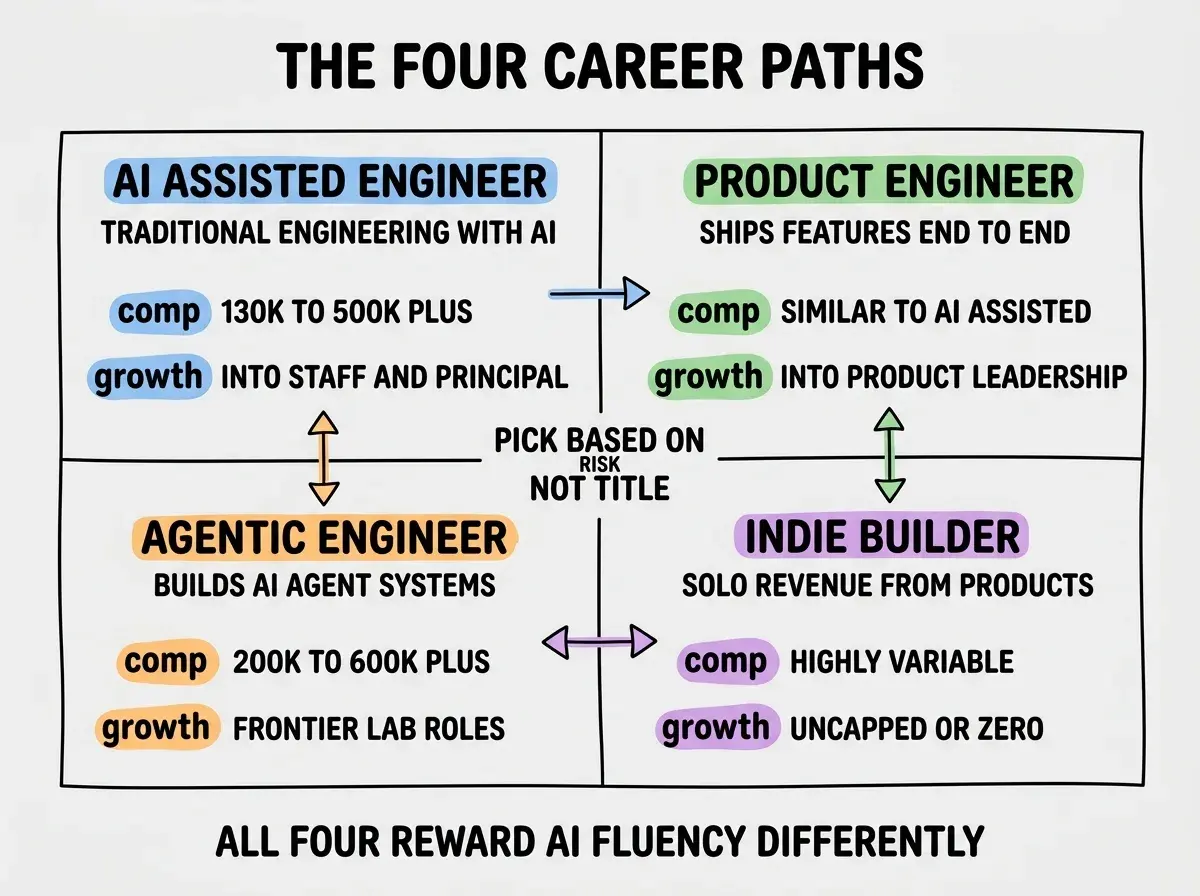
Path 3, the agentic engineer. This is the newest path. Agentic engineers build systems where AI agents do meaningful work autonomously, with human oversight and review. The skills include traditional engineering plus prompt design, agent architecture, evaluation and safety frameworks, and the ability to debug emergent behavior. Compensation skews higher, 200k to 600k+ at the top, because the supply of qualified people is small.
Path 4, the indie builder. This path uses AI tools to build and ship products solo, monetizing through subscriptions, one-time sales, or marketplaces. The compensation is highly variable, anywhere from zero to 500k+ per year depending on what you ship. The path requires entrepreneurial skill more than technical skill, and most who try it do not succeed. The ones who do often outearn their employed peers.
How to Pick Your Path
The honest framework for choosing a path is risk tolerance times skill profile. Path 1 is the lowest risk and the most predictable. Path 4 is the highest risk and the least predictable. Paths 2 and 3 fall in the middle but require different skill investments.
If you want stability, optimize for path 1 or 2. If you want maximum upside and you have entrepreneurial wiring, optimize for path 4. If you are technically curious and want to be at the frontier, path 3 is where the most interesting work is happening.
Read more career and learning guides for the AI era
Browse foundations articlesThe skills that transfer across all four paths are the same, judgment about what to ship, the ability to read code (even if you do not write much of it), debugging discipline, and clear written communication. Investing in those is path-agnostic. Specialization happens later, after you have tried at least one path for 6 to 12 months.
What Each Path Demands in 2026
Each path has a slightly different "core skill stack" that defines what good looks like in 2026. Investing in the right stack for your chosen path is what produces meaningful career outcomes.
For AI-assisted engineering, the core stack is, depth in one language, breadth across one frontend framework and one backend stack, AI tool fluency (Cursor, Claude Code, GitHub Copilot), code review skill, and architecture judgment. The promotion path is into staff and principal engineer roles.
For product engineering, the core stack is the same engineering depth plus user research, product analytics, copywriting, and the ability to scope features. The promotion path is into product leadership, often Director of Engineering or VP Product.
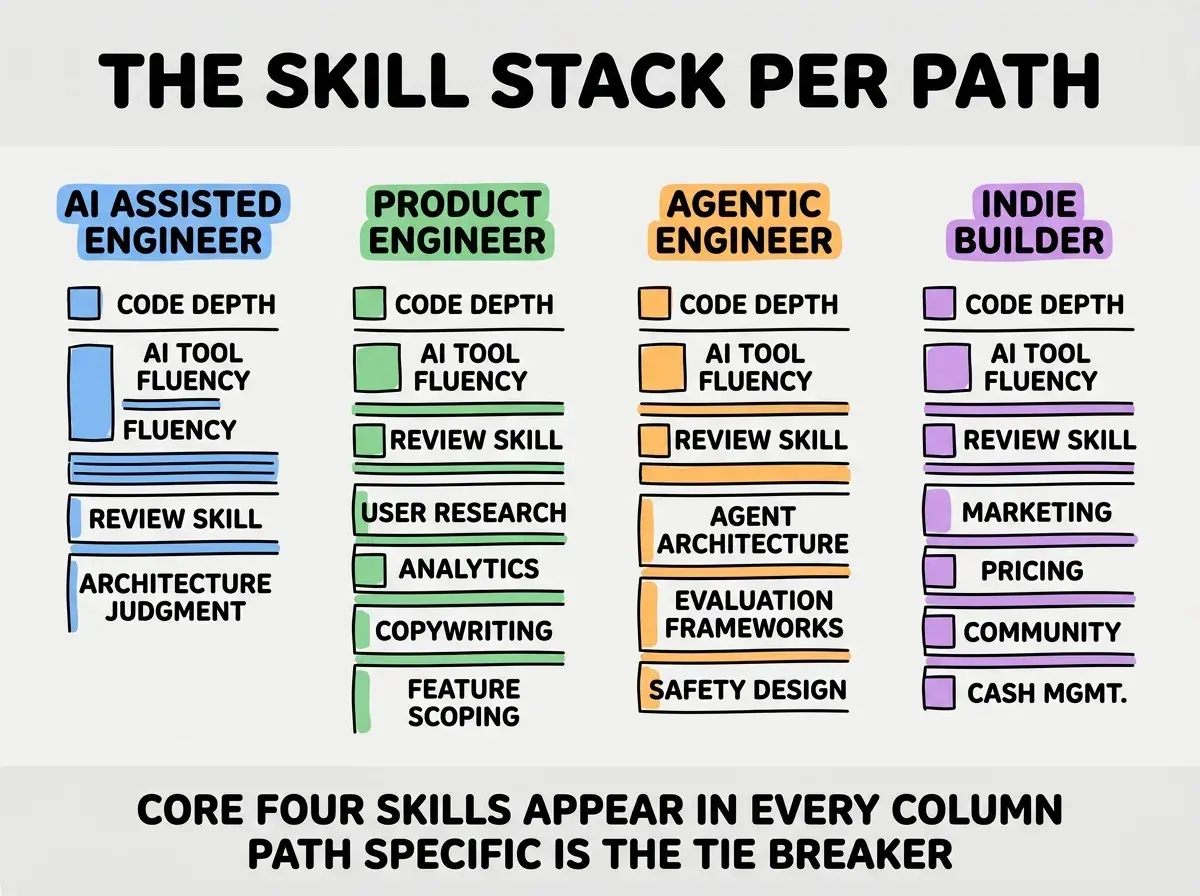
For agentic engineering, the stack adds agent architecture, evaluation framework design, prompt engineering at depth, and safety thinking. The promotion path is into research roles, frontier lab positions, or staff engineer at AI-first companies.
For indie building, the stack is engineering plus marketing, pricing, community building, and cash management. The "promotion" is your business growing, and the path-specific skills look more like running a small company than climbing an engineering ladder.
The most expensive career mistake in vibe coding is picking a path based on title or salary alone. The four paths look similar at the top of the comp range but reward very different daily activities. A path 4 indie builder who hates marketing will be miserable even if they hit 500k. Pick based on what work you want to do most days, not what the highest tier looks like.
The corollary is that switching paths costs something but is not impossible. Most senior engineers have switched paths at least once, sometimes twice, over a career. The cost is usually 6 to 18 months of slower growth while you learn the path-specific skills.
What This Means For You
The career landscape is more varied than it has been in decades, and the variety is still expanding. Picking thoughtfully is more important than committing early.
- If you're a founder: Knowing which path your hires want is critical. Pitching path 1 stability to someone who wants path 4 freedom (or vice versa) is the most common reason early hires churn.
- If you're changing careers: The non-traditional paths (3 and 4) are more open to career changers than they were five years ago, because the senior bottleneck has shifted.
- If you're a student: Try at least one project on each of the four paths during your first two years post-graduation. The fastest way to know which path fits is direct experience, not introspection.
Browse more career guides for vibe coders
Read more foundations