To navigate the AI code labeling debate in 2026, recognize that there are legitimate arguments on both sides (transparency builds trust, but labeling implies AI code is inferior), evaluate against four practical decisions you face today (whether to label AI usage in your product, in your code commits, in your contributions to open-source, in your portfolio work), and adopt patterns that match your specific context rather than following one-size-fits-all rules. The labeling question has no universal answer; it has context-specific answers that vary by audience and purpose.
This piece walks through the arguments on both sides, the four practical decisions you face, the patterns that work in different contexts, and the four mistakes builders make when reasoning about transparency.
Why This Question Has No Easy Answer
The labeling debate involves competing legitimate values: transparency vs autonomy, disclosure vs stigma, honesty vs marketing. Reasonable people disagree about the right balance. The debate is unlikely to resolve into a single answer; the question is how to navigate it thoughtfully.
The 2026 reality is that different contexts produce different right answers. Customer-facing products often benefit from disclosure; portfolio work often does not. Open-source contributions face different norms than proprietary work. Context-aware decisions outperform universal rules.
A 2025 Pew Research survey of 5,000 software users found that 64 percent wanted to know when AI was involved in software they used, but only 23 percent would refuse to use disclosed AI-built software. The data suggests users want transparency without strong preference against AI; the labeling concern (that disclosure would harm adoption) is largely unsupported. Disclosure is generally low-risk and increasingly expected.
The pattern to copy is the way food labeling evolved. Food labeling was contentious initially; producers worried about consumer reactions to specific ingredients. The reality was that consumers wanted information and made nuanced decisions; labeling did not produce the disasters producers feared. AI labeling is following a similar trajectory; transparency proves less harmful than feared.
The Four Arguments For Labeling
Four arguments support labeling AI-generated code in user-facing contexts.
Argument 1, transparency builds user trust. Users who feel they are being deceived (about AI involvement) lose trust when they discover it. Disclosure prevents the trust damage that follows surprise discovery of concealed information.
Argument 2, regulatory direction favors transparency. EU AI Act, US state laws, sector-specific guidance all trend toward more disclosure. Building disclosure now anticipates likely future requirements at substantially lower cost than retrofit.
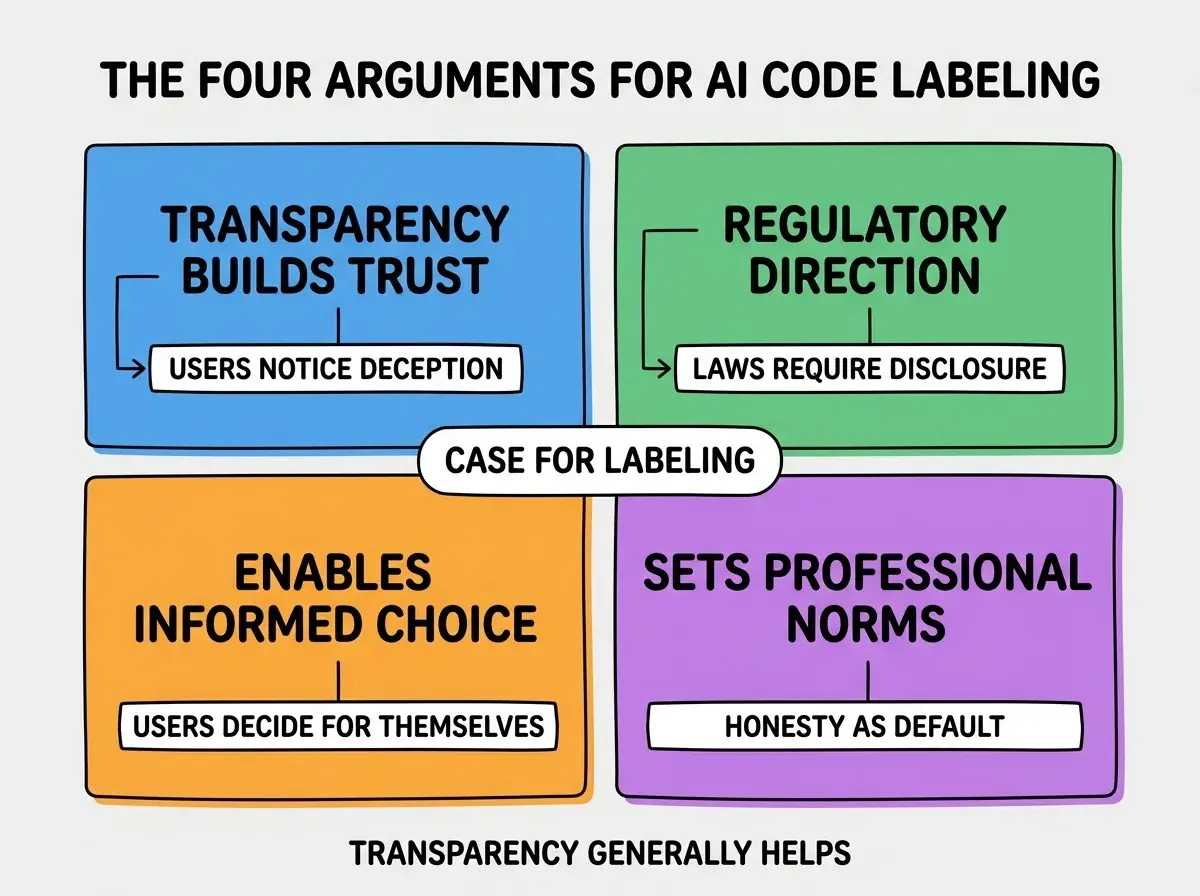
Argument 3, enables informed user choice. Some users have preferences about AI involvement; they cannot exercise those preferences without disclosure. Choice requires information; transparency enables choice rather than imposing it.
Argument 4, sets professional norms. Disclosure normalized makes the industry better; concealment normalized makes it worse. The collective effect of individual disclosure decisions shapes the field over years and decades.
The Four Arguments Against Labeling
Four arguments raise concerns about labeling, each worth considering.
Argument 1, labeling implies AI code is inferior. Like organic labels imply non-organic is worse, AI labels can imply non-AI is better. The implication may be unwarranted but is hard to prevent in practice.
Browse more transparency and ethics guides
Read more foundations articlesArgument 2, the line between AI and human is increasingly blurry. When an AI generates 70 percent of a function and a human modifies 30 percent, who wrote it? Labels imply clean categorization that may not exist in practice; the granularity question is hard to answer consistently.
Argument 3, labels can create stigma without educating. Users see "AI-generated" labels but do not understand what they mean or how to evaluate. The labels become noise rather than information; education must accompany labeling for it to mean something.
Argument 4, competitive disadvantage if not universal. If only some products label, those that label face competitive friction with those that do not. Universal adoption would solve this; partial adoption creates uneven playing field where ethics is penalized financially.
The Four Practical Decisions You Face
Three practical decisions arise for most builders. Each has different right answers.
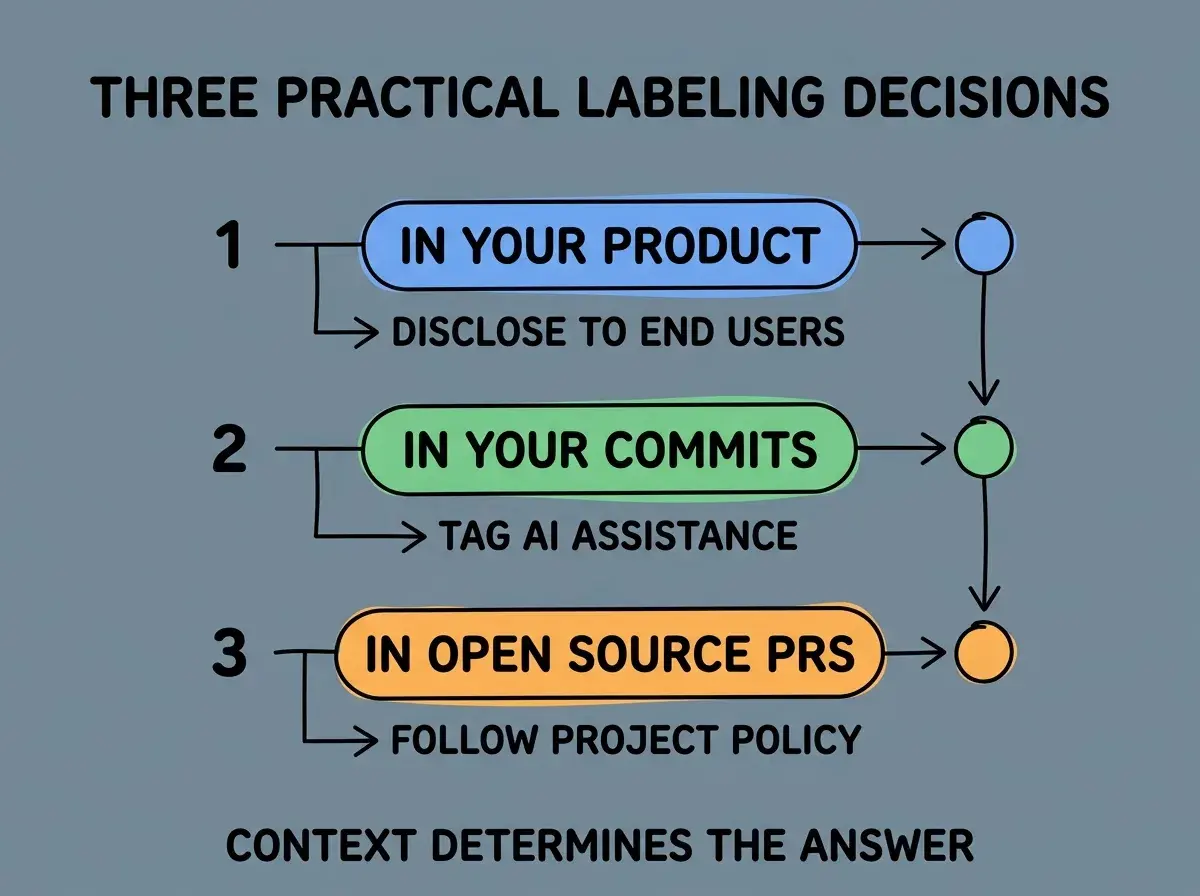
Decision 1, in your product to end users. Generally favor disclosure for AI-generated content (text, images, code) shown to users. Light-touch disclosure is usually sufficient; heavy-handed warnings often produce more friction than they should.
Decision 2, in your code commits. Tagging AI-assisted commits is increasingly common. Helps with future debugging and reviews; does not require user-facing change; useful for internal accountability tracking.
Decision 3, in open-source PRs. Follow each project's specific policy. Some require disclosure; some do not; some prohibit AI contributions entirely. Read the contribution guidelines before submitting AI-assisted work.
How Different Industries Are Handling Labeling
Three industry-specific patterns illustrate how the labeling debate plays out in different contexts.
Industry 1, journalism and media. Many news organizations now label AI-assisted articles. The transparency is increasingly required by readers and editorial standards alike.
Industry 2, software development. Mixed practice. Some teams label AI commits; some do not. Open-source projects vary widely; commercial products generally avoid labeling for marketing reasons.
Industry 3, design and creative. Fashion, design, and creative industries are wrestling with labeling. Stock photo sites have explicit policies; design portfolios are still figuring it out.
The combination shows that labeling norms vary by industry context. Software is in early stages of working out norms; the next 2-3 years will produce more clarity.
How to Decide Your Personal Position
Three principles help develop a personal position on labeling that you can defend.
Principle 1, default to disclosure unless you have specific reason not to. Disclosure is generally low-cost and aligns with where regulation is heading; the burden of proof should be on concealment, not transparency.
Principle 2, distinguish between tools and authorship. "Built with AI assistance" is reasonable; "AI built this" is rarely accurate when humans were involved. Calibrate the disclosure to actual involvement.
Principle 3, watch how your audience responds. Some audiences want disclosure; others do not care; some are skeptical of disclosed AI involvement. Adjust based on your audience response.
The combination produces position you can defend in conversation. Without an explicit position, builders default to whatever feels comfortable in the moment, which produces inconsistent practice.
The most damaging labeling mistake is hiding AI involvement when prospects or customers might discover it. Sophisticated audiences (investors, technical buyers, journalists) often detect AI involvement; the perceived deception when discovered damages trust more than disclosure would have. The fix is to default to honest disclosure even when not strictly required; the worst case (slight friction) is far better than the worst case of concealment (trust damage when discovered). Honesty plus framing works better than concealment plus rationalization.
The other mistake is treating labeling as binary when graduated disclosure works better. "AI-assisted" is different from "AI-generated"; "trained on AI patterns" is different from "AI wrote every line." The fix is to use language that accurately reflects involvement; precision serves users better than blanket labels.
A third mistake is letting the labeling debate paralyze decision-making. Some builders spend months agonizing over the right approach. The fix is to pick a reasonable default position and adjust based on feedback; reasonable disclosure that gets applied consistently outperforms perfect disclosure that never ships.
What This Means For You
The AI labeling debate is real and unresolved in 2026. The four arguments on each side, the practical decisions, and the personal position framework produce thoughtful navigation rather than reflexive responses.
- If you're a founder: Develop your labeling position before customers ask. Having a thoughtful answer ready beats improvising under pressure.
- If you're changing careers into development: The labeling question is becoming part of professional ethics in software. Engage with it thoughtfully as you build your career.
- If you're a student: Practice the disclosure decisions on portfolio work. Building the habit early makes professional decisions easier later.
Browse more ethics and policy guides
Read more foundations articles