The deskilling debate asks whether AI assisted programming makes individual programmers less skilled over time. Four positions exist: pure deskilling (AI atrophies skills), augmentation (AI amplifies skills), bifurcation (AI separates skilled from unskilled programmers), and reskilling (AI shifts which skills matter). Evidence suggests bifurcation and reskilling more than pure deskilling; outcomes depend on individual practice habits more than tool availability.
This piece walks through the four positions, what evidence supports each, what determines individual outcomes, and the four mistakes when interpreting deskilling claims.
Why The Deskilling Debate Matters
The deskilling debate matters because individual practice decisions today shape skill trajectories across decades. Wrong assumptions produce wrong practice; wrong practice produces career consequences.
The 2026 reality is that the debate has matured beyond initial AI hype and pessimism. Nuanced positions backed by evidence dominate; simple yes or no positions misrepresent reality.
A 2025 longitudinal study of 500 developers tracked over 18 months found that developers who maintained deliberate practice without AI maintained skills, while developers who relied entirely on AI for routine work showed measurable skill decay in fundamentals. Skill outcomes correlated with practice habits, not AI use volume.
The pattern to copy is the way calculator adoption shaped math education. Calculators replaced some calculation skills; foundational math skills became more important, not less. Math educators adapted; some students gained, some lost. AI assisted programming follows similar trajectory.
The Four Positions
Four positions characterize the deskilling debate.
Position 1, pure deskilling. AI atrophies programming skills; reliance produces dependence; long term capability decreases.
Position 2, augmentation. AI amplifies existing skills; skilled programmers become more skilled; AI is leverage.
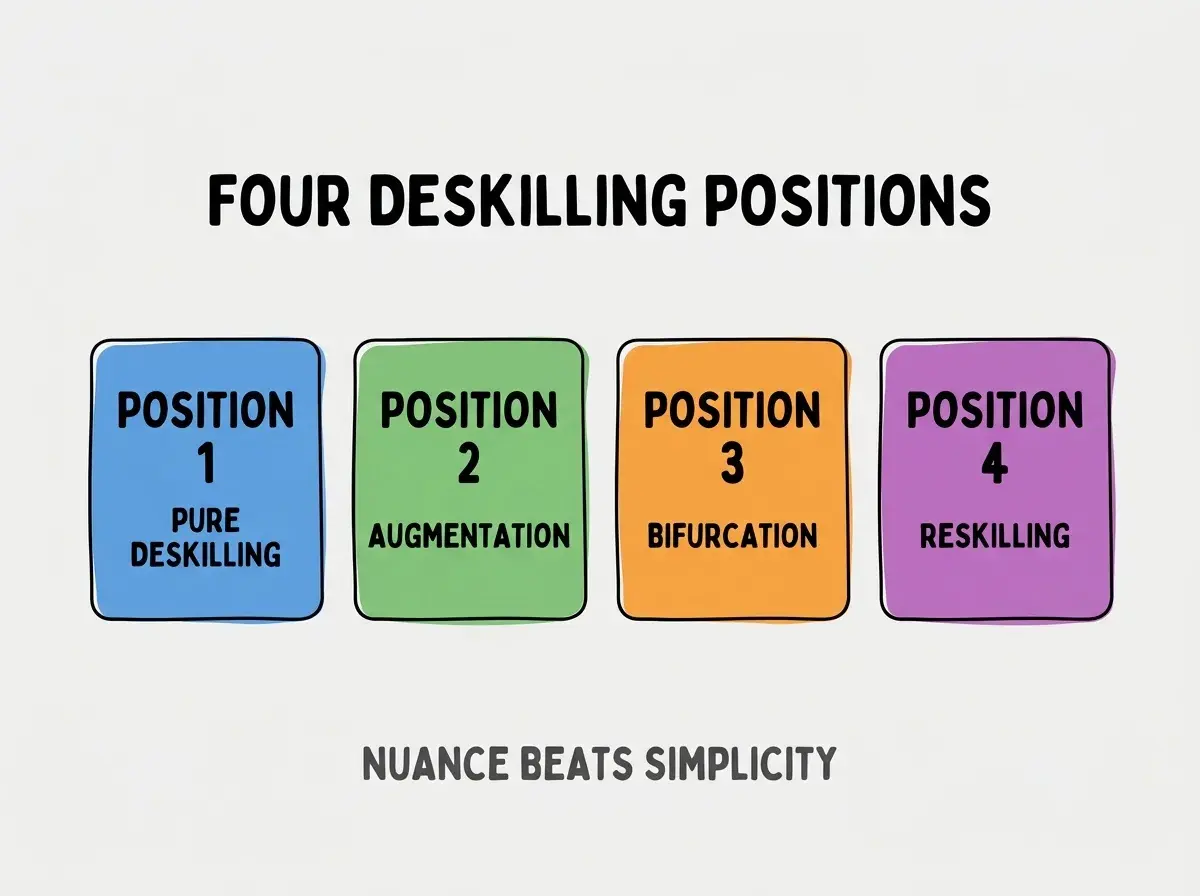
Position 3, bifurcation. AI separates skilled from unskilled; gap widens between groups.
Position 4, reskilling. AI shifts which skills matter; old skills decline, new skills rise; net skill changes.
What Evidence Supports Each Position
Four evidence patterns inform position assessment.
Evidence for pure deskilling. Some developers report skill decay in areas they delegate to AI. Decay real but not universal.
Browse more foundations
Read more foundationsEvidence for augmentation. Senior developers achieve dramatic productivity gains; gains compound their existing skill.
Evidence for bifurcation. Productivity gap between skilled and unskilled developers widens; bifurcation evidence strong.
Evidence for reskilling. New skills (prompting, AI judgment, system design) become valuable; old skills (memorized syntax) less valuable.
What Determines Individual Outcomes
Three factors determine which position matches individual outcomes.
Factor 1, deliberate practice habits. Developers who maintain deliberate practice avoid pure deskilling.
Factor 2, fundamental skill foundation. Developers with strong fundamentals see augmentation; weak fundamentals limit AI productivity.
Factor 3, AI use intentionality. Intentional AI use produces gains; default AI use produces dependence.
What Makes Skill Maintenance Sustainable
Three patterns separate sustainable skill maintenance from skill decay.
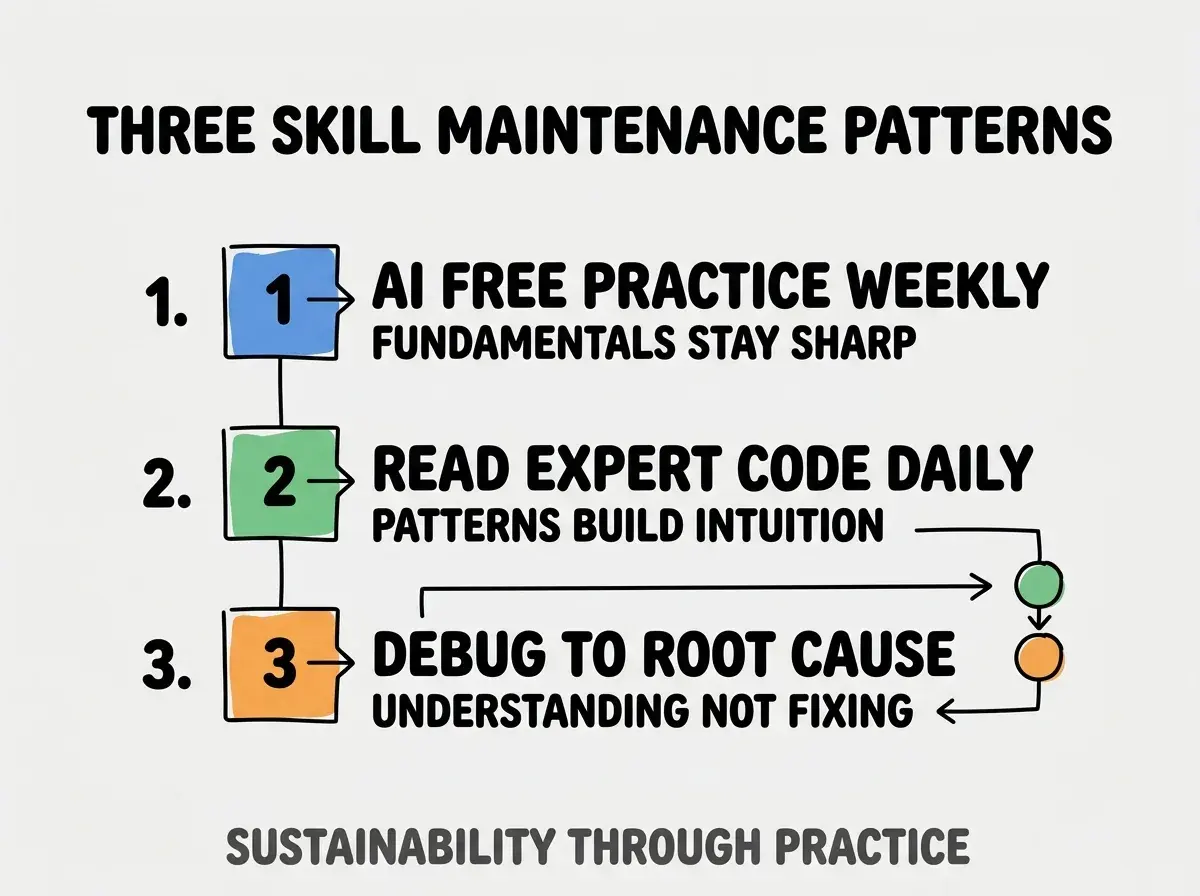
Pattern 1, AI free practice weekly. Periodic AI free coding maintains base capability.
Pattern 2, read expert code daily. Reading builds patterns that AI use cannot teach.
Pattern 3, debug to root cause. Root cause debugging builds understanding; surface fixes do not.
The combination produces sustained skill development. Without these patterns, skills decay despite AI productivity.
How To Position For Long Term Skill
Three positioning patterns help individual developers.
Pattern A, embrace AI as amplifier. Use AI for routine; reserve thinking time for non routine; amplification compounds.
Pattern B, invest in fundamentals continuously. Fundamentals enable AI productivity; investment pays back exponentially.
Pattern C, develop AI judgment specifically. Judgment about AI output is new skill; develop deliberately.
Common Questions About Deskilling
The deskilling debate raises questions worth addressing directly.
The first question is whether to limit AI use to prevent deskilling. Limiting AI use sometimes appropriate; total avoidance unlikely optimal.
The second question is whether deskilling affects all programmers equally. No; effects depend on individual practice and starting skill.
The third question is whether new programmers should learn without AI first. Brief foundational period without AI helpful; extended avoidance unnecessary.
The fourth question is whether AI dependence is reversible. Yes with deliberate practice; reversal takes time and effort.
How Deskilling Affects Career Trajectories
Deskilling affects career trajectories in compounding ways. Career effects compound across decades.
The first compounding effect is skill ceiling. Strong skills enable advancement; weak skills limit ceiling.
The second compounding effect is hiring competitiveness. Skilled developers compete for senior roles; less skilled compete for commodity roles.
The third compounding effect is income trajectory. Skill differentiates compensation; differentiation compounds across raises.
The combination produces career trajectories shaped by skill development. Without skill maintenance, trajectories plateau.
How To Recover From Skill Decay
Three recovery patterns work for developers experiencing skill decay.
Pattern A, identify specific decay areas. Decay usually specific to certain skills; identification enables targeted recovery.
Pattern B, structured practice in decay areas. Deliberate practice in identified areas; practice rebuilds.
Pattern C, time off AI tools periodically. Periodic AI breaks reveal what skills decayed; awareness enables recovery.
The combination produces skill recovery. Without recovery effort, decay continues.
The most damaging deskilling mistake is treating the debate as binary (AI good or AI bad). The debate is about practice habits more than tool use; same tool produces different outcomes for different practitioners. The fix is to focus on practice rather than tool position; practice determines individual outcomes regardless of which deskilling position is most correct in aggregate. Developers who focus on practice maintain skill; developers who focus on tool position miss what actually matters.
The other mistake is over claiming personal deskilling. Self assessment unreliable; measurement reveals truth that perception obscures.
A third mistake is missing the bifurcation reality. Bifurcation is happening; ignoring bifurcation produces career stagnation.
A fourth mistake is treating skill as static. Skills require maintenance; static skill assumption produces decay.
What This Means For You
The deskilling debate reveals that programmer skill outcomes depend on practice habits more than tool availability. The four positions, evidence, and maintenance patterns produce framework for skill development that compounds across career.
- If you're a senior dev: Maintain deliberate AI free practice; investment compounds skill maintenance.
- If you're a student: Build foundations deliberately; foundations determine AI productivity ceiling.
Browse more foundations
Read more foundations