To ship code you do not fully understand responsibly in 2026, accept that you remain ethically responsible for what your software does even when AI wrote the code, evaluate against four risk dimensions that determine how much understanding is required (user safety implications, financial consequences, regulatory exposure, and reputational stakes), and invest in understanding proportional to risk rather than uniformly. Shipping AI-generated code is not unethical by itself; shipping high-risk code without sufficient understanding is.
This piece walks through the four risk dimensions, the understanding-by-risk principle, the patterns for safe shipping, and the four mistakes founders make when reasoning about AI code responsibility.
Why This Question Matters Now
In 2026, AI tools generate substantial portions of shipped code at many companies. The traditional model where every line was written by a developer who understood it has shifted. Some lines are written by AI and shipped by humans who reviewed but did not author them. The ethical implications are real and worth thinking through explicitly.
The 2026 reality is that "I did not write that, the AI did" does not transfer ethical responsibility. The person who shipped the code is responsible for what it does, regardless of who wrote it. This principle aligns with how responsibility works in other domains; pretending it does not apply to software produces both ethical and practical problems.
A 2025 ACM Software Engineering ethics study of 600 incidents involving AI-generated code found that in 78 percent of cases where harm occurred, the deploying team had not fully understood the code that caused the harm. The pattern was consistent across security breaches, data losses, and user-facing bugs. Understanding gaps correlated strongly with severity of resulting incidents. Shipping code you do not understand is not always unethical; it is risky in proportion to what the code does.
The pattern to copy is the way pharmacists handle prescriptions. Pharmacists do not write prescriptions; doctors do. But pharmacists are professionally responsible for catching dangerous interactions and refusing to fill harmful combinations. They do not blindly trust the prescription; they apply professional judgment. Software developers shipping AI code work the same way; the AI is the prescriber, the developer is the pharmacist with veto power and professional responsibility.
The Four Risk Dimensions
Four dimensions determine how much understanding is ethically required before shipping. High scores on any dimension mean more understanding is needed.
Dimension 1, user safety implications. Code that affects user safety (health apps, financial transactions, vehicle control) requires deep understanding. The cost of bugs reaches users directly.
Dimension 2, financial consequences. Code that handles money (payments, billing, accounting) requires careful review. Bugs in financial code cost real money for real people.
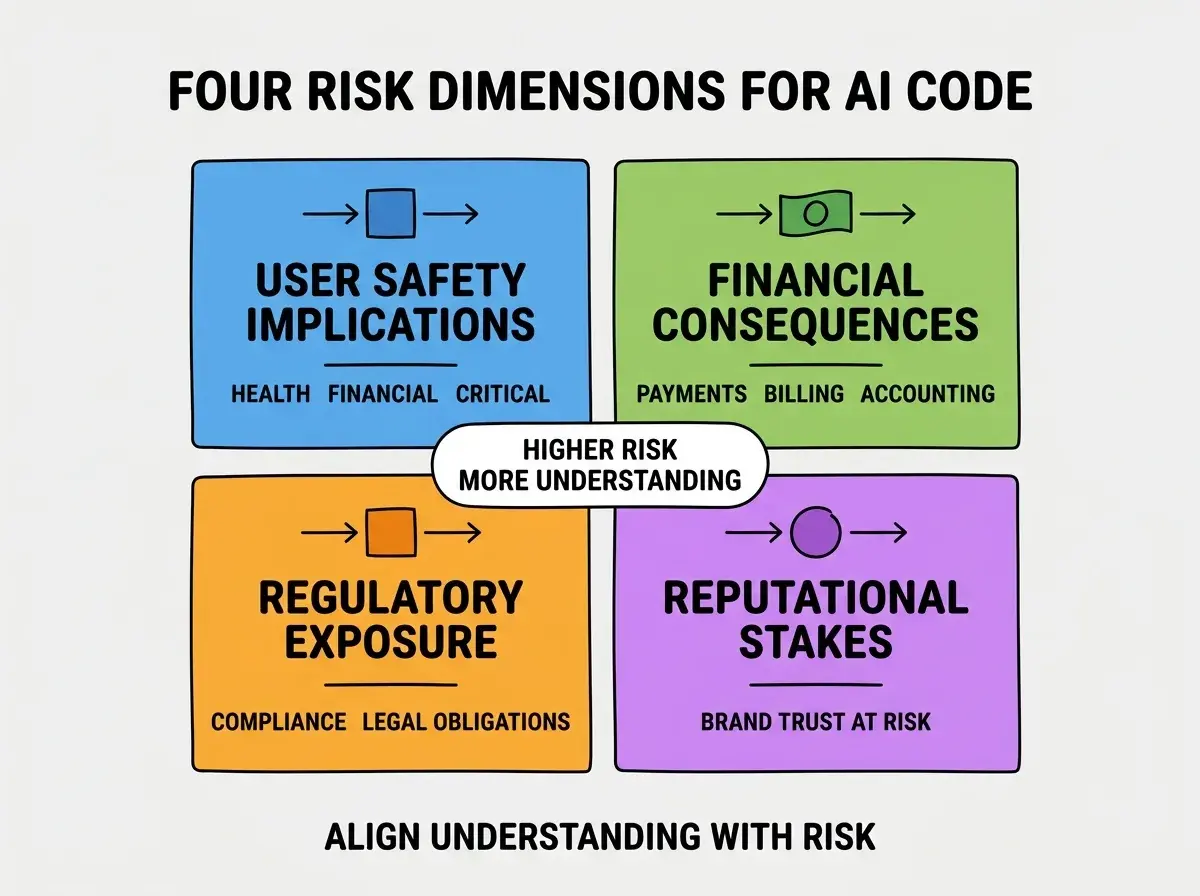
Dimension 3, regulatory exposure. Code subject to compliance requirements (GDPR, HIPAA, financial regulations) requires understanding to ensure compliance. Regulatory gaps produce legal exposure.
Dimension 4, reputational stakes. Public-facing code, code that handles communications, code that represents your brand. Bugs damage reputation in ways that take years to recover from.
How to Calibrate Understanding to Risk
Three calibration patterns help allocate understanding investment proportional to risk.
Pattern 1, low-risk code can ship with surface review. Internal tools, throwaway scripts, prototype features. Understanding the high-level intent is sufficient; deep code review wastes time and slows experimentation needlessly.
Browse more ethics and responsibility guides
Read more foundations articlesPattern 2, medium-risk code requires line-by-line understanding. User-facing features, basic data handling, standard integrations. Read every line; understand what each does; verify the implementation matches intent.
Pattern 3, high-risk code requires understanding plus testing plus expert review. Financial flows, security boundaries, safety-critical paths. AI generates a starting point; humans understand fully and validate exhaustively before shipping; second-pair review by someone qualified is often required.
How to Build Understanding Efficiently
Three patterns help build the necessary understanding without exhaustive line-by-line study of every AI output.
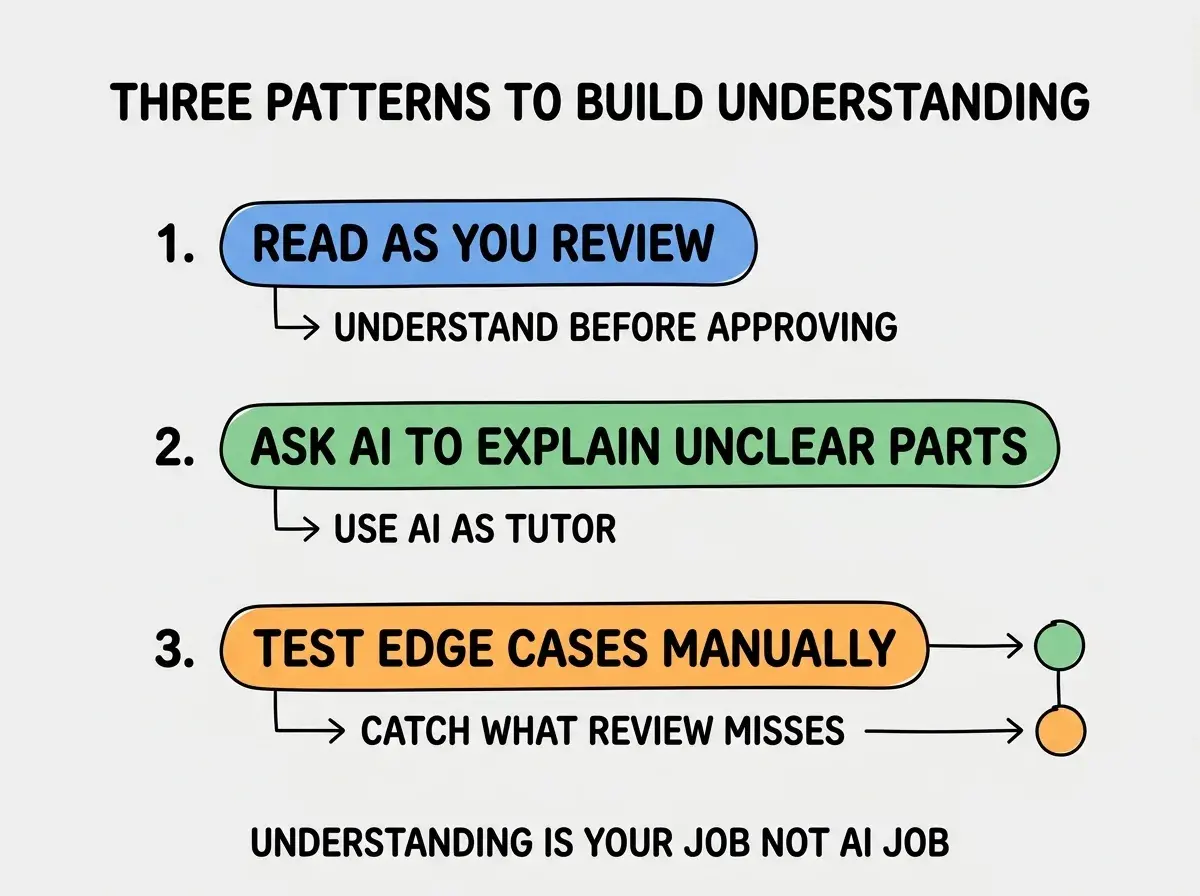
Pattern 1, read as you review. Treat AI output as a code review submission; understand what it does before approving. This is the minimum bar; without this, you are not really shipping responsibly.
Pattern 2, ask AI to explain unclear parts. When AI generates code you do not understand, ask the AI to explain it. Use the AI as a tutor; this builds understanding faster than studying the code alone.
Pattern 3, test edge cases manually. What happens with unexpected inputs, boundary conditions, errors. Manual edge case testing reveals understanding gaps before users discover them.
How to Build a Team Practice Around This
Three team patterns help operationalize ethical AI code shipping at organizational level.
Pattern 1, code review checklist explicit about AI involvement. Standard code review templates should include questions about AI usage, level of human review, and risk classification. The checklist makes the considerations visible.
Pattern 2, escalation paths for high-risk code. Define which code categories require senior review or expert sign-off. Low-risk code can ship with junior review; high-risk code requires more.
Pattern 3, post-incident analysis includes AI involvement. When incidents occur, document whether AI-generated code was involved and whether understanding was sufficient. The patterns inform future practice.
The combination produces team practice that handles AI code responsibly at scale. Without team practices, individual responsibility varies; with them, the organization maintains consistent standards.
How to Decide When You Should Not Ship
Three signals indicate code should not ship even if it appears to work.
Signal 1, you cannot explain what it does to a colleague. If you cannot explain the code, you do not understand it well enough to be responsible for it. Build understanding before shipping.
Signal 2, edge cases produce unexpected behavior. AI code often handles happy paths well and edge cases poorly. Edge case failures signal incomplete generation; ship only after edge cases are handled correctly.
Signal 3, the code interacts with high-risk systems. Authentication, payment processing, user data storage. High-risk paths warrant additional review; if you do not have time for the review, do not ship.
The combination produces ethical shipping decisions. Without explicit signals, founders sometimes ship high-risk code with insufficient understanding because the AI made it seem easy.
The most damaging ethics mistake is assuming AI code is automatically responsible because the AI is "smart." AI generates code that looks professional but can contain subtle bugs, security issues, or edge case failures that the AI itself does not flag. The fix is to maintain the same professional skepticism toward AI code that you would toward any code from an unfamiliar source. Founders who treat AI as an authority rather than as a productive but fallible collaborator ship more bugs and face more incidents than founders who maintain healthy skepticism.
The other mistake is conflating "the AI wrote it" with reduced legal liability. Courts have generally held that the deploying party remains responsible for software outcomes regardless of how the code was created. The fix is to operate as if you are personally responsible for everything you ship, because legally and ethically you are. The "AI did it" defense rarely succeeds in practice and damages credibility when attempted.
What This Means For You
Shipping AI code responsibly is core competency in 2026. The four risk dimensions and calibration patterns produce ethical shipping decisions for most situations.
- If you're a founder: Apply the risk dimensions to every shipping decision. High-risk code warrants deep review; low-risk code can ship with surface review. The proportionality matters.
- If you're changing careers into development: Understanding code remains core skill even as AI writes more of it. Invest in fundamentals; the understanding skill compounds across your career.
- If you're a student: Practice explaining AI-generated code to others. The teaching exercise is the strongest test of whether you actually understand the code.
Browse more responsibility and ethics guides
Read more foundations articles