Session management in production for vibe-coded apps in 2026 should use either JWT-based stateless sessions or server-side session tokens stored in a fast key-value store (Redis or similar), with HttpOnly secure cookies for browser delivery, short access token lifetimes (15 to 60 minutes) backed by longer refresh tokens, and explicit logout that invalidates server-side state. The right pattern depends on whether your app is single-region (server sessions are simpler) or multi-region (JWT is easier to scale), and getting the security defaults right matters more than the architectural choice. Most session bugs in production come from the same four mistakes regardless of which pattern you choose.
This piece walks through the JWT vs server session decision, the security defaults you cannot skip, the four common bugs, and how to test that your session management actually holds up under attack from determined adversaries.
Why Session Management Is Worth Getting Right
A broken session system causes one of three outcomes: users get logged out unexpectedly (frustrating), users stay logged in too long (security risk), or attackers can hijack sessions (catastrophic). All three are visible to users in different ways, and all three damage trust in the product.
Vibe-coded apps often skip serious session management because most authentication libraries (NextAuth, Clerk, Supabase Auth) handle the basics out of the box. This is fine for prototypes. In production, you eventually need to think about session expiration policies, refresh tokens, multi-device session management, forced logout, and protection against common attacks. The libraries provide the primitives; you have to make the policy decisions.
A 2025 OWASP analysis of 1,200 web app security incidents found that session management bugs were the second-most common vulnerability class (behind authentication itself). The most damaging incidents involved sessions that did not expire properly, sessions that could be hijacked via XSS or CSRF, and missing logout that left tokens valid after users clicked "log out." Each of these is preventable with standard patterns that take an hour to implement.
The pattern to copy is the way hotel keycards work. The card grants access for the duration of your stay, expires automatically when you check out, can be invalidated remotely if reported stolen, and the issuer (the front desk) can audit who used which card. Modern session management is the same: short-lived, automatically expiring, remotely revocable, and auditable.
The JWT vs Server Session Decision
Both approaches are valid in 2026 and both have clear right use cases. The decision depends on your scale and architecture.
JWT (JSON Web Tokens). Stateless tokens that contain user identity and claims, signed by your server. The browser holds the token; your server verifies the signature on each request. No session storage needed. Best for multi-region apps, microservices, and APIs because no shared session store is required.
Server sessions. A random session ID stored in a server-side store (Redis, database) with the user data attached. The browser holds the ID; your server looks up the data. Best for single-region monoliths because session storage is simpler to operate and easier to invalidate.
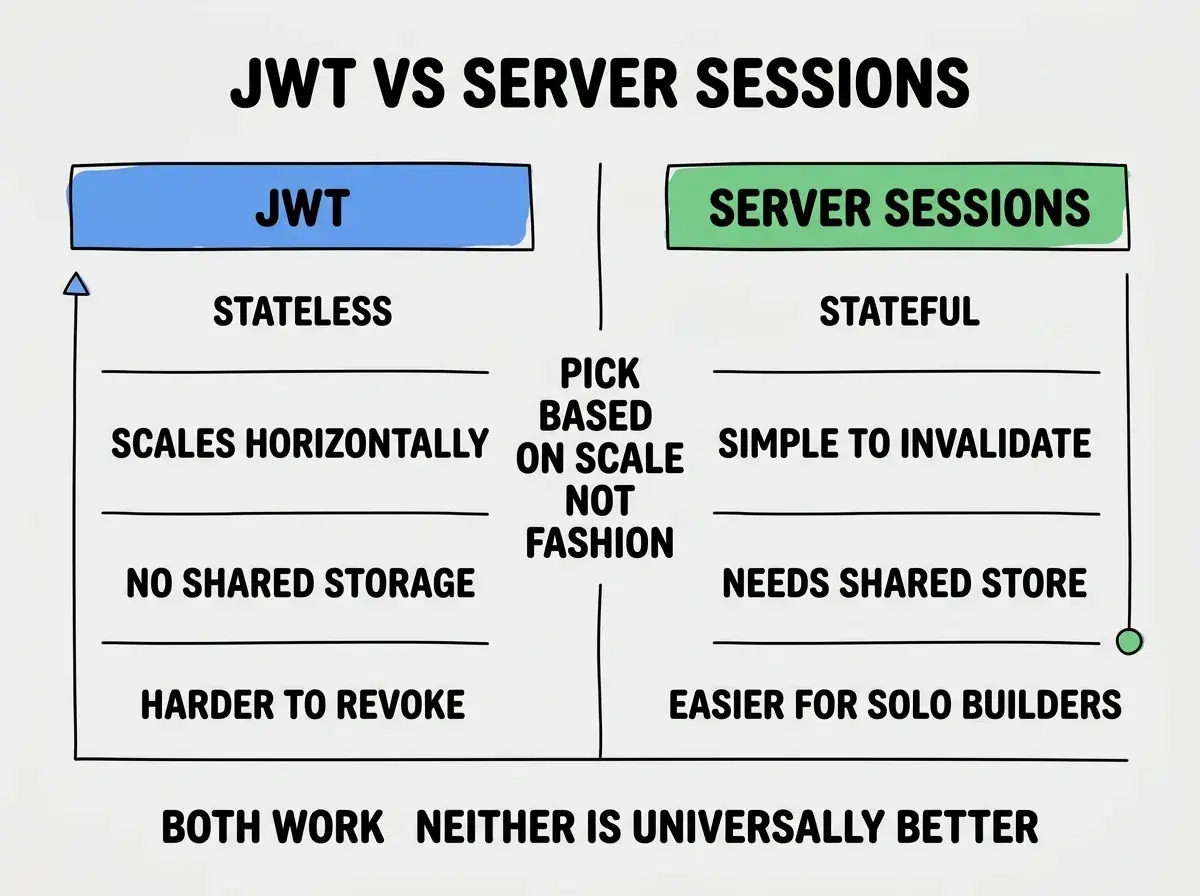
The choice is reversible but not free. Switching from JWT to server sessions or vice versa typically requires a migration that affects every authenticated request, so picking the right one upfront saves weeks of work later.
Security Defaults You Cannot Skip
Regardless of JWT or server sessions, four security defaults are non-negotiable. Skipping any of them creates vulnerabilities that attackers actively look for.
HttpOnly cookies. Session tokens (whether JWT or session ID) should be in HttpOnly cookies, not in JavaScript-accessible storage. This protects against XSS attacks stealing tokens. The default in most libraries is correct; verify you have not changed it.
Secure cookies. Cookies should be marked Secure so they only transmit over HTTPS. This is a one-line config but often missed in development setups that get copied to production.
Browse more production and security guides
Read more ship articlesSameSite cookies. Set SameSite=Lax (default) or Strict for session cookies. This protects against CSRF attacks. Strict is more secure but breaks some cross-site flows; Lax is the right default for most apps and works correctly with the majority of payment providers and OAuth flows.
Short access tokens with refresh tokens. Access tokens (used on every request) should be short-lived (15 to 60 minutes). Refresh tokens (used to get new access tokens) can be longer (7 to 30 days). This limits the window of damage if a token is stolen.
The Four Common Session Bugs
Each of these bugs shows up in real production apps and is preventable with deliberate setup.
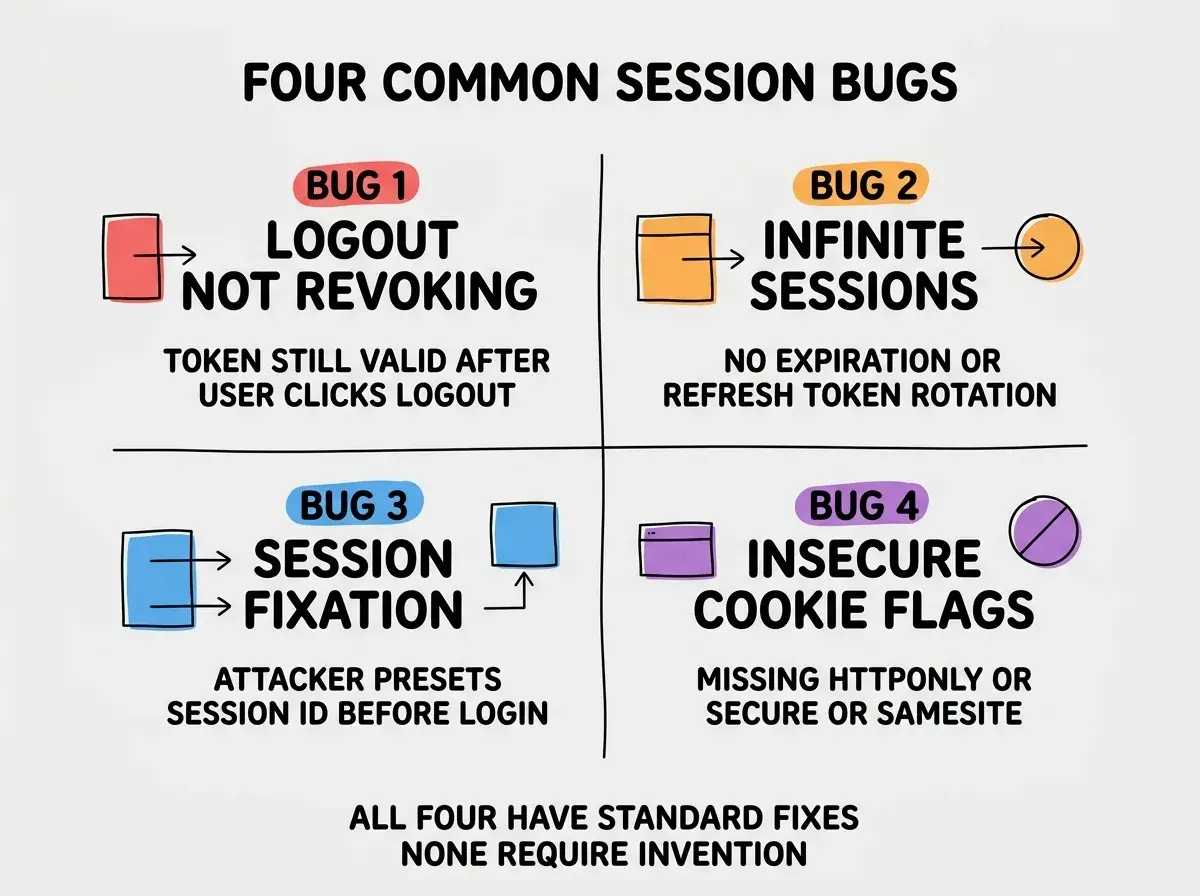
Bug 1, logout not revoking. The user clicks logout, but the session token remains valid until expiration. An attacker who steals the token before logout can keep using it. The fix is server-side revocation (a blocklist of revoked tokens) or short token lifetimes that limit the damage window.
Bug 2, infinite sessions. Sessions that never expire, refresh tokens that never rotate. A token from two years ago might still work. The fix is to expire sessions after a sliding window of inactivity (often 30 days) and rotate refresh tokens on use.
Bug 3, session fixation. An attacker tricks a user into using an attacker-known session ID before login. After login, the attacker has the same session and can act as the user. The fix is to regenerate the session ID on every successful login.
Bug 4, insecure cookie flags. Missing HttpOnly, Secure, or SameSite flags. Each missing flag enables a class of attack. The fix is to use a security-focused cookie library that defaults all three flags correctly.
The most damaging session management mistake is rolling your own auth instead of using a battle-tested library. Most session bugs come from custom implementations that miss subtle attack vectors. Use NextAuth, Clerk, Supabase Auth, Auth0, or another reputable provider. Your time is better spent building product than reimplementing security primitives that experts have already gotten right. Custom session code is one of the few places in 2026 where building it yourself is almost always wrong.
The other mistake is testing session management only with the happy path. Real testing requires trying to break it: tokens that should be invalid, sessions that should be expired, cookies tampered with in transit. Run an OWASP-style session security review at least annually and after any major auth change.
A useful exercise is to log every session-related event (login, logout, token refresh, session revocation) to your observability tool with the user ID and IP. After a few weeks of data, you can identify suspicious patterns like multiple concurrent sessions from very different geographic locations, refresh tokens being used from new devices, or accounts with sessions that span unusual time windows. These patterns surface compromised accounts before users complain.
What This Means For You
Session management is not glamorous, but getting it right is one of the highest-leverage security investments any production app can make. The defaults from modern libraries are mostly correct; your job is to verify them and to avoid the common bugs.
- If you're a founder: Use a managed auth provider rather than rolling your own. The trust your customers place in your product depends on this getting right.
- If you're changing careers: Auth and session management is a depth specialization that pays well at security-conscious companies. Build expertise here for differentiation.
- If you're a student: Read the OWASP Session Management Cheat Sheet end-to-end. The patterns are evergreen and the knowledge transfers across every framework you might use.
Browse more production readiness guides
Read more ship articles