Scoping and pricing AI-assisted agency projects in 2026 means moving away from time-based estimates (which AI invalidates) and toward value-based, outcome-based, or productized pricing that captures the productivity gain without giving it all to clients. The four pricing models that work for agencies in this transition are: fixed-scope value pricing (charge for the deliverable, not the hours), retainer with deliverable cap (monthly fee for defined output volume), productized service (fixed price for a packaged offering), and hybrid (small fixed fee plus performance bonus). Each model has a clear right use case based on project type and client sophistication, and choosing the wrong one consistently leaves money on the table.
This piece walks through the scoping process that holds up when AI changes velocity, the four pricing models with their trade-offs, the negotiation pattern that captures fair value, and the four mistakes agencies make most often.
Why Time Based Pricing Stopped Working
The traditional agency pricing model was hourly billing or daily rates. This worked when productivity was relatively stable across teams and projects. AI broke this assumption. An engineer using Cursor or Claude Code can ship 2 to 5 times more code per hour than the same engineer two years ago, but billing 2 to 5 times more hours is impossible. The result is that hourly pricing transfers all the AI productivity gain to clients and erodes agency margins.
Agencies that stayed on hourly billing through 2024 and 2025 saw their effective hourly rates compress as client expectations adjusted. Agencies that moved to value or outcome-based pricing captured the gain. The shift is not optional in 2026; the market has already repriced the work.
A 2025 Digital Agency Pricing report compared 500 agencies across pricing models. Agencies on hourly billing saw average margin compression of 22 percent year over year. Agencies on value-based pricing saw margin growth of 14 percent. The same engineering work was being done at both types of agencies; the difference was entirely in how the pricing model captured the AI productivity gain. Pricing model is now a strategic choice, not a billing detail.
The pattern to copy is the way photographers transitioned from charging per hour or per shot in the film era to charging per session or per package in the digital era. Digital cameras compressed the marginal cost of taking a photo to near zero, which broke per-shot pricing. Photographers who packaged their work captured the value; those who tried to keep per-shot billing went out of business. AI is doing the same thing to development.
The Four Pricing Models That Work
Each model fits a different project type and client situation. Choosing well is more important than the specific dollar number.
Fixed-scope value pricing. Charge a fixed price for a defined deliverable (a landing page, a client portal, an integration). Scope is locked, price is locked, you absorb both upside and downside on speed. Best for well-defined projects with clients who value certainty.
Retainer with deliverable cap. A monthly fee that covers up to a defined volume of output (e.g., 5 features per month, or up to 20 hours of work translated to 60 hours of pre-AI output). Best for ongoing relationships where you want recurring revenue.
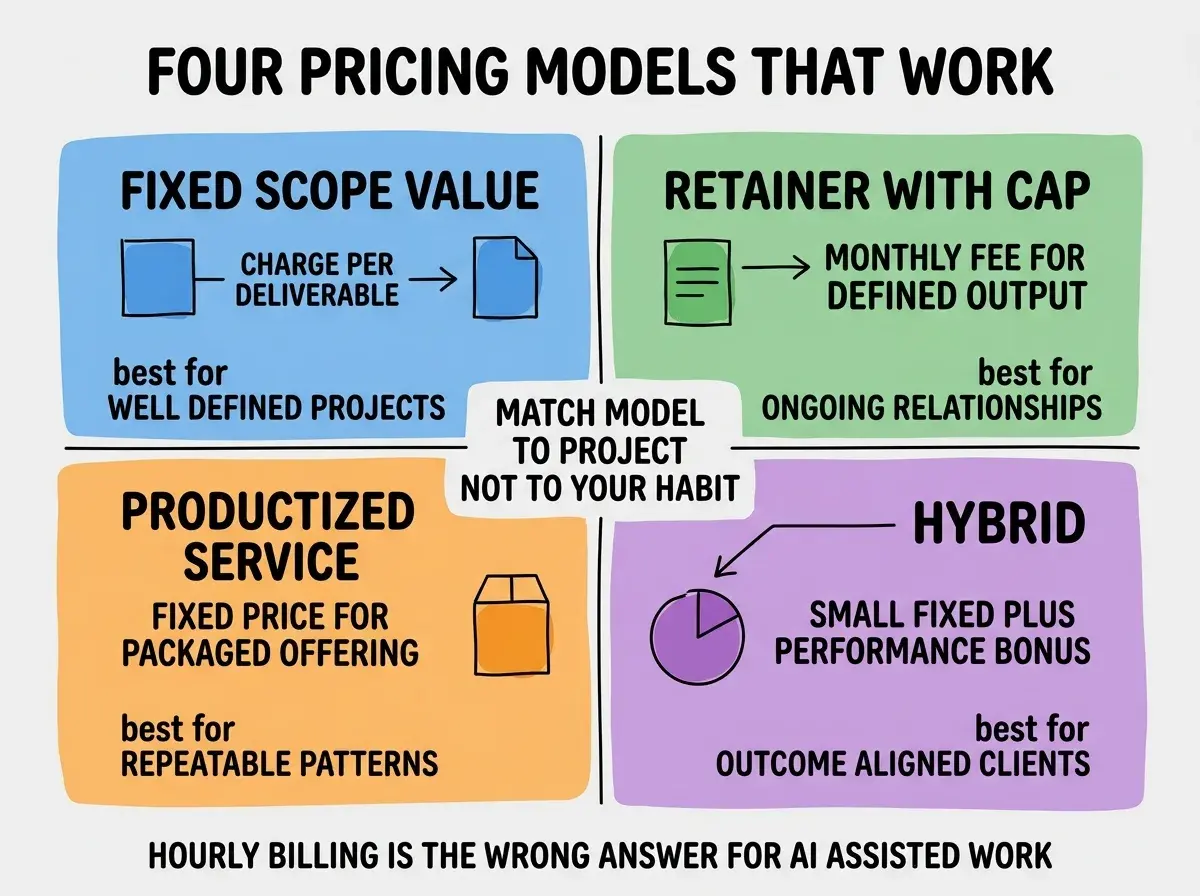
Productized service. A fixed-price packaged offering (e.g., "we build your MVP for $25,000 in 4 weeks"). Same scope, same price, every client. Best when you have a repeatable pattern and want to scale through volume.
Hybrid. A small fixed fee plus performance bonus tied to outcomes (revenue, conversion lift, user growth). Best for sophisticated clients with measurable goals where you can credibly contribute to the metric.
The Scoping Process That Holds Up
Scoping is what makes value pricing actually work. Without good scoping, fixed-price projects either lose money on scope creep or feel like they over-deliver on the original ask.
Step 1, define the deliverable in customer terms. Not "build a React app" but "users can log in, browse products, complete checkout, and receive an email confirmation." This anchors the scope on outcomes the client cares about.
Browse more agency and pricing guides
Read more build articlesStep 2, identify the unknowns explicitly. List the things that could change scope (third-party integrations, design iterations, content provided late). For each, decide whether to absorb, charge separately, or set a cap.
Step 3, agree on what is out of scope in writing. "Out of scope" matters as much as "in scope." Write it down explicitly so the conversation about extra work has a starting point.
The Margins Question
AI-assisted agency work has higher margins than pre-AI work, but only if you price for the value rather than the time. The math typically looks like a project that used to take 200 hours at $150/hour ($30,000) now takes 60 hours but is priced at $25,000 to $35,000 based on value. The agency keeps most of the productivity gain, the client pays slightly less than before, and everyone is happy.
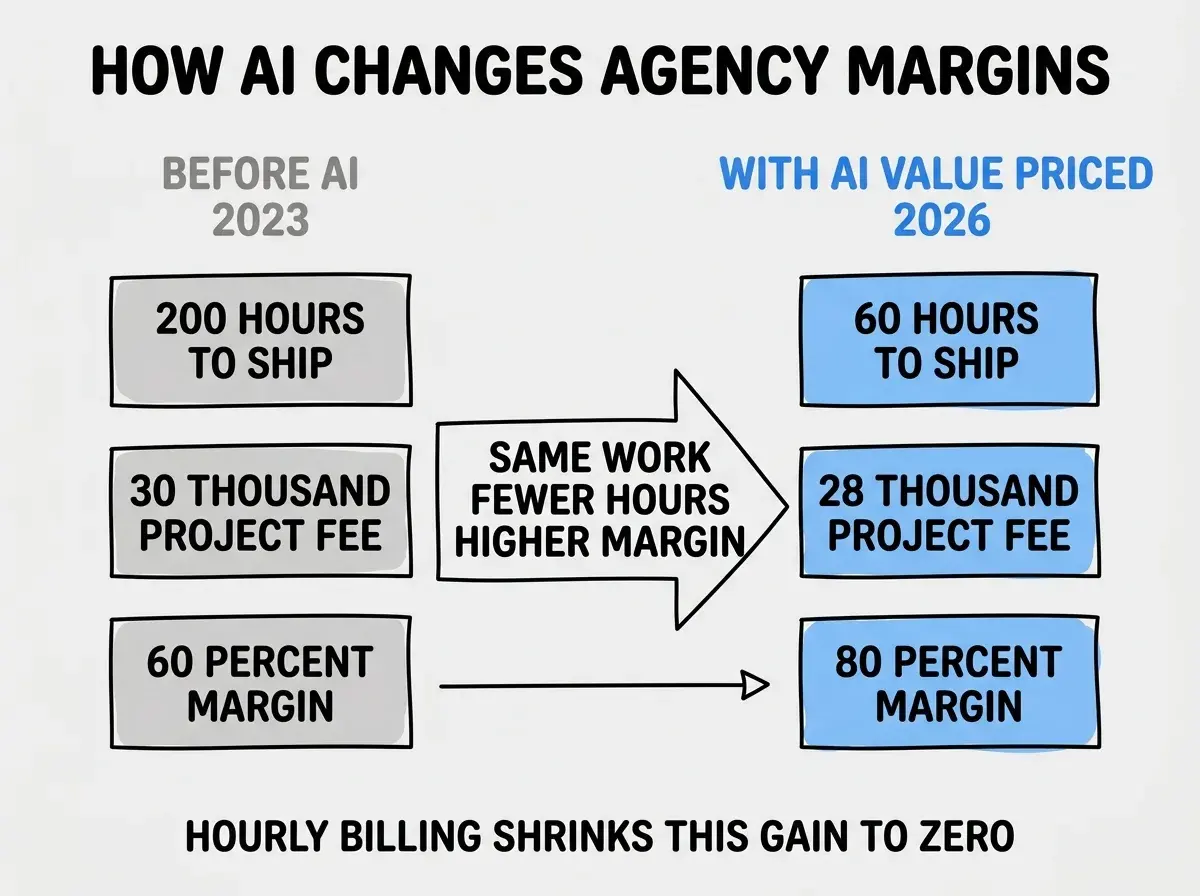
The clients who push back on this math usually do so because they understand the productivity gain and want it for themselves. The agency answer is to be transparent about the value (faster delivery, better quality, lower risk) and to walk away from clients who insist on hourly billing in 2026. The market has changed; agencies that hold the line on value pricing find clients who are willing to pay for it.
The most expensive scoping mistake agencies make is including unlimited revisions in fixed-price projects. The AI productivity gain is real, but unlimited revisions destroy it because the marginal revision now feels free to the client and is asked for endlessly. The fix is to define a specific number of revision rounds (typically 2 to 3) in the contract, with additional rounds priced separately. This protects margins and trains clients to think carefully about feedback rather than treating revisions as free.
The other mistake is competing on price during the transition. Agencies racing to the bottom on hourly rates lose the productivity gain to clients and burn out their teams. The right move is to charge for value and let competitors compete on price. The market is segmenting between low-cost commoditized agencies and high-value specialized ones; the middle is collapsing.
A useful exercise during scoping is to write down the three most important risks for the project and decide explicitly who absorbs each one. Risks like "the client provides content late" or "third-party integration breaks" should be assigned to a party in the contract. Without this, every risk lands on the agency by default and erodes the margin. Twenty minutes of upfront risk allocation often saves multiple days of rework or scope arguments later.
Dig deeper
A few hand-picked sources if you want to go further.
What This Means For You
Pricing strategy is the highest-leverage decision an agency can make in 2026. The right model captures the AI productivity gain and keeps margins healthy; the wrong model gives the gain to clients and shrinks the agency.
- If you're a founder: Move off hourly billing this quarter. Pick one of the four models and pilot it with new clients.
- If you're changing careers: Joining an agency that has figured out value pricing is dramatically better than joining one still on hourly billing. Ask about the pricing model in interviews.
- If you're a student: Study how agencies price their work. The same skill applies to negotiating your own salary as you grow into senior roles.
Browse more agency and business guides
Read more build articles