The scope trap is the cognitive pattern where each additional feature feels small relative to the project, but the cumulative additions destroy the project. AI coding tools accelerate the trap because feature addition cost feels lower than ever. The protective patterns include explicit scope locking, feature freeze periods, completion before expansion rules, and external scope review. Without protective patterns, the scope trap kills projects that would have shipped and earned.
This piece walks through how the scope trap works, why AI accelerates it, the four protective patterns, and the four mistakes that builders make trying to manage scope.
Why The Scope Trap Matters
The scope trap matters because it kills projects that were positioned to succeed. Projects do not fail from impossible features; they fail from successful features added to projects that should have already shipped.
The 2026 reality is that AI tools have reduced per feature cost while increasing project complexity faster than reductions in cost. Net effect: scope trap risk has increased, not decreased, in the AI era.
A 2025 indie hacker post mortem analysis of 200 abandoned AI built projects found that 73 percent of abandonment occurred not from technical failure but from scope expansion that turned 1 month projects into 6 month death marches. Scope expansion kills more projects than technical limitations.
The pattern to copy is the way successful authors finish manuscripts before adding chapters. Adding chapters to an unfinished book delays publication indefinitely; finishing first then expanding produces actual books. Software projects work the same way.
How The Scope Trap Actually Works
Three mechanisms drive the scope trap.
Mechanism 1, marginal cost feels low. Each individual feature feels like a small addition to existing work. The math suggests low cost; the math is wrong because complexity grows non linearly.
Mechanism 2, completion feels less satisfying than addition. Adding new things produces dopamine; completing existing things produces less. Brain chemistry biases toward addition.
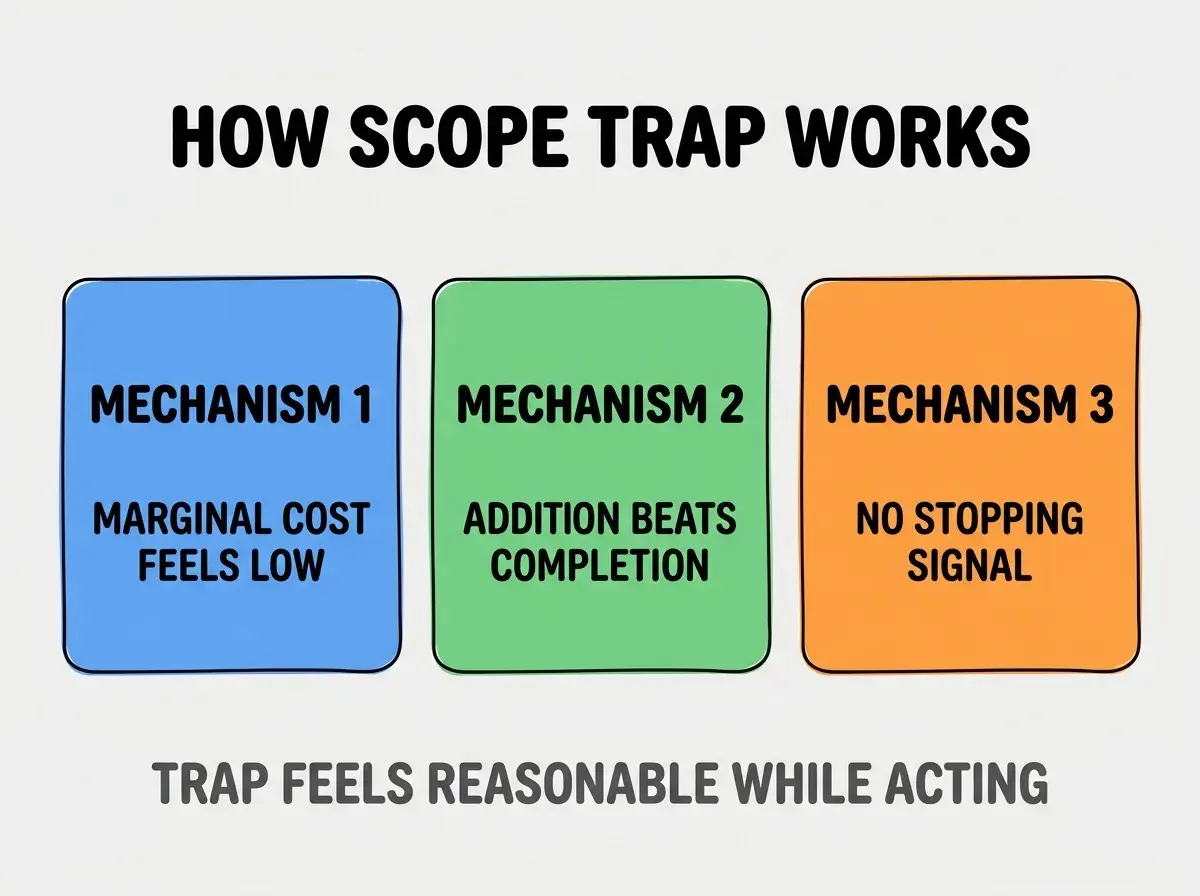
Mechanism 3, no natural stopping signal. Software projects have no equivalent of a publisher's deadline. Without external stopping force, internal forces favor expansion.
The combination produces scope expansion that feels reasonable while it happens. The destruction is only visible in retrospect.
Why AI Tools Accelerate The Trap
Three patterns explain why AI tools make the scope trap worse, not better.
Pattern 1, lower per feature cost. AI reduces the time to add a feature; lower cost makes more features feel feasible. Feasibility is not a stopping signal.
Browse more foundations
Read more foundationsPattern 2, faster prototyping enables more ideas. Easier prototyping generates more feature ideas; more ideas trigger more additions.
Pattern 3, complexity hiding via abstraction. AI generates abstractions that hide complexity; hidden complexity does not feel like a cost. The cost surfaces later as bugs and maintenance.
The combination explains why AI era projects often have more features and ship less often than pre AI projects. Tools amplify both productivity and trap.
The Four Protective Patterns
Four patterns protect projects from scope trap destruction.
Pattern 1, explicit scope locking before building. Write the feature list before starting code; treat additions during build as exceptional, not normal. Scope locks force conscious decisions.
Pattern 2, feature freeze periods. "No new features for 2 weeks while we ship what exists" creates the stopping signal that scope trap mechanisms lack.
Pattern 3, completion before expansion rules. New feature requires existing feature to be 100 percent done, deployed, and used. Completion gates expansion.
Pattern 4, external scope review. Friend, mentor, or accountability partner reviews scope changes. External review catches the trap that internal perception misses.
What Makes Scope Discipline Sustainable
Three patterns separate sustainable scope discipline from temporary willpower.
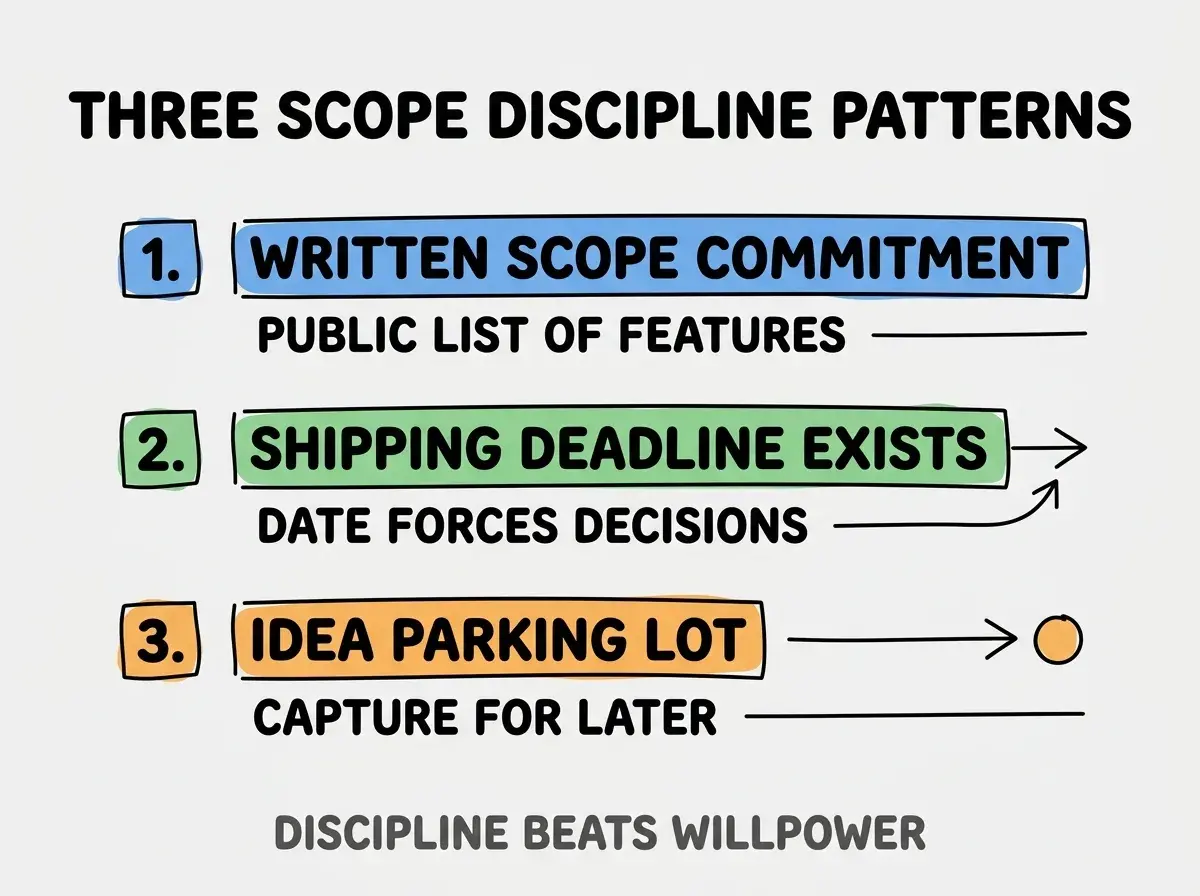
Pattern 1, written scope commitment. Public list of features in scope, accessible to anyone affected. Public commitment creates accountability that private commitment lacks.
Pattern 2, shipping deadline that exists. Real date for shipping forces real scope decisions. Without dates, scope expands to fill available time.
Pattern 3, idea parking lot for new features. Capture new ideas in a parking lot rather than implementing them. Parking lot satisfies idea generation without scope expansion.
The combination produces scope discipline that lasts entire projects. Without these patterns, willpower depletes and scope expands.
How To Recognize The Trap In Action
Three warning signs indicate active scope trap.
Warning 1, original timeline doubled or more. "I thought 1 month, now I am at month 3" is the trap signature. Timeline expansion correlates with scope expansion.
Warning 2, features added without removing. Healthy projects sometimes remove features; trapped projects only add. Net feature count rising without drops indicates trap.
Warning 3, completion percentage stuck. "I am 70 percent done" for 2 months means the 100 percent target keeps moving. Stuck percentage indicates trap.
The pattern recognition matters because the trap is invisible from inside. Warning signs come from comparing intentions to outcomes.
When To Add Features Without Trap Risk
Not every feature addition is the scope trap. Three patterns indicate safe additions.
Pattern A, customer paid for it. A customer is paying for a specific feature; you add it as agreed. Customer payment is the simplest non trap signal.
Pattern B, current scope shipped first. Existing scope is live, used, and stable; new feature builds on shipped foundation. Shipped foundation enables expansion.
Pattern C, removing equivalent scope. Add feature A while removing feature B. Net scope unchanged; this is refinement, not expansion.
The combination produces healthy feature evolution. Without these guards, every addition risks scope trap.
Common Questions About The Scope Trap
The scope trap raises questions worth addressing directly.
The first question is whether scope discipline limits ambition. No; scope discipline enables shipping ambitious projects by forcing focus. Discipline serves ambition rather than constraining it.
The second question is whether agile or iterative development immunizes against the trap. Iteration helps when shipped iterations exist; iteration without shipping is just slower scope expansion.
The third question is whether the trap affects all project types equally. Personal projects are most vulnerable because they lack external constraints. Client work has built in scope discipline.
The fourth question is whether AI tools could detect the trap automatically. Some tools track scope creep; the human pattern of feeling reasonable while expanding remains the harder problem.
How The Scope Trap Affects Builder Careers
The scope trap affects builder careers in compounding ways. Career effects compound across projects.
The first compounding effect is portfolio of unfinished projects. Builders trapped repeatedly accumulate impressive starts and few completions. Portfolio depth suffers.
The second compounding effect is income that does not match work. Unfinished projects generate no revenue regardless of effort invested. Income disconnect causes burnout.
The third compounding effect is reputation as starter rather than finisher. Industry reputation affects opportunity flow; finisher reputation outperforms starter reputation.
The combination produces career trajectories that diverge from intentions. Without scope discipline, the divergence accumulates across years.
The most damaging scope trap mistake is believing you have unique discipline that exempts you from the trap. The trap is universal because it is built into how brains evaluate marginal additions. Every successful builder has scope traps; the difference is structural support that catches them. The fix is to build the structural support before you need it; scope locks, deadlines, parking lots all installed in advance. Builders who build support produce shipped projects; builders who rely on discipline alone produce unfinished portfolios.
The other mistake is treating scope expansion as evidence of project value. More features feels like more value; users care about working features, not feature count.
A third mistake is removing scope discipline once a project ships first version. Post launch scope trap is just as deadly; v1.5 with infinite features is the same trap shape as v1 with infinite features.
A fourth mistake is shame about needing scope discipline. Discipline structures are professional tools, not personal weakness indicators.
How To Recover From An Active Scope Trap
When you recognize you are in the trap, three recovery patterns work.
Recovery 1, declare what ships now. Pick the smallest version that delivers value; commit publicly to shipping it; freeze everything else.
Recovery 2, document the rest as v2. Captured ideas reduce loss anxiety. V2 list satisfies the desire to capture without requiring immediate implementation.
Recovery 3, ship before adding anything. Shipping breaks the trap by completing the cycle. Once shipped, fresh scope decisions become possible.
The combination produces recovery from active traps. Without recovery patterns, builders abandon trapped projects rather than completing them.
What This Means For You
The scope trap kills more vibe coded projects than technical limitations do. The protective patterns, recognition signals, and recovery approaches produce shipped projects rather than abandoned portfolios.
- If you're a founder: Write the v1 scope publicly before starting; public commitment creates accountability that private notes lack.
- If you're an indie hacker: Set a shipping date and treat scope expansion as a date violation. Date discipline beats feature discipline.
Browse more foundations
Read more foundations