To practice responsible AI coding as a vibe coder in 2026, apply a four-pillar framework that covers the major responsibility dimensions (understand the code you ship, respect user privacy and consent, build inclusively for diverse user groups, and maintain transparency about AI involvement), check decisions against the framework before shipping, and treat responsibility as ongoing practice rather than one-time achievement. Responsible AI coding is achievable for individual builders; the framework makes it actionable rather than abstract.
This piece walks through the four pillars, the daily decisions where each applies, the patterns that make responsible practice sustainable, and the four mistakes vibe coders make when reasoning about their responsibility.
Why Responsibility Matters Even for Solo Builders
Solo builders often think responsibility is for big companies with legal teams. The reality is that small builders affect users with their software, and those users care just as much about being treated well by small products as by big ones. The responsibility scales with impact, not with company size.
The 2026 reality is that AI tools have made building software accessible to many more people, which means many more builders are making decisions that affect users. Responsibility frameworks that previously required dedicated teams can now be applied by individual builders with the right approach.
A 2025 IndieHackers responsibility study of 1,200 solo builders found that those who explicitly applied a responsibility framework had 67 percent higher user retention than those who did not. The mechanism was straightforward: responsible practices produced better user experiences; users noticed and stayed. Responsibility is not just ethical; it is good business. The framework users practice professionally outperforms ad-hoc responsibility.
The pattern to copy is the way professional chefs handle food safety. They do not have legal teams enforcing food safety; they internalize the practices because the practices protect customers and the business. Solo builders should approach responsibility the same way; the practices protect users and ultimately the builder's reputation.
The Four-Pillar Framework
Four pillars cover the major responsibility dimensions. Together they provide a checklist applicable to most decisions.
Pillar 1, understand the code you ship. Take responsibility for what your software does, regardless of who or what wrote the code. Build understanding proportional to risk; high-stakes code requires deeper understanding than low-stakes code.
Pillar 2, respect user privacy and consent. Handle user data with the care users would want. Get explicit consent for tracking; minimize data collection; secure what you do collect with appropriate technical and organizational measures.

Pillar 3, build inclusively for diverse users. Design for users different from yourself: different abilities, different cultures, different contexts. Inclusive design is responsible design and produces software that serves more users effectively.
Pillar 4, maintain transparency about AI involvement. Tell users when AI is part of the experience. Transparency builds trust and meets emerging regulatory requirements; the practice positions you well as disclosure norms continue to develop.
How to Apply the Framework Daily
Three application patterns make the framework actionable rather than aspirational.
Pattern 1, pre-ship checklist. Before shipping any new feature, run through the four pillars. Five minutes per feature; catches most responsibility gaps before they reach users; the small time cost is dramatically smaller than incident remediation cost.
Browse more responsibility frameworks
Read more foundations articlesPattern 2, weekly responsibility review. 15 minutes weekly to review recent shipping against the framework. The retrospective catches patterns the per-feature check missed and produces continuous learning.
Pattern 3, quarterly framework refresh. Re-read your framework principles quarterly. The refresh prevents drift; without it, frameworks become stale and cease to influence decisions over months and years.
How to Make Responsibility Sustainable
Three sustainability patterns prevent responsibility burnout.
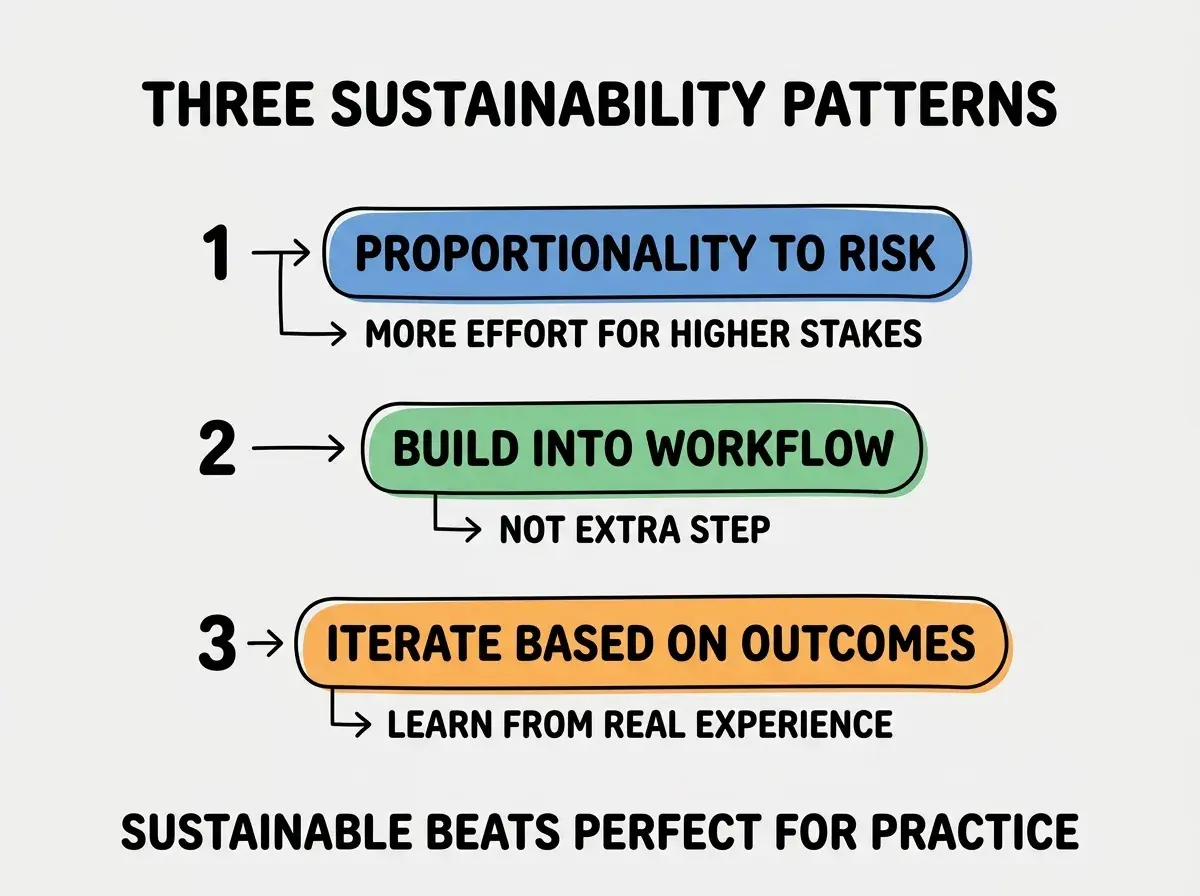
Pattern 1, proportionality to risk. Low-risk decisions get light review; high-risk decisions get deep review. Uniform high-effort review burns out solo builders quickly; calibrated effort produces sustainable practice.
Pattern 2, build into workflow. Responsibility checks should be part of normal workflow, not extra step. Integration produces sustained practice; isolation produces eventual abandonment as schedules tighten.
Pattern 3, iterate based on outcomes. When responsibility decisions produce good or bad outcomes, learn from them. Iteration improves practice over time; static practice stagnates and eventually fails to address evolving challenges.
How to Build Each Pillar in Practice
Three implementation patterns help build practical capability under each pillar.
Pattern 1, build understanding through code reading habit. Spend 30 minutes weekly reading AI-generated code without changing it. The exercise builds the comprehension skill that pillar 1 requires.
Pattern 2, audit privacy practices quarterly. Once per quarter, review your data handling against the privacy pillar. Catch drift before it becomes incidents.
Pattern 3, include diverse users in beta testing. Recruit beta testers from different demographics, abilities, and contexts. The diversity surfaces inclusivity gaps before launch.
The combination converts the framework from abstract principles to operational practice. Without specific implementation patterns, frameworks remain wall art rather than working tools.
How to Handle Edge Cases
Three edge case patterns help when the framework does not give clear answers.
Pattern A, default to user benefit. When unsure, choose the option that benefits users most. The default produces good outcomes even when reasoning is unclear; the user-benefit lens often clarifies decisions that seem complex.
Pattern B, ask trusted peers. Other builders can reason from outside your situation. A 5-minute conversation often clarifies decisions that felt complex alone; the outside perspective surfaces what insider thinking misses.
Pattern C, document the decision and reasoning. Even imperfect decisions become learning material if documented. The documentation builds your judgment over time and helps your future self learn from past situations.
The combination produces practice that improves with experience. Without explicit edge case patterns, builders often default to convenience over responsibility when situations are unclear.
The most damaging responsibility mistake is treating the framework as an all-or-nothing commitment. Builders sometimes feel they cannot apply responsibility frameworks because they cannot do everything perfectly. The fix is to start with the easiest pillar and build practice over weeks; partial responsibility practice is dramatically better than none. Builders who apply even one pillar consistently produce better outcomes than builders who aspire to all four pillars without applying any. Start small and build over time.
The other mistake is treating responsibility as someone else's problem (the AI vendor, the platform, the regulator). The fix is to recognize that you are the last line of defense before users encounter your software; your decisions matter regardless of what other parties do. Builders who own responsibility ship better software than builders who hope others will catch their problems.
A third mistake is mistaking documentation for practice. Some builders write extensive responsibility policies and then fail to follow them. The fix is to focus on observable behavior; the policies that get applied matter more than the policies that get written. Behavior beats documentation for practice over time.
A fourth mistake is failing to revisit the framework as your product evolves. What worked for an MVP may not work for a scaled product; what served 100 users may need adjustment for 100,000. The fix is to revisit the framework annually and adjust based on what your product is becoming.
What This Means For You
Responsible AI coding is achievable for individual builders in 2026. The four pillars, daily application, and sustainability patterns produce practice that compounds over years.
- If you're a founder: Adopt the framework as part of your standard build process. The discipline produces both better products and better business outcomes.
- If you're changing careers into development: Build responsibility practices early; the patterns transfer across every job and every product you ever work on.
- If you're a student: Practice responsibility on small projects. The skill is increasingly expected by employers and produces better software regardless of context.
Browse more responsibility and ethics guides
Read more foundations articles