To prepare for AI coding regulation in 2026, track four regulatory dimensions that are actively evolving (transparency requirements about AI usage in software, liability frameworks that determine responsibility for AI-generated bugs, training data rights and copyright disputes that affect what AI tools can use, and sector-specific rules in regulated industries like healthcare and finance), monitor jurisdictions where you operate, and adopt practices now that will likely be required later. Regulation is coming faster than many founders expect; proactive preparation is dramatically cheaper than reactive compliance.
This piece walks through the four regulatory dimensions, the current state of legislation across major jurisdictions, the practices founders should adopt proactively, and the four mistakes founders make when reasoning about AI regulation.
Why AI Coding Regulation Matters Now
AI coding moved from niche to widespread in just three years; regulators are catching up. The EU AI Act passed in 2024 set initial framework; US states are passing legislation throughout 2025-2026; sector regulators (FDA, FTC, financial regulators) are issuing guidance specific to their domains. The regulatory landscape is changing fast.
The 2026 reality is that founders building today will need to comply with regulations that did not exist when they started. Proactive practices that anticipate regulation are far cheaper than reactive compliance after laws pass. The pattern is well-established from previous tech regulation cycles (GDPR, accessibility law, securities regulation).
A 2025 Brookings Institution analysis of 40 active legislative proposals related to AI coding found that proposals in 18 US states and 6 international jurisdictions would impose meaningful compliance requirements on software using AI-generated code. The compliance burden ranges from disclosure requirements (low cost) to liability frameworks (potentially significant cost). Founders building toward 2027 should anticipate substantially more regulation than 2025 had; planning now is materially cheaper than retrofitting later.
The pattern to copy is the way GDPR rolled out. Companies that proactively built privacy practices anticipating EU regulation faced lower compliance costs when GDPR took effect; companies that waited until enforcement scrambled at high cost. AI regulation is following a similar trajectory; the proactive companies will pay less than the reactive ones.
The Four Regulatory Dimensions
Four dimensions cover most active AI coding regulation. Each has different implications.
Dimension 1, transparency requirements. Disclosure obligations about AI usage in software. EU AI Act requires this for many systems; US states are following. Compliance is generally low-cost but increasingly required.
Dimension 2, liability frameworks. Who is responsible when AI-generated code causes harm. Current law generally holds the deploying party responsible; some proposed frameworks would shift liability partially to AI vendors.
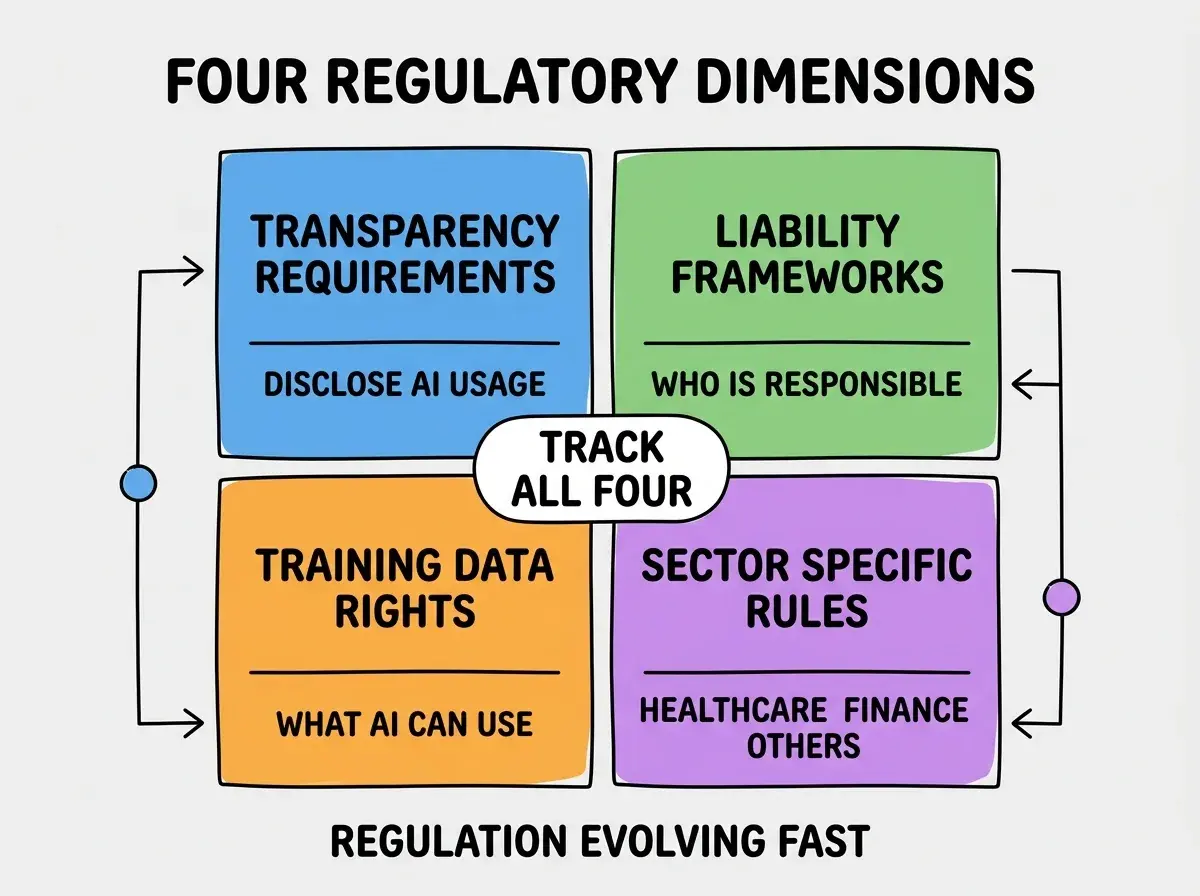
Dimension 3, training data rights. Copyright disputes over what data AI models can train on. Court rulings and proposed legislation will shape what AI tools can do; affected if your AI tools change capabilities.
Dimension 4, sector-specific rules. Healthcare (FDA), finance (FINRA, SEC), aviation (FAA) are issuing AI-specific guidance. Sectoral rules often impose much higher requirements than general AI regulation.
The Current State of Legislation
Three jurisdictional summaries help calibrate what compliance looks like today.
Summary 1, EU AI Act. Passed 2024, enforcement phased through 2026-2027. Risk-based approach: high-risk systems face strict requirements; lower-risk systems face mostly transparency. Affects any company selling to EU customers.
Browse more compliance and policy guides
Read more pulse articlesSummary 2, US state legislation. California, New York, Colorado, Texas have passed or are advancing AI laws. Patchwork compliance is the practical reality; no single federal framework yet exists.
Summary 3, sector-specific guidance. FDA on AI in medical devices; FINRA on AI in financial advisory; FAA on AI in aviation. Sector rules supersede general rules in their domains.
Practices to Adopt Proactively
Three proactive practices reduce future compliance burden and improve software quality immediately.
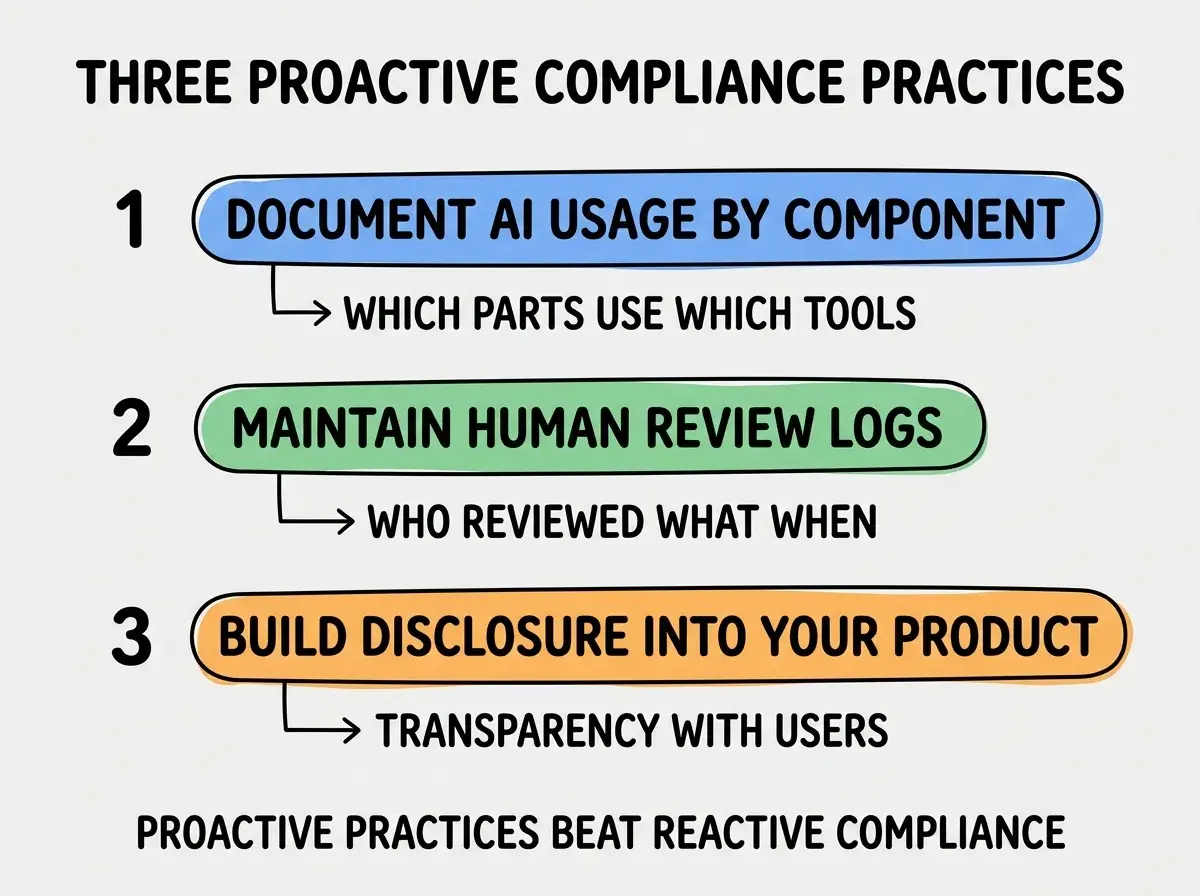
Practice 1, document AI usage by component. Maintain records of which parts of your software use which AI tools. The documentation supports both transparency requirements and liability defenses if questions arise from regulators or customers.
Practice 2, maintain human review logs. Record who reviewed what AI output before shipping. The logs demonstrate human oversight that liability frameworks increasingly require and provide evidence of due diligence if challenged.
Practice 3, build user-facing disclosure into your product. Tell users when AI was used in your product. Transparency is increasingly expected by users and required by regulation; building it now is cheaper than retrofitting later under regulatory deadline pressure.
How to Track Regulatory Developments Efficiently
Three tracking patterns help monitor AI regulation without becoming a full-time job.
Pattern 1, subscribe to two or three legal newsletters covering AI policy. Newsletters from major firms (Cooley, WSGR, DLA Piper) or specialized publications (AI Policy Institute) cover material developments in concise format.
Pattern 2, set quarterly calendar reminders to review developments. 30 minutes per quarter is enough for most companies. The discipline matters more than the depth.
Pattern 3, join one industry association that tracks AI regulation. Industry associations (AICUP, Information Technology Industry Council) often have working groups that track AI policy professionally.
The combination produces sufficient regulatory awareness without consuming founder time. Without tracking patterns, founders learn about regulations only when something goes wrong; with tracking, they adapt before problems arise.
How to Decide When to Engage Counsel
Three decision triggers suggest when AI regulation requires legal review rather than self-help.
Trigger 1, you operate in a regulated sector. Healthcare, finance, aviation, education have specific rules that warrant attorney review. The cost of getting it wrong exceeds the cost of legal counsel by orders of magnitude.
Trigger 2, you serve EU customers. EU AI Act has technical requirements that benefit from specialized review. EU compliance counsel costs less than EU non-compliance penalties.
Trigger 3, you raise venture funding. Investors increasingly ask about AI regulation exposure during due diligence. Having counsel-reviewed practices accelerates the due diligence process and can affect valuation positively.
The combination produces calibrated legal investment. Without explicit triggers, founders either over-invest (every decision through counsel) or under-invest (no counsel until problems arise); both are inefficient.
The most damaging regulation mistake is assuming current practices will remain compliant. Founders sometimes treat AI regulation as a future problem and ignore it until enforcement begins. The fix is to track regulatory developments quarterly; one hour every three months catches most material changes. Founders who track regulation adapt incrementally; founders who ignore it face expensive compliance scrambles when laws pass. Continuous awareness is dramatically cheaper than reactive compliance.
The other mistake is treating regulation as binary (compliant vs non-compliant) when it is actually graduated risk. Most regulations have both clear violations and gray areas; gray areas can be defensible if you have documented good practices. The fix is to maintain documentation of your AI practices even when not strictly required; the documentation becomes valuable evidence if questioned later. Documented good faith effort is meaningful protection even in unclear regulatory situations.
A third mistake is treating self-regulation as substitute for compliance with actual law. Some founders adopt internal AI ethics policies and assume those satisfy regulators. The fix is to recognize that voluntary policies are good practice but legal compliance still requires meeting actual statutory requirements. Self-regulation supports compliance; it does not replace it.
What This Means For You
AI regulation is evolving rapidly in 2026 and will affect more companies through 2027. The four dimensions, current legislation, and proactive practices produce reasonable preparation for most situations.
- If you're a founder: Spend an hour quarterly tracking AI regulation in your jurisdictions. The investment is small; the protection from surprise is substantial.
- If you're changing careers into compliance or legal: AI regulation expertise is increasingly valued. The field is new and growing fast.
- If you're a student: Study AI policy alongside technical skills. The combination produces hireable professionals as regulation matures.
Browse more policy and compliance guides
Read more pulse articles