To learn AI coding skills effectively, recognize the four learning patterns that distinguish what reading teaches from what doing teaches (concepts and frameworks transfer through reading, judgment and intuition require doing, debugging skills require errors that doing produces, and verification habits require practice that reading cannot provide), see what mix of reading and doing produces capability, and apply the patterns that produce sustained learning. The read vs practice question matters because misallocating learning time between reading and doing produces slower capability development.
This piece walks through the four learning patterns, what each teaches, the practice patterns, and the four mistakes when allocating learning time.
Why Read vs Practice Allocation Matters
Read vs practice allocation matters for skill development efficiency. The matter; same time invested produces dramatically different capability based on allocation.
The 2026 reality is that AI coding skills require both reading and doing. Pure reading produces theoretical knowledge; pure doing produces narrow experience. Mix matters.
A 2025 developer skill development study tracking 1,000 learners found that learners with structured reading plus doing practice developed AI coding capability 3.2x faster than learners with reading only or doing only patterns. Mix produces dramatically faster development.
The pattern to copy is the way medical training combines coursework and clinical practice. Coursework provides foundation; clinical practice produces capability. Neither alone produces doctors. AI coding skills follow similar pattern; reading provides foundation, doing produces capability.
The Four Learning Patterns
Four patterns characterize what reading versus doing teaches.
Pattern 1, concepts and frameworks transfer through reading. Mental models, terminology, concepts learnable through reading. Reading produces foundation.
Pattern 2, judgment and intuition require doing. When patterns apply, when they fail. Judgment from experience.
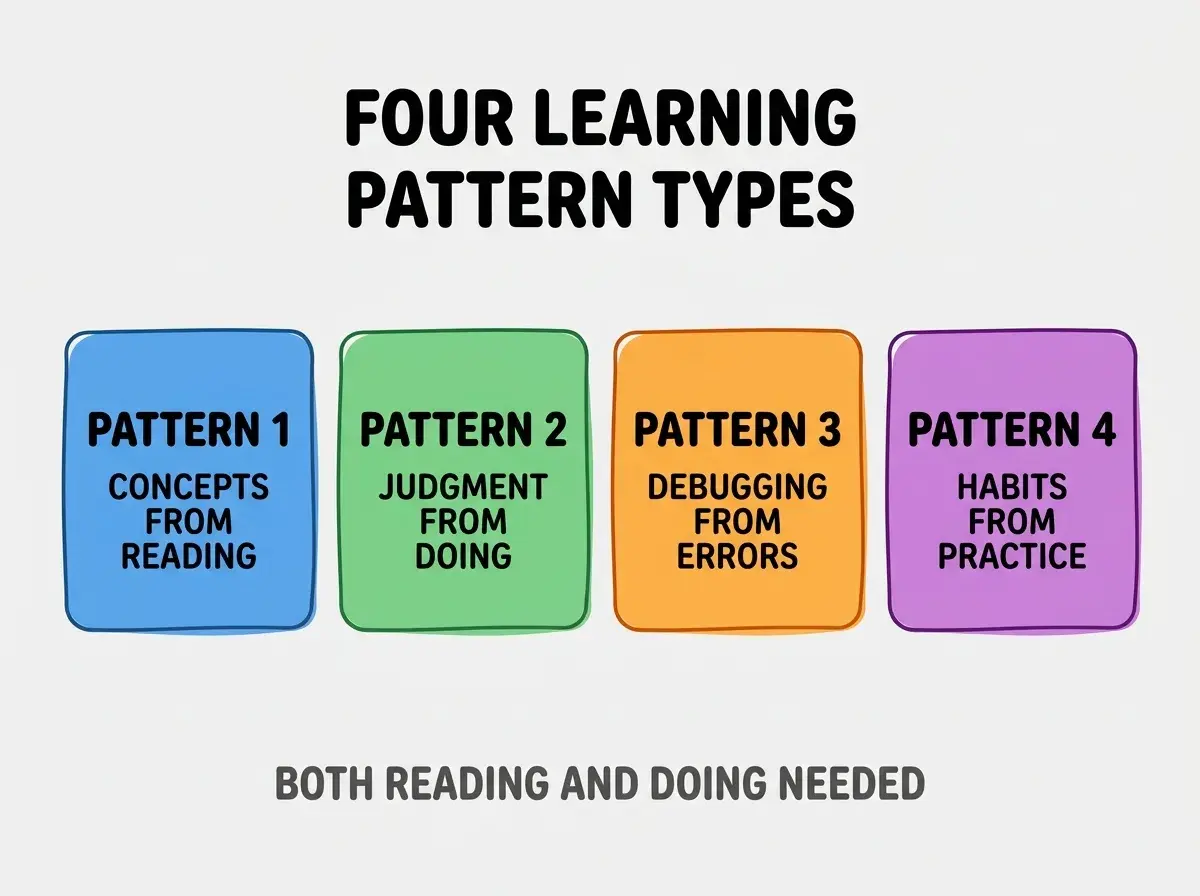
Pattern 3, debugging skills require errors. Error encounter teaches debugging. Reading about errors does not produce debugging capability.
Pattern 4, verification habits require practice. Habits form through repetition. Reading about habits does not form them.
What The Right Mix Looks Like
Three patterns characterize productive reading plus doing mix.
Pattern 1, read concept then practice immediately. Reading without practice forgets quickly. Immediate practice cements concept.
Browse more foundations
Read more foundationsPattern 2, allocate 30 percent reading and 70 percent doing. Doing dominates time; reading provides direction. Mix matches skill characteristics.
Pattern 3, document insights from doing back to reading. Personal documentation captures learning. Without documentation, doing learning stays implicit.
The Practice Patterns That Build Skills
Three patterns produce productive practice.
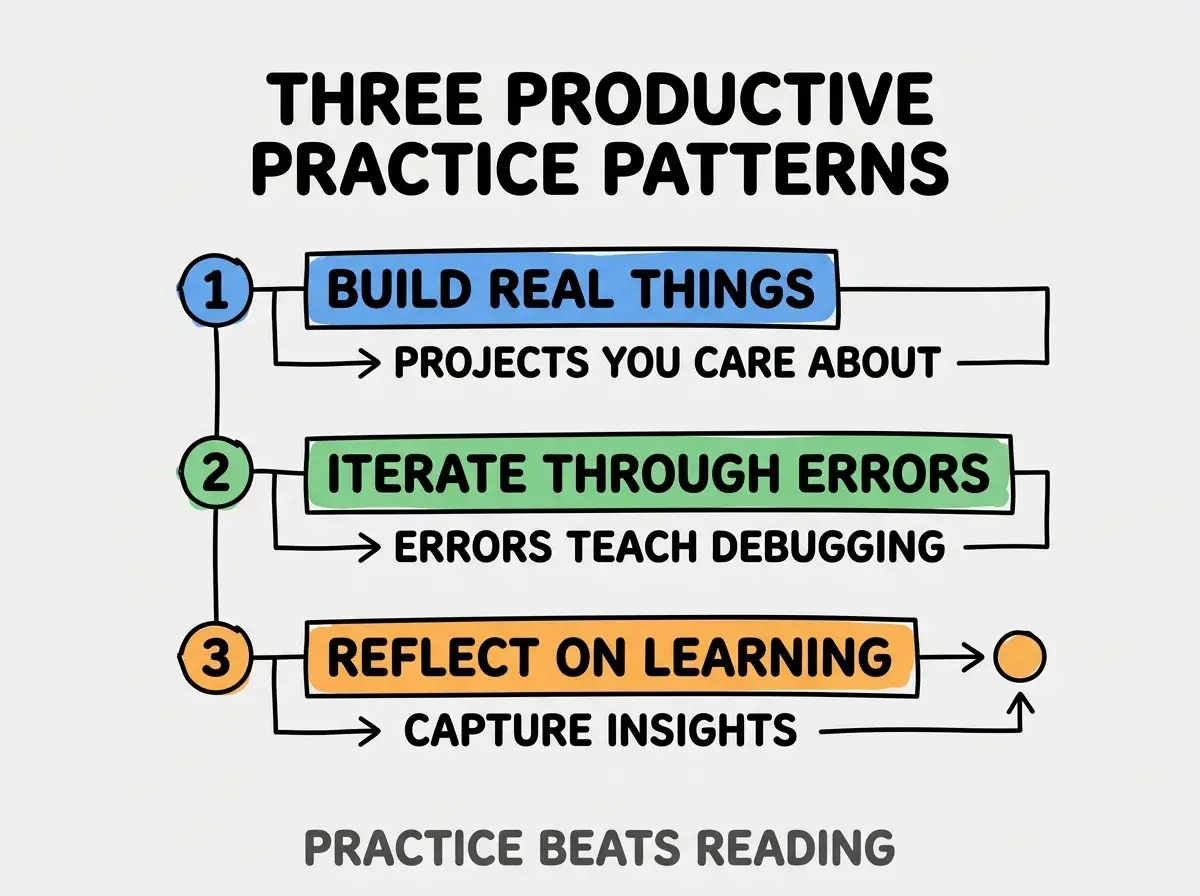
Pattern 1, build real things you care about. Real projects produce engagement; care produces sustained effort. Tutorial projects often miss engagement.
Pattern 2, iterate through errors. Errors are learning opportunities. Without iteration, errors become abandonment triggers.
Pattern 3, reflect on learning to capture insights. Reflection converts experience into skill. Without reflection, experience does not compound.
What Makes Learning Sustainable
Three patterns separate sustainable learning from problematic patterns.
Pattern 1, learning sessions varied between reading and doing. Variety prevents fatigue. Without variety, learning becomes monotonous.
Pattern 2, projects challenging but completable. Challenge produces growth; completability produces confidence. Both matter.
Pattern 3, community engagement supplementing solo learning. Other learners provide perspective. Without community, solo learning isolated.
The combination produces sustainable learning that compounds over time. Without these patterns, learning often produces burnout.
How To Identify Skills Requiring Doing
Three pattern recognition approaches help identify doing required skills.
Pattern A, skills where context matters dramatically. Context heavy skills require doing in context. Reading about context does not provide context.
Pattern B, skills involving subjective judgment. Judgment from experience patterns. Reading about judgment does not produce judgment.
Pattern C, skills requiring habit formation. Habits form through repetition. Reading about habits does not form them.
The combination produces skill identification that informs allocation. Without identification, allocation stays generic.
The most damaging read vs practice mistake is over investing in reading at expense of doing. Reading feels productive but produces theoretical knowledge that may not transfer to actual capability. The fix is to bias toward doing; 70 percent doing 30 percent reading produces faster capability than reverse allocation. Learners who do produce better outcomes than learners who read; doing teaches what reading cannot.
The other mistake is missing reflection on doing. Doing without reflection produces narrow experience; reflection converts experience into skill.
A third mistake is treating tutorial projects as real practice. Tutorial projects produce tutorial capability; real projects produce real capability.
A fourth mistake is solo learning isolation. Community provides perspective and motivation that solo learning misses.
How To Structure Learning Time
Three time structure patterns help productive learning.
Pattern A, daily practice over weekend cramming. Daily practice produces compounding; weekend cramming produces forgetting.
Pattern B, project based learning over exercise based. Projects produce real capability; exercises produce exercise capability.
Pattern C, community engagement weekly. Weekly community engagement maintains connection. Without engagement, learning isolates.
The combination produces time structure that develops skills. Without structure, learning often happens randomly.
How AI Coding Learning Will Likely Evolve
AI coding learning patterns will likely continue evolving as field matures.
The first likely evolution is AI assisted learning becoming standard. AI tools that adapt to learner pace. AI assistance accelerates learning.
The second likely evolution is community learning patterns evolving. New community formats, new sharing patterns. Community evolves with technology.
The third likely evolution is project portfolios mattering more than credentials. Demonstration through portfolio. Portfolio matters as credentials proliferate.
The combination suggests learning will become more capable. Learners building skills now compound foundations.
Common Questions About Read vs Practice
Read vs practice raises questions worth addressing directly.
The first question is whether bootcamps or self study produces better outcomes. Both work; bootcamps provide structure that some learners need. Choose based on personal patterns.
The second question is how to find good practice projects. Start with personal interests; passion sustains effort. Without interest, practice often abandons.
The third question is whether to learn one AI tool deeply or multiple. One first; multiple after foundation. Depth before breadth.
The fourth question is how to balance learning new things with deepening existing skills. Both matter; ratio depends on career stage. Early career emphasize breadth; mid career emphasize depth.
How Read vs Practice Affects Career Trajectory
Read vs practice allocation affects career trajectory beyond immediate skill development. Allocation patterns compound over years.
The first compounding effect is portfolio versus theoretical knowledge. Portfolio of completed projects beats theoretical knowledge in hiring. Doing builds portfolio.
The second compounding effect is judgment development pace. Judgment from experience compounds; pure reading produces theoretical understanding without judgment.
The third compounding effect is community engagement opportunities. Doing creates artifacts to discuss; reading creates ideas to discuss. Both produce community engagement but different patterns.
The combination of reading and doing produces career trajectories that pure reading or pure doing cannot match. Mix matters for sustained career growth.
Engineers who consistently combine reading and doing develop capabilities faster and build careers more sustainably than engineers who optimize for either alone.
What This Means For You
Read vs practice allocation determines AI coding skill development efficiency. The four patterns, mix patterns, and practice approaches produce framework for productive learning.
- If you're a student: Bias toward doing; 70 percent doing produces faster capability than 70 percent reading.
- If you're a career changer: Build real projects from start; tutorials produce tutorial capability while projects produce real capability.
- If you're a founder: Help engineering team prioritize doing in learning. Doing produces capability that builds product.
Browse more foundations
Read more foundations