React vs Vue vs Svelte is not really a framework debate anymore. With 92% of developers using AI tools daily, the question has shifted from "which framework do I like best" to "which framework does my AI assistant understand best." The answer changes the calculus for vibe coders in ways that traditional comparison articles miss entirely.
Think of it like spoken languages. React is English. It is the most widely spoken, has the most written material, and every AI model has been trained on enormous volumes of it. Vue is Spanish. Easier grammar, logical structure, a substantial global community, but less raw training data for AI models to learn from. Svelte is a constructed language like Esperanto. Beautifully designed, elegantly simple, beloved by its speakers, but with a fraction of the real-world text that AI systems need to generate fluent code.
This analogy holds up remarkably well across every dimension that matters for vibe coding. Let's walk through it.
Quick Verdict
| React | Vue | Svelte | |
|---|---|---|---|
| Best for | Maximum AI tool support, largest ecosystem | Clean syntax, progressive adoption | Smallest bundle sizes, simplest mental model |
| AI fluency | Excellent (most training data by far) | Good (solid but smaller corpus) | Fair (limited training examples) |
| Learning curve | Moderate (JSX, hooks, mental model) | Low (template syntax, Options or Composition API) | Lowest (write less, compiler does more) |
| Ecosystem | Massive (npm packages, tutorials, jobs) | Large (growing fast, especially in Asia/Europe) | Small but passionate |
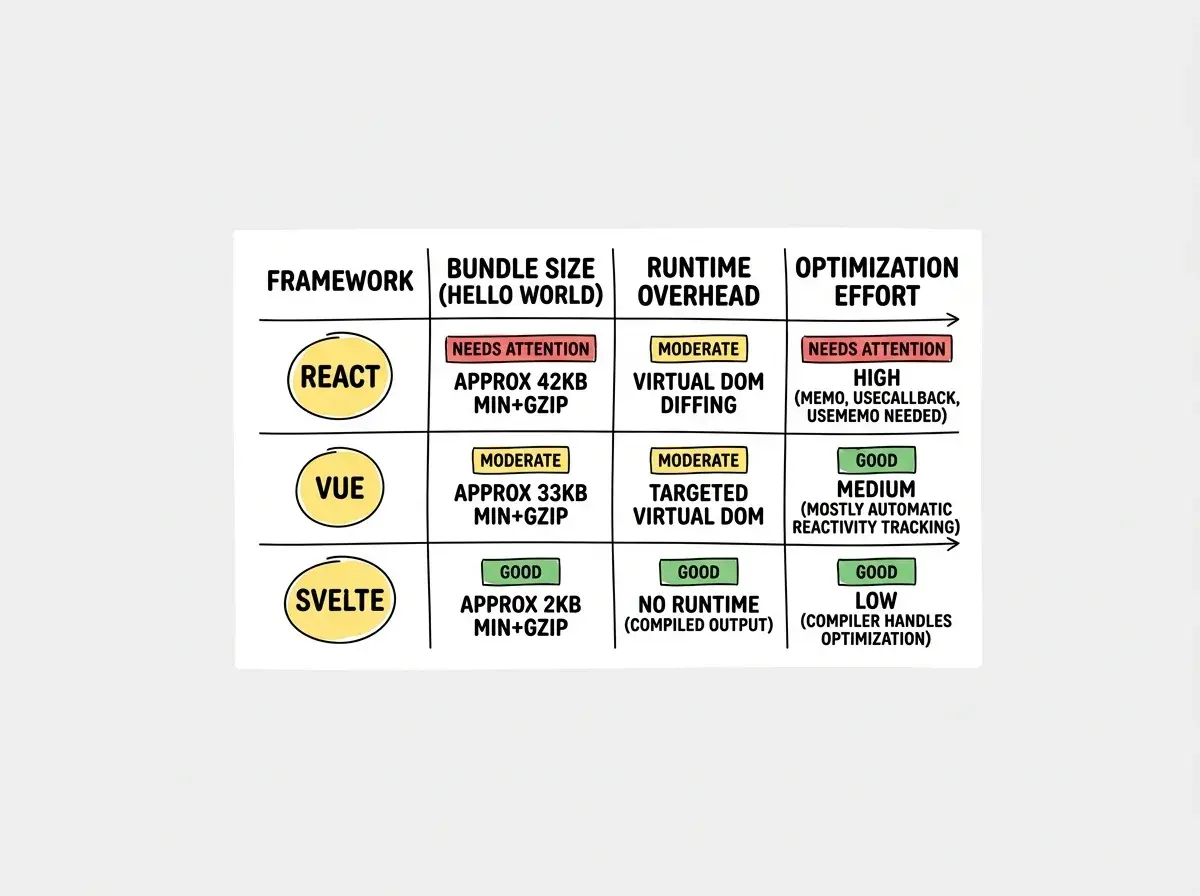
| Performance | Good with optimization effort | Good out of the box | Excellent by default (no virtual DOM) |
The surface comparison looks familiar. React has the biggest ecosystem. Vue has the gentlest learning curve. Svelte has the best raw performance. But for vibe coders, the AI fluency row is what changes the decision.
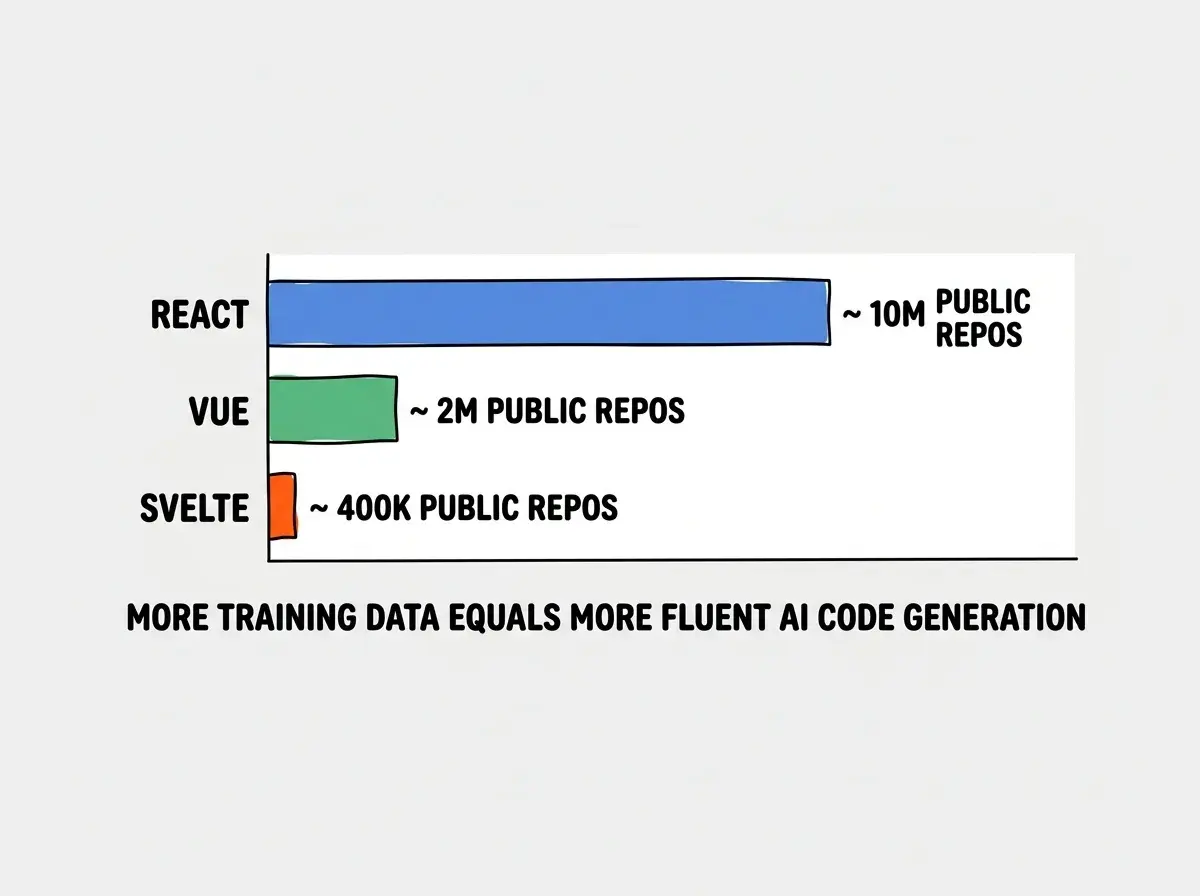
AI code generation quality is directly proportional to training data volume. React dominates open-source repositories, Stack Overflow answers, tutorials, and blog posts by a factor of 5-10x over Vue and 20-50x over Svelte. When your AI tool generates React code, it draws from millions of examples. When it generates Svelte code, it draws from thousands. This gap affects every prompt you write and every component you ask your AI to build.
AI Tool Support and the Training Data Gap
This is the factor that traditional framework comparisons ignore, and it is the most important one for vibe coders.
React's dominance in AI tools is not about preference. It is about math. GitHub hosts roughly 10 million public repositories using React. Vue has around 2 million. Svelte has closer to 400,000. Every major AI model (Claude, GPT, Gemini) was trained on public code, and React's representation in that training data dwarfs everything else. When you prompt Cursor or Claude Code to "build a dashboard with charts and authentication," the React version will be more complete, more idiomatic, and more likely to work on the first try.
Vue generates decent but sometimes outdated code. AI tools occasionally produce Vue 2 Options API code instead of Vue 3 Composition API, mixing paradigms in confusing ways. The training data includes years of Vue 2 tutorials alongside newer Vue 3 content, and models do not always distinguish between them cleanly. You will spend time correcting generation artifacts that React users rarely encounter.
Svelte generation is hit or miss. Simple components render correctly. But the moment you need SvelteKit routing, server-side loading functions, or Svelte 5's new runes syntax, AI tools stumble. The training data simply does not contain enough SvelteKit examples to generate reliable full-stack patterns. Returning to the language analogy, asking your AI to write Svelte is like asking it to write in Esperanto. It can manage basic sentences, but complex paragraphs reveal the gaps.
Ecosystem Size and Package Availability
The spoken language analogy extends perfectly to ecosystems. English speakers can find a book on any topic. Spanish speakers have excellent coverage for most subjects. Esperanto speakers sometimes need to translate from other languages.
React's npm ecosystem is unmatched. Need a date picker? There are 15 well-maintained options. Need a component library? Material UI, Chakra, Radix, shadcn/ui. For any problem you encounter, someone has published a React solution. More importantly, your AI tool knows about these packages and can integrate them correctly.
Vue's ecosystem is comprehensive but thinner. Vuetify, Quasar, PrimeVue cover the component library space. Pinia handles state management. Nuxt provides the full-stack framework. The tools are there, but for niche needs you might find one or two options instead of ten, and your AI tool may not know the correct API for the latest version.
Svelte's ecosystem requires more DIY. Skeleton UI and Flowbite Svelte exist for component libraries. SvelteKit handles full-stack needs. But you will encounter gaps where no Svelte-specific package exists and you need to adapt a vanilla JavaScript library yourself.
Learning Curve for Each Framework
Here is where the non-React options start winning.
React's learning curve is the steepest of the three. JSX syntax, the hooks mental model (useState, useEffect, useCallback, useMemo), the rules of hooks, the component lifecycle through effects, and the distinction between server and client components in modern Next.js. React is powerful precisely because it gives you many tools, but those tools take time to understand deeply. Continuing our language analogy, English has irregular verbs, inconsistent spelling, and borrowed vocabulary from a dozen other languages. It works, but the rules are messy.
Vue's learning curve is gentler. The template syntax reads like enhanced HTML. The Composition API (setup, ref, computed, watch) is clean and predictable. Single-file components keep template, script, and style in one place with clear boundaries. Vue is Spanish in this regard. Logical grammar, consistent rules, fewer exceptions. A senior developer moving from React to Vue often comments that things "just make sense" faster.
Svelte's learning curve is the shallowest. You write something close to plain HTML, CSS, and JavaScript. Reactivity is built into the language through assignments (change a variable, the DOM updates). There is no virtual DOM, no hooks API, no special syntax for reactive declarations in Svelte 5's runes beyond simple annotations. Svelte is Esperanto. Deliberately designed to be logical, regular, and easy to learn. Most developers can build their first Svelte app in an afternoon.
Choosing a framework solely because AI generates it well, without considering whether you can maintain the code yourself. If an AI generates 500 lines of React with complex hook dependencies and you do not understand the useEffect cleanup lifecycle, you will struggle to debug production issues. A framework you understand deeply but that AI supports moderately (like Vue) often beats one the AI writes fluently but you cannot read (like unfamiliar React patterns). Pick the framework where your understanding and AI support overlap most.
Performance in Production
Svelte wins the performance benchmarks. Because Svelte compiles your components into imperative DOM manipulation code at build time, there is no framework runtime shipped to the browser. A Svelte app's baseline JavaScript payload is significantly smaller than the equivalent React or Vue app. For performance-critical applications, landing pages, or projects targeting users on slow connections, this matters.
Vue performs well with minimal effort. Vue's reactivity system is efficient out of the box, and its virtual DOM implementation runs faster than React's in most scenarios. You rarely need to think about performance optimization in Vue until your app reaches significant complexity.
React requires intentional optimization. React's rendering model re-renders more aggressively than Vue or Svelte by default. You manage this with React.memo, useMemo, useCallback, and careful component composition. In skilled hands, React performs excellently. But for vibe coders who rely on AI-generated code, those optimization techniques are often missing from the generated output, leading to apps that feel sluggish as they grow.
When Each Framework Makes Sense for Vibe Coders
Choose React when AI tool support is your top priority, when you need a specific npm package that only exists for React, when you are building within the Next.js or Remix ecosystem, or when your team already knows React. The ecosystem and AI fluency advantages compound together. Every prompt works better and every package integrates faster.
Choose Vue when you want a balance between AI support and developer ergonomics. Vue with Nuxt is a capable full-stack solution with growing AI tool coverage. If you find React's hooks model unintuitive, Vue's Composition API might click better for you. Vue is also the strongest choice for teams who want to progressively adopt a framework into existing server-rendered pages.
Choose Svelte when performance is non-negotiable, when you are building something where bundle size directly affects user experience, or when you enjoy learning the framework deeply enough to compensate for weaker AI generation. Svelte also makes sense for smaller projects where the ecosystem gaps are less likely to matter. A personal site, a focused tool, a single-purpose app. These play to Svelte's strengths without exposing its ecosystem limitations.
Framework choice is just the beginning. Get the full stack right.
See the full toolkitThe Pragmatic Take
For most vibe coders in 2026, React is the pragmatic default. Not because it is the best-designed framework (Vue and Svelte both have cleaner APIs), not because it is the fastest (Svelte wins handily), but because AI tools speak React most fluently. When you are moving fast and relying on AI assistance for 60-80% of your code, that fluency advantage translates directly into shipping speed.
But pragmatic defaults have limits. If you are a senior developer who already knows Vue deeply, switching to React for marginally better AI output is a bad trade. Your deep Vue knowledge plus decent AI support will outperform surface-level React knowledge plus excellent AI support every time. The same logic applies to Svelte, with the caveat that the AI support gap is wider.
The spoken language analogy gives us the final insight. English is the global lingua franca, but a native Spanish speaker does not need to switch to English for every conversation. They just need to know when English serves them better and when Spanish gets the job done perfectly well.
Pick the framework where your expertise and your AI tool's fluency overlap the most. That intersection is where vibe coding works best.
The framework is just one decision. Here is everything else you need to get right.
Read the complete guide