Push notification strategies that do not annoy users come down to six patterns: ask permission late not early, send only when the user gets value not when you want attention, segment by behavior not by demographics, time around the user's local context, write notifications as if the user is paying for them, and measure unsubscribe rate as your primary KPI not click rate. Products that follow these patterns hit notification opt-in rates of 60 to 80 percent and unsubscribe rates under 5 percent per quarter. Products that ignore them average opt-in rates around 30 percent and lose users at 3 to 5x the rate.
This piece walks through each pattern, the timing rules that compound, and the four content principles that separate notifications users want from notifications users hate.
Why Push Notifications Are So Easy to Get Wrong
Push notifications are the most powerful re-engagement channel a product has, and they are also the easiest channel to abuse. A single tap interrupts the user wherever they are, and even one bad notification can produce a permanent opt-out or, worse, a deletion of the app. The asymmetry between upside and downside is sharp, and most products underweight the downside until users have already left.
The default behavior in 2026 is to ship a notification system, ask for permission on the first screen, and start sending whatever the marketing team thinks will drive opens. The result is the standard 30 percent opt-in rate, sub-1 percent click rate, and a steady drip of users disabling notifications until the channel is functionally dead. Products that follow even three of the six patterns below avoid this trajectory.
A 2025 Localytics study of 80 mobile and web apps found that products that asked for notification permission within the first 30 seconds of first use had a 27 percent opt-in rate. Products that asked after the user had taken at least one meaningful action (signup, first save, first share) had a 71 percent opt-in rate. The single biggest variable in notification health was when you asked.
The pattern to copy is the door-to-door sales playbook. The salesperson who knocks and immediately pitches a product gets the door slammed. The one who chats first, asks about the homeowner's situation, and pitches only when the moment is right makes the sale. Notifications follow the same psychology. Earn the right to send, then send carefully.
The Six Patterns That Work
Each pattern below targets a specific failure mode. Implementing all six is ideal, implementing the first three is the minimum viable bar.
Pattern 1, ask permission late. Wait until the user has taken at least one meaningful action before requesting notification permission. The right moment is often right after they save something, share something, or complete a primary task. Never ask in the first 30 seconds.
Pattern 2, send when the user gets value. A notification that exists because of something happening to the user (a friend liked their post, a price dropped, a deal closed) is welcome. A notification that exists because the company wants attention (a marketing nudge, a "we miss you" message) is unwelcome. Default to the first type.
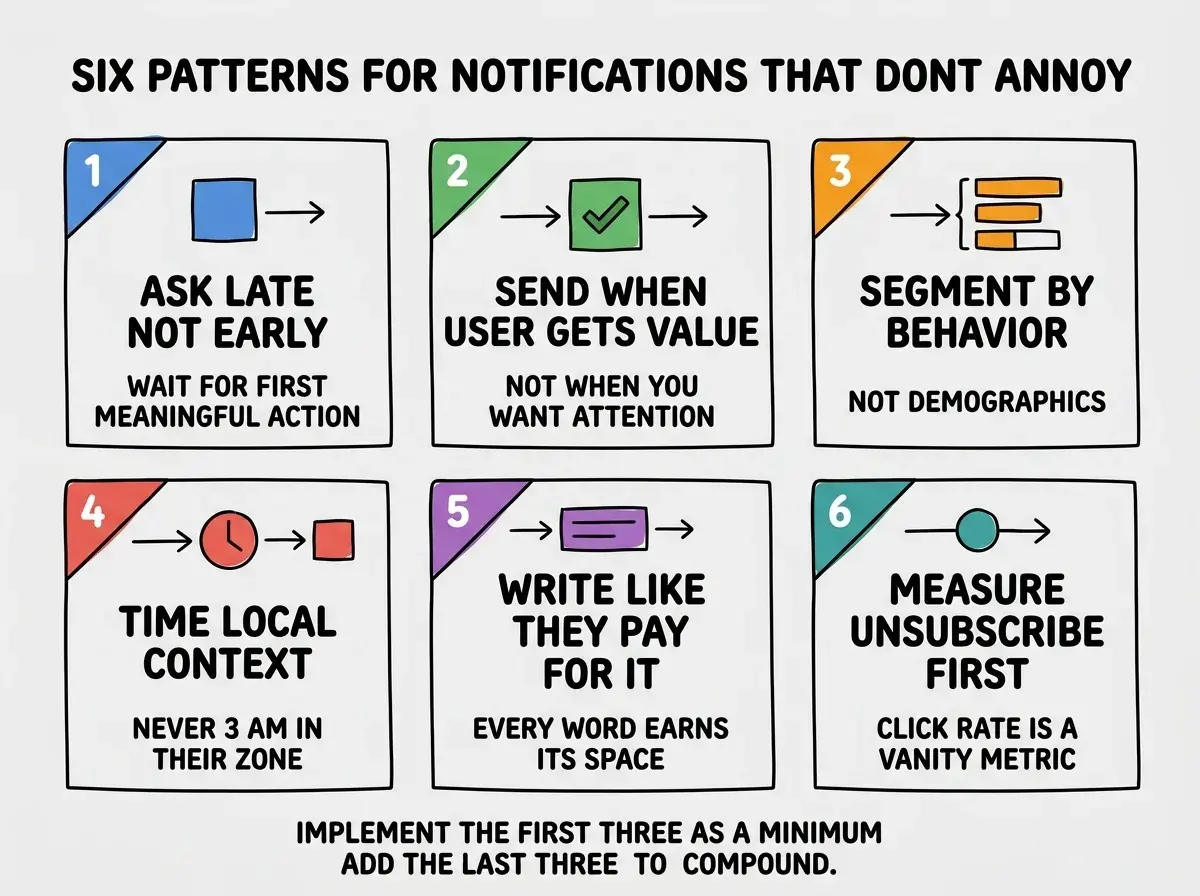
Pattern 3, segment by behavior. Send to users based on what they have done in the product, not on what they checked at signup. A user who has not opened the app in 14 days needs a different message than one who has opened it 14 times today.
Pattern 4, time around local context. Use the user's timezone for delivery, never your own. Avoid early morning, late evening, and meal times. The right window for most consumer products is 11 AM to 8 PM in the user's local time, with a sweet spot around 5 PM.
The Content Rules That Separate Good from Bad
A well-targeted notification can still be ignored or resented if the content is wrong. The content layer is where most products lose the gains they made on targeting.
Write like the user is paying for the notification. Every word should earn its space. Most notifications fail the test "would I send this to a friend." Cut the marketing voice, keep the news.
Browse more retention and growth guides
Read more grow articlesLead with the user's name or context, not the brand. "Sarah, your team replied" beats "Update from CompanyX." The first feels like a friend texting, the second feels like a corporate email.
Include the action in the notification. Tapping a notification should land the user exactly on the relevant screen, not on a generic home screen that requires more navigation. Deep linking is the difference between a 40 percent click rate and a 5 percent click rate.
Cap frequency tightly. No more than one notification per user per day for most consumer products, no more than three per week for most B2B products. Exceptions exist (chat apps, real-time alerts), but the cap should be deliberate.
How to Measure Whether You Are Getting It Right
Most teams measure notification health with click rate, which is a vanity metric. The real metric is the trend in opt-out rate over time, plus the long-term retention of users who have notifications enabled versus disabled.
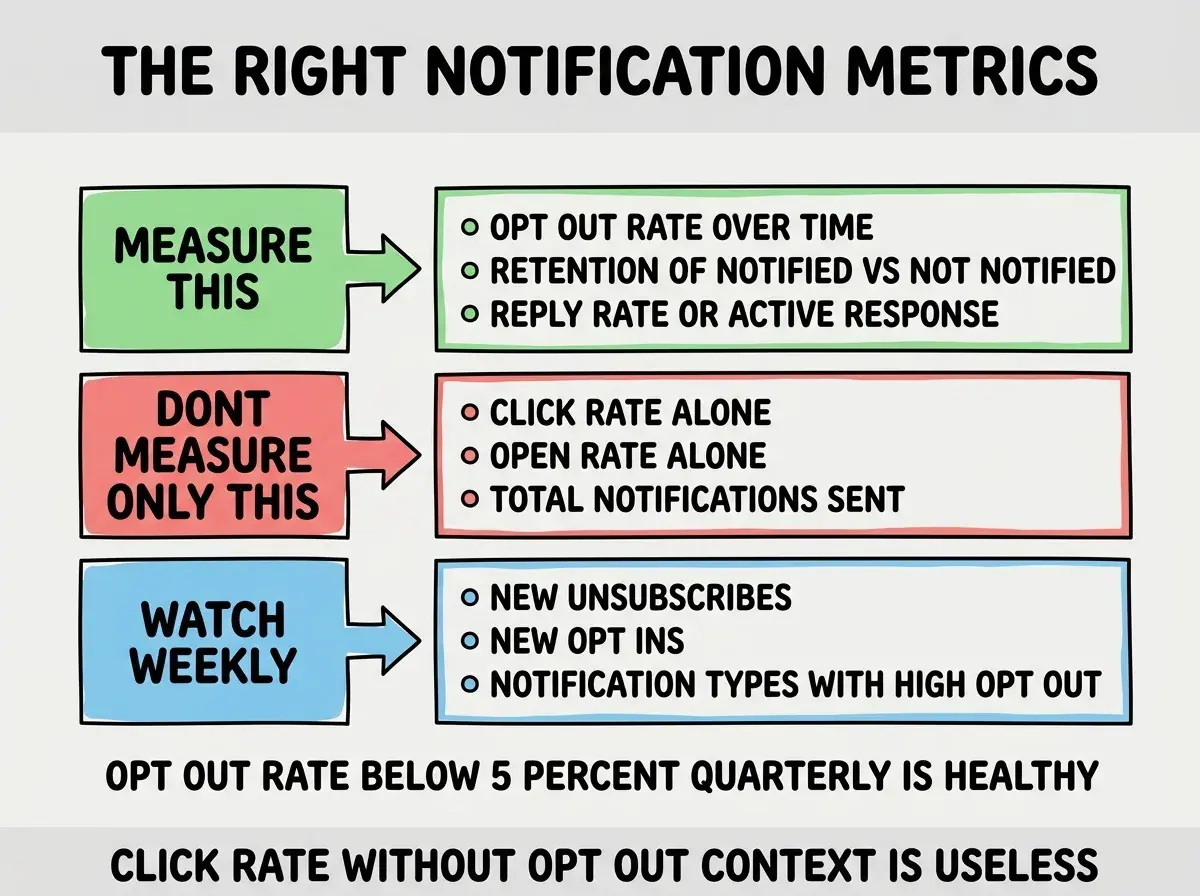
The benchmark is an opt-out rate under 5 percent per quarter. Products in the 10 percent and above range are training their users to disable notifications, which produces a slow erosion of the channel. Products under 5 percent per quarter are typically growing their notification reach over time.
The most common notification mistake is treating opt-in as a one-time event. A user who opted in last year may be one bad notification from opting out, and once they do, getting them back is almost impossible. Treat every notification as a chance to lose the user, not just a chance to get them to click. The mental model that produces the best decisions is "would this notification make the user disable my entire category."
The other mistake is using the same notification strategy across user segments. New users need fewer, more carefully timed notifications than power users. Power users often want more, faster, and more granular control. A one-size-fits-all approach underserves both.
A useful exercise is to draft your notifications as if you had to pay a small fee to send each one. Treat each delivery as a budget line item, not a free channel. Most teams that try this exercise cut their notification volume by 30 to 50 percent in the first week and see no change in click-through, because the notifications they cut were the ones nobody wanted anyway. The exercise sharpens taste in a way that style guides do not.
What This Means For You
Notifications can be the highest-leverage retention channel or the fastest way to lose users. The difference is mostly about discipline, not technology. Following the six patterns above puts you in the top decile of products on this dimension.
- If you're a founder: Audit your current notification policy against the six patterns. Most teams find at least three obvious fixes within an hour.
- If you're changing careers: Notification design is a great PM skill to develop. The trade-offs are concrete and the data feedback is fast.
- If you're a student: When you build your portfolio projects, instrument notifications properly. Showing thoughtful notification metrics in interviews is a strong signal of product judgment.
Browse more user growth and retention guides
Read more grow articles