To build a community around your product in 2026, pick from four community models that fit different product shapes (Discord servers for fast-moving discussion, dedicated forums for searchable knowledge, Slack workspaces for B2B customer communities, and in-product community features for the deepest engagement), start with a small focused group rather than launching publicly with no members, and invest founder time directly in the early community before delegating. Communities compound retention dramatically when they work; they fail silently when founders treat them as a marketing checkbox rather than a relationship investment.
This piece walks through the four community models, the launch patterns that work, the founder-time commitment required, and the four mistakes that turn community efforts into ghost towns.
Why Community Matters More Than Most Founders Realize
Community produces retention effects that no other tactic matches. Users who participate in your product's community churn 3-5x less than users who do not. The relationship to other users creates lock-in that pure product features cannot replicate.
The 2026 reality is that community has become a competitive necessity for many product categories. Products with strong communities pull ahead; products without them face increasing pressure even when their pure features are equivalent or better.
A 2025 CMX community industry report of 800 SaaS products found that products with active customer communities had 41 percent higher net revenue retention than products without. The mechanism was straightforward: community members got more value from the product, churned less, and referred more. Community is one of the highest-leverage retention investments available; the products that build it well compound the advantage over years.
The pattern to copy is the way local independent bookstores survived the Amazon era. They survived not by competing on price or selection but by building communities around their stores: author events, reading groups, recommendations from staff who know customers personally. Software products face similar dynamics; community is the moat that pure features cannot build.
The Four Community Models That Work
Four community models consistently work for AI-built products. Each fits different product shapes and customer behaviors.
Model 1, Discord servers. Fast-moving discussion, voice chat, channel-based topics. Best for younger audiences and consumer or developer products. Lower barrier to participation than forums.
Model 2, dedicated forums. Searchable knowledge that compounds over time. Best for products where users have repeated questions and answers help future users. Higher friction but better long-term value.
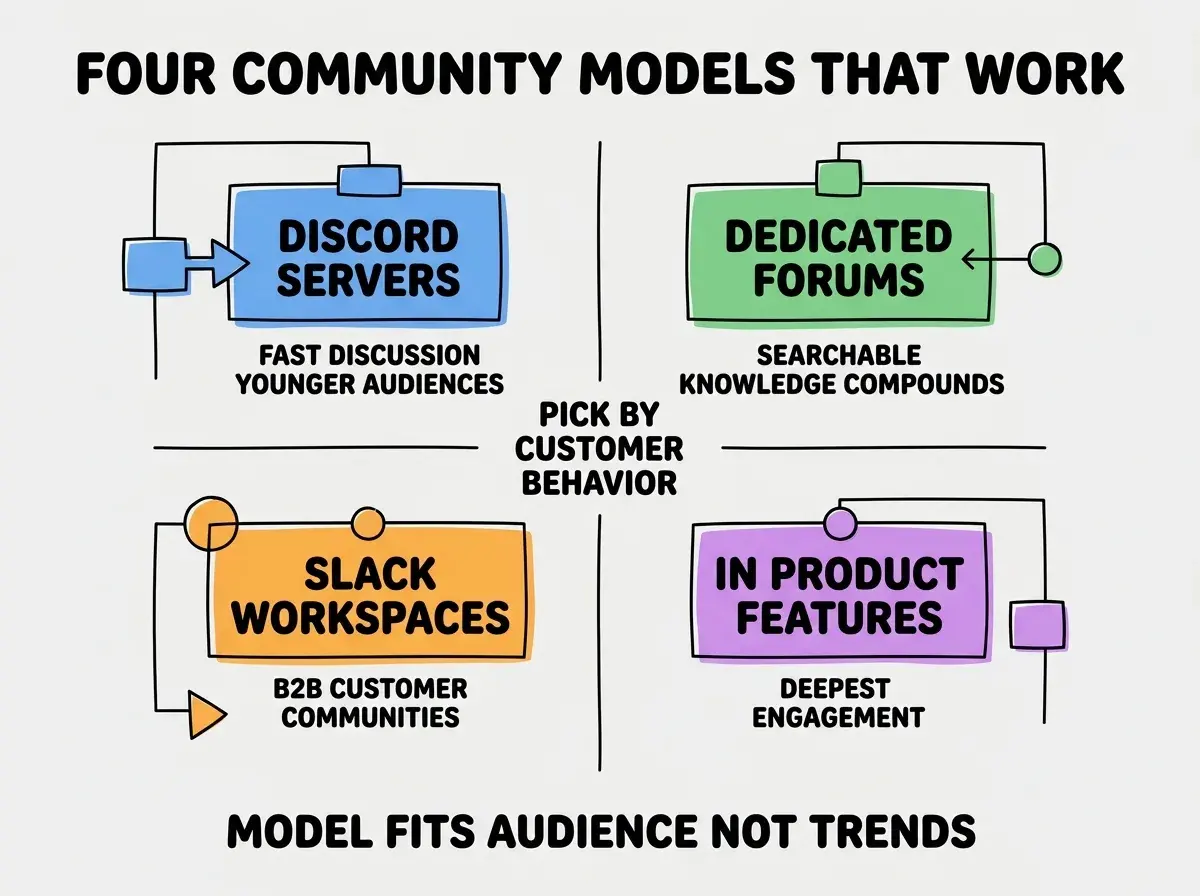
Model 3, Slack workspaces. B2B customer communities where the customer is already a Slack user. Best for B2B SaaS where customers spend their workday in Slack anyway.
Model 4, in-product community features. Comments, profiles, sharing within your own product. Best for products that have natural community elements (creative tools, collaboration software). Highest engagement but most expensive to build.
How to Launch Without an Audience
Three launch patterns prevent the empty-room problem that kills most community attempts.
Pattern 1, start with 10 hand-picked invitees. Personal invitations to power users, early customers, and friends. Active discussion among 10 motivated people produces the seed culture; broader recruiting comes later.
Browse more community and retention guides
Read more grow articlesPattern 2, founder posts daily for the first 30 days. Founder-led discussion attracts other discussion. Founders who launch and disappear leave dead communities; founders who post daily for the first month establish the rhythm others follow.
Pattern 3, prevent broad public access for the first 90 days. Invite-only or application-required keeps quality high while culture forms. Premature opening produces lurkers and spam; deliberate gating produces engagement.
The Founder-Time Investment Required
Three time-investment principles separate communities that thrive from communities that wither.
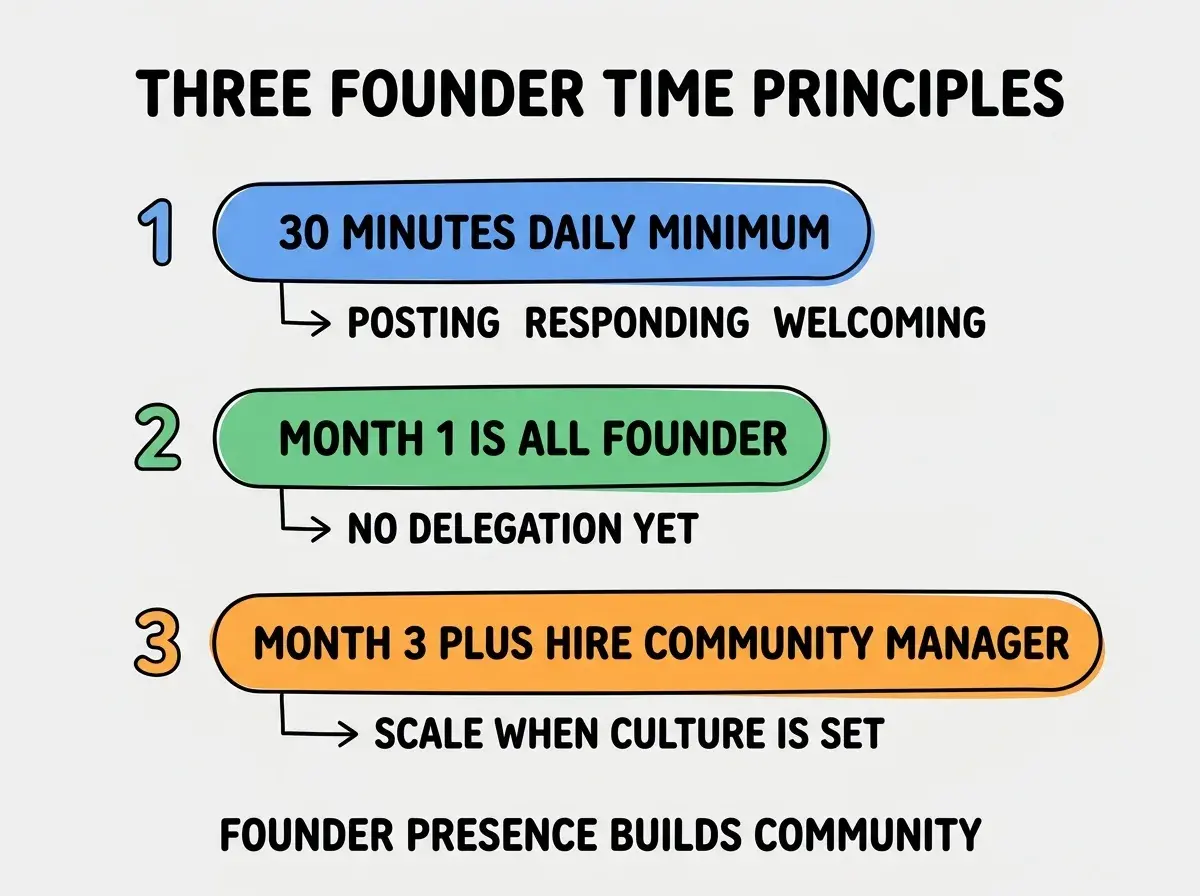
Principle 1, 30 minutes daily minimum in early days. Posting questions, responding to members, welcoming new joiners. Less than 30 minutes signals deprioritization; members notice quickly.
Principle 2, month 1 is all founder, no delegation. The early culture forms in month 1; the founder's voice and standards set the tone. Delegating too early produces communities that drift away from the founder's vision.
Principle 3, hire a community manager only after month 3. By month 3, the culture is established and a community manager can maintain it. Hiring earlier risks losing the founder's voice that made the community work.
How to Choose the Right Platform
Three platform-selection principles help pick where the community lives.
Principle 1, go where your customers already are. B2B customers in Slack favor Slack workspaces; developer audiences favor Discord; consumer audiences may favor Discord or Reddit. The platform should match customer behavior, not founder preference.
Principle 2, prefer searchable platforms for knowledge-heavy communities. Discord and Slack have weak search; questions get re-asked endlessly. Forums (Discourse, Circle) make knowledge compound over time.
Principle 3, avoid building custom platform infrastructure. Custom community software is a year of engineering work. Use managed platforms (Discord, Slack, Discourse) until your community proves valuable enough to justify custom software.
The combination produces platform decisions that match the community's actual needs rather than founder enthusiasm for a particular tool.
How to Measure Community Health
Three metrics matter more than vanity numbers like total members.
Metric 1, weekly active participants. People who post or react in a given week. Total members include lurkers; weekly active participants is the engaged core that actually produces value for the community.
Metric 2, response rate to questions. What percentage of questions receive useful answers within 24 hours. High response rates indicate healthy communities; low response rates indicate the community is failing at its core purpose of mutual help.
Metric 3, churn correlation. Community participants vs non-participants among your customer base. If churn rates are similar, community is not driving retention; if community participants churn dramatically less, community is producing real business value that justifies continued investment.
The combination produces honest community health assessment. Without these metrics, founders measure success by total members and miss the underlying engagement problems.
The most damaging community-building mistake is treating community as a marketing channel rather than a relationship investment. Founders launch communities expecting acquisition, then disappointed when communities produce mostly retention. The fix is to expect community to drive retention, not acquisition; the ROI is in keeping customers longer, not getting new ones cheaper. Communities optimized for retention produce 3-5x more value than communities optimized for acquisition. The retention framing leads to better community decisions and better community outcomes.
The other mistake is overinvesting in community infrastructure before validating the model. Founders sometimes build elaborate forum software, dedicated branding, complex tier systems before knowing whether their audience wants community at all. The fix is to start with the simplest possible setup (a Discord server or Slack workspace), validate engagement for 90 days, then invest in custom infrastructure only if engagement justifies it. Most communities should never graduate beyond Discord or Slack.
A third mistake is allowing the community to drift off-topic over time. Communities started around a product often drift toward general industry chat, off-topic socializing, or sales pitches from members. The fix is to maintain explicit community guidelines and moderation; products that let drift happen lose the focused engagement that made the community valuable initially. Active moderation is part of community building, not optional polish.
What This Means For You
Community building is a multi-year investment that compounds dramatically when done well. The four models, launch patterns, and time commitments produce reliable results for committed founders.
- If you're a founder: Decide whether community fits your product before starting. Half-hearted community efforts waste founder time and damage brand; committed efforts compound retention powerfully.
- If you're changing careers into community management: Community building skills are increasingly valued. Practice on side projects to build the portfolio.
- If you're a student: Study healthy product communities (Notion, Figma, Linear). The patterns generalize across product types.
Browse more retention and community guides
Read more grow articles