Churn prevention is the discipline of identifying which paying users are at risk of canceling and intervening before they do. For a vibe coded SaaS, churn is the silent killer that turns 20 percent monthly growth into 5 percent net growth, because new signups are bailing out the back door faster than they enter the front. The good news is that 80 percent of cancellation events show specific behavioral warning signs in the days or weeks before the actual cancel, and a small intervention playbook can recover a meaningful percentage of at risk users.
This piece walks through the four behavior patterns that consistently predict churn, the specific interventions that work, the metrics that reveal whether your interventions are working, and the tooling pattern that makes this practical for a solo builder.
Why Churn Is Worse Than It Looks
The math of churn is not intuitive at first. A SaaS with 5% monthly churn loses about half its customers every year just to maintain the same headcount. That translates into a constant treadmill of acquisition spending that never compounds, because every dollar earned on a new customer is offset by a dollar lost on a canceling one. Reducing churn from 5% to 3% is not a 40% improvement, it is a doubling of the long-term value of your business.
The scary part is how quietly this happens. Founders pay attention to MAU and revenue, both of which can grow even while underlying retention is poor. By the time the founder notices the problem on a financial dashboard, the patterns that drove churn have been baked into the product for months. Identifying the signals earlier is the work that prevents the slow leak from becoming a flood.
A 2024 ProfitWell analysis of 8,000 SaaS companies found that the median company underestimated their actual churn rate by 27%, because they measured "voluntary cancellation" but missed "passive churn" from failed payments and inactive accounts. The combined number was always larger than the founder thought.
The pattern to copy is preventive medicine. Doctors do not wait for symptoms before checking blood pressure, they check it routinely so they can intervene before the heart attack. Your churn prevention should work the same way, identify the early signals before the user is already mentally checked out.
The Four Behavioral Patterns That Predict Churn
After studying retention cohorts across many SaaS apps, four patterns consistently emerge as the strongest predictors of cancellation. Each pattern has a typical lead time before the actual cancel, and each one has a different intervention.
Pattern 1, declining usage frequency. The user logged in 5 times a week, now they log in once a week, soon they will not log in at all. The lead time is 3 to 6 weeks, the longest of the four signals. The intervention is re-engagement, an email asking what changed, often paired with a feature reminder.
Pattern 2, support ticket without resolution. The user filed a support ticket, the response was unsatisfactory or slow, and now they are quietly looking at competitors. The lead time is 1 to 3 weeks. The intervention is a personal follow-up from the founder or support lead, ideally before the ticket auto-closes.
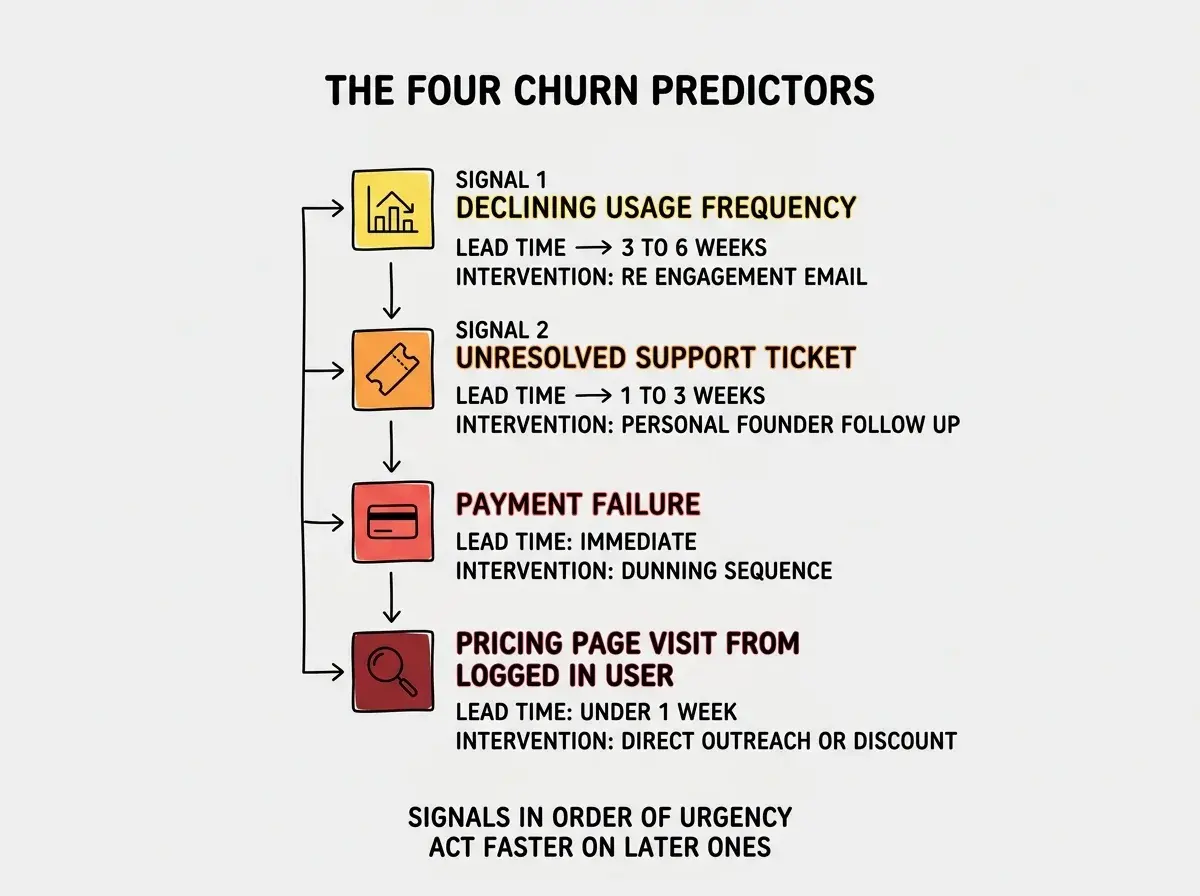
Pattern 3, payment failure. The credit card on file failed to charge. Without a dunning sequence (automated emails asking the user to update payment), passive churn from this signal alone is typically 10% to 20% of monthly revenue. The intervention is a sequence of three to five emails over 14 days, with progressively clearer urgency.
Pattern 4, pricing page visit from a logged-in user. A user who is already paying and visits your pricing page is comparing their plan or considering a downgrade. The lead time is under a week and the signal is unambiguous. The intervention is direct outreach with a discount, a free month, or a personal email asking what is on their mind.
The Intervention Playbook
The interventions only work if they are timely, specific, and personal. Generic mass emails to anyone "at risk" do not reduce churn, they annoy users and can accelerate cancellation. The pattern that works follows three rules.
Rule 1, segment narrowly. Do not send the same intervention to everyone in a churn risk bucket. Segment by signal type, by tenure, and by plan tier. A user on the lowest plan who has not logged in for 6 weeks needs a different message than a user on the highest plan who just had a support ticket close unresolved.
Read more retention and growth guides for vibe coded apps
Browse the grow categoryRule 2, lead with curiosity, not desperation. The email should ask a question, "We noticed you have not used X feature in a while. Was it not working as expected." It should not say "Please come back, we miss you." Curious questions invite real responses, desperate language signals weakness and accelerates the user's decision to leave.
Rule 3, follow up personally on the high-value cases. For customers paying meaningful money, an automated email is not enough. The founder or a customer success person should manually follow up on every at risk signal. A 15-minute call recovers more enterprise customers than 50 automated emails do.
The Metrics That Reveal Truth
You cannot improve what you cannot measure. The metrics that actually reveal churn dynamics are different from the metrics most founders track.
Net revenue retention (NRR). Total revenue from a cohort of customers, divided by what they paid 12 months ago. A healthy SaaS has NRR over 100% (existing customers expand spend faster than they cancel), a struggling one has NRR under 80%. NRR is much harder to game than MAU and reflects the true health of the business.
Time to cancel from first warning signal. How long, on average, between the first behavioral warning and the actual cancellation. A short time means your interventions are not catching users in time. A long time means there is more room to recover them.
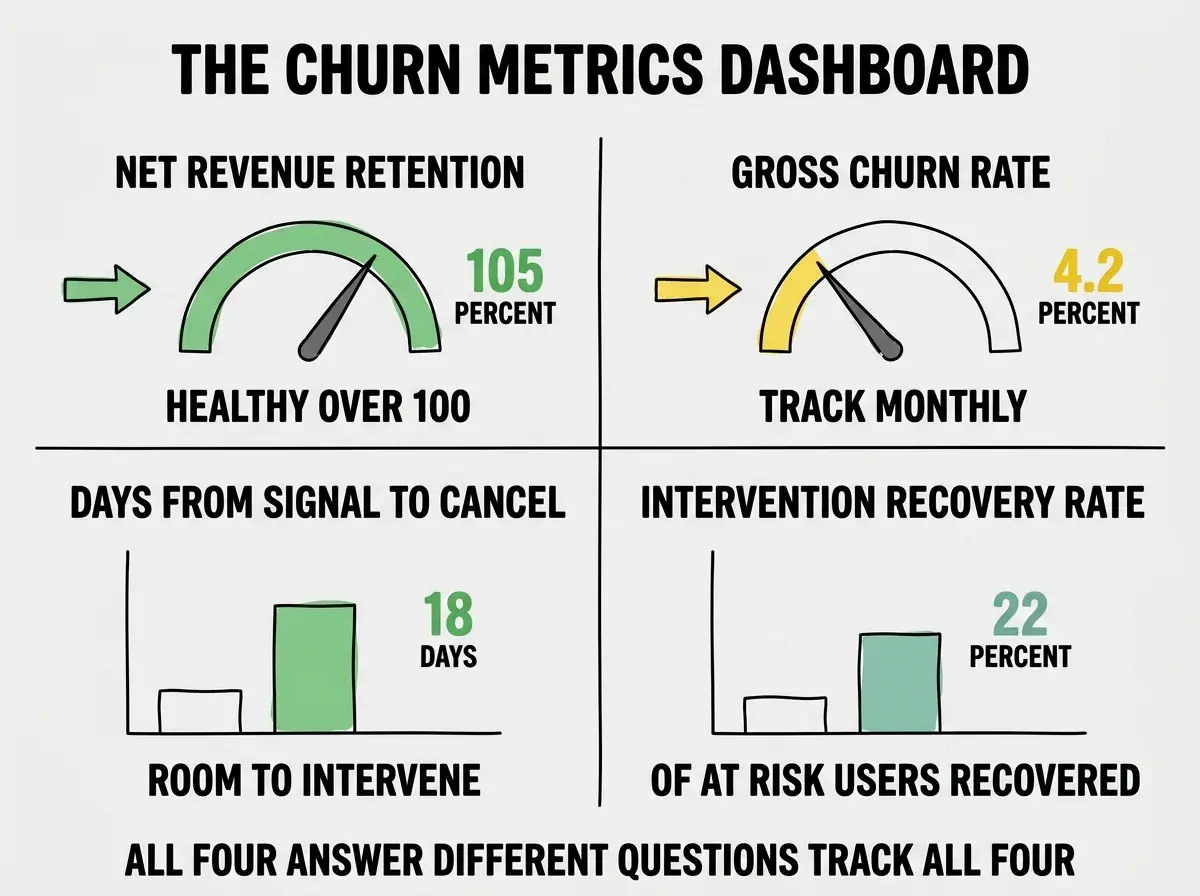
Intervention recovery rate. Of users who hit a churn warning signal and received an intervention, what percentage stayed paying 60 days later. This is the metric that tells you whether your interventions are working. Below 10%, your interventions need redesign. Above 25%, you have a real retention engine.
The most expensive churn prevention mistake is the discount-first reflex. When a user shows churn signals, the founder offers them 50% off to stay. The user takes the discount and churns four months later anyway, having now trained both the customer and the next ones to negotiate. Discounts should be the last resort, not the first.
The corollary is that the cheapest churn prevention is often free. A personal email asking what is going wrong, an offer to extend the trial, or a hand-off to a more relevant feature recovers users at higher rates than discounts and does not damage your pricing power.
What This Means For You
Churn prevention is the back-office work of growth. It is less glamorous than acquisition but matters more for long-term outcomes. The four signals above cover most of the behavioral patterns that predict cancellation, and a simple intervention playbook can recover a meaningful percentage.
- If you're a founder: Set up the four signals as automated alerts this month. Even a manual intervention loop, triggered by an email when a signal fires, is enough to start changing your retention curve.
- If you're changing careers: Retention thinking is one of the highest-leverage skills in product and growth roles. The patterns are universal and the interview questions reliably touch on them.
- If you're a student: Read the public retention reports from companies like Slack, Notion, and Figma. The patterns they describe at scale are the same patterns that work at any size.
Browse more retention and growth guides
Read more grow guides