To recognize the gap between a localhost demo and a shippable product in 2026, understand that AI excels at producing programs that run on your machine but a shippable product requires four additional dimensions that AI does not provide automatically (operational reliability for real users, security against real attackers, scalability for variable load, polish that signals professional quality), build the discipline of distinguishing "demo works" from "product is ready," and invest the time between the two states deliberately rather than hoping for the best. The gap is typically 10x the time to ship the demo; budget accordingly.
This piece walks through the four dimensions that distinguish demos from products, why AI makes the gap easy to ignore, the practical checklist for closing the gap, and the four mistakes that come from confusing localhost works with product is shippable.
Why the Gap Matters More With AI
In pre-AI development, the gap between "code runs locally" and "product ships" was visible because the localhost demo took weeks of work. Builders had time to internalize the work that came after. AI compressed the time to localhost demo from weeks to hours, but did not compress the post-demo work proportionally. The result is a much wider gap between "demo works" and "product ships."
The 2026 reality is that founders and builders consistently underestimate the post-demo work. The localhost demo feels like the project is 80 percent done; in reality it is more like 20 percent done. The gap is where most vibe-coded projects die.
A 2025 indie hacker survey of 2,000 vibe-coded MVPs found that 67 percent of projects that reached "demo works on localhost" never reached "publicly launched." Of those that died, 84 percent cited "underestimated post-demo work" as the primary reason. The gap is real and it is the leading cause of vibe-coded project death. Recognizing the gap upfront is the first step toward bridging it.
The pattern to copy is the way restaurants distinguish "test kitchen recipe" from "menu item." A recipe that works once in a controlled kitchen needs significant additional work to become a menu item that produces consistent quality at scale across servers, cooks, and ingredients of varying freshness. Software products follow the same pattern: a demo that works once needs significant additional work to become a product that works for all users in all conditions.
The Four Dimensions That Distinguish Demos From Products
Four dimensions consistently differentiate localhost demos from shippable products.
Dimension 1, operational reliability. Demo works for happy-path inputs from one user. Product handles unexpected inputs, network failures, race conditions, edge cases from many users.
Dimension 2, security. Demo trusts inputs and ignores attack scenarios. Product validates inputs, rate-limits abuse, protects against common attack patterns.
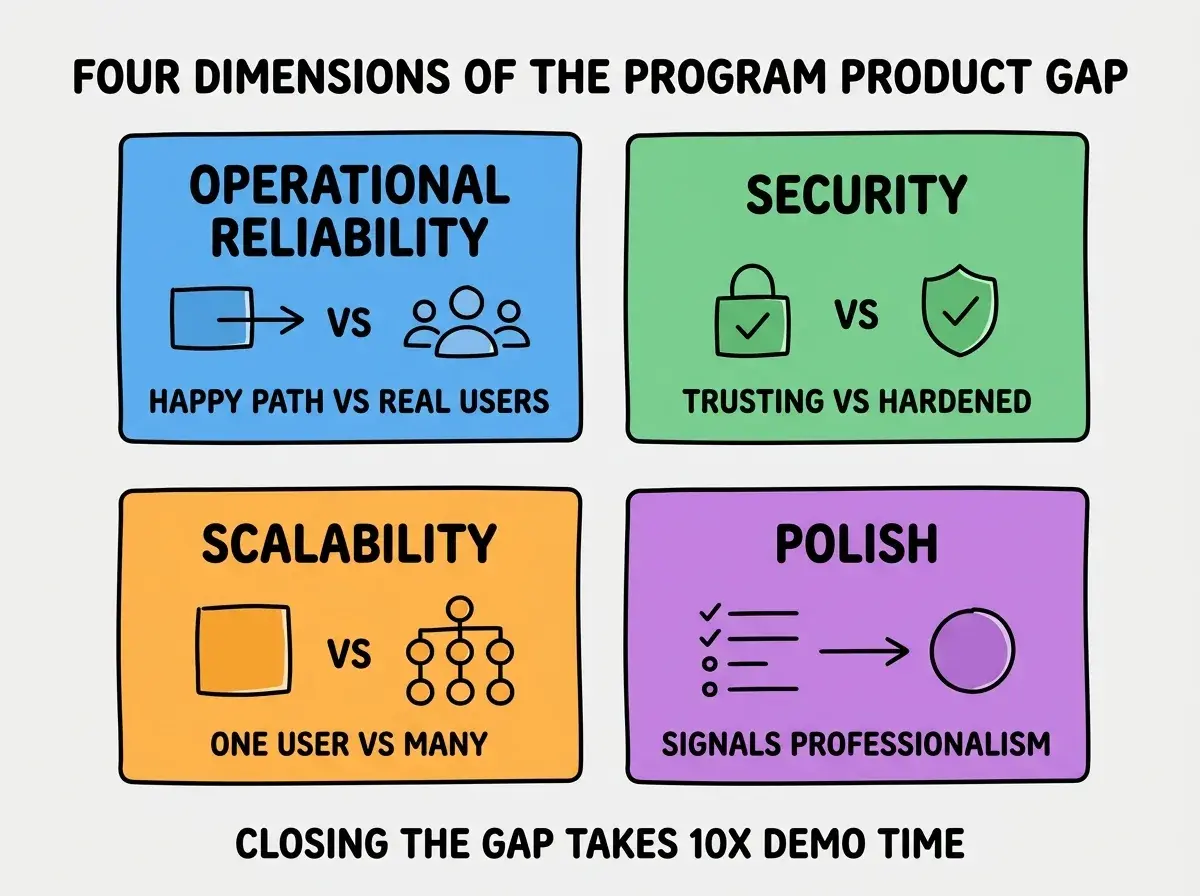
Dimension 3, scalability. Demo works for one developer testing manually. Product works for hundreds or thousands of concurrent users with predictable performance.
Dimension 4, polish. Demo has rough edges that the developer accepts because they understand the context. Product has the polish that signals "this is professional software made by serious people."
Why AI Makes the Gap Easy to Ignore
Three structural reasons explain why AI consistently produces demos that look more shippable than they are.
Reason 1, AI generates demo-quality output by default. AI optimizes for the specific prompt; "make this work" produces working demos, not shippable products. The gap is the unspecified work AI does not do.
Browse more product mental models
Read more foundations articlesReason 2, polished demos disguise the gap. AI generates UI that looks finished even when the underlying app is fragile. Visual polish creates false confidence that the app is ready.
Reason 3, the gap is invisible until users hit it. Founders never hit edge cases on their own demo. Real users hit them immediately. The gap is hidden during development and revealed at launch.
The Practical Checklist for Closing the Gap
Three checklists cover most of the work between demo and shippable product.
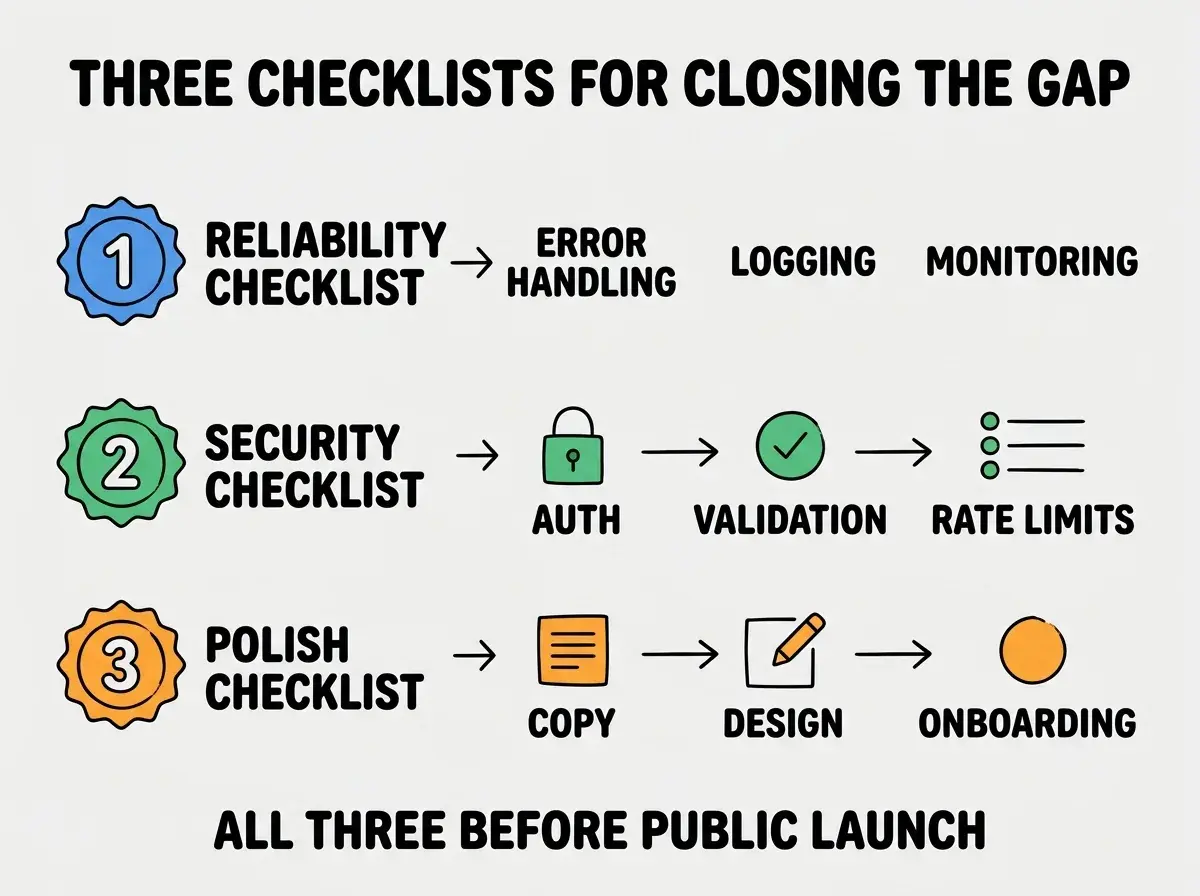
Checklist 1, reliability. Error handling for every external call, logging for diagnostics, monitoring for production visibility, graceful degradation for partial failures.
Checklist 2, security. Input validation on every user-controlled field, authentication and authorization properly scoped, rate limits on abuse-prone endpoints, secrets handled correctly.
Checklist 3, polish. Copy reviewed for clarity, design consistent across screens, onboarding tested with first-time users, error messages that help rather than confuse.
How to Plan for the Gap
Three planning patterns help builders budget the gap realistically rather than hoping it does not exist.
Pattern 1, allocate 10x the demo time for shipping. Demo took 10 hours; ship takes 100 hours. The ratio is consistent across project types.
Pattern 2, do user testing before launch. Five real users using the demo will surface 80 percent of the gap items. The investment is small; the diagnostic value is huge.
Pattern 3, ship to a small audience first. Even after the polish work, soft-launch to 10-20 friendly users before broader launch. The feedback catches the last gap items.
The combination produces shipping plans that hold up to reality. Plans that ignore the gap consistently miss launch dates and produce embarrassing first impressions when launches happen prematurely.
The most damaging program-product gap mistake is launching publicly when the demo works but the gap is unaddressed. The launch produces embarrassing failures (bugs, security issues, poor performance) that damage the founder's reputation and waste the launch momentum. The fix is to deliberately close the gap before public launch. Use the three checklists. Do user testing with real users. Soft launch to a small audience. The discipline of "demo works is not ship ready" prevents the most painful failure mode in vibe coding: launching too early.
The other mistake is treating gap-closing work as boring or low-status. The work of closing the gap is what separates amateurs from professionals. Founders who treat gap-closing as the most important phase of building (not as cleanup work after the "real" work of building the demo) consistently ship better products than founders who rush past it to next features.
How to Tell When You Have Closed the Gap
Three signals indicate the gap is closed and the product is genuinely shippable.
Signal 1, you can hand someone the URL and walk away. A friendly user can use the product without your help, hit edge cases, and recover from problems. If you have to be present to make the demo work, the gap is not closed.
Signal 2, the product handles a small surprise gracefully. Test what happens with bad inputs, slow networks, unexpected user behavior. If the product breaks visibly, the gap is not closed.
Signal 3, you would be proud if a journalist wrote about it. Imagine the product covered in TechCrunch tomorrow. If your reaction is "wait, I need to fix some things first," the gap is not closed.
The combination of these three signals produces a high bar that filters out launches that look ready but are not. Without the bar, founders launch on hope; with it, they launch on evidence.
What This Means For You
The program-product gap is one of the most important mental models for vibe coders in 2026. Recognizing the gap and budgeting for it is the difference between projects that ship and projects that die at the demo stage.
- If you're a founder: Plan for the gap explicitly. If you spent 20 hours on the demo, plan for 200 hours of post-demo work before public launch.
- If you're changing careers into product: The gap is where product judgment lives. Develop your eye for what separates demos from products by studying both.
- If you're a student: Build at least one project all the way through the gap to public launch. The experience teaches more than five demos that never launched.
Browse more product mental models
Read more foundations articles