To handle privacy correctly when using AI coding tools in 2026, evaluate against four exposure categories that determine your privacy risk (your own proprietary code being sent to AI vendors, your customers' data appearing in prompts, AI output potentially containing training data leaks, and persistent storage of your prompts by AI vendors), check each tool's data handling policies before using it for sensitive work, and adopt patterns that limit exposure such as local AI models for highly sensitive code and sanitized prompts for sensitive customer data. Privacy is not automatic with AI coding tools; it requires deliberate practice.
This piece walks through the four exposure categories, the tool data handling differences, the protection patterns that work, and the four mistakes founders make about AI coding privacy.
Why Privacy Matters More for AI Coding Than Most Tools
Most software development tools (IDEs, version control, package managers) do not transmit your code to external services for processing. AI coding tools fundamentally do; the AI lives on someone else's servers, and processing requires sending code to it. The privacy implications differ from most other developer tooling.
The 2026 reality is that AI coding tool privacy practices vary widely. Some tools have strong privacy protections (no training on your data, no persistence beyond session); others have weaker protections (data may train future models, code may persist for review). Founders who understand the differences make better tool choices than founders who treat all tools equivalently.
A 2025 Snyk security analysis of 500 organizations using AI coding tools found that 47 percent had not reviewed the privacy implications before adopting their primary tool, and 23 percent later discovered tool data handling that violated their internal policies or customer commitments. The privacy gap was widely underestimated. Founders who proactively evaluated privacy implications avoided the costly retroactive cleanup that downstream discovery produced.
The pattern to copy is the way medical professionals handle patient data. They do not send patient information to arbitrary services; they verify each service's HIPAA compliance and data handling first. Software developers should approach AI coding tools with similar rigor when handling sensitive code or customer data; the discipline prevents privacy incidents.
The Four Exposure Categories
Four categories cover most privacy concerns. Each requires different mitigation.
Category 1, your proprietary code transmitted to AI vendors. Code you send to AI tools may be stored, reviewed by employees, or used to train future models. The exposure depends on tool policies.
Category 2, customer data appearing in prompts. Code that includes real customer data (test data, production samples, integrations) sends customer data along with the code. This often violates customer agreements or regulations.
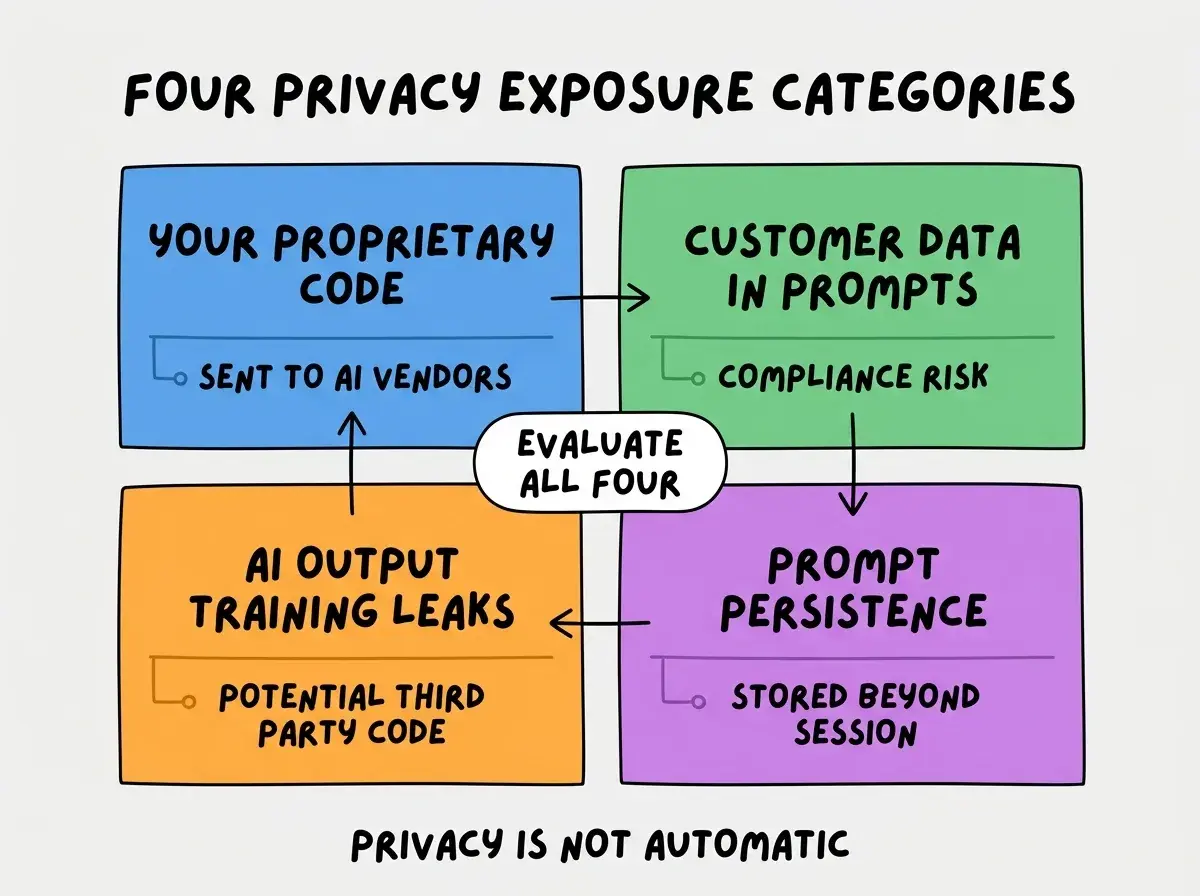
Category 3, AI output potentially containing training data leaks. AI models trained on copyrighted or proprietary code may reproduce portions of training data. Your shipped code may unintentionally include third-party code with associated licenses.
Category 4, prompt persistence beyond session. Some AI vendors store prompts indefinitely for various purposes (debugging, model improvement, abuse detection). Persistent prompts mean your code persists in vendor systems.
How AI Coding Tools Differ in Data Handling
Three patterns characterize how major AI coding tools handle data. Knowing them helps choose tools appropriately.
Pattern 1, enterprise tier promises (Cursor, Claude Code, GitHub Copilot Business). Major vendors offer enterprise tiers with explicit "no training on your data" commitments. The premium price often reflects real privacy improvements.
Browse more privacy and security guides
Read more foundations articlesPattern 2, free tier defaults often weaker. Free tiers may train on your data, store prompts longer, or have less restrictive policies. The "free" cost is sometimes data exposure.
Pattern 3, local models for maximum privacy. Running AI locally (Ollama, LM Studio with open-source models) keeps everything on your machine. Lower model quality but maximum privacy.
Protection Patterns That Work
Three patterns reduce privacy exposure without preventing AI tool use entirely.
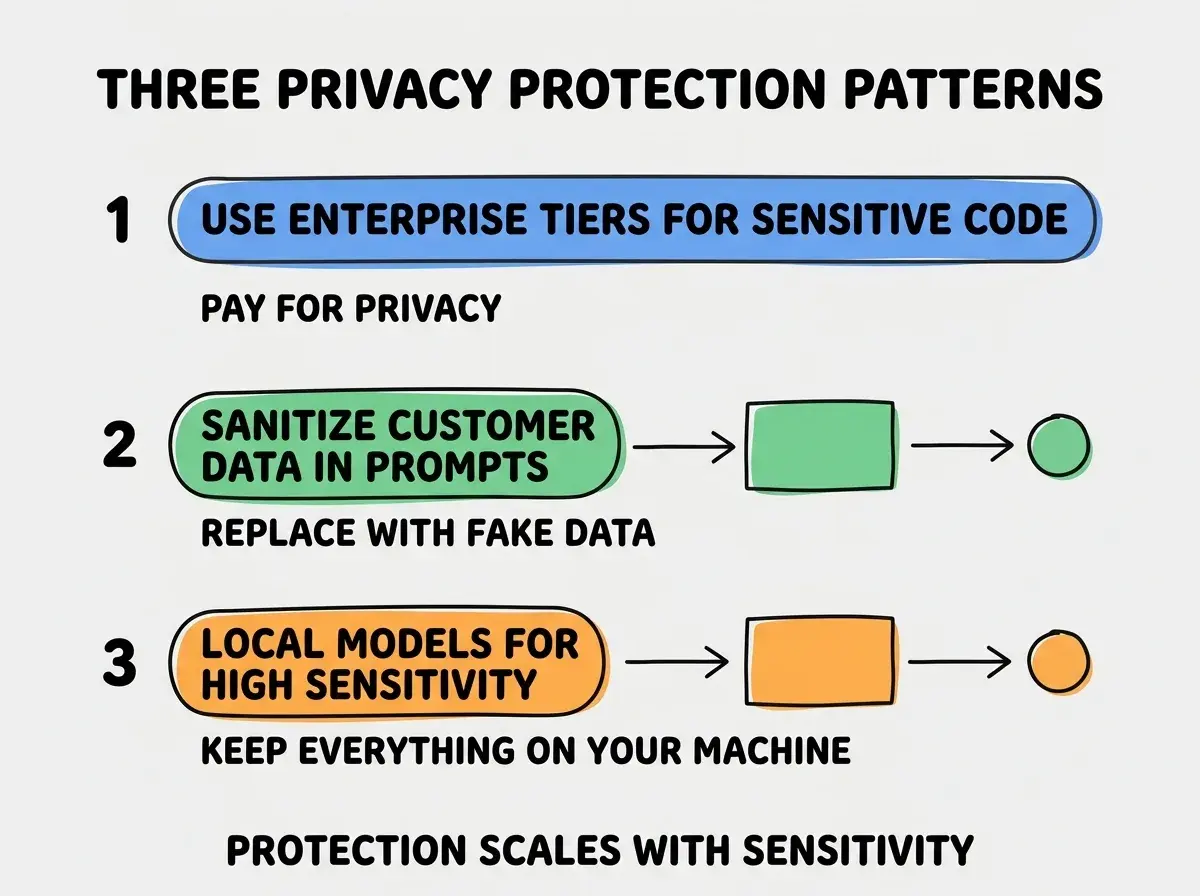
Pattern 1, use enterprise tiers for sensitive code. Pay for the privacy improvements when working with proprietary or sensitive code. The premium is small relative to the protection produced.
Pattern 2, sanitize customer data in prompts. Replace real customer data with fake but realistic data before sending to AI tools. The sanitization preserves the AI's ability to help while protecting actual customer information.
Pattern 3, local models for high-sensitivity code. Authentication, encryption, customer data handling code can use local AI models. Lower quality but no external transmission.
How to Audit Your Current AI Tool Privacy Posture
Three audit steps reveal your current privacy exposure. The audit takes a few hours and prevents expensive surprises.
Step 1, list every AI tool currently in use. Cursor, Copilot, Claude Code, Replit, custom integrations. The list is often longer than founders realize.
Step 2, check each tool's data handling policies. Read the privacy section; note training policies, retention policies, employee access policies. Document each.
Step 3, classify code sensitivity and match to tool tier. Low-sensitivity code can use any tool; high-sensitivity code needs enterprise tier or local models. Match deliberately.
The audit reveals gaps. Without it, founders operate on assumptions about tool privacy that may not match reality; the gap shows up at the worst times (compliance reviews, security incidents, customer escalations).
How to Comply With Customer and Regulatory Requirements
Three compliance patterns help when customer agreements or regulations restrict AI tool use.
Pattern A, check customer contracts for data handling restrictions. Some B2B customers prohibit sending their data to external AI services. Check before processing customer-related code with AI tools.
Pattern B, document AI tool usage in your privacy policy. Disclose to your own customers that you use AI tools and what data handling policies you follow. Transparency builds trust and meets disclosure obligations.
Pattern C, segment AI tool usage by sensitivity level. Use cloud AI for low-sensitivity code; use enterprise tiers or local models for sensitive code. Segmentation preserves the AI productivity benefit while limiting exposure.
The combination produces compliant AI tool usage. Without these patterns, founders often discover compliance gaps after they have already created exposure.
The most damaging privacy mistake is using free tier AI tools for production code without reviewing data handling policies. Free tier convenience leads founders to send sensitive code to vendors whose policies they have never read. The fix is to read the privacy section of every AI tool you use before using it for sensitive work; budget the 30 minutes once per tool. Founders who do this once per tool catch privacy issues before they become incidents; founders who skip this discover problems after exposure has occurred. Prevention is dramatically cheaper than remediation for privacy incidents.
The other mistake is treating AI coding tool privacy as one-time consideration. Tool policies change; new tools enter the market with different policies; your sensitive code mix evolves. The fix is to review AI tool privacy practices annually as part of broader security review. Annual review catches policy changes and tool additions before they create exposure that compounds.
A third mistake is failing to train developers on which code categories require which tier. Even with good policies, day-to-day decisions matter. The fix is to make sensitivity classification visible in the development workflow; developers should know which tier to use without having to think about it for each task.
What This Means For You
Privacy is real consideration when using AI coding tools in 2026. The four exposure categories, tool differences, and protection patterns produce reasonable privacy posture for most teams.
- If you're a founder: Review your AI tool privacy practices today. Most founders have not done this; the review takes hours and prevents incidents that take months to remediate.
- If you're changing careers into development: Privacy fluency is increasingly expected for senior roles. Understand the patterns even if your current employer handles tool selection.
- If you're a student: Study privacy principles alongside technical skills. The combination is what produces hireable engineers in 2026.
Browse more privacy and security guides
Read more foundations articles