To prepare your AI built app for 100K users, work through the four readiness categories that matter at this scale (infrastructure that handles concurrent load without degradation, observability that surfaces issues before users report them, operational practices that handle scale gracefully, and business systems that scale alongside technical systems), recognize what differs from 1000 user preparation, and apply the patterns that produce sustainable scale. The 100K user preparation matters because scale exposes weaknesses that low traffic hides.
This piece walks through the four readiness categories, what differs from 1000 user prep, the specific checklist items, and the four mistakes that produce scale failure.
Why 100K User Preparation Matters
100K user preparation matters as success scales applications past initial validation. The preparation matters; applications that hit 100K users without preparation often fail visibly in ways that erode user trust and slow growth.
The 2026 reality is that AI tools enable rapid initial growth but do not automatically prepare applications for sustained scale. Without explicit preparation, applications that grow to 100K users often experience scale failures that proper preparation would prevent.
A 2025 startup growth survey of 200 companies that crossed 100K user milestones found that 73 percent experienced significant production incidents in the first month at scale. Among those with structured 100K preparation, the rate dropped to 22 percent. Preparation dramatically reduces but does not eliminate scaling incidents.
The pattern to copy is the way buildings prepare for occupancy. Buildings designed for occupancy include systems that empty buildings do not need (HVAC, fire suppression, water capacity); applications at scale need systems that small applications do not need. Preparation matters before occupancy not after.
The Four Readiness Categories
Four categories characterize 100K user readiness.
Category 1, infrastructure handling concurrent load. Auto scaling, database capacity, caching, CDN. Infrastructure determines whether traffic spikes degrade service.
Category 2, observability surfacing issues proactively. Application monitoring, error tracking, performance monitoring, log aggregation. Observability determines incident response speed.
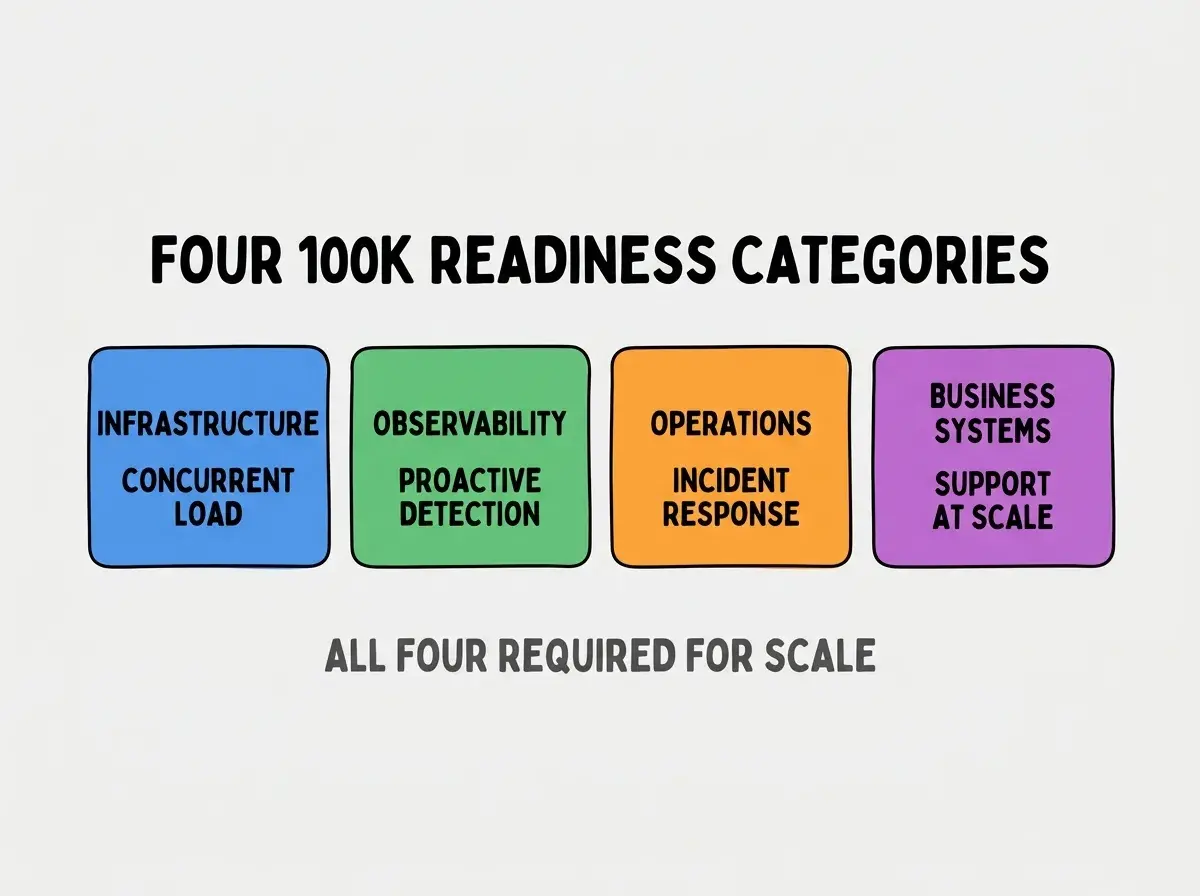
Category 3, operational practices for scale. On call rotations, runbooks, incident response. Operations determine recovery time when issues occur.
Category 4, business systems scaling alongside technical. Customer support, payment processing, legal compliance. Business systems often constrain growth more than technical systems at this scale.
What Differs From 1000 User Preparation
Three differences distinguish 100K preparation from 1000 user preparation.
Difference 1, single points of failure become visible. What handled 1000 users may have hidden failure modes that emerge at 100K. Failure modes scale with traffic.
Browse more grow articles
Read more grow articlesDifference 2, manual processes become impossible. Operations that worked manually at 1000 users overwhelm humans at 100K. Automation becomes essential not optional.
Difference 3, business systems start mattering. Support, billing, compliance all matter more at 100K than at 1000. Business systems often constrain growth.
The Specific Infrastructure Checklist
Three infrastructure areas deserve specific attention.
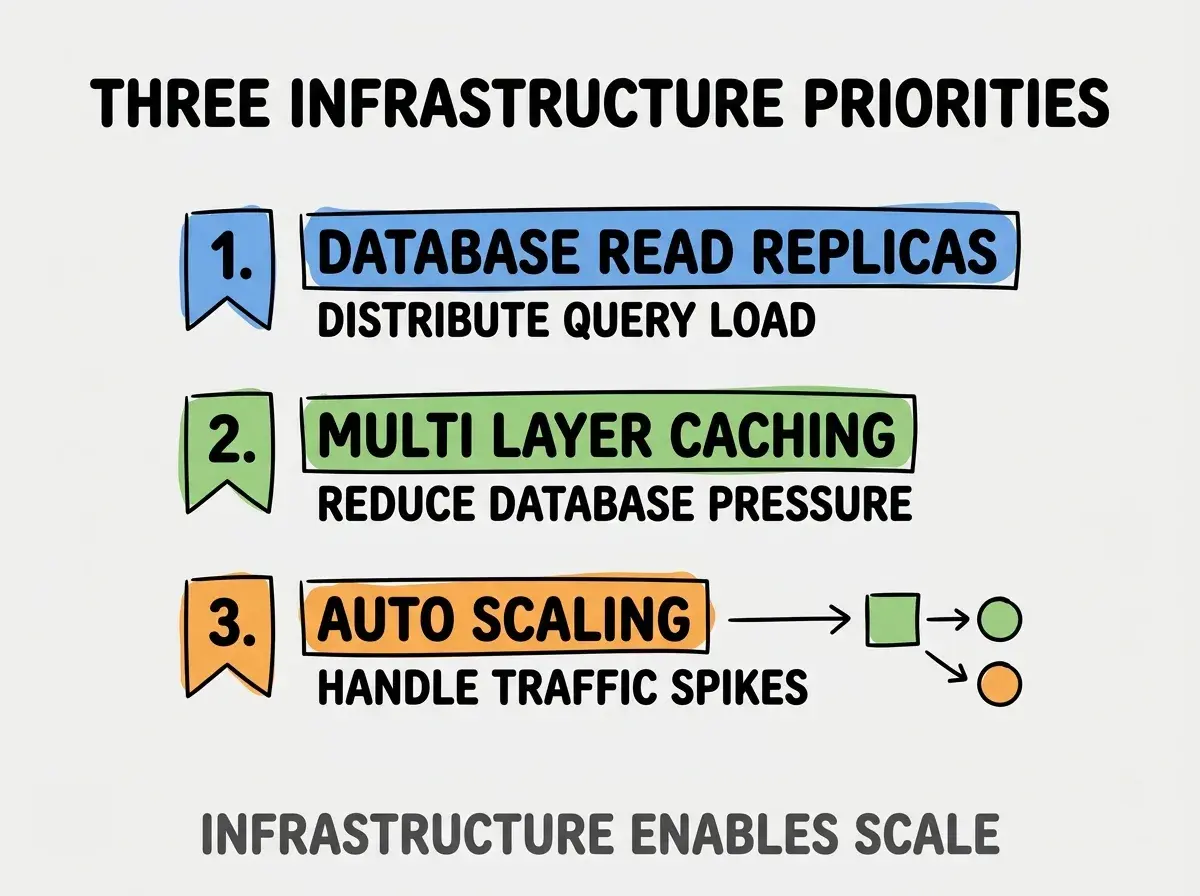
Priority 1, database read replicas distributing query load. Read heavy queries to replicas, writes to primary. Replicas handle read scaling that single database struggles with.
Priority 2, multi layer caching reducing database pressure. CDN cache, application cache, database cache. Layered caching reduces database load dramatically.
Priority 3, auto scaling handling traffic spikes. Auto scaling rules based on CPU, memory, or queue depth. Spikes happen; auto scaling prevents incidents.
What Makes 100K Scale Sustainable
Three patterns separate sustainable 100K scale from problematic scale.
Pattern 1, capacity headroom of at least 2x peak load. Headroom absorbs unexpected spikes. Without headroom, spikes become incidents.
Pattern 2, observability matching infrastructure complexity. Each infrastructure layer needs corresponding observability. Without matching observability, issues become invisible until they impact users.
Pattern 3, on call practices that distribute load sustainably. On call burden affects engineer retention; sustainable practices matter for team longevity. Without sustainable practices, scale produces engineer burnout.
The combination produces 100K scale that sustains over time. Without these patterns, scale often becomes crisis mode that erodes team and application health.
How To Plan The Preparation Timeline
Three planning patterns help structure 100K preparation.
Pattern A, start preparation at 10K users or earlier. Preparation takes months; starting at 10K provides buffer. Starting at 80K produces panic mode.
Pattern B, prioritize based on observed bottlenecks. Real bottlenecks reveal themselves through observation. Without observation, preparation often addresses theoretical rather than actual bottlenecks.
Pattern C, validate preparation through load testing. Theoretical preparation differs from validated preparation. Load testing reveals what preparation actually handles.
The combination produces preparation timelines that finish before scale arrives. Without timeline planning, preparation often arrives after scale problems.
The most damaging 100K preparation mistake is treating it as one time project rather than ongoing capability building. Scale capability requires sustained practices not just initial setup. The fix is to build practices that maintain readiness; on call rotation, capacity review, observability review become regular activities not one time tasks. Teams that treat 100K prep as one time project often experience scale problems despite initial preparation; teams that treat it as ongoing practice maintain readiness.
The other mistake is missing business system scaling. Customer support, billing, legal often become bottlenecks at 100K users. The fix is to scale business systems alongside technical systems.
A third mistake is overprovisioning before validation. Provisioning costs scale with capacity; over provisioning before validating need wastes resources. The fix is to validate need then provision.
A fourth mistake is treating 100K as destination rather than waypoint. 100K is meaningful milestone but not destination; preparation should consider 1M user trajectory.
How To Handle Specific Scale Challenges
Three challenges deserve specific approaches at 100K scale.
Challenge 1, database write contention. Writes to popular records create contention. Solutions include sharding, write batching, eventual consistency patterns.
Challenge 2, search infrastructure overload. Search load grows non linearly with user count. Solutions include dedicated search infrastructure scaling.
Challenge 3, support volume overwhelming small teams. Support tickets scale with users; small teams cannot handle 100K user support volume manually. Solutions include self service support, AI assisted support, escalation patterns.
The combination produces approaches to specific 100K challenges. Without specific approaches, common challenges become incidents.
How 100K Preparation Will Likely Evolve
100K preparation patterns will likely evolve as tooling improves but core principles remain.
The first likely evolution is managed services reducing infrastructure preparation burden. Database scaling, caching, CDN all becoming more managed. Reduction enables smaller teams to handle scale.
The second likely evolution is observability tooling becoming more standard. Open source and managed observability becoming more capable. Standardization reduces observability investment.
The third likely evolution is AI assisted operations becoming standard. AI for incident response, capacity planning, optimization. AI assistance reduces operational burden.
The combination suggests 100K preparation will become more accessible to smaller teams. Engineers learning patterns now build skills that remain valuable as tooling matures.
Common Questions About 100K Preparation
100K user preparation raises questions worth addressing directly.
The first question is when to start hiring versus relying on AI tools. AI tools handle technical scaling effectively; hiring matters for business systems and operational capacity. Hire for capacity gaps not technical capability.
The second question is whether to migrate platforms before 100K. Platform migration mid scale produces incidents; migration before 10K cheaper than after 100K. Decide before scale arrives.
The third question is how to handle international scale. International users require geographic infrastructure consideration; CDN, regional databases, time zone aware operations all matter. Plan international scale alongside user scale.
What This Means For You
100K user preparation determines whether scale produces success or crisis. The four categories, infrastructure priorities, and timeline patterns produce framework for scale readiness.
- If you're an indie hacker: Plan 100K preparation starting at 10K users. Late preparation produces incidents that erode user trust during critical growth window.
- If you're a senior dev: 100K scale exposes infrastructure weaknesses invisible at lower scale. Build infrastructure that scales rather than infrastructure that works at low scale.
- If you're a founder: 100K user scale affects business systems beyond engineering. Plan support, billing, compliance scaling alongside engineering scaling.
Browse more grow articles
Read more grow articles