To understand the post-mortem of the $607 Replit bill from runaway AI costs, recognize four root causes that produced the unexpected bill (auto-generated agent loops without spending caps, AI-generated debugging that recursively called more AI, lack of usage monitoring or alerts, and the founder discovering only at billing close), see the cost spiral mechanics that turned reasonable AI usage into bill shock, and adopt the prevention patterns that protect against similar surprises. The case is real and the lessons are widely applicable; runaway AI costs catch many founders off-guard.
This piece walks through the four root causes, the cost spiral mechanics, the prevention patterns, and the four mistakes that lead to similar bill surprises.
Why This Case Study Spread So Widely
The $607 Replit bill story spread because it captured a specific anxiety many founders have: AI tool bills can spiral in ways traditional software bills cannot. The case provides concrete data point about how the spiral happens and what it costs.
The 2026 reality is that AI cost management has become essential founder skill. Founders who develop the discipline avoid bill shocks; founders who ignore it sometimes get caught.
The $607 Replit bill accumulated over approximately 4 days of agent usage that ran in loops without spending limits configured. The founder reported being shocked when discovering the bill; usage monitoring would have caught the spiral within hours. The case represents a broader pattern; AI tool spending patterns differ fundamentally from subscription tools and require different cost management approaches.
The pattern to copy is the way utilities companies prevent bill shock. They send usage alerts, allow customers to set caps, and provide visibility into consumption patterns. Smart utilities customers configure alerts and caps; smart AI tool users do the same. The infrastructure exists; using it is the work.
The Four Root Causes
Four root causes combined to produce the bill spiral.
Cause 1, auto-generated agent loops without spending caps. AI agents that called themselves recursively for problem-solving. Each call cost real money; loops produced exponential cost growth that nothing was monitoring or stopping.
Cause 2, AI-generated debugging that recursively called more AI. The founder asked AI to debug an issue; AI's debugging itself called AI services. Multiplied cost without obvious visibility into the meta-recursion happening behind the scenes.
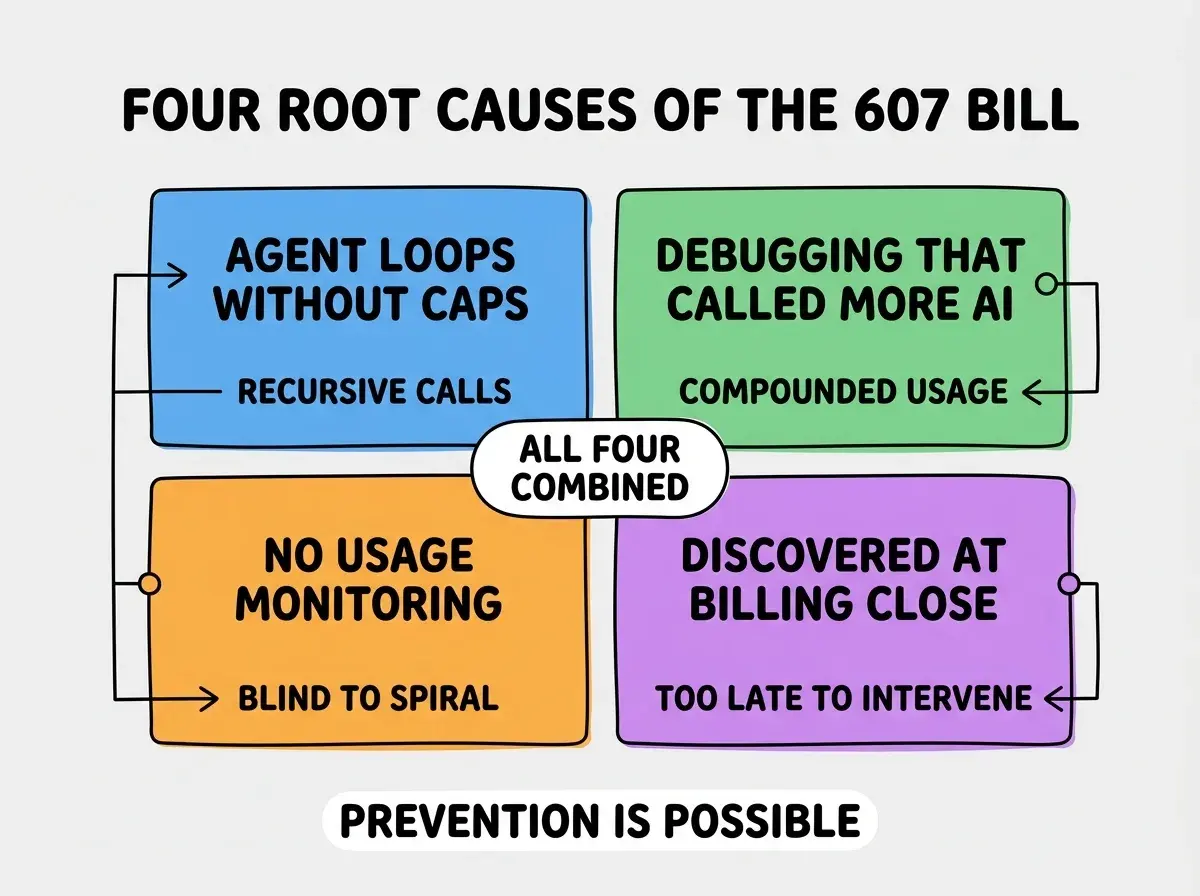
Cause 3, lack of usage monitoring or alerts. The founder had not configured spending alerts. The accumulating bill was invisible until billing close; alerts would have caught it within hours of the spiral starting and prevented most of the eventual cost.
Cause 4, discovered only at billing close. By the time the bill was visible, the spiral had already accumulated days of charges. Earlier visibility would have allowed intervention; late discovery prevented intervention until the cost had already accumulated fully.
The Cost Spiral Mechanics
Three mechanic patterns produce AI cost spirals that surprise founders.
Pattern 1, exponential growth from recursive calls. AI agents that call themselves for sub-problems can multiply cost exponentially. Each recursive level adds cost; deep recursion produces very large total cost from what looked like single original requests.
Browse more cost management guides
Read more pulse articlesPattern 2, retry loops that amplify failures. When AI calls fail, retry logic often retries automatically. Failed calls still cost money in many billing models; retries multiply the cost of failures rather than absorbing it as you might expect.
Pattern 3, parallel processing that amplifies cost-per-task. Modern AI agents process multiple tasks in parallel. Parallel cost adds up faster than sequential cost; the speed advantage comes with cost amplification that catches founders off-guard.
The Prevention Patterns That Work
Three prevention patterns protect against similar bill spirals.
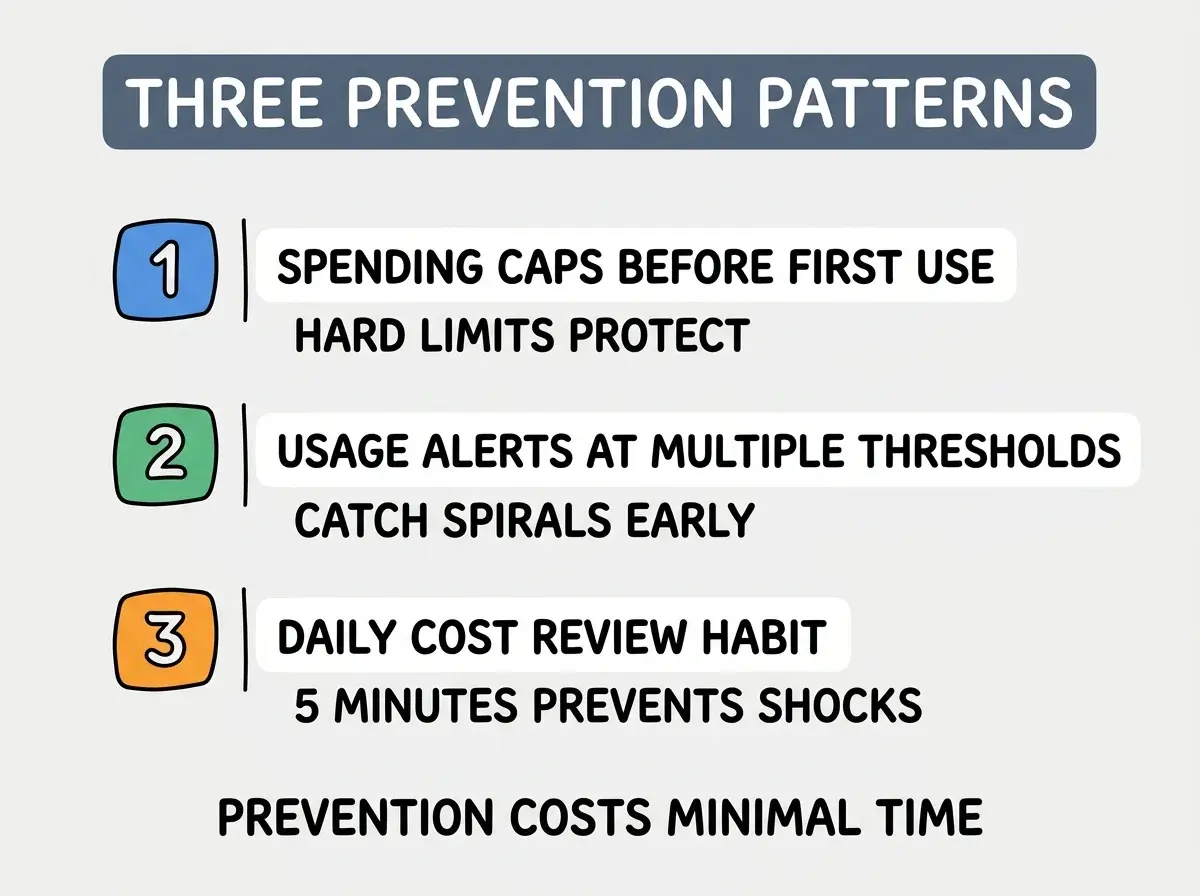
Pattern 1, spending caps before first use. Configure hard limits before starting to use any AI tool. Caps prevent the worst case; reduce limits later if appropriate but start protected with conservative caps you can later raise.
Pattern 2, usage alerts at multiple thresholds. Alerts at 25 percent, 50 percent, 75 percent of cap. Multiple alerts catch spirals at different stages; single alert may fire too late to allow useful intervention before substantial cost accumulates.
Pattern 3, daily cost review habit. 5 minutes daily checking AI tool spending dashboards. The discipline catches anomalies within 24 hours; without it, anomalies compound for weeks before discovery.
How Different AI Tools Differ in Cost Risk
Three tool categories have different cost risk profiles.
Category 1, fixed subscription tools (Cursor, Copilot). Predictable monthly cost regardless of usage. Lower bill shock risk; harder to overspend dramatically.
Category 2, usage-based API tools (OpenAI, Anthropic direct API). Cost scales with usage. Bill shock risk depends entirely on usage management; configuration matters.
Category 3, agent platforms with autonomous loops (Replit Agents, custom agents). Highest bill shock risk. Autonomous behavior can amplify cost in ways developers do not expect; require strongest controls.
The combination shows that not all AI tools have equal cost risk. Without category awareness, founders treat all AI tools the same and fail to apply category-appropriate controls.
How to Recover From a Bill Shock
Three patterns help if you experience similar bill shock.
Pattern A, contact vendor support immediately. Most vendors will partially refund first-time bill shocks if contacted promptly. The relationship and timing matter; do not delay; vendors typically do not refund delayed reports as readily as immediate ones.
Pattern B, document what happened systematically. Specific cause, timeline, prevention now in place. Documentation supports vendor negotiations and prevents recurrence by making the patterns visible to your future self.
Pattern C, share the lesson publicly. Other founders benefit from learning from your experience. The shared learning protects others while building your reputation as transparent builder who handles setbacks well.
The combination produces both individual recovery and broader benefit. Without these patterns, bill shocks become both costly and isolating; with them, the shocks become learning opportunities.
The most damaging AI cost mistake is treating AI tool spending like subscription spending. Subscription tools have predictable monthly costs; AI tools have usage-based costs that can vary by orders of magnitude depending on activity. The fix is to apply the cost management discipline that variable spending requires (caps, alerts, monitoring) from the first day of use, not after the first surprise bill. Founders who treat AI costs as variable spending from the start avoid the surprises that catch founders treating them as fixed costs.
The other mistake is over-correcting after a bill shock by abandoning AI tools entirely. The tools provide real value; the answer is better cost management, not abstention. The fix is to address root causes (caps, alerts, monitoring) and continue using the tools with proper protection. Abandonment loses the value while addressing only the symptoms.
A third mistake is failing to share the lesson with team members or partners. If you experienced a bill shock, others on your team or in your circle could too. The fix is to share what happened proactively; the shared awareness prevents repeats across your collaborators.
What This Means For You
The $607 Replit bill case study teaches widely applicable lessons about AI cost management. The four causes, prevention patterns, and recovery approaches produce protected AI usage.
- If you're a founder: Configure caps and alerts on every AI tool today. The 30-minute setup prevents bill shocks that take much longer to recover from.
- If you're changing careers into building: Build cost management discipline alongside building skill. The combination is what professional builders maintain.
- If you're a student: Apply the same discipline to your AI tool usage. Even student usage can produce bill shocks; the prevention patterns transfer regardless of context.
Browse more cost management case studies
Read more pulse articles