Microsoft is canceling Claude Code licenses across its Experiences and Devices division by June 30, 2026. Uber burned through its entire 2026 AI coding budget in four months after rolling out Claude Code to 84 percent of its 5,000-person engineering organization. Amazon shut down an internal token leaderboard called Kirorank after employees gamed it. Three separate incidents in one week reveal the same underlying problem: Claude Code works extremely well, but enterprises have no governance model for what happens when it works too well.
The pattern matters for every builder, not just enterprise architects. If you work at a company that gives you AI tools, your access is contingent on the company not getting surprised by the bill. If you sell software to enterprises, budget controls are becoming a required feature. And if you are building your own products with AI, the same cost dynamics apply at smaller scale.
What Happened at Microsoft This Week
Microsoft's Experiences and Devices group covers Windows, Microsoft 365, Outlook, Teams, and Surface. It is one of the most engineering-dense divisions in the company. Tom Warren reported on May 14 via his Notepad newsletter that the group is canceling Claude Code licenses and requiring engineers to transition to GitHub Copilot CLI by June 30, the last day of Microsoft's fiscal year.
The official reason is "toolchain unification." The actual reason, reading between the lines, is cost. Claude Code spread far beyond its intended audience inside Microsoft. Engineers, product managers, and designers adopted it because it worked. The tool became the preferred choice over Microsoft's own GitHub Copilot CLI, which was supposed to serve the same function. That internal adoption story, while impressive, created an unusual situation: a Fortune 10 company was paying significant per-token fees to a competitor for a tool that competed directly with its own product.
Microsoft is moving engineers to GitHub Copilot CLI, which gives the company much more predictable pricing and keeps spend inside its own ecosystem.
Uber CTO Praveen Neppalli Naga told The Information that Uber's engineering organization went from 32 percent Claude Code adoption in December 2025 to 84 percent by March 2026. Individual engineers were spending $500 to $2,000 per month. Uber exhausted its entire 2026 AI coding budget within the first four months of the year.
The Uber numbers help explain why Microsoft acted when it did. When 84 percent of a 5,000-person engineering organization actively uses a tool priced by token consumption, the monthly invoice is not a line item; it is a budget crisis waiting to be discovered.
Why Token Pricing Breaks Enterprise Budgeting
Software executives know how to budget per-seat licenses. You have 3,000 engineers, you pay for 3,000 seats, the cost is fixed and predictable. AI coding tools like Claude Code work differently. You pay for tokens consumed, and consumption is a function of how hard each engineer pushes the tool.
An engineer who asks Claude Code to refactor a large module, run tests, fix the failures, and iterate several times in a single session can consume $40 or more of tokens in an afternoon. Multiply that by 3,000 engineers across 250 working days, and the annual number is not a software license fee; it is closer to an infrastructure budget.
Traditional enterprise procurement processes have no playbook for this. The tool was purchased as a productivity product. It ended up on the infrastructure invoice.

Uber COO Andrew Macdonald added another layer to this story. Speaking on a podcast, he said that the AI spending had not led to a measurable increase in projects shipped or productivity. The engineers were using the tools enthusiastically. The outcomes were not yet proportional to the cost. That disconnect between adoption metrics and productivity metrics is what forces finance teams to intervene.
What Amazon Did with Kirorank
Amazon's situation illustrates a different failure mode. Amazon shut down Kirorank, an informal internal leaderboard that tracked which teams were using the most AI tokens. Employees began gaming the leaderboard by running AI agents on tasks that did not need AI, simply to accumulate tokens and rank higher.
Amazon's internal statement was direct: "Don't use AI just to use AI." The leaderboard, created to encourage adoption, ended up incentivizing waste instead of measuring actual value.
The lesson is separate from cost but closely related. When AI usage becomes a performance signal, people optimize the signal rather than the outcome. Kirorank was measuring the wrong thing.
The Vibe Coder Blog covers practical AI development for builders who ship.
Read MoreWhat the Productivity Question Actually Means
The Uber COO's comment about productivity is the most important part of this story, and it is also the most commonly misread one. He was not saying that Claude Code does not work. He was saying that bulk adoption without measurement does not automatically convert to business outcomes.
This is a different claim. Claude Code demonstrably speeds up individual coding tasks. The question is whether organizational-level speed on individual tasks translates to organizational-level speed on shipping products. That translation requires more than access to a good tool; it requires changed workflows, better planning, and measurement systems that track outcomes rather than activity.
Uber's engineers were spending more. Uber was not shipping proportionally more. The tool was not the problem. The system around the tool was not ready.
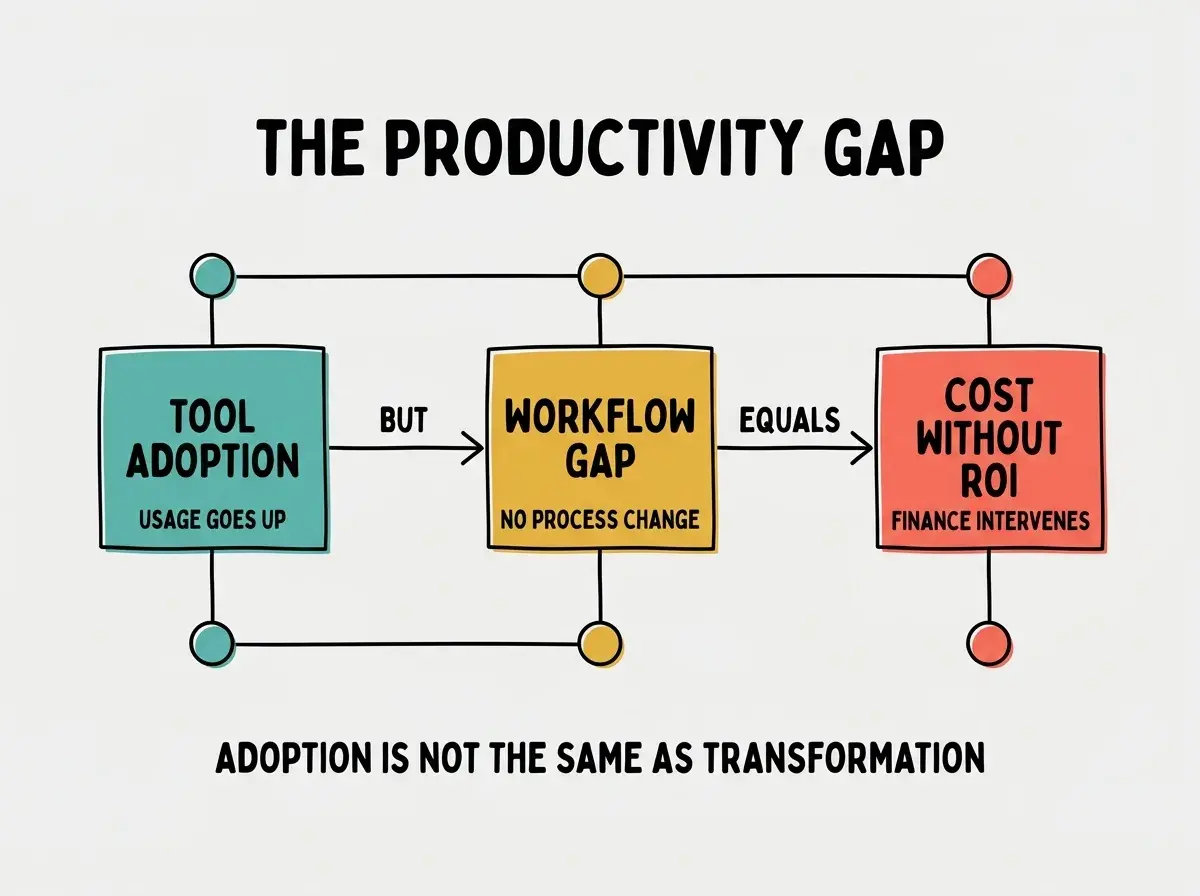
The builders who avoid this trap are the ones who treat AI tools as a workflow redesign question, not just an access question. More access to a tool you do not know how to measure is not an advantage.
The most common mistake at both the enterprise and individual builder level is treating AI coding tool adoption as the goal rather than the means. Uber's engineers were not wrong to use Claude Code extensively. The mistake was organizational: no measurement system existed to connect that usage to shipped product outcomes. Without that connection, any finance team will eventually cut the tool rather than redesign the system.
What This Means for Builders
If you work at a company that provides Claude Code or similar tools, treat that access as contingent. The pattern at Microsoft, Uber, and Amazon shows that adoption alone is not protection. Build habits that produce visible, verifiable outputs from your AI usage, because those outputs are the only argument for keeping the budget line when finance asks.
If you are building products that enterprises will use for AI-assisted workflows, budget controls are now a table-stakes feature. Your users' finance teams will ask two questions: what does this cost per month, and how do I cap it. If your product cannot answer both questions before the demo ends, you will lose deals to products that can.
If you are a solo builder or small team, the same dynamics apply at a smaller scale. Token-based pricing can surprise you the same way it surprised Uber, just with a smaller number. Set spending alerts on any pay-per-token tool you use. Know your average session cost. Build that number into your project budget, not your grocery budget.
The Microsoft, Uber, and Amazon stories are not evidence that Claude Code does not work. They are evidence that organizations are still learning how to govern tools that work very well. The builders who learn governance before they need to are the ones who keep their tools when the finance review happens.
The Vibe Coder Blog publishes analysis for builders who ship with AI.
Browse All Posts