PHP, Java, and .NET developers transitioning into AI-assisted development in 2026 have a much shorter learning curve than they often expect because four core skills transfer directly: object-oriented design, debugging discipline, system architecture thinking, and SQL fluency. The gaps are mostly in modern frontend frameworks (React, Next.js), serverless and edge deployment patterns, and the AI workflow itself (Cursor, Claude Code, prompt engineering). With focused effort, an experienced PHP or Java developer can become productive in the modern AI-assisted stack in 6 to 8 weeks, and the prior experience compounds rather than working against the new patterns.
This piece walks through the four skills that transfer directly, the gaps to fill, the realistic 6-week learning path, and the four mistakes that slow most career transitions unnecessarily.
Why Older Stack Experience Is an Asset Not a Liability
The popular fear among PHP, Java, and .NET developers is that their experience is somehow "old" and that they will be at a disadvantage compared to fresh graduates who learned React first. The data shows the opposite. Engineers with 5+ years of experience in any production stack adopt AI coding tools faster and produce higher-quality output than fresh graduates, because the AI tools amplify judgment and judgment comes from experience.
The pattern that matters is not which language you have used; it is whether you have shipped production software, debugged real issues, and made architecture decisions that survived real users. Those experiences are language-agnostic. The new stack (Next.js, Supabase, Cursor) is a vocabulary change, not a fundamental skill change.
A 2025 GitHub Octoverse career transition study tracked 1,000 developers moving from older stacks (PHP, Java, .NET) to modern AI-assisted development. The median transition took 6 weeks of focused learning. Developers with 5+ years of prior experience were productive in 4 weeks; developers with under 2 years of prior experience took 10 weeks. The takeaway: experience compounds. The transition is not starting over; it is adding new tools to a foundation you already have.
The pattern to copy is the way photographers transitioned from film to digital in the early 2000s. The composition skills, the eye for light, the customer relationships all transferred. What changed was the tooling. Photographers who treated digital as "starting over" struggled; those who treated it as "new tools for the same craft" thrived. The transition from PHP/Java/.NET to AI-assisted development follows the same pattern.
The Four Skills That Transfer Directly
Each of these skills was built by years of work in older stacks and applies directly to AI-assisted development without modification.
Skill 1, object-oriented design. Java and .NET developers think in classes, interfaces, and inheritance hierarchies. Modern TypeScript with proper class-based components and dependency injection benefits enormously from this thinking. The patterns are the same; only the syntax is slightly different.
Skill 2, debugging discipline. PHP, Java, and .NET developers who shipped production code know how to read stack traces, narrow hypotheses, and isolate root causes. This is the most undervalued transferable skill. Modern AI-assisted development still produces bugs; the engineers who debug them effectively are the ones who learned debugging in older stacks.
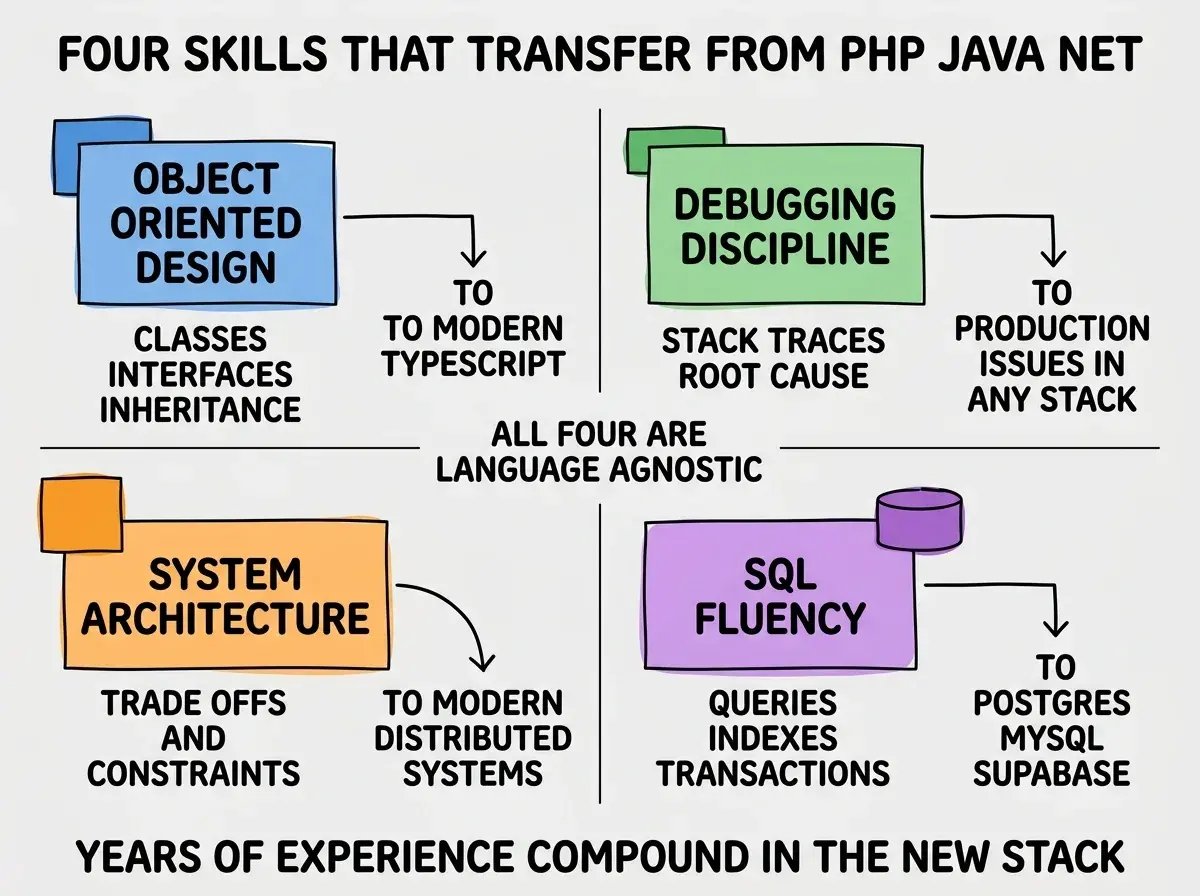
Skill 3, system architecture thinking. Choosing how to structure an application, when to use a queue, how to handle concurrency. These trade-off decisions are the same in 2026 as they were in 2010, just with different tool options.
Skill 4, SQL fluency. PHP, Java, and .NET developers almost always know SQL well. This is gold in 2026 because LLMs are surprisingly bad at writing efficient SQL, and developers who can write and read SQL fluently outperform LLM-only approaches consistently.
The Gaps to Fill in 6 Weeks
The new skills are concentrated in four areas. Each takes 1 to 2 weeks of focused practice for an experienced developer.
Gap 1, modern frontend. React, Next.js, Tailwind CSS. The mental model is different from server-rendered PHP or JSP, but learnable. Spend a week building one small project with each (a portfolio, a blog, a SaaS dashboard).
Gap 2, serverless and edge. Vercel, Cloudflare Workers, Supabase Edge Functions. The deployment model is different from the J2EE container or LAMP stack you are used to. Spend a few days deploying small projects to each.
Browse more career transition guides
Read more foundationsGap 3, the AI workflow. Cursor, Claude Code, prompt engineering for code. Spend two weeks using these tools daily on real projects. The fluency comes from practice, not from reading.
Gap 4, modern DevOps. GitHub Actions, environment variables, deploy previews. Most of this maps to concepts you already know (CI/CD, configuration management) just with different tools.
The Realistic 6-Week Path
A focused 6-week learning plan looks roughly like this for an experienced developer with 5+ years in PHP, Java, or .NET.
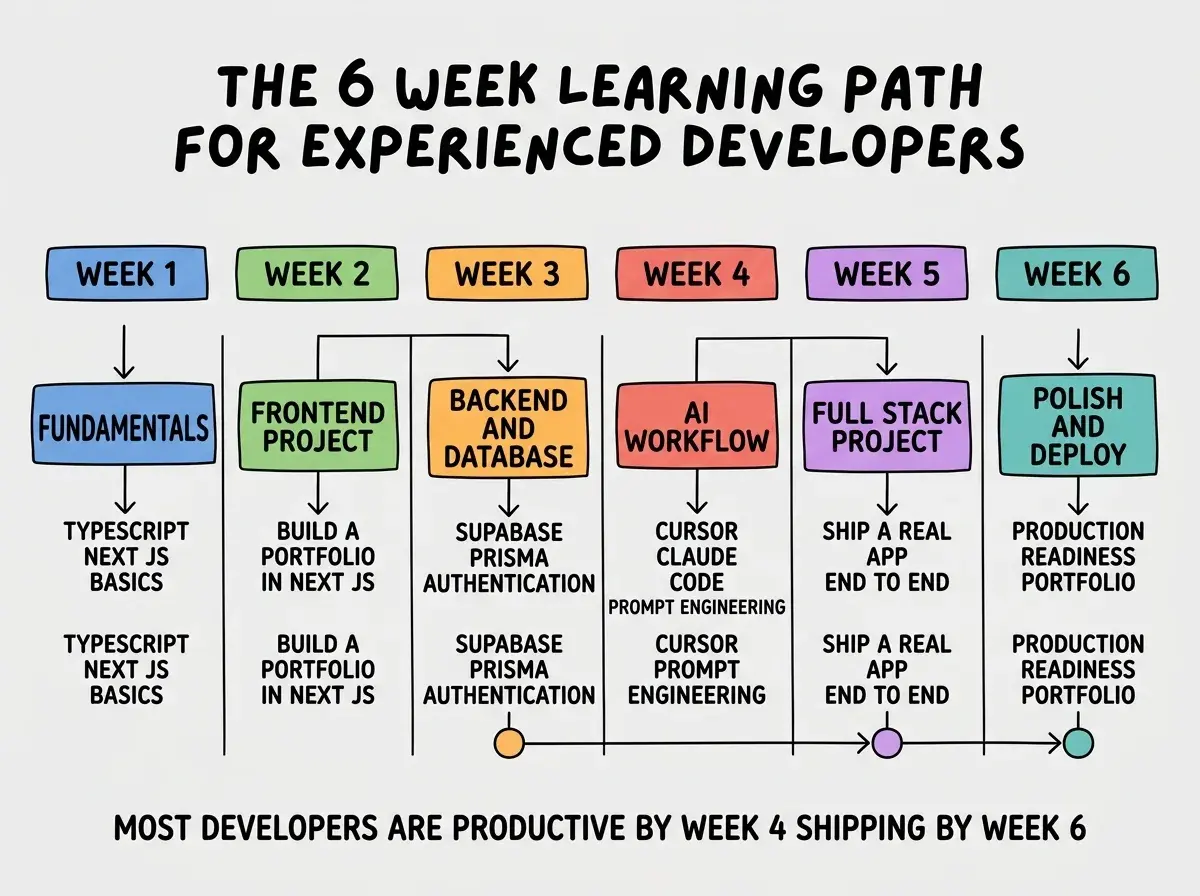
Weeks 1-2, fundamentals and frontend. TypeScript basics if you have not used a typed JS variant. Next.js basics. Build a portfolio site in Next.js as the first practical project.
Weeks 3-4, backend and AI workflow. Supabase or Neon for database, Clerk or Auth.js for auth. Start using Cursor or Claude Code daily. Build a small CRUD app end-to-end.
Weeks 5-6, full project and production. Ship a real app (a tool, a SaaS, a side project). Deploy it. Add error tracking, analytics, basic SEO. By the end of week 6, you have a portfolio piece that demonstrates your AI-assisted development fluency.
The most common mistake experienced developers make in this transition is trying to translate older patterns directly into the new stack instead of learning the new patterns. Java developers who try to write Next.js as if it were Spring produce slow, awkward code that fights the framework. The right move is to actively unlearn assumptions and adopt the modern patterns, even when they feel different. The patterns are different for good reasons, and fighting them produces the worst version of both worlds.
The other mistake is undervaluing your experience during job interviews. Hiring managers consistently report that developers with prior production experience interview better than fresh graduates, but the developers themselves often present as junior because they feel new to the modern stack. The right framing is "I have 5 years of production experience plus 6 weeks of focused modern stack work," not "I am new to the modern stack."
A useful exercise is to write a one-page resume bridge document that maps each year of your prior experience to specific modern equivalents. Years working on Java enterprise systems map to system design experience. Years debugging PHP production issues map to debugging fluency. Years writing Stored Procedures map to SQL fluency. The mapping makes the value of your background concrete to hiring managers who otherwise might dismiss it as "old stack."
What This Means For You
The transition from PHP, Java, or .NET to AI-assisted development is much more achievable than the popular framing suggests. The transferable skills are real and substantial, the gaps are well-defined, and the timeline is roughly 6 weeks for an experienced developer.
- If you're a founder: Hire experienced developers from older stacks who are willing to learn the modern stack. The judgment they bring is hard to replicate in fresh graduates, and the modern stack training is shorter than people assume.
- If you're changing careers: Do the focused 6-week plan rather than reading articles indefinitely. Building real projects is what produces fluency.
- If you're a student: Study how experienced developers from older stacks approach problems. The judgment patterns transfer to the modern stack and are worth learning before you have made enough mistakes to develop them yourself.
Browse more career transition guides
Read more foundations