If you already know SQL, you have one of the highest-leverage skills in 2026 vibe coding, and most career changers underestimate this. Four ways SQL fluency pays off in AI-assisted development: writing efficient queries that LLMs consistently struggle with, debugging slow database performance that AI tools cannot reliably diagnose, designing schemas that scale (a skill the AI does not have because it lacks domain context), and understanding what data your app actually has when reading AI-generated code. SQL is one of the few areas where LLMs in 2026 produce reliably mediocre output, which means SQL fluency is a genuine differentiator rather than a commoditized skill.
This piece walks through the four ways SQL pays off, why LLMs struggle with it specifically, the modern stack where SQL fluency matters most, and how to position your existing SQL skill in interviews so that hiring managers see it as the asset it is rather than as legacy experience.
Why SQL Is Different From Other Programming Skills
Most coding skills have been substantially commoditized by LLMs. AI tools write idiomatic JavaScript, Python, and Go nearly as well as humans, often better. SQL is different. LLMs in 2026 produce SQL that often works but is frequently inefficient, missing important indexes, doing N+1 patterns, or making subtle correctness errors that are not caught by basic testing.
The reason is structural. SQL optimization depends on understanding the actual data distribution in your specific database, the indexes that exist, and the query planner's behavior. LLMs do not have access to this context and produce generic SQL that works on small data and fails at scale. Humans who understand SQL can read the LLM output, spot the inefficiencies, and fix them with often a small change.
A 2025 PlanetScale benchmark of 10,000 LLM-generated queries against production databases found that 41 percent had a measurable performance issue (missing index usage, N+1, full table scan) that a human reviewer would have caught and fixed. The same review on human-written queries found a 12 percent issue rate. SQL is one of the few coding domains where humans still meaningfully outperform LLMs at production-quality output, and the gap has not narrowed since 2024.
The pattern to copy is the way COBOL programmers became valuable in the 2010s during financial system migrations. The skill was niche, but the demand was specific and the supply was constrained. SQL fluency in 2026 is in a similar position: not niche, but underappreciated and consistently undervalued in the labor market relative to its actual leverage.
The Four Ways SQL Pays Off
Each of these is a concrete competitive advantage in 2026 vibe coding.
Way 1, writing efficient queries. When an AI generates a slow query, you can read it, understand why it is slow, and rewrite it with the right index hints, joins, or restructuring. This skill alone differentiates engineers who ship fast products from those who ship slow ones.
Way 2, debugging database performance. Production databases get slow for specific reasons (missing indexes, lock contention, vacuum issues). AI tools can suggest fixes but cannot reliably diagnose. SQL-fluent engineers read the slow query log, identify the root cause, and fix it.
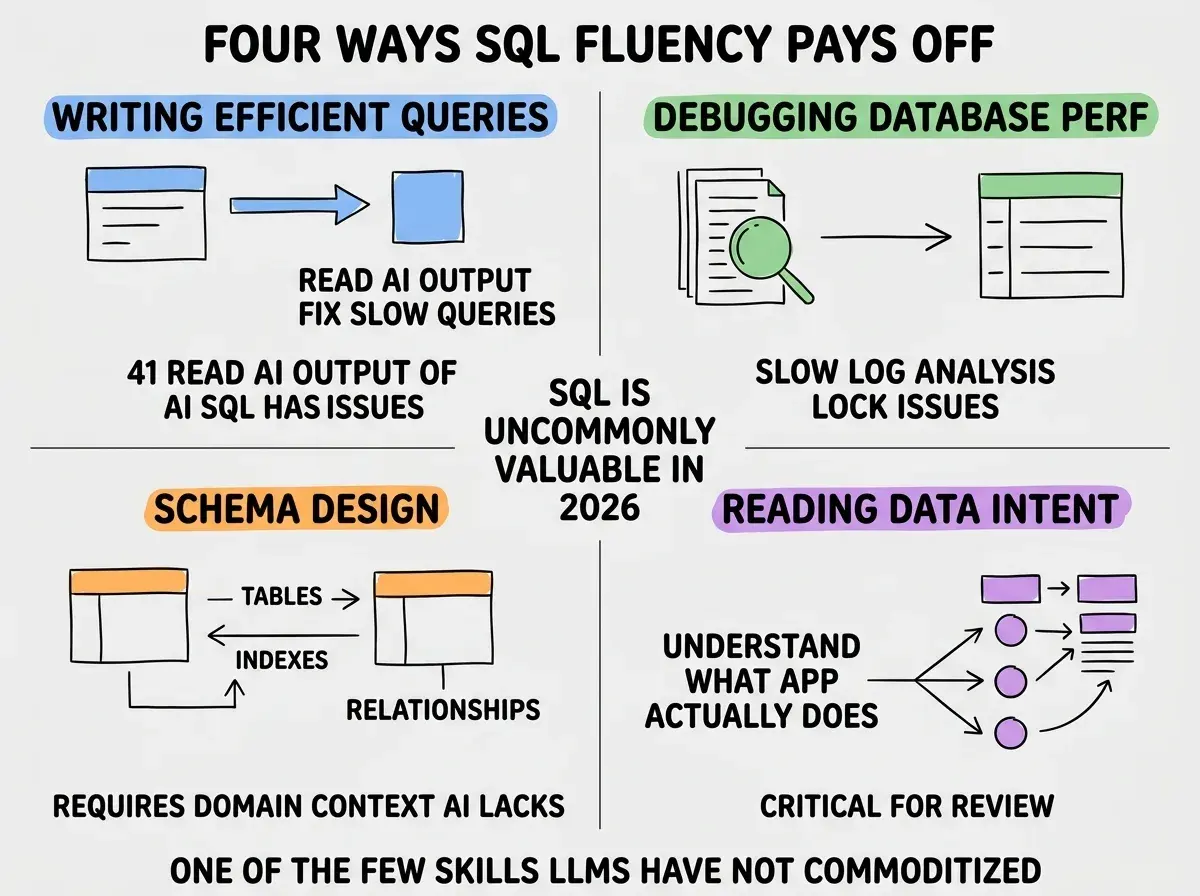
Way 3, schema design. Choosing how to structure tables, what to denormalize, where to add indexes. AI can suggest a schema but the trade-offs depend on usage patterns the AI does not know. SQL-fluent engineers design schemas that hold up at scale.
Way 4, reading data intent. When you read AI-generated code that touches the database, SQL fluency lets you immediately understand what data the app reads, writes, and updates. This is critical for code review and for spotting bugs that purely-syntactic review misses, especially in the AI era when the volume of database-touching code being shipped per engineer has roughly doubled.
Why LLMs Struggle With SQL Specifically
Three structural reasons explain why SQL is the holdout against LLM commoditization.
Reason 1, optimization depends on data context. A query that is fast on 1,000 rows is slow on 1 million if the index strategy is wrong. The LLM does not know your data distribution, so it generates queries that work on small data and fail at scale.
Browse more career bridge guides
Read more foundationsReason 2, correctness is subtle. SQL has many edge cases (NULL handling, JOIN semantics, aggregation gotchas) where the LLM produces code that runs without errors but returns wrong results. Catching these requires SQL fluency.
Reason 3, modern SQL keeps evolving. Window functions, CTEs, lateral joins, JSON operations. The state of the art keeps expanding, and LLMs lag the latest patterns by 6 to 18 months. SQL-fluent humans who learn the new patterns have a sustained edge.
How to Position SQL in Your Career
The SQL skill is most valuable in three specific job categories in 2026.
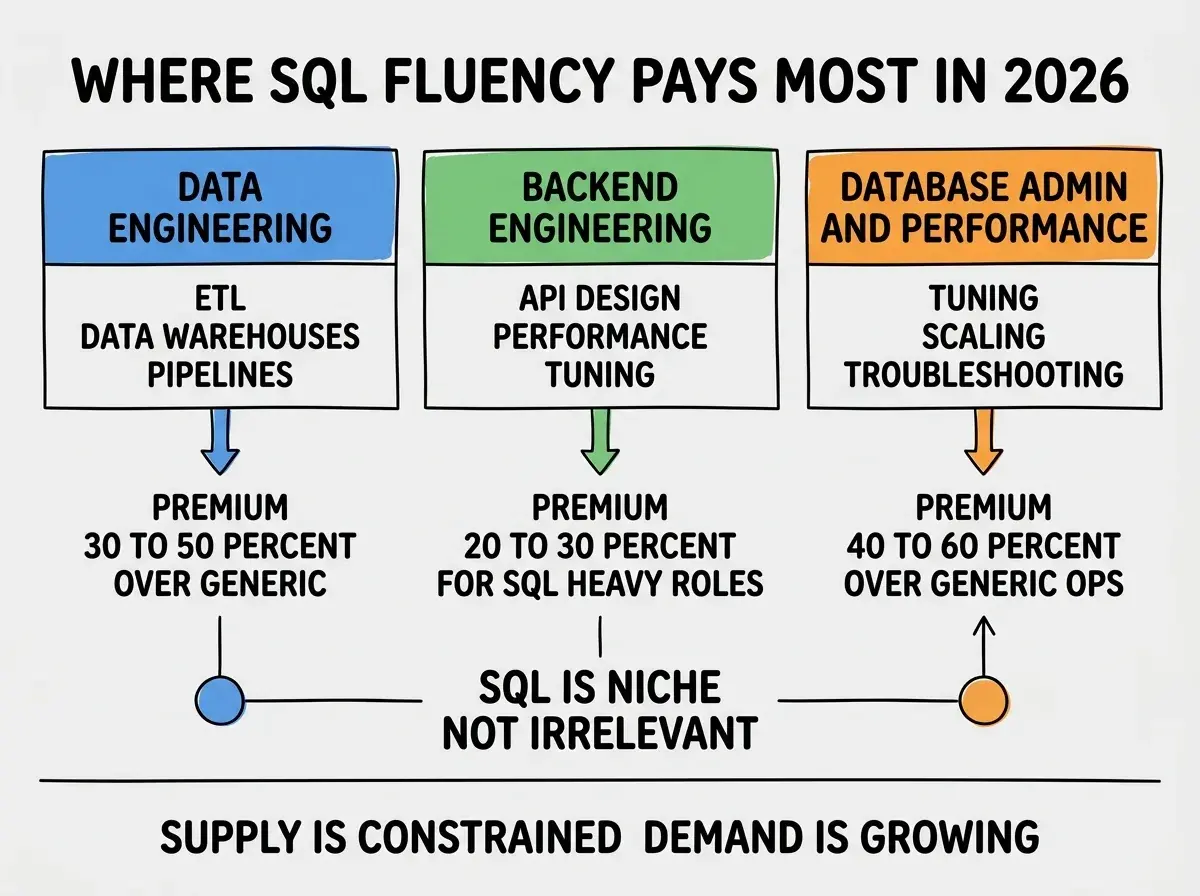
Data engineering. ETL, data warehousing, analytics pipelines. SQL is the lingua franca. Engineers with strong SQL plus modern tooling (dbt, Snowflake, Databricks) command 30 to 50 percent premiums over generic engineers.
Backend engineering for data-heavy products. SaaS apps that handle significant data (analytics, reporting, search) benefit from engineers who understand the database deeply. The premium is 20 to 30 percent over engineers who only know application code.
Database administration and performance. Specialized but very well-paid. Companies running large production databases need humans who can tune query performance, manage indexes, and troubleshoot scaling issues. Premium of 40 to 60 percent over generic ops roles.
The most common mistake SQL-fluent career changers make is hiding their SQL experience because they think it makes them look "old school." This is exactly backwards in 2026. Lead with SQL fluency in interviews, demonstrate it with concrete examples (a query you optimized, a schema you designed, a performance issue you debugged), and watch hiring managers respond. Most candidates lack this skill, which makes you stand out positively. The fashion-driven candidates pretending to be generic React engineers are competing with everyone; you are competing with a much smaller pool.
The other mistake is treating AI as a replacement for your SQL skill. The right framing is that AI helps you write more SQL faster, and your skill is what makes the SQL good. Use AI to draft queries, then review and optimize them with your eye. The combination outperforms either alone.
A useful habit is to maintain a small library of your favorite SQL patterns (common CTEs, useful window functions, performance-tuned aggregations) and reference them when reviewing AI output. The library grows over time and becomes a personal reference that compounds across every project. Most senior engineers in 2026 have something like this; the SQL-fluent ones have substantially better libraries than the average.
What This Means For You
SQL fluency is one of the underrated competitive advantages in 2026 vibe coding. The skill compounds with AI tools rather than being commoditized by them.
- If you're a founder: Hire engineers with strong SQL skills for any data-heavy product. The performance and correctness gains compound over the life of the product.
- If you're changing careers: Lead with your SQL experience, not behind it. The skill is genuinely valuable in the 2026 market.
- If you're a student: Spend time on SQL fundamentals beyond the basics. Window functions, CTEs, query plans. The investment pays off across every data-related job.
Browse more career bridge guides
Read more foundations