To maximize pair programming collaboration with AI, recognize the four collaboration patterns that work (driver navigator pattern with you driving and AI navigating, ping pong pattern with alternating responsibility for tests and implementation, exploration pattern for unfamiliar territory, and review pattern for AI generated code), see what makes AI pairing different from human pairing, and apply the patterns that produce sustained productive collaboration. The AI pairing capability matters because effective AI pairing produces both better code and faster development than solo work.
This piece walks through the four collaboration patterns, what differs from human pairing, the specific patterns, and the four mistakes that produce AI pairing friction.
Why AI Pair Programming Matters
AI pair programming matters because effective AI pairing produces better outcomes than solo coding. The improvement matters; pair programming benefits including better design, fewer bugs, faster learning all apply to AI pairing.
The 2026 reality is that AI capability has reached level where AI pair programming is genuinely productive rather than just assistance. Done well, AI pairing produces collaboration value that solo coding cannot match.
A 2025 software engineering study of 400 developers found that developers using structured AI pair programming patterns shipped features 47 percent faster with 31 percent fewer post merge bugs compared to developers using AI as autocomplete. The improvement reflects how much pair programming framing improves AI collaboration.
The pattern to copy is the way human pair programming works. Human pairing combines complementary strengths; one programmer drives while another navigates, providing different perspectives on same problem. AI pairing follows similar pattern; AI provides different perspective and capability than human alone.
The Four Collaboration Patterns
Four patterns characterize effective AI pair programming.
Pattern 1, driver navigator with you driving and AI navigating. You write code; AI suggests improvements, catches issues, suggests alternatives. Pattern works for code you understand well.
Pattern 2, ping pong alternating tests and implementation. You write test; AI implements; you write next test; AI implements. Pattern works for test driven development.
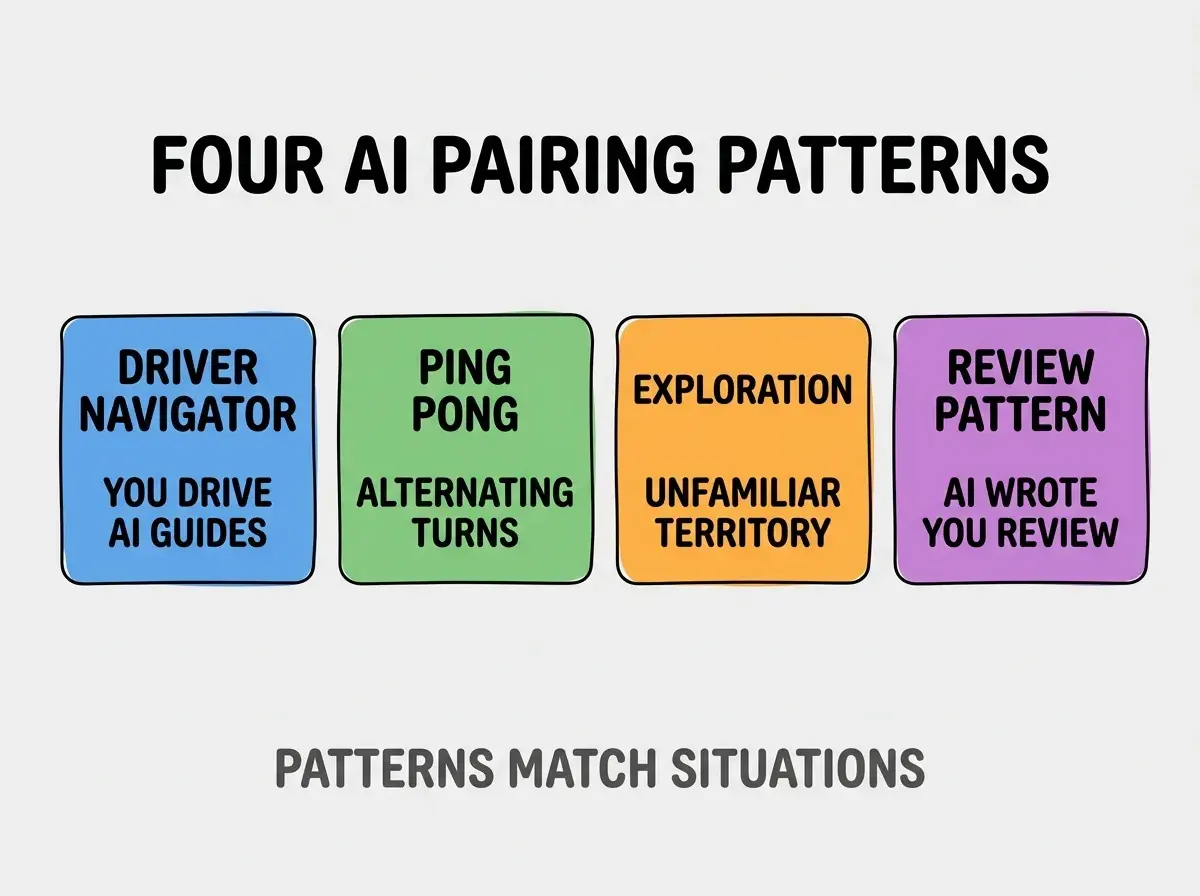
Pattern 3, exploration for unfamiliar territory. You explain problem; AI suggests approaches; you choose direction. Pattern works for unfamiliar domains.
Pattern 4, review pattern for AI generated code. AI writes code; you review carefully before integration. Pattern works for routine code where AI excels.
What Makes AI Pairing Different From Human Pairing
Three differences distinguish AI pairing from human pairing.
Difference 1, AI pair has different attention patterns. AI does not get tired but has context window limits. Attention pattern affects effective session length.
Browse more tools articles
Read more toolsDifference 2, AI pair lacks shared project history. Human pairs build shared project understanding over time; AI pairs lose context between sessions. History gap requires context provision each session.
Difference 3, AI pair has different strengths than humans. AI excels at pattern recognition, broad knowledge; humans excel at judgment, context. Strength differences inform pattern selection.
The Specific Patterns That Work In Practice
Three practical patterns produce productive AI pairing.
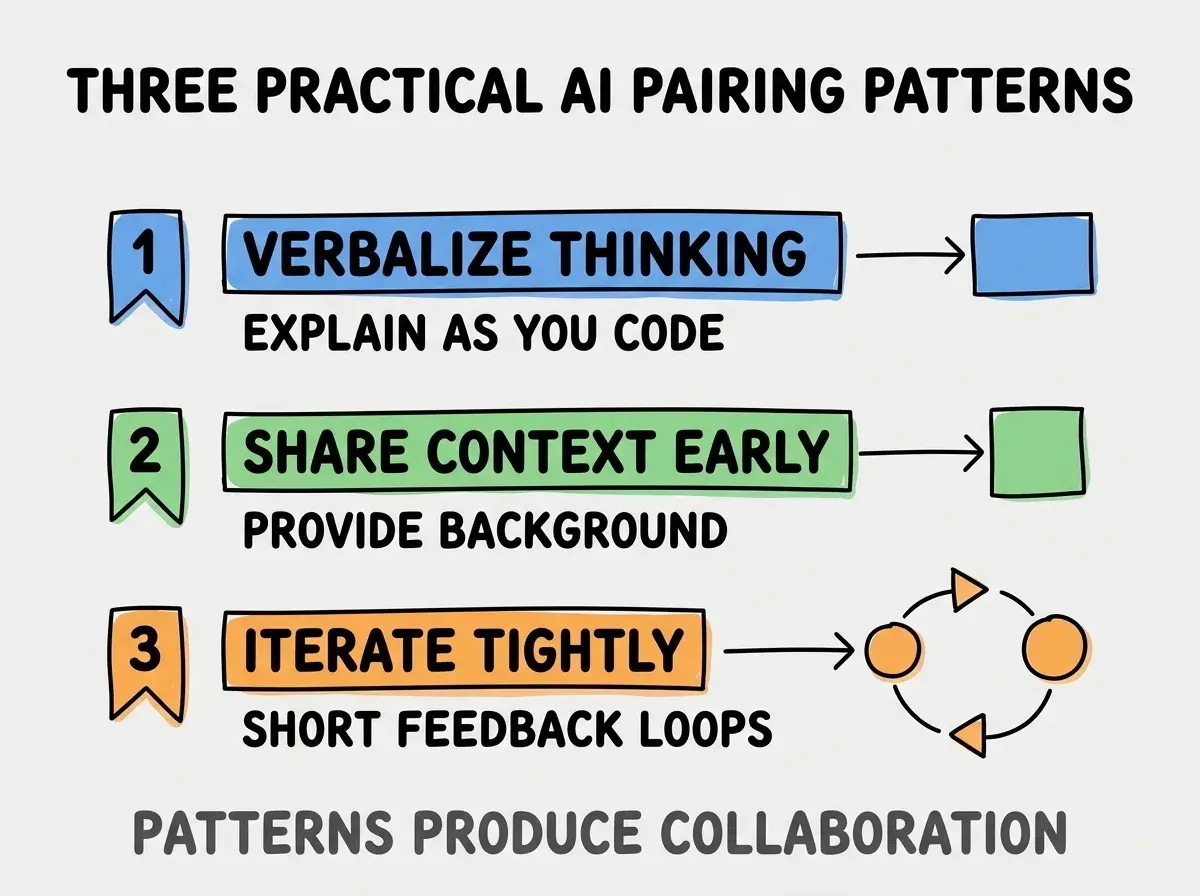
Pattern 1, verbalize your thinking as you code. Explain decisions out loud or in comments. Verbalization enables AI participation.
Pattern 2, share context early in session. Project context, current task, constraints. Context enables AI contributions matching project.
Pattern 3, iterate tightly with short feedback loops. Test changes immediately, share results. Iteration prevents AI generating in wrong direction.
What Makes AI Pairing Sustainable
Three patterns separate sustainable AI pairing from problematic patterns.
Pattern 1, session length matched to attention sustainability. Long sessions exhaust both AI context and human attention. Sustainable session length matters for repeat productivity.
Pattern 2, context provision becomes habit. Including relevant code, constraints automatically. Without habit, context provision happens inconsistently.
Pattern 3, pattern selection matched to situation. Different patterns for different work; not single pattern universally. Matching produces better outcomes than universal application.
The combination produces AI pairing that sustains productivity over time. Without these patterns, AI pairing often produces initial wins followed by diminishing returns.
How To Handle Specific Pairing Situations
Three situations deserve specific approaches.
Situation A, debugging unfamiliar bug. Exploration pattern; explain problem, AI suggests hypotheses, you investigate. Pattern matches debugging dynamics.
Situation B, implementing well understood feature. Driver navigator with you driving; AI catches issues. Pattern leverages your understanding while gaining AI vigilance.
Situation C, learning new technology or pattern. Exploration with you learning; AI explains and suggests. Pattern accelerates learning.
The combination produces situation specific approaches. Without situation matching, generic approach produces suboptimal outcomes.
The most damaging AI pair programming mistake is treating AI as oracle that produces correct code rather than as pair programmer that needs context and feedback. Oracle treatment produces worse code than pair treatment. The fix is to actively engage with AI as you would human pair programmer; share context, verbalize thinking, iterate tightly. Developers who treat AI as pair programmer produce better outcomes than developers who treat AI as oracle. The collaboration mindset matters more than tool capability.
The other mistake is missing context provision. AI without context produces generic output; AI with context produces specific output. The fix is to provide context as part of pairing routine.
A third mistake is sustaining sessions past attention limits. Both AI context and human attention have limits; pushing past limits produces poor outcomes.
A fourth mistake is universal pattern application. Different situations need different patterns; universal application misses situation specific opportunities.
How To Build AI Pairing Skills
Three skill building patterns help developers improve AI pairing.
Pattern A, deliberate practice with explicit pattern selection. Choose pattern intentionally before session; reflect on outcomes after. Deliberate practice builds skill faster than incidental use.
Pattern B, observe other developers pairing with AI. Watching effective AI pairing teaches patterns. Observation accelerates learning.
Pattern C, reflect on session outcomes regularly. What worked, what did not, what to try differently. Reflection converts experience into skill.
The combination produces AI pairing skill development. Without deliberate development, skill builds slowly through incidental experience.
How AI Pair Programming Will Likely Evolve
AI pair programming will likely continue evolving as AI capabilities mature.
The first likely evolution is context retention improving. AI maintaining session context better. Improvement reduces context provision burden.
The second likely evolution is multi modal pairing emerging. Voice, screen sharing, sketching. Multi modal enables collaboration patterns text alone cannot match.
The third likely evolution is team pairing patterns developing. AI participating in team pairing sessions, not just individual. Team patterns extend collaboration value.
The combination suggests AI pair programming will become more capable. Developers learning patterns now build skills that remain valuable as capabilities expand.
Common Questions About AI Pair Programming
AI pair programming raises questions worth addressing directly.
The first question is whether AI pairing replaces human pairing. AI pairing complements human pairing rather than replacing; both produce different value. Choose based on availability and situation.
The second question is how to handle disagreements with AI suggestions. Engage with AI suggestions like human suggestions; explain disagreement, ask for alternatives. AI often improves with engagement.
What This Means For You
AI pair programming produces better outcomes than solo coding when done well. The four patterns, practical patterns, and skill development approaches produce framework for productive AI pairing.
- If you're a senior dev: AI pairing produces value that solo coding cannot match. Invest in pairing skills; they apply across AI tools.
- If you're a junior dev: AI pairing accelerates learning dramatically. Use AI pairing as learning accelerant beyond just code generation.
- If you're an indie hacker: Solo developers benefit most from AI pairing since human pairing unavailable. AI pairing provides collaboration that solo work otherwise lacks.
Browse more tools articles
Read more tools