Vibe coding is a way of building software by describing what you want in plain English instead of writing code by hand. An AI model translates your natural language instructions into working code. The term was coined by AI researcher Andrej Karpathy in February 2025, and it has since grown into a $4.7 billion industry.
That definition probably sounds simple. It is, at the surface level. But understanding what vibe coding actually involves, where it shines, and where it will leave you stranded requires more than a one-sentence summary. This guide covers all of it.
Why Millions of People Are Paying Attention
Something shifted in early 2025. Non-developers started building real software. Not drag-and-drop website builders or form tools, but actual applications with databases, authentication, and payment processing. They did it by talking to AI.
The numbers tell the story. Ninety-two percent of US developers now use AI coding tools daily. But the bigger surprise is who else showed up: 63% of active vibe coding users are not developers at all. They are founders, marketers, designers, and career changers who discovered they could describe an app and watch it materialize.
Google searches for "vibe coding" grew 2,400% in the months after Karpathy's tweet. Collins Dictionary named it their Word of the Year for 2025. Y Combinator's Winter 2025 batch included startups where 95% or more of the codebase was AI-generated. This is not a niche trend. It is a fundamental change in who gets to build software.
63% of active vibe coding users are non-developers. For the first time, the majority of people building software with code have no formal programming background.
The speed of adoption catches even insiders off guard. Tools like Cursor, Lovable, and Bolt went from unknown to essential in under a year. Lovable reports that 60% of its users are non-developers. The barrier to entry for software creation has effectively collapsed.
The Automatic Transmission of Software Development
Here is the analogy that makes vibe coding click for most people. Think about learning to drive.
With a manual transmission car, you need to understand clutch engagement, gear ratios, and rev matching. You need to coordinate your left foot, right foot, and right hand simultaneously. It takes weeks of practice before you can drive smoothly, and months before it becomes second nature. Traditional coding works the same way. You learn syntax, data structures, algorithms, debugging techniques, and version control. It takes months to build anything useful and years to get truly proficient.
An automatic transmission abstracts all of that away. You put it in drive and press the gas. You still need to know where you are going, how to read traffic, and when to brake. But the mechanical complexity of operating the vehicle is handled for you. Vibe coding is the automatic transmission of software development.
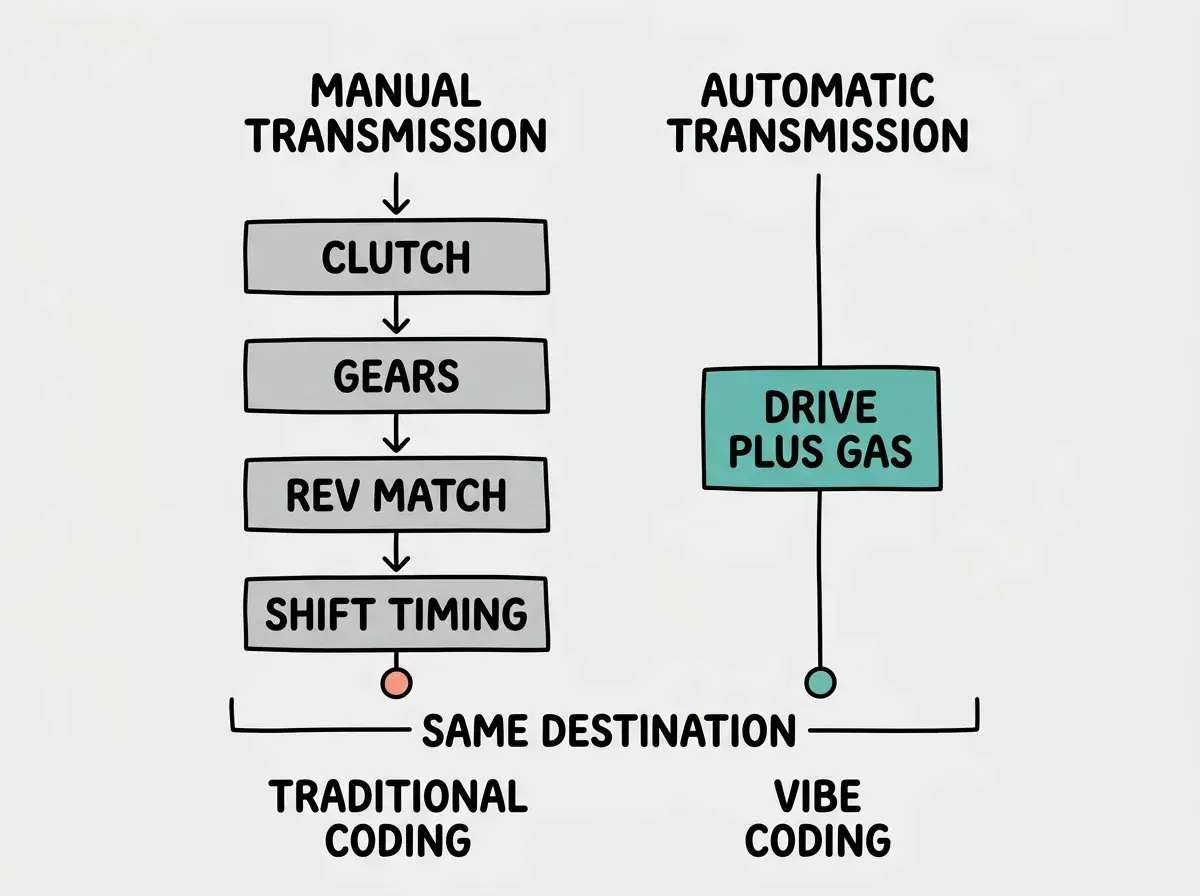
This analogy carries further than you might expect. Automatic transmissions did not eliminate the need for driving skill. They eliminated one specific type of skill (operating a clutch) while making driving accessible to millions more people. Similarly, vibe coding does not eliminate the need for software thinking. It eliminates the need for syntax fluency while making software creation accessible to millions more people.
And just like automatic transmissions, vibe coding has tradeoffs. Race car drivers still use manual. Developers building high-performance systems, embedded software, or complex distributed architectures still write code by hand. The right choice depends on what you are building and what you need from the experience.
How Vibe Coding Actually Works in Practice
The workflow is surprisingly conversational. You describe what you want. AI generates code. You test it. You refine your description. AI updates the code. This loop repeats until the software does what you need.
Karpathy described his own process in the tweet that started it all: "I just see stuff, say stuff, run stuff, and copy paste stuff, and it mostly works." That casual description captures the feel of it perfectly. You are not engineering software in the traditional sense. You are directing it, the way you might direct a conversation.
Here is what a typical session looks like. You open a tool like Cursor or Claude and say something like "build me a landing page with an email signup form that saves subscribers to a database." The AI generates the HTML structure, the styling, the form logic, and the database connection. You preview it in your browser. Maybe the button color is wrong or the form does not validate email addresses properly. You say "make the button blue and add email validation." The AI updates the code. You test again.
Our step-by-step guides walk you through building your first project.
Start buildingThis loop of describe, generate, test, and refine is the core of vibe coding. It feels less like programming and more like collaborating with a very fast, very literal junior developer who never gets tired.
Where Vibe Coding Works and Where It Breaks Down
This confuses everyone at first, so let me be direct about it. Vibe coding is excellent for some things and genuinely terrible for others.
It works well for MVPs and prototypes, internal tools, landing pages, CRUD applications (apps that create, read, update, and delete data), simple automations, and personal projects. If you are a founder who needs to test an idea before hiring engineers, vibe coding can get you to a working prototype in days instead of months.
It struggles with complex systems that require deep architectural thinking, performance-critical applications, anything involving sophisticated security requirements, and projects that need to scale to millions of users without a rewrite. The industry has a name for this limitation: the 70% wall. AI gets you roughly 80% of the way to a working product very quickly, but the remaining 20% can become agonizing. Bug loops (where fixing one thing breaks another), hallucinated APIs (where the AI references code libraries that do not exist), and context window degradation (where the AI loses track of your project's full picture) are real problems.
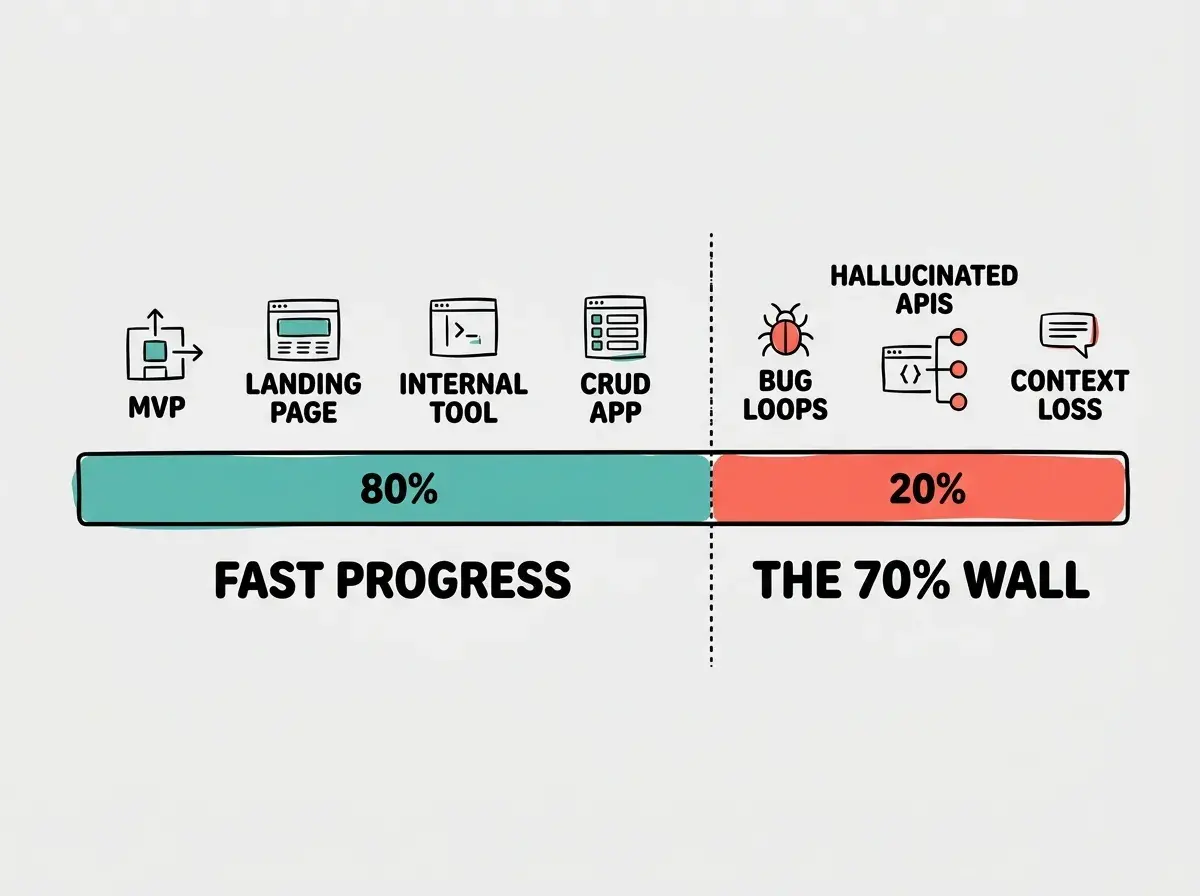
Here is the thing people miss about the 70% wall. It is not a reason to avoid vibe coding. It is a reason to plan for it. Senior developers who use vibe coding tools report 81% productivity gains and ship 2.5 times more code than juniors using the same tools. The difference is not that senior devs avoid the wall. They know what is on the other side and how to push through it.
The biggest mistake beginners make is treating vibe coding as fully autonomous. They accept all AI suggestions without testing, skip error messages instead of reading them, and end up in spiraling bug loops. Vibe coding is collaborative, not automatic. You are the driver; AI is the engine.
You might think you need to understand code to push through the wall. But actually, what you need is a clear mental model of what your software should do. When you can describe the expected behavior precisely ("when a user clicks submit, the form should validate the email field, save the data, and show a confirmation message"), the AI can fix most problems. When your description is vague ("it's broken, fix it"), the AI spirals.
Who Is Vibe Coding For
The data on who is actually using vibe coding might surprise you. It is not just hobbyists and tinkerers.
Among active vibe coding users, 36.4% are founders building products. Eighty-five percent of students now use AI coding assistants. Eighty-seven percent of Fortune 500 companies have adopted vibe coding tools. The Y Combinator CEO stated that "ten engineers using vibe coding deliver what fifty to one hundred used to."
This is not a tool for people who cannot code. It is a tool for anyone who wants to build faster. Non-developers use it to create things they never could before. Experienced developers use it to eliminate tedious work and focus on the hard problems. The overlap between these two groups is where the most interesting work is happening.
The pattern across all successful vibe coders is the same. They start with a clear idea of what they want. They describe it precisely. They test the output. They iterate. The skill is not coding. The skill is clarity, specificity, and the patience to refine.
Frequently Asked Questions
Dig deeper
A few hand-picked sources if you want to go further.
What This Means For You
Vibe coding is not a toy, a shortcut, or a replacement for understanding how software works. It is a new interface for building things, and it rewards the same qualities that every creative tool rewards: clear thinking, iterative refinement, and honest assessment of what is working and what is not.
- If you're a founder: Vibe coding lets you build and test MVPs without hiring a development team upfront. Start with a simple prototype of your core feature, validate it with real users, and use that evidence to decide whether to invest in professional development. The 36.4% of vibe coders who are founders are proving this path works.
- If you're changing careers: Your domain expertise is your unfair advantage. A nurse who understands hospital workflows can vibe code a patient scheduling tool that no generic developer would think to build. Start with a problem you understand deeply and let AI handle the syntax.
- If you're a student: You are entering the workforce at the exact moment when the ability to build software is becoming as common as the ability to write a spreadsheet. Learn vibe coding alongside your primary field of study. The combination of domain knowledge and building ability is extraordinarily valuable right now.
Learn the fundamentals and build something real this week.
Get started free