Vibe coding for career changers is not about starting over. It is about finally having a tool that speaks your language. You have spent years, maybe decades, solving problems in your field. You know what customers need, how processes break, where the bottlenecks hide, and why the "obvious" solution never works. That knowledge is exactly what building software requires, and until now, the only thing standing between you and building it yourself was the syntax.
A story went viral on Hacker News recently. A 60-year-old developer with decades of experience in legacy technology wrote about rediscovering the joy of coding through Claude Code. The post earned 1,058 points, extraordinary for a personal story on a platform known for skepticism. The comments were flooded with similar stories. A 50-year-old wrote, "Tools like Claude Code are the ultimate cheat code for me." A 66-year-old shared, "I built three Laravel apps from the ground up and sold one."
These are not beginner stories. These are experienced professionals who already understood how software should work but were locked out by the mechanics of making it work.
Why Your Experience Is Worth More Than a CS Degree
Think of building software like building a house. For decades, the construction industry has required you to operate the power tools yourself. Want to build a house? Better learn to use a circular saw, a nail gun, a table router. The tools were the gatekeepers, and mastering them took years of practice that had almost nothing to do with understanding architecture, structural engineering, or what makes a home livable.
Vibe coding is like getting a skilled crew that operates the tools for you while you direct the project. You are the general contractor. You know the building codes because you have lived in buildings your whole career. You know what the client wants because you have been the client. You know where corners get cut because you have seen the consequences. The AI crew handles the saw and the nail gun. You handle everything else.
This analogy reveals the real hierarchy of skills in software development. Syntax is the saw. Architecture is the blueprint. Domain knowledge is understanding why the client needs three bathrooms on the second floor. Guess which one the AI handles, and guess which ones only you can provide.
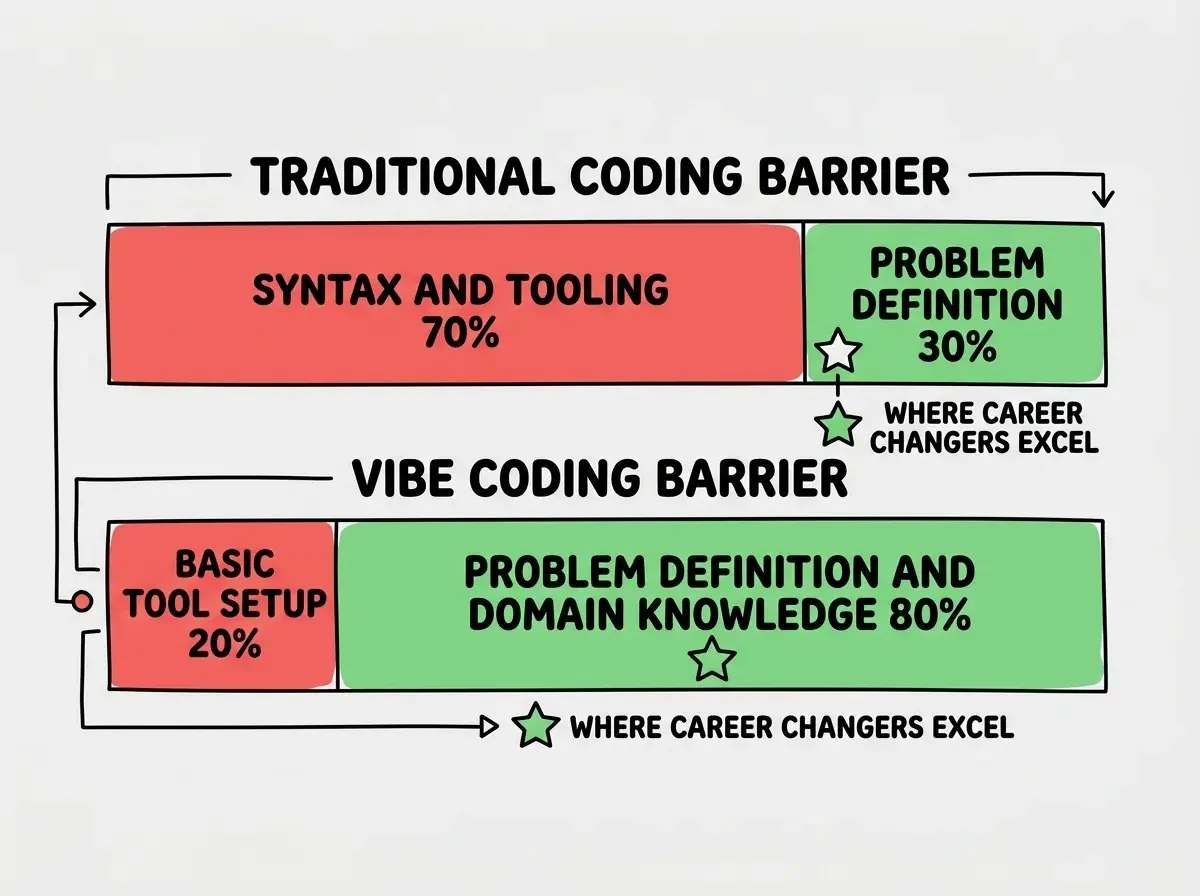
Career changers consistently underestimate how much of software development is problem definition, not problem solving. Knowing the right thing to build (which comes from domain expertise) matters far more than knowing how to build it (which AI now handles). Your years of experience gave you the hard part. Vibe coding gives you the rest.
You might think that real developers have some fundamental understanding that you are missing. But actually, the gap between an experienced professional and a junior developer is smaller than you expect, and it is shrinking fast. Junior developers know syntax. You know systems. The AI bridges the syntax gap in seconds. Nobody can bridge the systems gap for you because it only comes from lived experience.
How Your Old Skills Map to New Tools
This confuses everyone at first. Career changers assume they need to learn programming from scratch before they can use AI tools. They sign up for bootcamps, buy courses, and try to memorize JavaScript fundamentals. Then they get frustrated because the learning curve is steep and the payoff feels distant.
Here is what they should do instead: start building something from their existing domain.
If you were a project manager, you already think in workflows, dependencies, and edge cases. You can describe a process so clearly that a developer could build it. That same description, given to an AI coding tool, produces working software. Your skill is specification, and specification is the bottleneck in every software project.
If you worked in finance, you understand data models, compliance requirements, and the difference between what a report shows and what it should show. You can build internal tools that your former colleagues would actually use, because you know what they need in a way no developer without financial experience ever could.
If you were a teacher, you understand learning sequences, progress tracking, and the difference between engagement and comprehension. Educational software built by former teachers is better than educational software built by developers who have never stood in front of a classroom. Every time. No exceptions.
If you were in healthcare, you understand workflows that literally cannot fail and regulatory constraints that shape every decision. Healthcare software is notoriously bad precisely because it is usually built by people who have never worked a shift in a hospital.
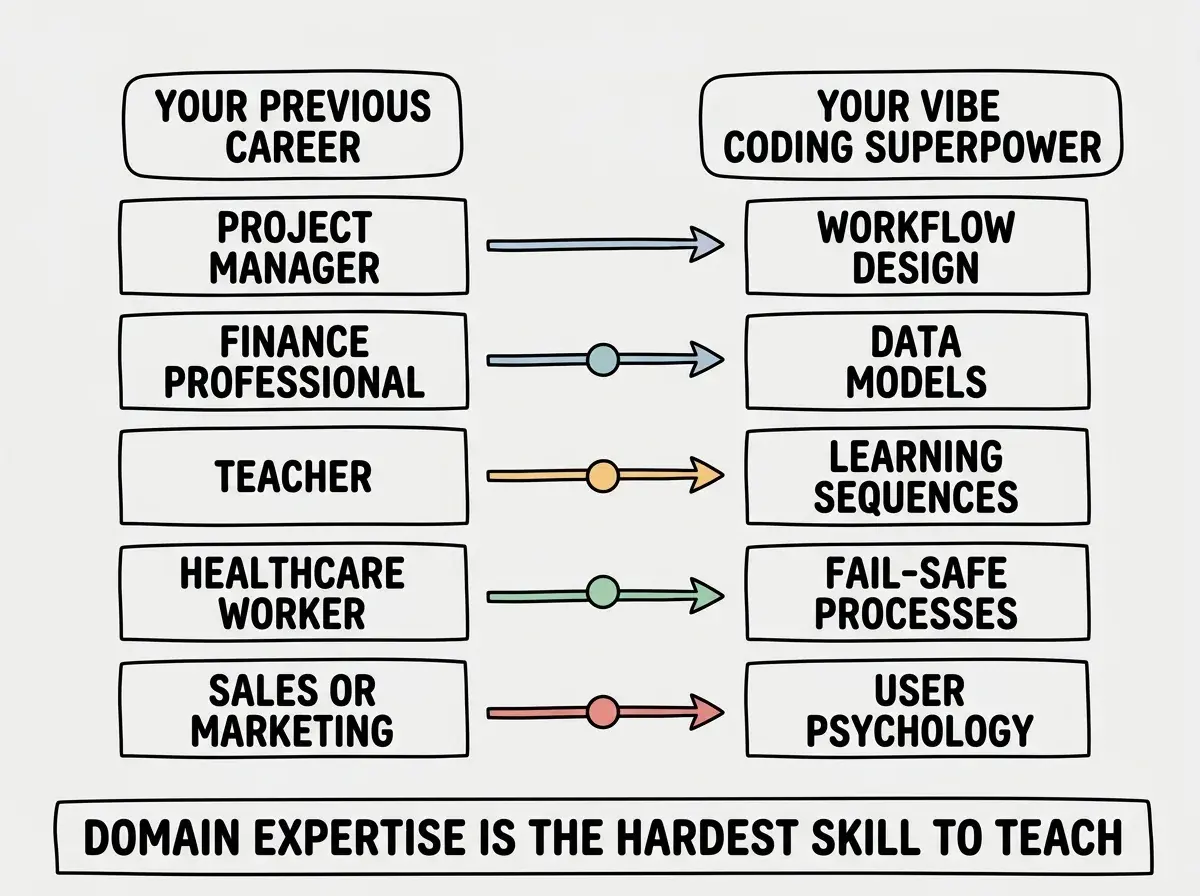
The pattern is consistent across every field. Developers are good at building things. They are often terrible at knowing what to build. You are the opposite, and vibe coding lets the two halves meet.
The Practical Path from Zero to Shipping
Let me be specific about what getting started actually looks like, because vague encouragement helps nobody.
Week one: pick your problem. Choose something from your previous career that frustrated you. A process that was manual and should not have been. A report that took hours to compile. A communication gap that caused recurring mistakes. Do not think about technology. Think about the problem.
Week two: describe the solution in plain language. Write it the way you would explain it to a new hire. "When a customer submits a request, it goes to the right department based on these criteria. The lead sees it in a queue sorted by urgency. If nobody responds within four hours, it escalates." That is a software specification. You just wrote one without knowing any programming language.
Week three: build it with an AI tool. Take that specification, open an AI coding tool like Cursor or Claude, and say, "Build this for me." The first version will not be perfect. But it will be functional, and the feeling of seeing your idea become a working application is genuinely transformative. The 66-year-old who built three Laravel apps did not start by learning Laravel. They started by describing what they wanted to build.
Week four: iterate and learn. Use the application yourself. Notice what is missing. Tell the AI to fix it. Each iteration teaches you something about how software works, not through abstract study but through direct experience with your own project. This is how the 60-year-old in the viral HN post described the process: not as learning to code, but as rediscovering the joy of building things.
Start with the fundamentals that make everything else click.
Learn the basicsAddressing the Voice in Your Head
There is a voice that career changers hear. "I'm too old for this." "Real developers will laugh at my code." "I missed my window."
That voice is wrong, and the evidence is overwhelming.
The viral Hacker News stories are not outliers. They represent a quiet movement of experienced professionals discovering that the barrier to building software was never intelligence or aptitude. It was tooling. The syntax barrier filtered for people who enjoyed memorizing syntax, not for people who could build valuable things.
The 50-year-old who called AI coding "the ultimate cheat code" was not cheating. They were applying decades of professional knowledge to a medium that had previously been inaccessible. That is not a cheat code. That is a locked door finally opening.
Trying to learn programming fundamentals before touching AI tools. Career changers who spend months on JavaScript courses before building anything often burn out and quit. Start by building something from your domain expertise using AI tools. You will learn programming concepts naturally through the process of building, and the concepts will stick because they are attached to a project you care about.
The reality is that age and experience are advantages in vibe coding, not disadvantages. You have seen more failure modes. You understand organizational dynamics. You know why the simple solution is usually the right one. A 25-year-old developer might write more elegant code, but a 50-year-old project manager will build a more useful application. Elegance is the AI's job. Usefulness is yours.
Building Confidence Through Small Wins
The career changers who succeed follow a pattern of escalating ambition. They do not start with a SaaS startup. They start with something small and personally useful.
Build a tool that automates something tedious from your old job. A scheduling helper. A report generator. A client communication tracker. Make it work for you first. Then show it to a former colleague. That reaction, the surprise that you built this, that it solves a problem they still deal with every day, is the confidence fuel that carries you forward.
The 66-year-old who built three Laravel apps and sold one did not start with the one they sold. They started with something simpler, built confidence through completion, and then attempted something more ambitious. Your first project will be rough. Your third might be something you can sell. That trajectory is faster than you think because you are not starting from zero.
Dig deeper
A few hand-picked sources if you want to go further.
What This Means For You
Vibe coding does not care about your age, your background, or whether you took a single CS class. It cares about whether you can clearly define a problem, describe a solution, and iterate based on feedback. Those are skills you have been building your entire career. The only thing that changed is that those skills can now produce working software.
- If you are a founder: Career changers who vibe code bring deep domain expertise and the ability to build their own prototypes. Look for candidates who built something from their previous industry. They understand users in a way that pure technologists rarely do, and that understanding is the difference between products that get used and products that get abandoned.
- If you are a career changer: Stop waiting for permission. You do not need a bootcamp certificate, a CS degree, or anyone's approval. Pick a problem from your career that you understand deeply, describe the solution in plain language, and let an AI tool build the first version. Your experience is not baggage from an old life. It is the foundation for your new one.
- If you are a student: Career changers have something you are still building: years of real-world experience watching systems succeed and fail. Partner with them when you can. Their domain knowledge combined with your native comfort with AI tools is a powerful combination, and you will both learn things the other cannot teach themselves.
Learn the foundational concepts that make vibe coding click.
Explore more